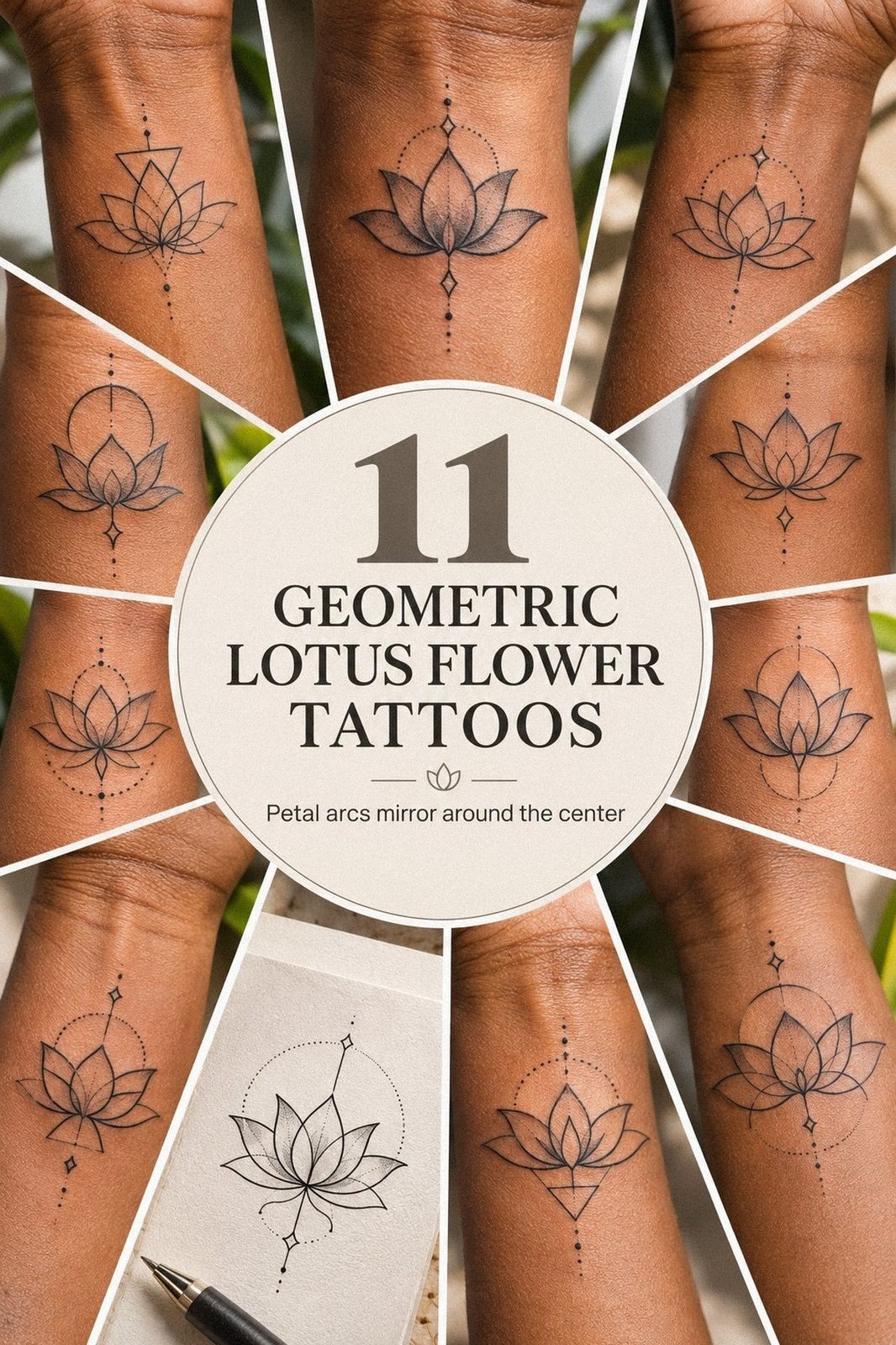
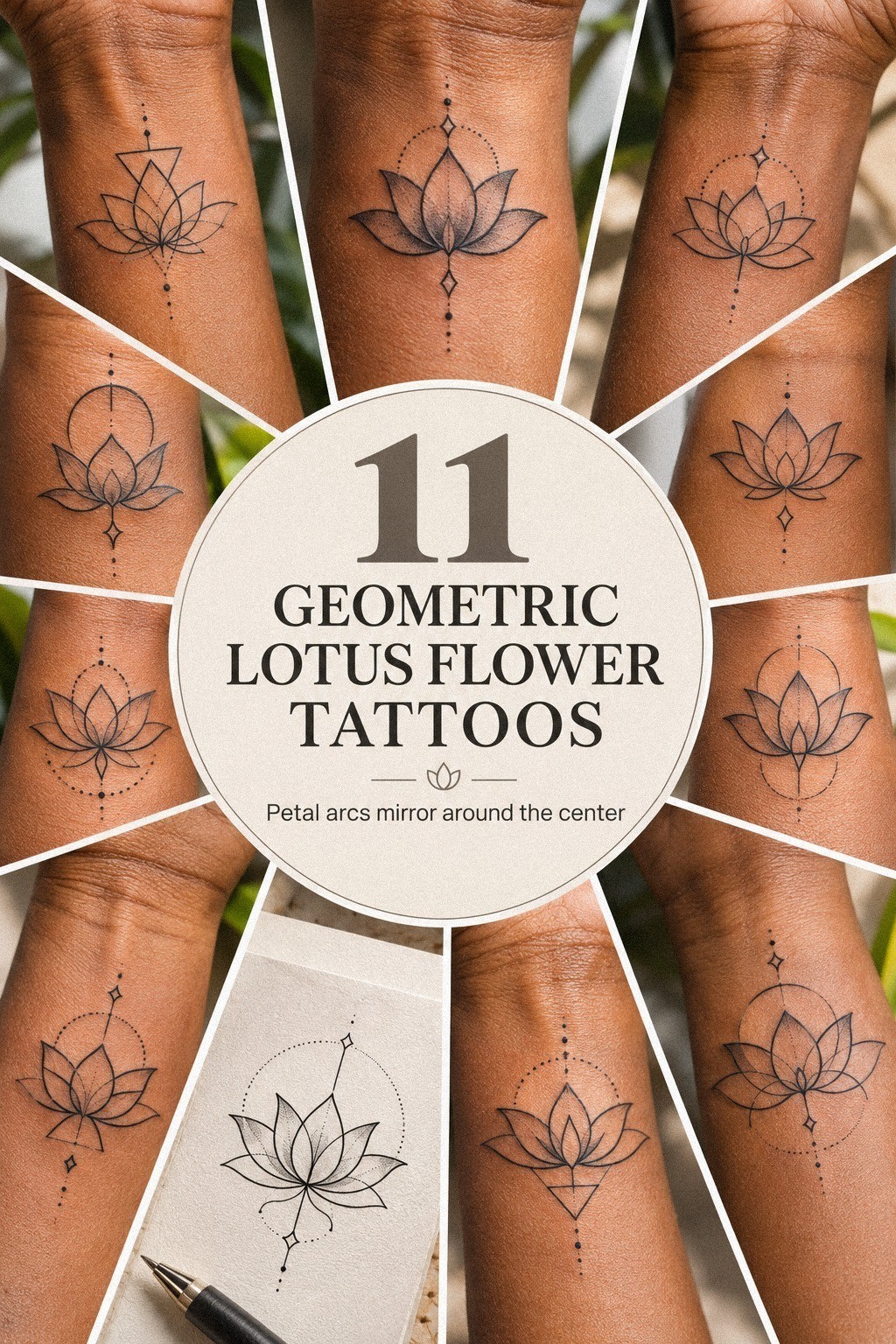
Geometric lotus flower tattoos can stay crisp and meaningful without turning your appointment into an endurance test. I once chose detail over breathing room, and the result looked crowded before it healed. These ideas use scale, placement, and negative space to keep the flower readable. You’ll see delicate lines, bold blackwork, and symbolic geometry that won’t overwhelm your skin.
- ✓ Start Small With a Geometric Lotus Flower Wrist Tattoo
- ✓ Can Fine Linework Stay Readable on the Ankle?
- ✓ Sacred Geometry That Keeps the Lotus First
Editor’s note: The best tattoo usually has one strong idea. Choose the shape, placement, or meaning that matters most, then let the rest support it.
- Start Small With a Geometric Lotus Flower Wrist Tattoo
- Can Fine Linework Stay Readable on the Ankle?
- Sacred Geometry That Keeps the Lotus First
- Spine Placement or Side Placement? Follow the Body
- Blackwork Without Losing the Petal Shape
- Build a Mandala Around the Lotus
- Why Choose a Compact Ankle Lotus?
- Dotwork That Fades Into an Ethereal Center
- An Asymmetrical Lotus With a Daring Twist
- Choose a Healed Forearm Design Over a Fresh One
- Chakra Meaning With a Symbolic Lotus
1Start Small With a Geometric Lotus Flower Wrist Tattoo

A small geometric lotus flower tattoo on the wrist works best with one stem, layered petals, and enough open skin between each shape. The compact placement keeps the design visible without demanding a long session. I’d keep the lotus vertical, with one clear center and terracotta-and-olive ink accents that won’t compete with the wrist’s movement.
This is where my Wrist-Scale Rule matters: one central flower, one stem, and one geometric border at most. Your wrist moves constantly, so overly intricate detail can blur into visual noise. A 3RL needle grouping may create delicate linework, but your artist should choose the setup after checking your skin and stencil.
If you want a smaller variation, compare it with these tiny lotus flower tattoo ideas before you book. You’ll notice that the strongest designs use fewer petals, not weaker ones. The result can feel minimal and sleek, especially when the stem follows your wrist’s natural length.
If you’re worried about visibility, ask for the stencil first and wear it for a few minutes. Your hand position changes the balance.
A personal adjustment can make the flower look intentional from both the palm side and the back of your wrist. That tiny check can save you from an expensive change later!
2Can Fine Linework Stay Readable on the Ankle?

Fine linework gives an ankle lotus a light, delicate quality. A clay-and-aged-brass palette can add warmth without making the petals visually heavy.
A Quick Placement Check
Before you choose the ankle, wrist, or forearm, look at the tattoo while your body is relaxed. A design can look sharp in a seated position and shift when you stand or walk. Your artist should check the stencil from the positions you’ll actually use, not only from straight ahead.
Stencil placement matters more than a quick first impression.
Think about visibility, movement, and future changes. If you want the lotus to face you, the stem may point differently than it would for people looking at it. That choice is personal, but it affects the stencil orientation and the emotional feel.
3Sacred Geometry That Keeps the Lotus First

A sacred geometry lotus works best when the petals remain the first thing you notice. Use one measured circle, triangle, or line system around the flower instead of several competing symbols. The central bloom can feel powerful without becoming oversized when the plum-and-rose-gold geometry stays restrained.
The goal isn’t to fill every inch of skin. Your artist should leave open space around the lotus so the geometry reads as a border rather than a cage.
I call this the Sacred Frame Method: the flower leads, and the surrounding lines reward a closer look. A measured geometric structure keeps the result graceful.
For the meaning behind the subject, read what does lotus flower tattoo represent before deciding which symbols belong in your stencil. A meaningful design usually has fewer symbols with stronger personal weight. You don’t need to explain every shape to make the tattoo matter.
Symbolic restraint often feels more personal.
If your concept leans toward resilience, this strength lotus flower tattoo meaning guide may help you narrow the message. I’d skip random sacred symbols copied from a reference board.
A sacred mark should connect to your story, or it risks looking decorative instead of symbolic. Personal meaning should lead.
4Spine Placement or Side Placement? Follow the Body

A lotus along the spine has a striking structure because the body already provides a long central axis. The vertical placement gives each layer room to breathe. I’d keep the flower aligned with the spine instead of tilting it for drama, especially if you want a navy-and-white vertical lotus stencil.
The Spine-Flow Rule is simple: the stem follows the body, and the petals widen slightly as they move outward. Your artist can place the flower between the shoulder blades or lower along the back, but the stencil should be checked while you’re standing normally. A design that looks centered while bent forward may shift when you straighten up.
Spine alignment deserves patience.
Your back can feel more sensitive over bone, so you’ll want a design that doesn’t demand unnecessary repetition. This small lotus flower tattoo collection can help you compare scale.
The finished result should feel timeless, not stretched just because the spine offered more length. Controlled scale keeps it elegant.
A spine lotus can look fierce when the central stem is clean and the outer petals stay controlled. If the quote rises because of extra detail, ask whether that detail improves the design’s value.
You’re paying for a lasting piece, not the largest possible stencil. Tattoo detail should earn its place.
5Blackwork Without Losing the Petal Shape

Blackwork can give a lotus an edgy, gritty presence, but solid fill shouldn’t swallow the petals. Choose the design with the clearest silhouette, then use heavier marks only where they strengthen the center. A blackwork anchor with emerald accents gives the flower one visual point while open skin carries the lighter areas.
A flash reference can make dense details look exciting, but skin doesn’t behave like paper. I’d ask your artist to redraw the lotus for your placement and body curve.
Your body’s movement will change the proportions, even when the original design looks perfectly balanced. A tailored redraw is worth the extra discussion.
A raw hand-drawn edge can become polished after a thoughtful redraw. Don’t treat a reference as a finished stencil.
The right artist will simplify what needs simplifying and explain which parts may blur or merge over time. Healed clarity matters more than first-day drama.
For another color-led direction, compare the meaning behind a red lotus flower tattoo, then decide whether you want pigment or black ink. I’d keep this concept limited to emerald, gold, and cream if its appeal comes from contrast.
That choice can feel bold without making the tattoo visually heavy. Color restraint keeps the silhouette sharp.
6Build a Mandala Around the Lotus
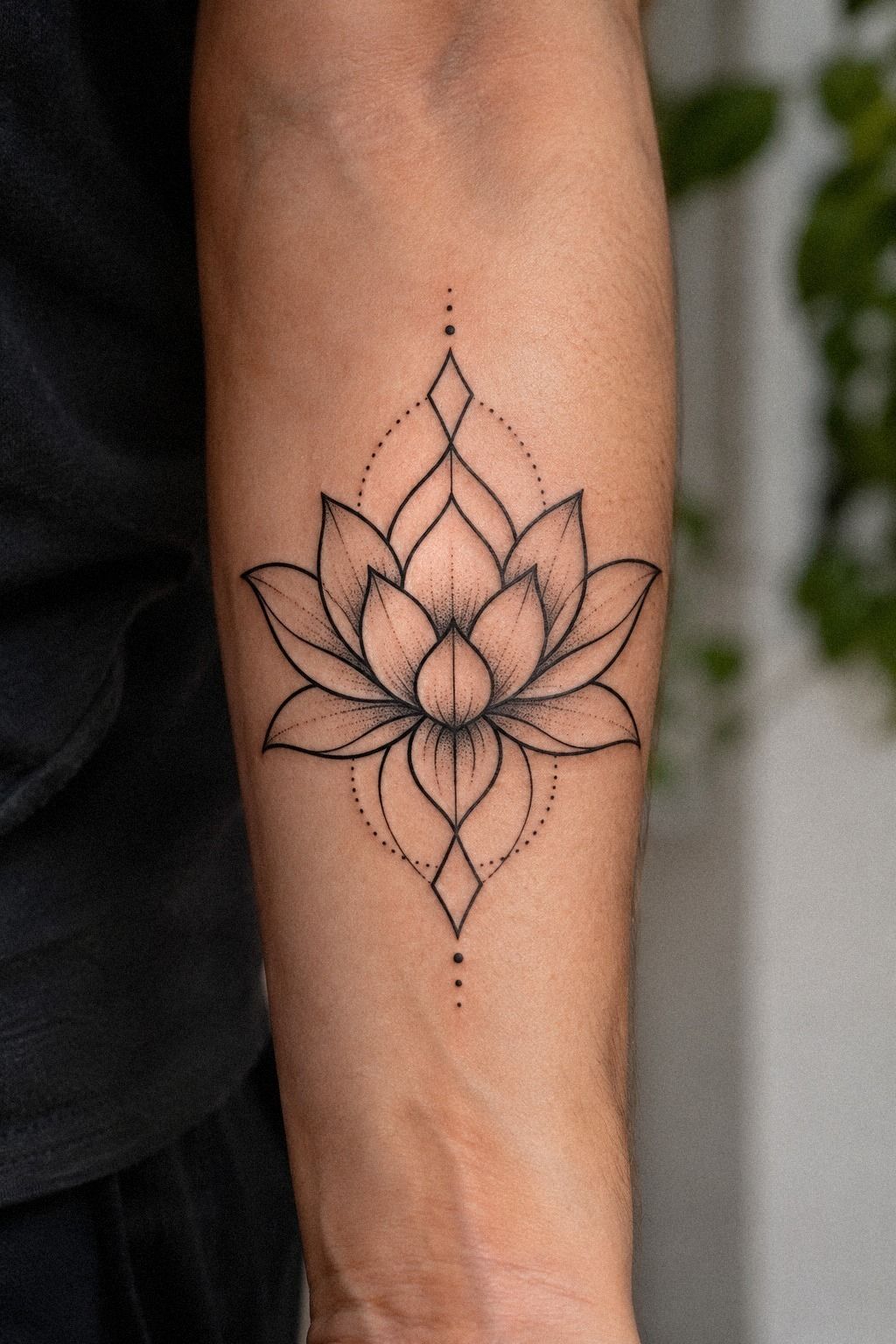
A mandala composition needs a balanced central lotus, layered petals, and circular geometry that spreads with purpose. The center should stay legible at a glance. A high-contrast forest-green foundation with rust accents can keep the shape readable while preserving the mandala’s ornate character.
Mandala contrast gives the center authority.
The Mandala Center Rule says the flower must remain the main event. Your artist shouldn’t let outer rings become so busy that the lotus disappears. I’d use repeated triangles or arcs, then leave small pockets of open skin between them.
That spacing creates a graceful pattern without flattening the flower. Open-skin spacing protects the petals.
If you want stronger personal meaning, browse purple lotus flower tattoo meaning and compare it with the broader lotus flower tattoo meaning guide. Color and geometry can carry different messages.
Your final design should have one main idea, not five unrelated ones. One central message feels more meaningful.
The forearm is a practical placement because you can see the tattoo during the day and show the full composition easily. Still, you’ll want to consider how the mandala looks when your arm rotates.
A vibrant concept can lose its structure if the center faces away from you. One clear focal point is usually worth the cost.
Forearm visibility is the advantage.
What Makes Geometric Lines Readable?
Readable geometry depends on spacing, line weight, and scale. Tiny gaps can close as the tattoo heals, especially when several lines meet in one area.
Ask your artist where they’d simplify the design and whether the smallest details add real value. Line spacing does more work than extra ornament.
Your design should work from a normal viewing distance. If you have to study it to find the lotus, the composition is too crowded. A sharp silhouette, measured spacing, and one memorable symbol will usually age better than a dense collection of marks.
Silhouette clarity is the test.
7Why Choose a Compact Ankle Lotus?
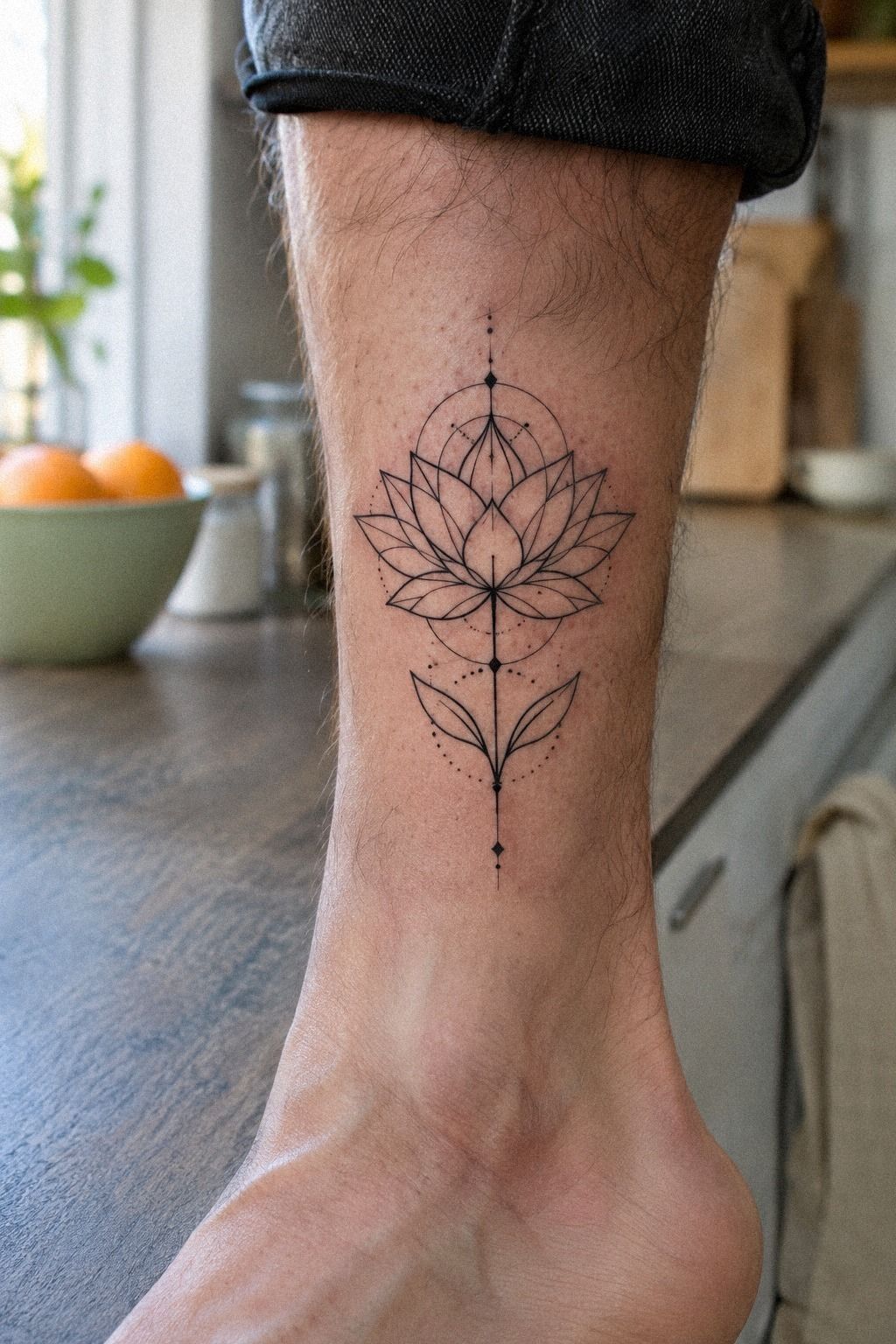
This ankle placement keeps the lotus vertical and compact, with layered petals above a narrow stem. Dusty rose, charcoal, and brass accents can make the ankle lotus palette feel expressive without overwhelming the small placement.
8Dotwork That Fades Into an Ethereal Center
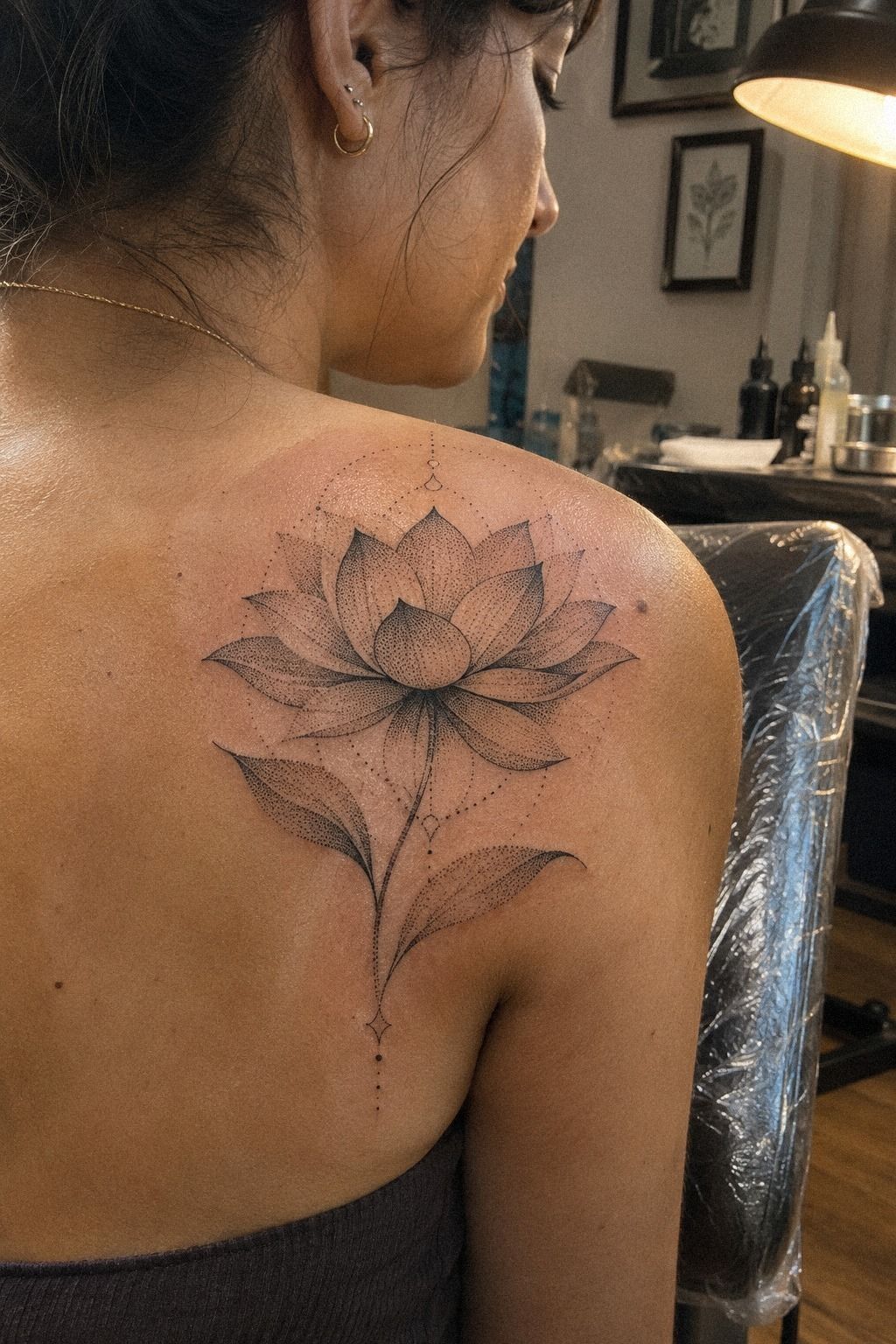
Dotwork can give a lotus an ethereal, engraved quality without using large solid fills. I’d keep the center dense and let the outer petals thin gradually. Warm white, camel, and black accents can support a flowing edge while preserving the dot-density gradient.
Dotwork still needs structure. Your artist should vary the dot density intentionally rather than scattering dots evenly across every surface. The Dot Density Ladder starts dark near the center, opens through the petals, and leaves the outer contour clear.
Intentional dot density keeps the result crisp.
If you’re deciding between black dotwork and a color wash, compare this watercolor lotus flower tattoo reference first. The two styles age differently in appearance.
I’d choose dotwork if you want the geometric pattern to remain the main event, especially for an understated shoulder piece. Black dotwork gives the geometry priority.
Shoulder skin changes shape when you lift your arm. You’ll want the stencil checked in a neutral position and with the arm raised. If the design includes a circle, make sure it still reads as circular when your shoulder moves.
That small check protects the tattoo’s intricate logic. Shoulder movement can change the balance.
9An Asymmetrical Lotus With a Daring Twist

An asymmetrical lotus can feel more daring than a perfectly mirrored flower, especially on the ankle. Uneven petals give the design a more organic direction, but the imbalance should look intentional. Midnight blue, copper, and ivory accents can support the asymmetrical outline without making it chaotic.
The One-Sided Bloom method works because it gives your eye a path. A longer petal on one side, a shorter geometric edge on the other, and a slightly offset stem can create movement without looking accidental.
Your artist should draw several versions before you choose the final balance. Offset petal weight creates movement.
For more compact references, look through these unique geometric lotus flower tattoo ideas. I’d avoid copying an asymmetrical design exactly because the best version will follow your ankle’s shape.
A whimsical adjustment can become playful when it responds to your body instead of fighting it. Ankle-specific tailoring makes it personal.
You’ll also want to think about how the tattoo faces when you look down. Some ankle tattoos point toward the wearer, while others face outward.
That choice changes the stem direction and emotional feel. A personal angle is worth more than symmetry for its own sake!
10Choose a Healed Forearm Design Over a Fresh One

A healed forearm tattoo can teach you more than a fresh reference. Strong spacing, a clear stem, and controlled line weight are easier to judge after the freshest phase fades. Sage green, warm cream, and subtle wood-toned brown can support the healed linework while keeping the lotus recognizable.
Your artist should explain which details may soften over time. Very fine lines can widen, while solid black areas and sensible spacing generally hold up better.
The Healed-First Test asks one question: will you still recognize the lotus if the smallest dots become less distinct? Healed spacing gives the answer.
Use a paper reference to discuss size, angle, and how the flower wraps around your forearm. You don’t need the stencil to match it perfectly.
A small lotus flower tattoo can show how reducing detail changes the design, while a watercolor lotus flower tattoo guide can help you compare a softer direction. Forearm scale should follow your anatomy.
If you want the tattoo to age well, protect it from UV exposure after healing. Sun can fade contrast, and fading changes the relationship between geometric lines.
I’d choose healed clarity over a crowded first-day effect every time. That’s the classic and understated move!
11Chakra Meaning With a Symbolic Lotus

A chakra-inspired lotus can carry symbolic meaning through a centered stem, layered petals, and restrained geometry. Terracotta, stone, and olive accents can make the design feel empowering when every mark connects to your own story. I’d keep the symbols limited so the chakra geometry doesn’t become a collection of unrelated shapes.
Your first step is deciding what the flower represents to you. Maybe it signals renewal, balance, spiritual practice, or a chapter you’ve survived. A lotus flower tattoo meaning guide can help you explore traditional associations, but your explanation should lead the final stencil.
Personal symbolism should guide the design.
If color matters to your concept, compare purple lotus flower tattoo meaning before adding pigment. I’d choose one accent at most because the geometric structure already gives the tattoo plenty of information. A romantic or haunting meaning doesn’t need a crowded palette to feel deep.
A single color accent can be enough.
The upper back gives you room to scale the flower without losing its central shape. You’ll want to see the stencil from several positions before the session begins.
A feminine curve, masculine structure, or neutral geometric border can work when the symbolism belongs to you. Upper-back placement offers flexibility.
A Budget Check Before You Book
A small or moderate geometric lotus can cost about $100 to $300 in the US, though shop minimums and hourly rates vary. A $50 to $100 minimum is common in some studios, while hourly pricing may run around $100 to $250. Ask what the quoted tattoo cost includes before you pay a deposit.
A higher price doesn’t automatically mean a better result. Look for healed work, clean spacing, and an artist whose style matches your idea.
That combination gives you better value than choosing the cheapest available appointment. Artist experience matters.
If your budget is tight, reduce detail before reducing artist quality. A smaller, minimal lotus may be worth it when it keeps the session manageable and the design readable.
Tell the artist your budget early so they can suggest a realistic scale. Session planning can protect the result.
Aftercare That Protects Fine Lines
The surface often settles in about two to three weeks, but complete healing can take two to three months. Wash gently, moisturize as directed, and avoid sun and swimming during the early stage. Good aftercare guidance helps protect the crisp structure you paid for.
Don’t judge the final tattoo while the skin is still changing. Peeling, dullness, and temporary softness can make the lines look different from the finished result. Follow your artist’s instructions and ask questions if anything seems unusual.
Healing changes are temporary.
The Design Choice I’d Make Before the Appointment
I’ve learned that a manageable tattoo session starts before the artist opens the ink. My first geometric design was too ambitious for its placement.
I wanted every petal, circle, and dot from the reference, and I treated open skin like wasted space. It wasn’t.
The empty areas were doing the work that made the flower readable. Negative space became the lesson.
Now I choose one visual priority first. Maybe it’s a clean lotus silhouette.
Maybe it’s sacred geometry around the center. Maybe it’s a vertical stem that follows the spine.
Once you pick that priority, the rest has to earn its place. If a detail doesn’t improve the shape or meaning, I’d remove it.
One design priority keeps the concept strong.
Your consultation should cover placement, estimated cost, line weight, and how the design may change as it heals. Ask about the session length, minimum charge, and whether a redraw changes the price. That conversation gives you a clearer appointment budget.
I’d also ask to see healed examples, not only fresh tattoos. Fresh black ink can look exceptionally bold, while healed lines show the real spacing and softness.
If you’re choosing fine linework, ask where the artist would simplify it after several years. Healed examples reveal the truth.
The most timeless choice is usually the one with enough room to age. I’d rather wear a meaningful, readable lotus with fewer details than a crowded piece that only looks impressive on appointment day. Your tattoo can still be iconic, stylish, and striking when restraint becomes part of the design.
Readable restraint is powerful.
A Few Things Worth Answering
How much does a geometric lotus flower tattoo usually cost?
A geometric lotus flower tattoo typically costs about $100 to $300 in the US, depending on size, placement, artist, and region. Some shops have a $50 to $100 minimum.
Ask for a quote after the artist sees your stencil and understands the detail level. A written quote helps.
Are geometric lotus flower tattoos a good idea for a first tattoo?
Yes, especially if you choose a tolerable placement and readable design. The forearm, shoulder, or thigh may be easier to manage than ribs, feet, hands, or sternum.
A clear silhouette gives you a confident first piece without excessive detail. A manageable placement helps.
How do I choose a tattoo artist for geometric lotus flower tattoos?
Look for clean linework, strong geometric spacing, healed photos, and careful hygiene practices. You’ll want an artist who understands how fine lines and blackwork change over time.
Their portfolio should show work similar to the scale and style you want. Portfolio consistency matters.
How much do geometric lotus flower tattoos hurt?
Pain varies by person and placement. Ribs, feet, hands, and sternum can feel more intense because they have less padding or sit close to bone.
The forearm, thigh, and shoulder are often more tolerable. Your artist can adjust the session plan.
Individual sensitivity varies.
How long does a geometric lotus flower tattoo take to heal?
The surface usually heals in about two to three weeks, while complete healing can take about two to three months. Wash gently, moisturize as directed, and avoid sun and swimming during the early stage.
Don’t judge the final lines while the skin is settling. Complete healing takes patience.
What’s the best placement for geometric lotus flower tattoos?
The forearm, shoulder, ankle, wrist, and upper back are practical choices, but each has a different tradeoff. Choose the forearm for visibility, the shoulder for a larger composition, or the upper back for sacred geometry with more breathing room. Placement choice should follow your priorities.
Where I’d Start First
If I had to pick one, I’d start with the healed forearm design. You can see it easily, and its spacing should stay readable as fine lines soften. Pin that reference for later and compare it with our small lotus flower tattoo guide before booking your consultation.