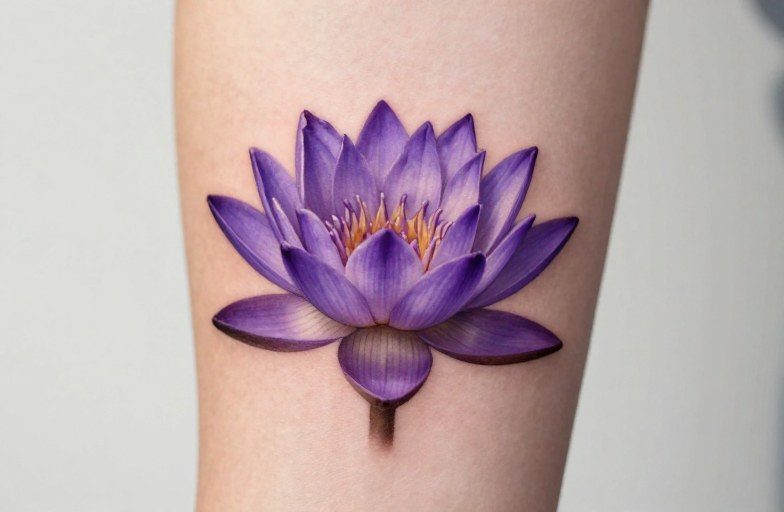
The purple lotus flower tattoo carries layered meaning rooted in Buddhist and Hindu traditions, where the lotus itself represents purity rising from muddy waters. Purple specifically signals spiritual awakening, esoteric knowledge, and the nobility of the soul’s journey. Unlike the more common pink or white lotus, the purple variant sits at the intersection of earthly power (red) and celestial calm (blue), making it a choice for those who’ve undergone significant inner transformation or who hold mysticism close.
How It Ages on Skin
The Purple Pigment Problem
Purple ink is notoriously finicky. The violet and magenta family sits in a chemical sweet spot where some formulations hold beautifully while others fade to muddy grey-blue within a few years. Quality purples from established manufacturers tend to stay truer longer, but budget inks often shift toward brown or slate. This matters especially for lotus designs, where the color gradient between petal tips and base is half the visual impact. A purple that goes flat loses the flower’s dimensionality fast.
Line work in a lotus tattoo gives the structure; purple fill gives it life. Without crisp outlines, a faded purple blob reads as generic flower rather than identifiable lotus. Artists who know their pigments will often lean toward blue-violet bases rather than red-violet, since the blue family resists photodegradation better. Sun exposure accelerates purple fading dramatically, expect a shoulder piece to hold color longer than a forearm or hand placement.
Shading and Detail Retention
Lotus petals have that characteristic pointed-oval shape with subtle veining. Fine detail in the petal centers and the seed pod demands single-needle or tight three-needle work. Over time, those details blur. A purple lotus with heavy black shading behind it maintains readable contrast longer than one relying solely on color value shifts. The seed pod’s distinctive geometry, the radiating stamens, the central dome, needs enough black or dark grey to stay defined as the purple lightens.
- Expect noticeable fading in 5-8 years on high-exposure areas
- Purples with white mixing (pastel tones) fade fastest
- Black-grey linework extends readable lifespan by years
- Touch-ups every 3-5 years keep the color intention clear
History & Cultural Roots
Buddhist and Hindu Symbolism
The lotus appears across sacred texts and temple carvings from ancient Egypt through Southeast Asia, but the purple lotus specifically holds strongest ties to esoteric Buddhist traditions. Often linked to the concept of the “mystic lotus” or padma in its eighth-petaled form, purple represents the highest state of consciousness, the Buddha’s direct connection to universal truth. Some trace it to Tantric practices where purple lotus imagery accompanies advanced meditation visualizations. In Hindu contexts, purple or deep violet lotuses connect to deities associated with cosmic order and spiritual sovereignty, though the color coding is less rigid than in Buddhist iconography.
Commonly associated with the crown chakra in later yogic traditions, the purple lotus bridges older symbolic systems with contemporary spiritual practice. This layered history means wearers may be drawing on Buddhist, Hindu, or modern New Age resonances, or all three simultaneously.
Western Adoption and Adaptation
The purple lotus entered Western tattoo vocabulary primarily through the 1990s and 2000s spread of Tibetan Buddhist art and the parallel growth of yoga culture. Unlike Japanese lotus imagery (which traveled through irezumi and then American traditional adaptation), the purple lotus came through fine art reproductions, thangka paintings, and spiritual book illustrations. This different lineage shows in typical Western designs: more illustrative, less bound to specific regional tattoo conventions, often mixed with geometric or mandala elements that would read as culturally hybrid to traditional practitioners.
Best Placements
Where you put a purple lotus changes how the symbolism reads and how the color performs.
High-Visibility Areas
Forearms, hands, and neck placements broadcast the symbol openly. The purple lotus on a forearm interior, visible when hands rest in meditation position, creates a deliberate contextual trigger. Throat placements carry vocal/spiritual expression connotations, though they’re a commitment most reserve for deeply personal significance. These areas see more sun, more friction, and faster fading.
Contained and Protected Spots
Upper back between shoulder blades, sternum, ribs, and upper thighs protect the purple pigment longer and allow for larger, more detailed renderings. The sternum placement particularly suits the lotus’s natural symmetry, with the seed pod centering on the breastbone. Rib placements follow the body’s curve, letting petals wrap organically. These spots also keep the tattoo private, revealed only by choice.
- Upper back: excellent for symmetrical mandala-lotus combinations
- Sternum: natural centering, high pain, strong visual payoff
- Thigh: large canvas, protected from sun, easy to expand into larger piece
- Behind ear: small, discreet, but purple fades fast there
Common Variations & Styles
Traditional and Neo-Traditional Approaches
Japanese-influenced lotus tattoos typically feature bold black outlines, limited color palette, and specific background elements like waves, wind bars, or flames. The purple reads as a flat fill with minimal gradient. Neo-traditional allows more purple variation, magenta shadows, lavender highlights, while keeping the bold graphic readability. Both approaches age better than purely realistic color work because the black structure carries the design even as purple shifts.
Illustrative and Realistic Renderings
Photorealistic purple lotus tattoos attempt to capture the velvety depth of actual flowers, with purples shifting from near-black in petal folds to pale lilac at edges. This demands significant color packing and expert understanding of how purple pigments layer. Watercolor-style treatments, purple washes bleeding beyond linework, look striking fresh but age poorly; the lack of containment means faded purple becomes unmoored abstraction rather than recognizable flower. Geometric lotus designs (polyline petals, sacred geometry integration) reduce the purple to flat planes, which actually preserves the symbolic content more durably.
Color vs Black and Grey
The choice to go purple versus monochrome changes everything about this tattoo’s meaning and longevity.
Black and grey lotus tattoos emphasize form, shadow, and the universal lotus symbolism without the specific spiritual coding of purple. They read as more timeless, less culturally situated, and they age with predictable dignity. A purple lotus, by contrast, makes a specific claim: this is about mysticism, about transformation, about the crown chakra or esoteric path. The color isn’t decorative; it’s semantic.
That said, a hybrid approach, black and grey structure with selective purple accents on key petals or the flower’s heart, can preserve both symbolic specificity and long-term readability. The purple becomes emphasis rather than foundation. Some artists work entirely in purple-black value shifts, using dilutions of the same purple pigment to create monochrome-within-color pieces that hold unusual coherence as they age.
Personal & Modern Meanings
Beyond Traditional Symbolism
Contemporary wearers layer personal meaning onto the purple lotus framework. Recovery from addiction or mental health struggle maps neatly onto the lotus-rising-from-mud narrative, with purple signaling the spiritual or psychological breakthrough rather than religious awakening specifically. Survivors of trauma sometimes choose the purple lotus to mark a reclamation of body and narrative sovereignty.
Gender and Identity Expressions
The lotus carries feminine associations in many cultures, but purple’s historical connection to royalty and spiritual authority gives it a gender-neutral or masculine-flexible quality that pink lotus tattoos rarely achieve. Men choosing purple lotus often pair it with geometric framing, animal companions (koi, tiger), or placement in larger pieces to shift the reading. Non-binary and trans wearers have adopted the purple lotus specifically for its liminal color position, neither warm nor cool, existing between categories.
- Recovery and transformation: the “mud to bloom” narrative
- Spiritual practice marker: meditation, yoga, or Buddhist commitment
- Creative identity: purple’s association with imagination and vision
- Memorial: the lotus as impermanence made visible
Final Thoughts
A purple lotus flower tattoo succeeds when the color choice is intentional rather than aesthetic default. The pigment demands more maintenance, more sun protection, and more thoughtful placement than black work or even red-pink lotus alternatives. What you gain is specificity: the purple signals spiritual depth, esoteric engagement, or transformation in ways other lotus colors don’t attempt. Work with an artist who can show you healed purples in their portfolio, not just fresh work. Ask about specific ink brands if you’re concerned about longevity. The symbol deserves the care its meaning implies, rising clean from difficulty, but only with sustained attention to what feeds and weathers it.
Frequently Asked Questions
Does a purple lotus tattoo have to be religious?
No. While the symbol originates in Buddhist and Hindu contexts, many wearers connect it to personal transformation, creative identity, or recovery without religious affiliation. The meaning depends on your intention and what the image represents to you.
Why does purple ink fade faster than other colors in lotus tattoos?
Purple pigments sit in a chemical range particularly vulnerable to UV breakdown. Red-violet formulations shift brown; blue-violet formulations shift grey. Quality inks and sun protection help, but purple generally requires more frequent touch-ups than black or blue.
What’s the difference between a purple lotus and a pink lotus tattoo?
Pink lotus tattoos most commonly represent compassion, devotion, and the historical Buddha’s earthly presence. Purple lotus tattoos signal esoteric knowledge, spiritual awakening, and the highest states of consciousness. The color choice changes the symbolic register significantly.
Can a purple lotus work in a small tattoo, or does it need to be large?
Small purple lotus tattoos are possible but risky. The color needs enough space to show variation, and fine detail in the seed pod blurs faster at small sizes. For pieces under 3 inches, black and grey or minimal purple accent often works better than full purple fill.