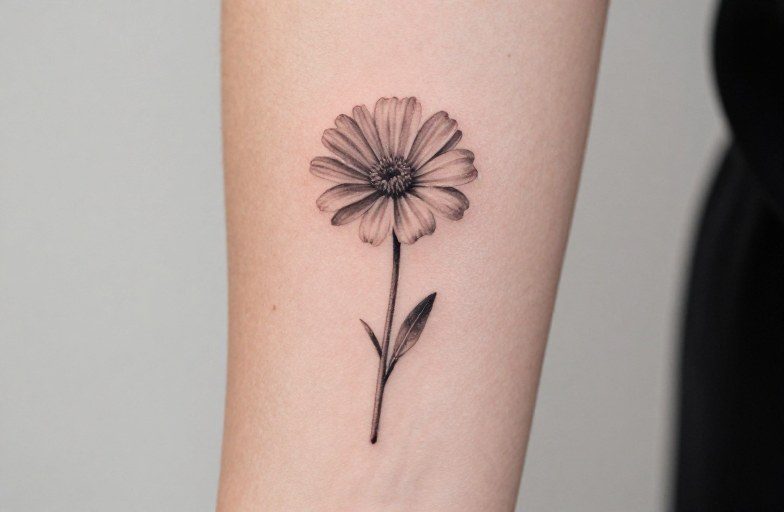
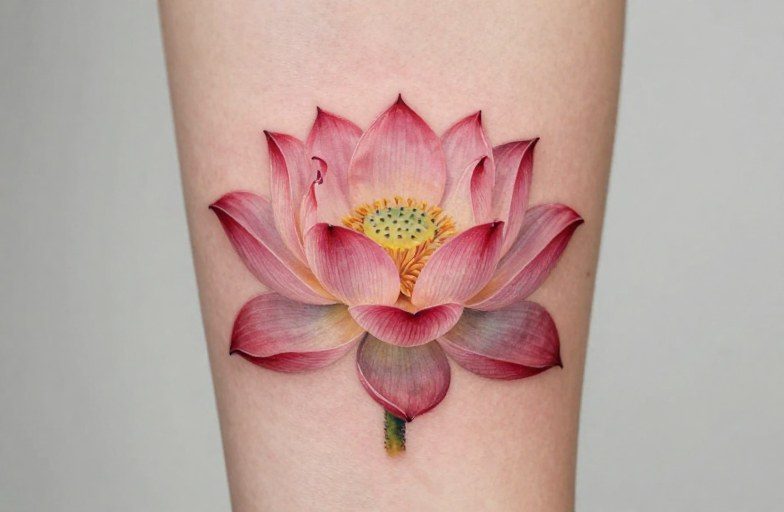
A color lotus flower tattoo typically represents spiritual awakening, resilience, and personal growth. The lotus rises from muddy water to bloom clean and bold, making it a natural symbol for overcoming hardship. Adding specific colors deepens that meaning, each hue carries its own traditional weight, from devotion to enlightenment to passion.
Personal & Modern Meanings
People gravitate toward the lotus for intensely personal reasons. The flower’s daily cycle, sinking underwater at night, breaking the surface each morning, mirrors recovery, renewal, and the stubborn persistence of getting up again. In modern tattoo culture, this resonance has only sharpened. The lotus doesn’t demand a specific religious affiliation to feel relevant.
What Different Colors Signal
Color choice is where personal narrative meets traditional symbolism. Here’s how specific lotus colors tend to read:
- Pink/magenta: Devotion, love, and compassion. Often chosen for memorial pieces or relationship markers.
- Blue: Wisdom, knowledge, and victory over the self. A cooler, more contemplative choice.
- White: Purity, spiritual perfection, and the mind’s potential before corruption. Demands technical precision to avoid looking muddy.
- Red: Passion, love, and the heart’s intensity. Saturated crimson lotus work ages dramatically and requires maintenance.
- Purple: Mysticism, esoteric knowledge, and the crown chakra. Less common, which makes it visually distinctive.
- Yellow/gold: Enlightenment, spiritual ascension, and reverence. High-yellow inks can shift orange with sun exposure.
Placement as Meaning
Where the lotus sits on the body shapes its personal significance. Sternum and rib placements emphasize the flower’s emergence from darkness, literally near the heart, protected by bone. Forearms and wrists make the symbol visible during daily struggle, a deliberate reminder. Upper back or shoulder blade placements feel more private, revealed selectively. Ankle and foot lotus work connects to groundedness, the root of the growth metaphor.
Common Variations & Styles
Style transforms the lotus from delicate to aggressive, from traditional to contemporary. The same flower rendered in Japanese tebori versus neo-traditional American versus fine-line minimalist carries completely different energy.
Style-Specific Considerations
- Traditional Japanese (irezumi): The lotus often appears with koi, dragons, or waves. Heavy black outlines, limited but saturated color palette, and background elements that “lock” the design to the body’s flow. Color sits bold and flat.
- Neo-traditional: Expanded color range, more dimensional shading, decorative elements like jewels or geometric frames. The lotus becomes ornamental as much as symbolic.
- Watercolor: Color bleeds and splatters replace solid fills. Visually striking when fresh, but the technique’s reliance on light washes means faster fading and blur.
- Fine-line and single-needle: Delicate, precise petal work. Color is often limited to subtle gradients or small accents. Heals soft, ages softer, touch-ups are practically guaranteed.
- Black and grey with color accent: Desaturated lotus with one or two petals in vivid color. The contrast draws the eye and isolates meaning, perhaps one red petal among grey for a specific loss or love.
Realistic vs. Stylized
Photorealistic lotus tattoos exist but are rare because the flower’s layered structure challenges even skilled color artists. Petal translucency, the seed pod’s texture, and the gradient from stem to bloom require serious technical investment. Most clients and artists prefer stylized or illustrative approaches that read clearly at tattoo scale and hold their structure as the skin changes.
Religious & Spiritual Angles
The lotus is deeply embedded in several religious traditions, and color specificity matters enormously within them.
Buddhist and Hindu Contexts
In Buddhist iconography, the lotus often represents the purity of body, speech, and mind rising above attachment. The color of a Buddha’s lotus seat carries doctrinal weight: blue lotus for wisdom and victory, white for purity, pink for the historical Buddha, red for compassion and love. A tattoo quoting these traditions without understanding the hierarchy can read as superficial or appropriative.
Hindu associations are similarly specific. Lakshmi stands on a pink lotus. Vishnu and Brahma are often depicted with white lotus attributes. The thousand-petaled lotus at the crown chakra is not a literal flower but a geometric meditation object.
Modern Spiritual Use
Contemporary practice often separates the lotus from doctrinal rigor. Yoga practitioners, meditation enthusiasts, and people in recovery may choose the symbol for its embodied metaphor without claiming religious affiliation. The color choices here tend toward personal resonance rather than traditional correspondence, someone might choose teal because it calms them, not because it maps to a specific deity.
Design Tips & Pairings
Smart lotus design accounts for how the flower interacts with body geometry and how color behaves over time.
Complementary Elements
- Water and waves: Reinforces the emergence narrative. Japanese-style water patterns or simple geometric ripples both work.
- Mandala geometry: The lotus naturally radiates from center, making it compatible with circular sacred geometry. Color can shift from center to edge.
- Script and text: Petals can frame words, but the curve challenges readability. Short phrases or single words work better than paragraphs.
- Chakra symbols: Directly maps the lotus to energetic body systems. Color coordination becomes critical, mismatching lotus and chakra hues reads as ignorant.
- Animals: Koi for perseverance, phoenix for rebirth, snake for transformation. Each pairing narrows the meaning.
Technical Color Advice
Color lotus tattoos demand planning. Yellows and light greens fade fastest and can shift to murky olive. Deep blues and magentas hold longest but can blow out if overworked. White ink is notoriously unreliable, on darker skin tones it often heals to ash or disappears entirely, and on lighter skin it yellows. If purity is the goal, negative space (skin showing through) frequently outperforms white pigment.
Petals need sufficient contrast between adjacent colors or they blur together within months. A common mistake: too many similar pinks and reds packed too tightly. The eye can’t distinguish them, and the aging process accelerates the mush.
History & Cultural Roots
The lotus as symbol is often linked to ancient Egyptian culture, where the blue lotus (Nymphaea caerulea) held significance in religious and funerary contexts. Some trace it to the Indus Valley civilization, where lotus motifs appear on seals. Its prominence in Buddhist and Hindu art spread across Asia through trade and conquest, adapting to local aesthetics while retaining core associations.
The color symbolism systematized differently across cultures. Chinese tradition often associated the lotus with summer, purity, and harmony, with less rigid color coding than South Asian sources. Japanese adaptation through Buddhist channels emphasized the lotus in mortuary art and temple decoration. Western adoption accelerated in the 20th century through Theosophy, early yoga movements, and later New Age spirituality, often stripping away doctrinal specificity in favor of generalized “enlightenment” messaging.
Tattoo-specific history is shorter. The lotus became a common Western tattoo motif primarily from the 1990s onward, alongside the popularization of yoga and Eastern spirituality. Earlier Western tattooing occasionally featured lotus flowers through Japanese-style work, but standalone color lotus pieces were rare before this cultural crossover.
How It Ages on Skin
Color lotus tattoos face predictable aging challenges. The flower’s layered structure means many fine edges and tight color transitions, exactly what time and sun damage attack first.
What Actually Happens
Within two to three years, initial vibrancy drops noticeably. Blacks soften to dark grey. Bright reds dull toward brick. Yellows often become the first color to require attention. The petal edges that looked crisp at six months may feather slightly, especially on areas with frequent movement like wrists, ankles, and ribs.
Line weight matters enormously for longevity. Fine-line lotus work with color wash can look ethereal when fresh but often dissolves into indistinct color blobs within five years. Heavier outline work, particularly in Japanese or neo-traditional styles, preserves the structure even as color fades. The tradeoff is visual weight; delicate aesthetic versus durable clarity.
Skin Tone Considerations
Color saturation and choice should adapt to melanin levels. On darker skin, high-contrast colors (deep crimson, cobalt, emerald) read better than pastels. White and pale yellow are generally inadvisable. On very fair skin, colors stay true longer but sun damage accelerates fading across the board. The lotus’s symbolic association with purity makes white an especially tempting but technically risky choice.
Final Word
A color lotus flower tattoo works when the color choice is deliberate, the style matches the body’s movement, and the symbolism is understood rather than borrowed. The flower’s meaning is genuinely ancient and cross-cultural, but that depth requires respect, not casual adoption. Pick a color that resonates with your specific experience, place it where the body’s geometry supports the design, and work with an artist who can explain how that color will look in five years, not just five minutes. The lotus rises from mud, your tattoo shouldn’t dissolve into it.
Frequently Asked Questions
Does a white lotus tattoo stay white over time?
White ink rarely stays true. On lighter skin it often yellows; on darker skin it frequently heals to ash grey or disappears entirely. Many artists recommend using negative space or very light grey instead.
Which lotus color is best for a first tattoo?
Deep pink or magenta offers strong symbolism, good visibility across skin tones, and reasonable longevity. These colors fade gracefully rather than turning muddy.
Can a color lotus tattoo be covered up later if I change my mind?
Lotus shapes with their radiating petals are moderately difficult to cover. The central symmetry limits directional options, but a skilled artist can often incorporate the existing structure into a larger mandala or floral piece.
How much does a color lotus tattoo typically cost compared to black and grey?
Color work generally costs more due to additional ink sets, longer session time, and higher technical demand. Expect 25-50% above a comparable black and grey piece, varying by artist and geographic location.