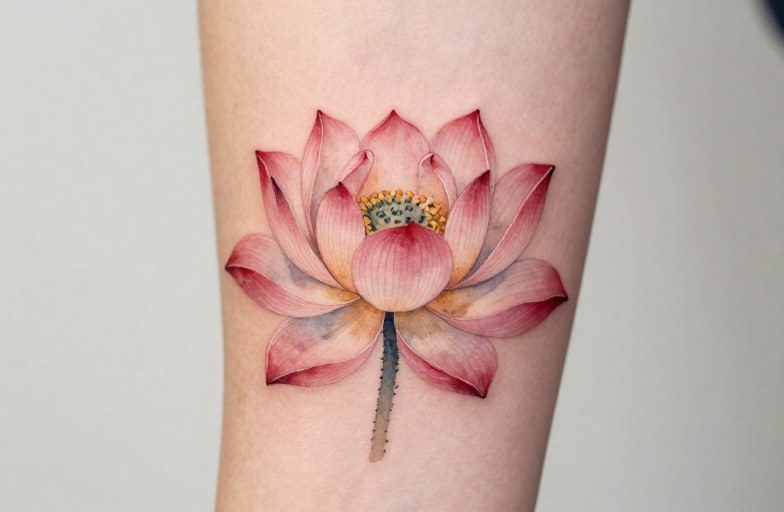
A watercolor lotus flower tattoo marries the recognizable geometry of the lotus, layered petals radiating from a central seed pod, with the loose, bleeding edges of watercolor painting. Unlike traditional tattoos that rely on bold black outlines to hold shape, this style uses color gradients, splatter effects, and negative space to suggest form. The lotus itself, with its natural symmetry, gives the artist a structural anchor; the watercolor technique provides the movement. Done well, it looks like pigment spilled across skin and dried in exactly the right shape. Done poorly, it becomes a muddy blur within five years.
Key Characteristics & Motifs
How the Watercolor Effect Actually Works
Real watercolor tattoos aren’t just “colorful.” The technique mimics four specific painterly effects: color bleeds where pigment appears to seep past imaginary boundaries, splatter dots that suggest flicked brushwork, gradient washes where one hue dissolves into another, and negative space gaps where skin tone shows through as “paper.” For a lotus, artists typically render the central pod and inner petal layers with tighter detail, sometimes fine line, sometimes soft gray shading, then let the outer petals dissolve into color washes. Magenta bleeding into teal, amber pooling into violet: these combinations work because they contrast against the lotus’s natural structure.
- Black “drip” lines added for contrast often age into gray blur; pure color-to-skin transitions hold cleaner
- Splatter dots away from the main image need spacing, clustered too tight, they merge into blobs
- Petals work better than leaves for watercolor; lotus leaves are broad and flat, harder to suggest with loose technique
- Seed pod detail in black ink provides the “anchor” that lets surrounding color feel intentional, not accidental
Placement Considerations
Watercolor lotus pieces need real estate. The effect requires enough surface for gradients to develop, too small, and the color transitions become abrupt stripes. Forearms, outer thighs, ribs, and shoulder caps offer the best canvas. Wrists and behind-the-ear placements fail this style consistently; the detail collapses into a smear. On ribs, the natural body contour can echo the petal curve, but breathing movement during the session tests an artist’s stabilization hand. Upper back pieces work well for larger compositions where the lotus sits amid broader splatter fields.
Aftercare Notes
Watercolor tattoos have a specific healing vulnerability: the lightest color washes. Where traditional bold-line pieces can scab thickly and still recover definition, watercolor’s subtle gradients live or die by how evenly the epidermis regenerates over them. Heavy scabbing in a pale yellow wash can pull pigment out unevenly, leaving patchy voids.
- Keep the piece out of direct sunlight during healing, UV exposure hits unprotected color harder than black ink
- Avoid submerging in water beyond quick showers; baths and pools soften scabs and leach pigment from loose washes
- Moisturize lightly; over-greasing keeps the wound too wet and can cause color to settle unevenly
- Expect longer “settling” time, final color clarity often takes 6-8 weeks, not the standard 4
Common Mistakes to Avoid
Artist Selection Errors
Not every color specialist understands watercolor technique. Some artists default to heavy black outlines with color filling, then add splatter as an afterthought, that’s not watercolor, that’s a traditional piece with decoration. Review healed photos, not just fresh work. Fresh watercolor tattoos look bold because the skin is inflamed and glossy; healed photos show whether the color actually held in those loose edges. Ask specifically about their approach to negative space, artists who plan skin-as-paper from the stencil stage understand the style better than those who fill in later.
Design Pitfalls
- Too many competing colors, three to four hues maximum, with one dominant
- Symmetrical splatter (real watercolor is random; mirrored “drips” look digital)
- Overworking the lotus center, hyper-detailed pods fight the loose surrounding technique
- Text integration, lettering embedded in watercolor washes almost always ages poorly
Origins & History
The watercolor tattoo style emerged in the early 2010s, often linked to artists in the US West Coast and UK who adapted painterly techniques to skin. Some trace the approach to Amanda Wachob’s abstract work in New York, though multiple artists developed similar methods independently. The lotus as subject matter predates this by millennia, Egyptian, Hindu, and Buddhist iconography all feature the flower, but its pairing with watercolor technique is distinctly modern. The style gained traction through social media visibility; fresh pieces photograph dramatically, which drove demand faster than understanding of how the technique ages. By the late 2010s, most established shops had at least one artist experimenting with the approach, though quality varies enormously.
Cost & Sessions
Watercolor lotus work typically runs higher than comparable black-and-gray pieces. The color saturation requires more passes, more needle changes, and more artist planning time. A palm-sized forearm piece might range from $400-$800 depending on market; full shoulder-to-elbow compositions with background splatter fields can hit $1,500-$2,500. The style rarely works well in single-session marathon sittings, skin saturation limits mean color packing needs breaks, and the artist’s color-mixing decisions benefit from fresh eyes between sessions. Budget for two sessions minimum on anything larger than a handspan.
- Touch-ups are common and should be discussed upfront, some artists include one within six months
- Color-specific pigments (certain teals, bright oranges) cost more per bottle and may affect pricing
- Travel to a specialist often pays off; local shops without watercolor portfolios are risky bets
How It Ages
The Five-Year Reality
All tattoos spread slightly as ink particles migrate through dermis layers. Watercolor pieces face this more acutely because their edges aren’t defined by black lines. A petal edge that reads as soft bleed fresh can become an indistinct color cloud by year five. The lotus structure helps, viewers recognize the flower shape even with degradation, but the “watercolor effect” itself softens considerably. Darker color concentrations (deep magentas, navy blues) hold longer than pale washes (soft pinks, light yellows). Splatter dots often disappear entirely, absorbed into surrounding tissue.
Long-Term Maintenance
Sun exposure is the primary accelerator of watercolor aging. Without consistent SPF application, a bold piece can dull to pastel murk in under a decade. The lotus’s central detail typically outlasts the outer color washes, creating a “reverse” effect where the anchor becomes the dominant visual while the watercolor framing fades. Some collectors embrace this evolution; others plan for refresher sessions every 7-10 years to re-establish color saturation. Black-and-gray lotus centers with watercolor-only petals age more gracefully than full-color pieces because the structural drawing persists even as color drifts.
The Takeaway
A watercolor lotus tattoo succeeds when the artist respects both disciplines: botanical accuracy and painterly looseness. The lotus provides built-in symbolism if you want it, rebirth, resilience, spiritual significance, but the tattoo’s visual impact comes from technical execution, not meaning. Choose an artist with healed portfolio examples, plan for multiple sessions and higher cost, protect the piece from sun diligently, and accept that the watercolor effect will soften over time. The best pieces balance that future fading into the design from day one, using color density and structural anchors that keep the lotus readable even as the “paint” appears to dry further.
Frequently Asked Questions
Do watercolor lotus tattoos need black outlines to last?
Not necessarily, but they need some dark anchor, usually the seed pod or fine gray shading in inner petals. Pure color-to-skin edges fade faster without any structural dark element nearby.
Can a watercolor lotus cover up an old tattoo?
Generally no. The style relies on negative space and light colors, which won’t hide existing dark ink. Cover-ups need heavier saturation than watercolor technique allows.
Why do some watercolor lotus tattoos look muddy after healing?
Usually either too many colors packed too close, or the artist worked too deep and caused color blending beneath the skin surface. Proper technique keeps pigments in distinct dermis layers.
Is the lotus shape necessary, or can it be more abstract?
The recognizable lotus structure is what makes the style work, it gives the viewer’s eye an anchor amid loose color. Fully abstract watercolor often reads as random pigment without that botanical reference.