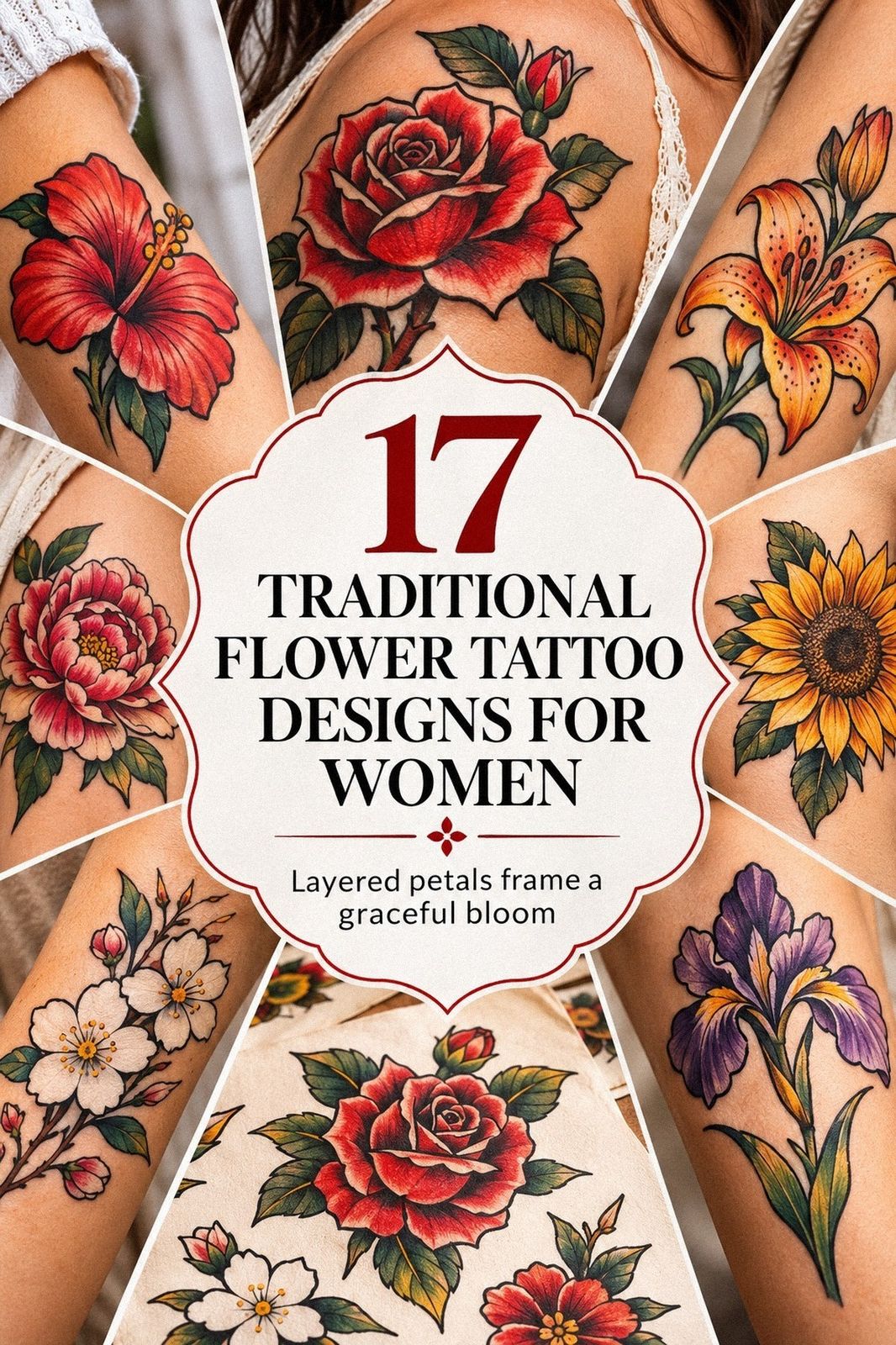
Traditional flower tattoos for women hold their shape best when bold outlines, solid color, and sensible placement work together. I learned that after choosing a tiny, delicate design that blurred sooner than expected. These ideas keep the classic feeling while giving you clearer scale, stronger contrast, and placement choices that can age with you. Save the ones that feel personal!
Editor’s note: crispness usually comes from three choices: readable scale, deliberate spacing, and enough contrast. A meaningful tattoo doesn’t need every tiny detail to feel expressive.
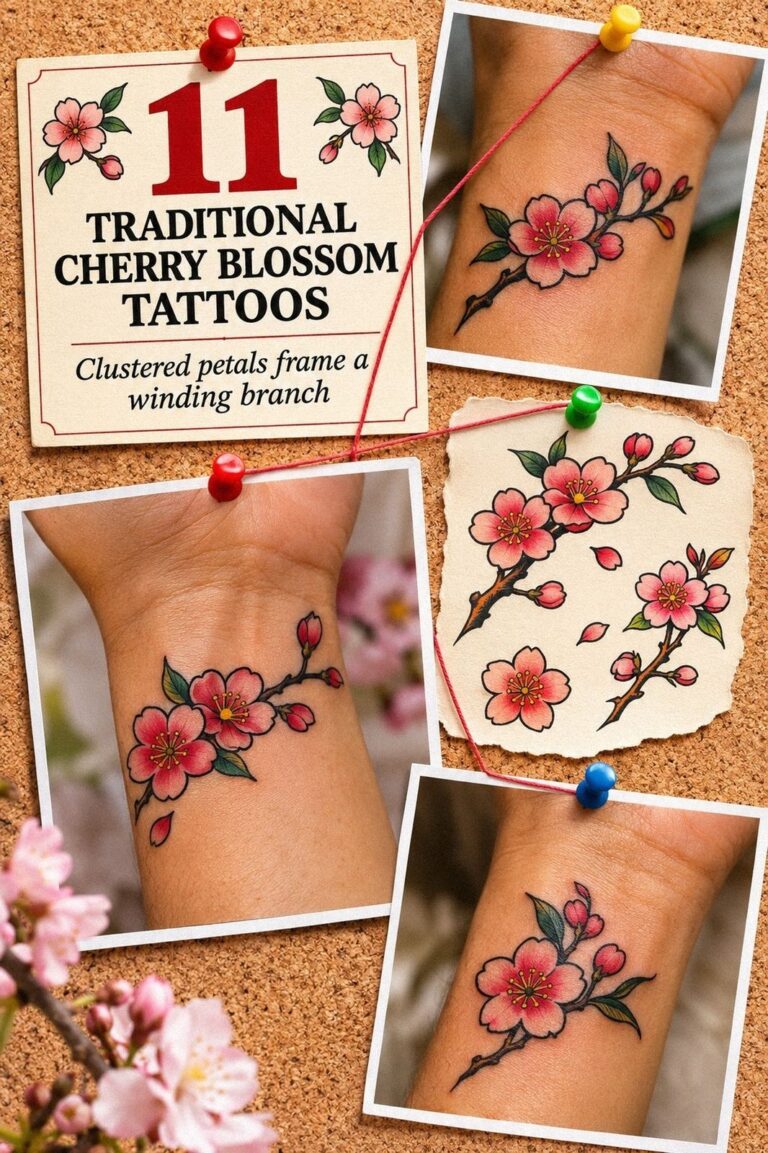
Small Traditional Rose Tattoo on the Wrist
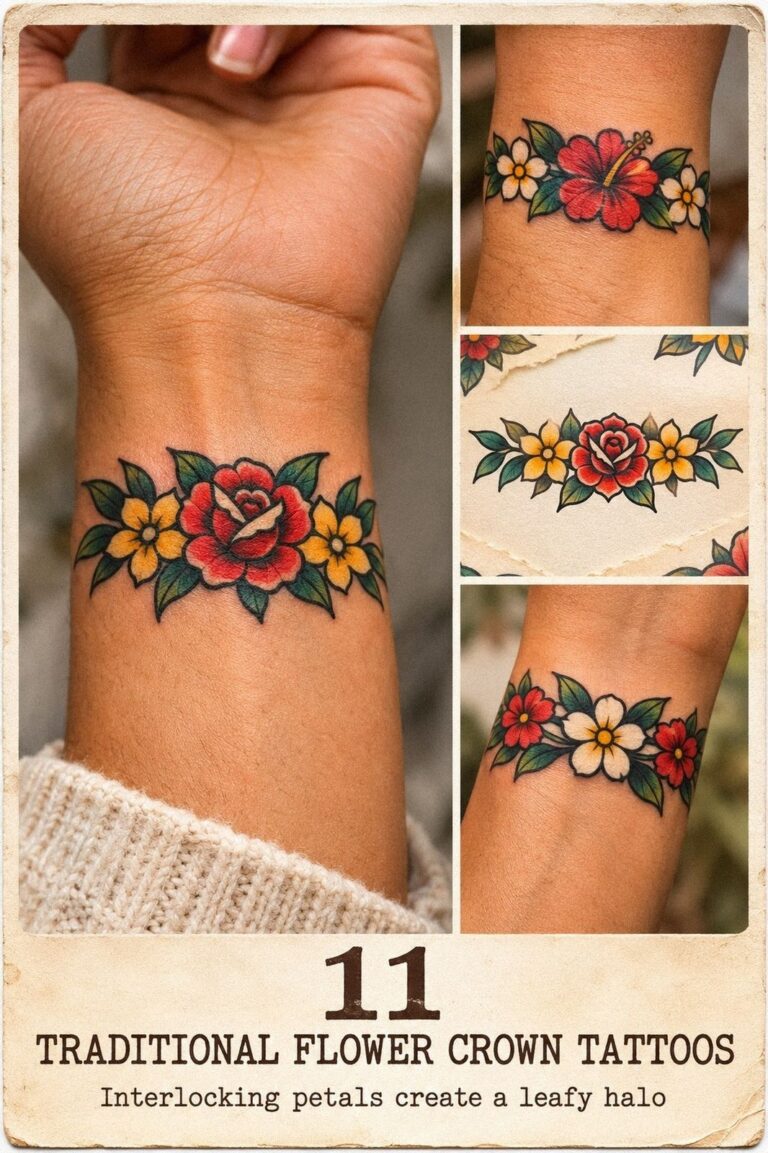
A small traditional rose on the wrist gives you a crisp focal point without taking over your whole arm. I’d keep the rose around 2 to 3 inches. That size lets the leaves and petal folds stay readable.
Anything much smaller can lose its sharp edges over time.
Choose a terracotta rose with solid black outlining, olive leaves, and a small pocket of clean skin around the stem. That contrast makes the design feel iconic rather than crowded. If you want a softer look, a black-and-grey version can feel elegant.
I’d still skip ultra-fine detail here.
The wrist is visible, so you’ll want a design that still feels meaningful when strangers see it. A crisp rose can symbolize love, remembrance, courage, or a personal turning point.
The best value comes from one clear silhouette. Ten competing details can weaken the whole idea.
For a lower budget, compare it with these small flower tattoo designs for women. A smaller piece may cost less. Simplifying the petals is worth it if you want the tattoo to remain readable.
Bold Peony Traditional Flower Tattoo on the Shoulder
A bold traditional peony belongs on the shoulder when you want drama with room for the petals to breathe. I’d rather see one powerful peony than a cramped cluster. A crowded arrangement can lose its personality.
The rounded shape follows the shoulder naturally and can feel feminine without becoming overly sweet.
Use clay-red pigment in the deepest petal folds, with muted cream or warm brass-gold accents across the open faces. The shoulder’s curve lets your artist angle the stem toward the collarbone or upper arm. That flowing placement feels graceful, polished, and easy to personalize.
A peony can look romantic, fierce, or symbolic. Its mood depends on the expression of the petals. Ask for clear negative spaces between each layer.
If you’re choosing between soft shading and heavy color, I’d choose heavier contrast. The extra cost can be worthwhile for stronger long-term readability!
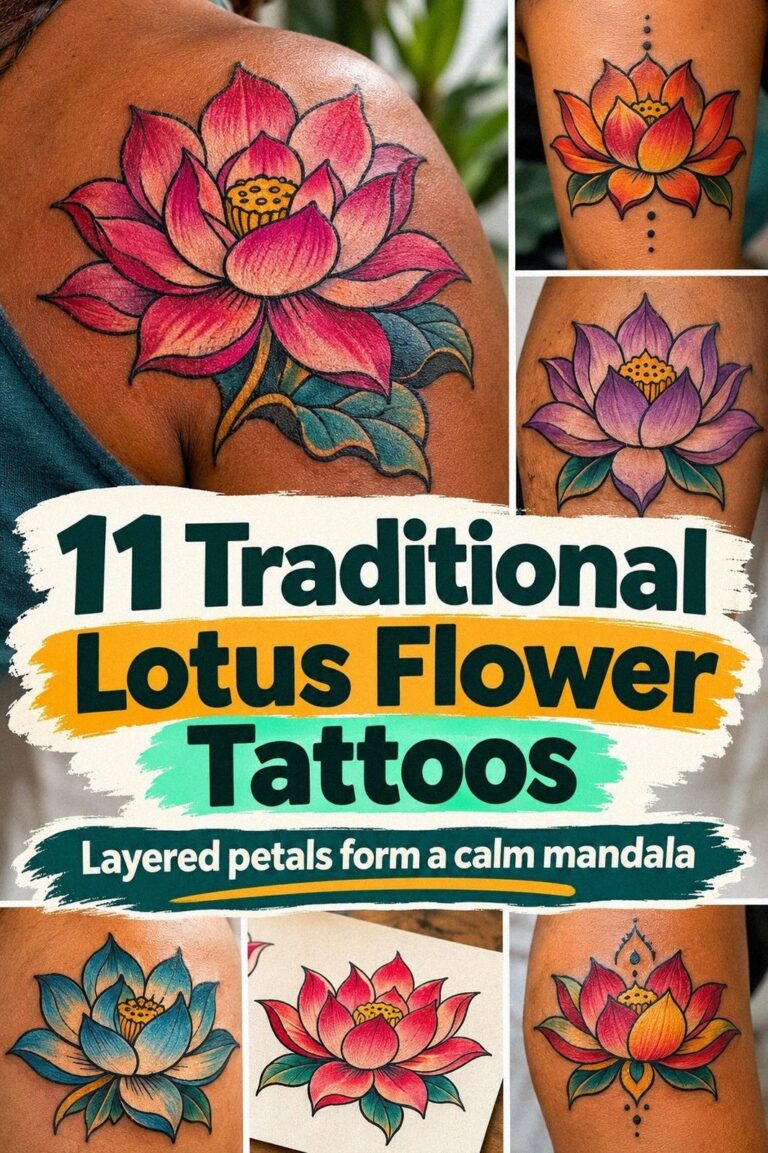
These traditional lotus flower tattoo ideas show how different petal structures change the mood. Choose the flower that matches the meaning you’re carrying. Don’t choose it only for the shape you saved!
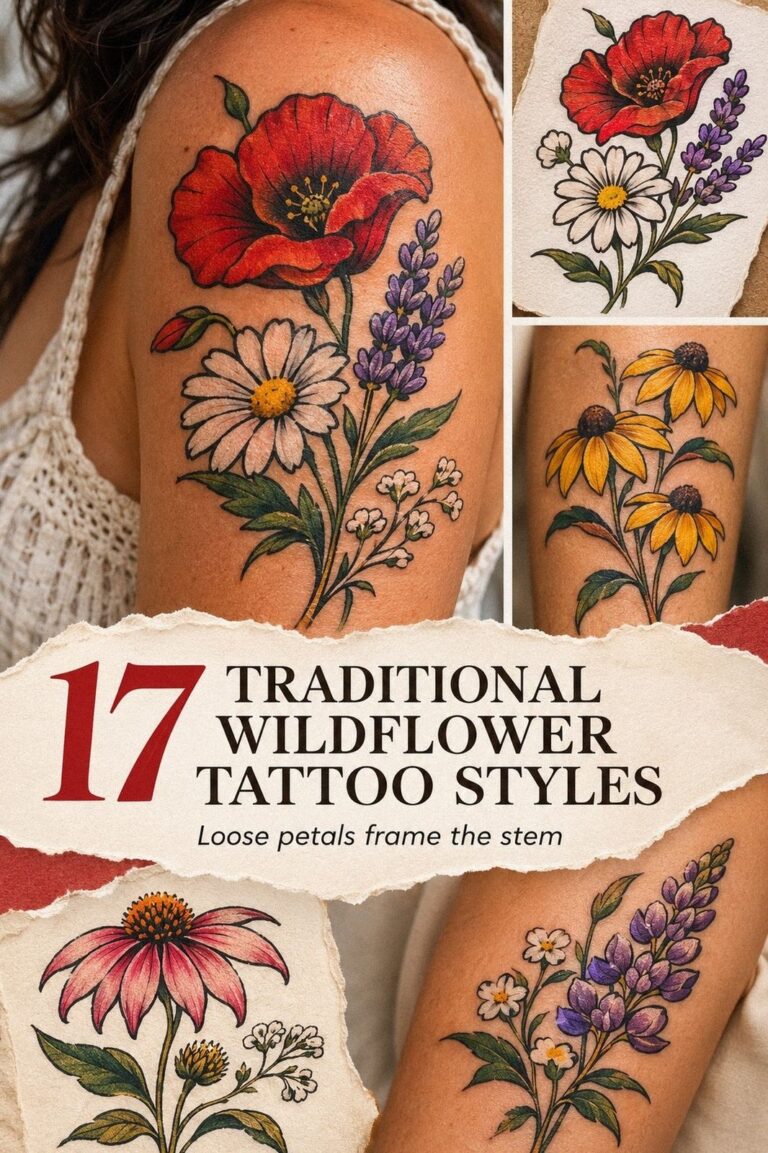
Unique Traditional Wildflower Tattoo Along the Ribcage
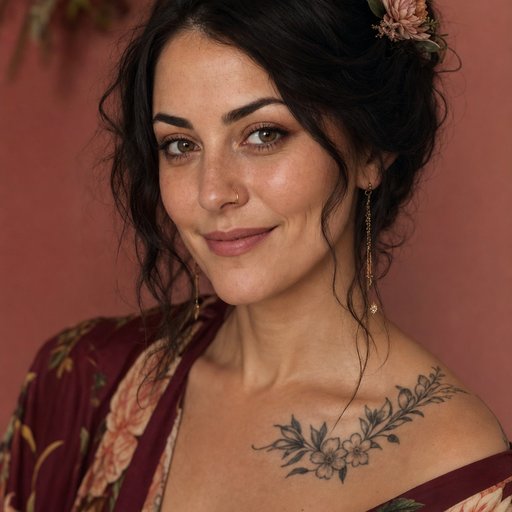
A traditional wildflower along the ribcage gives you a more personal, unexpected direction. I’d keep the stem flowing vertically.
A horizontal arrangement can look cramped when your body moves. The result can feel raw, expressive, and more personal than a familiar round emblem.
Choose opaque charcoal linework with plum petals, grey shading, and small rose-gold accents. The ribcage gives you enough length for an intricate stem and a pair of leaves. Your artist still needs to protect the open spaces.
This placement is more sensitive than the shoulder, especially near the lower ribs and sternum. Plan your session around clothing that won’t rub the area afterward.
Avoid placing the finest petal marks where the skin folds most. That decision can improve the tattoo’s value over time.
Look at these fine line flower tattoo ideas for women if you’re deciding how much detail you truly need. I prefer selective delicacy over fragile detail everywhere. It keeps the concept sharp!
Traditional Bouquet Tattoo for the Upper Arm
A traditional bouquet on the upper arm lets you combine several flowers while keeping each one readable. I’d use one dominant flower, one supporting bloom, and a few leaves. Three clear shapes will look more polished than a dozen tiny blossoms packed together.
Try navy and warm-white color blocks with deep brown stems and a clean black border. A bouquet can feel ornate, but it shouldn’t become visually muddy.
Ask your artist to vary the flower sizes. Rotate the heads slightly so the arrangement feels alive instead of stamped into one flat row.
The upper arm is a forgiving placement for a first larger tattoo. You’ll get more cushion than you would on the ribs, hands, or feet.
If you’re planning a future sleeve, leave small gaps where another flower could connect later. I made the mistake of filling every open spot too early. Expansion became harder than it needed to be.
For a softer arrangement, compare these traditional flower crown tattoo concepts. A repeated stem shape can make different flowers feel harmonious without making them identical.
Delicate Traditional Daisy Tattoo Behind the Ear
A delicate traditional daisy behind the ear works best when the drawing stays simple. The petals should remain unmistakable. The placement has a dainty, playful quality, but the outline still needs enough weight to survive daily friction.
Choose emerald petals with a gold center and a few cream accents. Behind the ear, a daisy can sit close to the hairline.
It can also angle slightly toward the neck. I’d skip dense shading because the available surface is small.
This placement is discreet but not invisible. If you have short hair, you’ll see it often. Choose a symbol you won’t tire of seeing in the mirror.
The area can be tender, and you’ll need to protect it from friction while it heals.
Browse these tiny flower tattoo ideas for women if you’re trying to keep the scale minimal without making the design weak. Clarity comes first.
Delicacy comes second. That distinction matters!
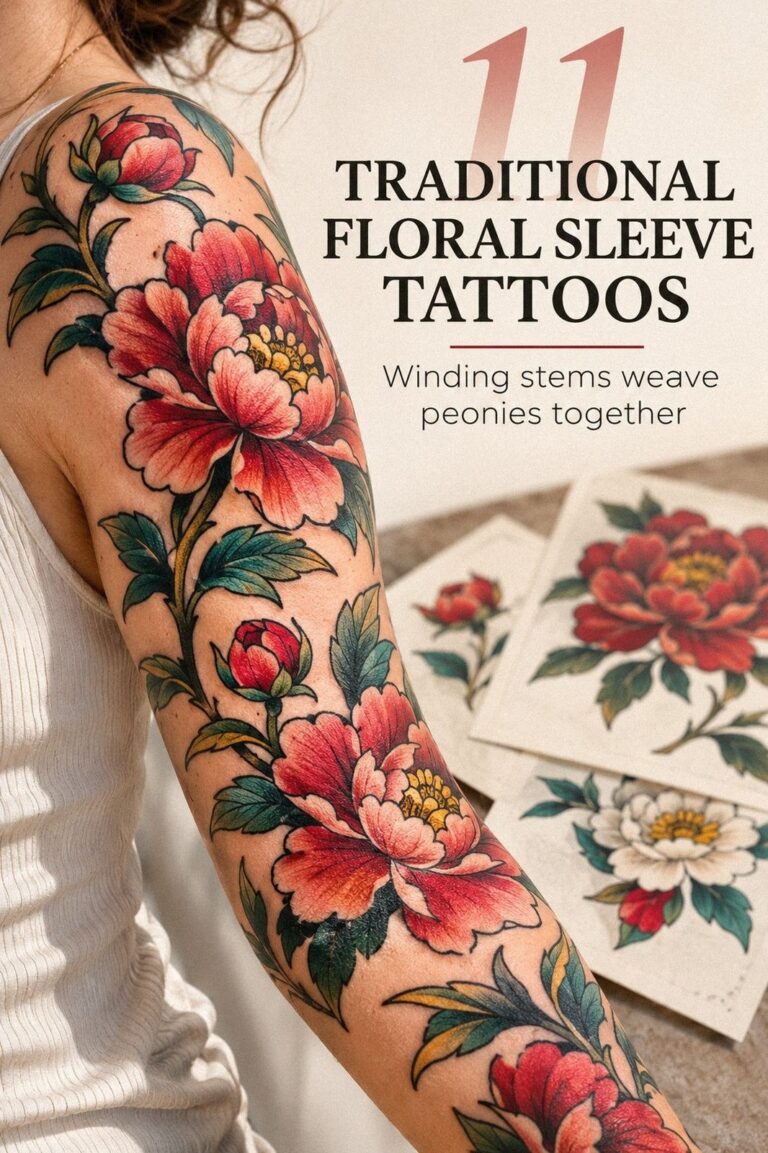
Traditional Floral Sleeve Tattoo with Vibrant Color
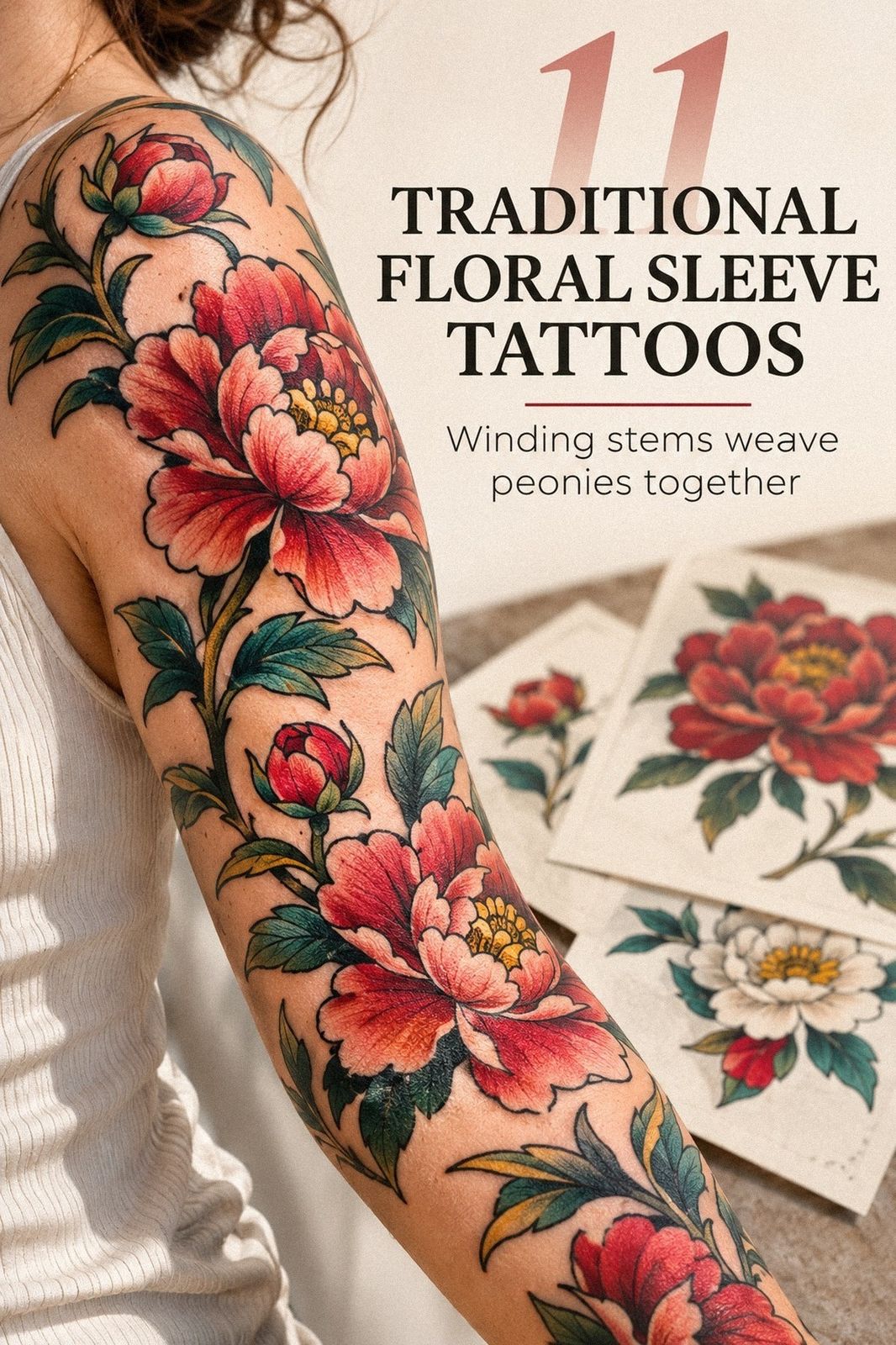
A traditional floral sleeve with vibrant color gives you the biggest visual impact on this list. Build it around a strong visual rhythm.
Don’t scatter unrelated flowers across the arm. From a distance, the sleeve should read as one confident composition.
Build the sleeve around rust-colored petals and forest-green leaves. Connect the flowers with natural brown stems, small filler shapes, or controlled negative space.
A sleeve can be expressive from a distance. It can then reveal intricate details when someone looks closer.
Your artist should show healed work on a range of skin tones. Fresh results aren’t enough.
Bright pigment can soften after healing, so healed work tells you much more about line stability and saturation. A multi-session sleeve may cost more, so ask for a realistic budget before booking.
These watercolor flower tattoo ideas for women can help you compare softer color movement with a bold traditional structure. If the full sleeve feels too daring, start with the forearm and expand later.
Meaningful Traditional Lotus Tattoo on the Forearm
A meaningful traditional lotus on the forearm gives you symbolism with excellent visibility. A lotus can represent renewal, endurance, faith, or a difficult season you’ve moved through. Its meaning stays personal, even when the symbol is familiar.
Choose dusty-rose lotus petals with a charcoal border and a brass-gold center if you want something less expected than red. The forearm gives the flower a stable, readable canvas. You can orient the bloom toward your wrist or elbow.
This is a strong first-tattoo option because the forearm is usually more tolerable than ribs, feet, hands, or sternum. Don’t rush the color decision. A meaningful symbol deserves a palette that feels like you, not one chosen because it was popular in a flash book.
These geometric flower tattoo ideas show how structure can sharpen a symbolic design. You’ll know the right version when the meaning survives after you remove the decorative extras.
Feminine Traditional Chrysanthemum Tattoo on the Thigh
A traditional chrysanthemum on the thigh gives you space for graceful petals, strong contrast, and a more private placement. Its layered structure can feel feminine, elegant, or fierce. The mood depends on how tightly the petals curl toward the center.
Use warm-white and camel petals with black accents to keep the flower vivid without making every petal identical. I’d ask for a few larger petal groups. Fewer tiny interior marks can make the tattoo more timeless as the skin settles.
The thigh is generally more tolerable than bony placements, though sensitivity varies from person to person. You’ll want loose clothing during the first days.
You’ll also need a plan for avoiding direct sun while the surface heals. A larger thigh piece can offer strong value because it gives your artist room to work.
Compare it with these small traditional flower tattoo ideas if you’re debating scale. Size changes the mood, but it doesn’t have to change the meaning.
Traditional Flower Tattoo with Elegant Black Linework
A traditional flower with elegant black linework feels understated until you see how much expression the contour carries. The design depends on confident outlines, restrained shading, and enough skin left open around the petals.
Choose midnight-blue petals with copper and ivory accents if you want an elegant result with controlled color. I’d keep the central outline sharp.
Let the interior marks stay selective. Fine lines can spread as a tattoo ages, so your artist should avoid stacking too many hairline details.
The ribs can be more painful than the forearm, shoulder, or thigh. Be honest about your comfort level before booking. A short session may be the wiser choice if this is your first tattoo.
You don’t need to prove anything by sitting through a marathon appointment.
These minimalist flower tattoo ideas are useful if you’re drawn to clean structure. A restrained design can still feel stylish, romantic, and expressive after the novelty wears off.
Traditional Poppy Tattoo Framing the Collarbone
A traditional poppy framing the collarbone gives you a striking, visible composition with natural movement. On the collarbone, the stem should follow the body.
It shouldn’t cut straight across it. A single poppy can look timeless, while two smaller blooms may feel more playful.
Use warm-cream poppy petals with sage-green leaves and a strong dark center. I’d leave a little negative space between the flower and the throat. Crowding that area can make the design feel heavy.
The collarbone is a delicate placement, so consider straps, sunlight, and friction during healing. The area can be sensitive, but the result may be worth it if you like a tattoo that moves with your posture. Don’t choose it only because it photographs well.
These watercolor flower tattoo designs show alternative color movement, but I’d keep the traditional version more solid if long-term crispness is your priority. What makes the poppy meaningful for you?
Tiny Traditional Flower Tattoo on the Ankle
A tiny traditional flower on the ankle is compact, personal, and surprisingly expressive. The design uses a clear silhouette rather than excessive detail. That is exactly what a small ankle tattoo needs.
Choose terracotta petals with olive leaves and one stone-grey accent. I’d keep the flower around 1.5 to 2 inches if you want it to remain identifiable. Smaller can work, but your artist may need to simplify the petals more than you expect.
The ankle sees friction from socks and shoes. Plan the appointment when you can wear loose footwear.
Feet and ankles can also feel more sensitive than the upper arm or thigh. Give your skin a calm window to settle.
For another compact option, look through these tiny flower tattoos for women. The most charming designs aren’t always the most intricate. A crisp, whimsical flower can carry more personality than a crowded miniature scene.
How Do You Compare Traditional Flower Tattoo Styles?
Start with the silhouette. American Traditional flowers usually rely on bold outlines, limited colors, and readable shapes.
Neo-traditional versions may add more tonal shifts, layered petals, and unusual color choices. Both can be striking, but they create different expectations for size and budget.
A limited-color palette often gives you clearer contrast and a more classic result. More colors can create a vibrant, edgy tattoo, but they may increase session time and total cost.
Ask whether the extra detail adds meaning. It may simply fill space.
I’d compare healed examples before choosing. Fresh work can look sharp and powerful.
Healed work shows how the artist handles spacing, saturation, and line stability. The best value is the style you’ll still enjoy when the initial excitement settles.
American Traditional or Neo-Traditional?
American Traditional is the classic choice when you want a bold, iconic, and timeless flower. Neo-traditional can feel more ornate, ethereal, or daring because it allows more dimensional shading and unusual proportions.
A traditional black outline gives either style a strong foundation. If you’re working with a smaller budget, American Traditional may be easier to keep readable. The design doesn’t depend on many delicate transitions.
Think about your existing tattoos, too. A sleek neo-traditional flower can sit beautifully beside softer work.
A gritty American Traditional rose may become the strongest visual anchor. There’s no universal winner.
Your collection should feel personal.
Why Does Scale Matter More Than Detail?
Scale decides whether the petals, leaves, and central shape can remain separate over time. A small tattoo can still be delicate and meaningful.
It needs fewer interior marks, though. An intricate design packed into a tiny area usually asks too much from the skin.
Ask your artist to show how the design changes at 1.5, 2, and 3 inches. A readable petal structure may look less impressive on paper.
It can age with more clarity, though. That’s often a better investment than paying for details that disappear into one dark shape.
I’d rather enlarge a simple flower than shrink a complex one. The result can feel more polished, personal, and empowering because the main idea remains obvious.
Which Colors Hold Their Character?
Traditional red, black, yellow, green, and blue can create a crisp palette when they’re applied with enough saturation. The right colors depend on your skin tone, contrast preference, and desired visual intensity.
Ask about saturated pigment if you want a romantic rose or a fierce poppy. Muted colors can feel vintage and understated.
Brighter combinations may look vibrant and playful. Your artist should explain how the chosen colors are likely to settle.
Color choices can affect the final cost if they add appointment time. A focused palette often gives you better value than adding every shade available.
Strong structure should lead. Color should support it!
What Should You Ask Before You Book?
Ask to see healed work, confirm the artist’s minimum, and request a price range based on your preferred size. You should also ask how the design will be simplified if the placement needs more breathing room.
Bring a clear placement plan and explain whether visibility, symbolism, or long-term crispness matters most to you. Mention work requirements, clothing friction, sun exposure, and any future plans for surrounding tattoos.
I’d also ask how long the appointment may take and whether a deposit is required. A clear brief saves money!
It helps the artist quote more accurately. It also prevents expensive changes during the session.
A Practical Budget for Traditional Flower Tattoos
The final cost depends on the artist, region, size, color, placement, and studio minimum. These ranges are planning estimates, not a guarantee. Ask for a quote before you commit.
A realistic tattoo budget should include the deposit, possible touch-up, travel, and aftercare supplies. The cheapest quote may not offer the best value if the artist lacks healed examples.
I’d rather save longer for a confident artist than choose a lower price and worry about repairs. A meaningful, well-planned piece can be worth the cost when the design stays readable.
What Changes as a Tattoo Heals?
A tattoo often looks darker, brighter, and sharper immediately after the appointment. As the surface settles, some saturation softens. The skin’s natural texture becomes more visible.
That change is normal, but poor spacing can become more obvious.
Follow your artist’s instructions for gentle aftercare, including washing, moisturizing, and avoiding soaking or direct sun while the skin heals. Surface healing commonly takes 2 to 3 weeks. Deeper settling may take 2 to 3 months.
I’d judge the result after it has healed. Don’t compare it with freshly completed work. Patience helps you decide whether a touch-up is actually needed.
The Linework Rule I Trust After Years of Looking at Healed Tattoos
I’ve changed my opinion about traditional flower tattoos after seeing enough healed work to notice what lasts. Fresh tattoos can be persuasive.
The color looks bright, the edges look sharp, and every small detail seems important. Months later, the design tells the truth.
The strongest pieces usually have confident outlines, deliberate spacing, and enough pigment contrast to remain readable when the skin has softened. That’s the part I’d prioritize. Even if it means removing a few decorative marks.
I once favored an extremely delicate flower because it looked refined in a studio setting. The healed version was still pretty, but the smallest interior lines had lost their separation.
I wouldn’t call it a disaster. I’d call it a useful lesson.
Placement matters just as much. Bony areas such as ribs, feet, hands, and sternum can feel more painful.
The forearm, thigh, and shoulder are often more tolerable. That doesn’t mean you should avoid a meaningful location.
It means you’ll want to plan the session length honestly.
My personal rule is simple: bold structure first, color second, tiny detail last. During the healing period, gentle washing, light moisturizing, and avoiding direct sun or swimming matter more than any dramatic ritual. If you’re comparing styles, these fine line flower tattoo ideas can help you see where delicacy works.
What People Always Want to Know
How much does a traditional flower tattoo for women usually cost?
I’d expect a small or medium traditional flower tattoo in the United States to cost roughly $100 to $300. The artist, region, size, and placement all matter. A shop minimum may be $50 to $100, while hourly rates can reach $100 to $250.
Are traditional flower tattoos for women a good idea for a first tattoo?
Yes, I think traditional flowers can be an excellent first tattoo because clear color blocks and strong outlines tend to remain readable. I’d choose the forearm, thigh, or shoulder if you’re nervous. Then discuss scale, symbolism, and aftercare with your artist.
How do I choose a tattoo artist for traditional flower tattoos?
I’d choose an artist with a strong traditional portfolio, clean lines, healed photographs, and experience with your placement. Look for consistent work across different skin tones. Ask about hygiene, and don’t book based on one fresh tattoo alone.
How much do traditional flower tattoos hurt?
I’d expect ribs, feet, hands, and sternum to feel more sensitive than the forearm, thigh, or shoulder. Pain varies, though. Session length matters, too.
If you’re worried, ask whether the design can be split into shorter appointments.
How long does a traditional flower tattoo take to heal?
I’d plan for the surface to heal in about 2 to 3 weeks. Complete settling can take around 2 to 3 months. Follow your artist’s instructions, avoid swimming and direct sun, and don’t judge the final color too early.
What’s the best placement for traditional flower tattoos?
I’d choose the forearm, shoulder, or thigh for clear, longer-lasting linework because each offers readable space and is often more tolerable. The wrist, ankle, ribs, and collarbone can look striking, but they may involve more friction or sensitivity.
Where I’d Start First
If I had to pick one, I’d start with the bold peony on the shoulder. Its larger petals and strong contrast won’t depend on fragile micro-detail. The curved placement gives the flower room to stay readable.
Pin the peony for later, show your artist the scale you’re considering, and ask for a healed-work portfolio. The right design should feel classic, empowering, and unmistakably yours.