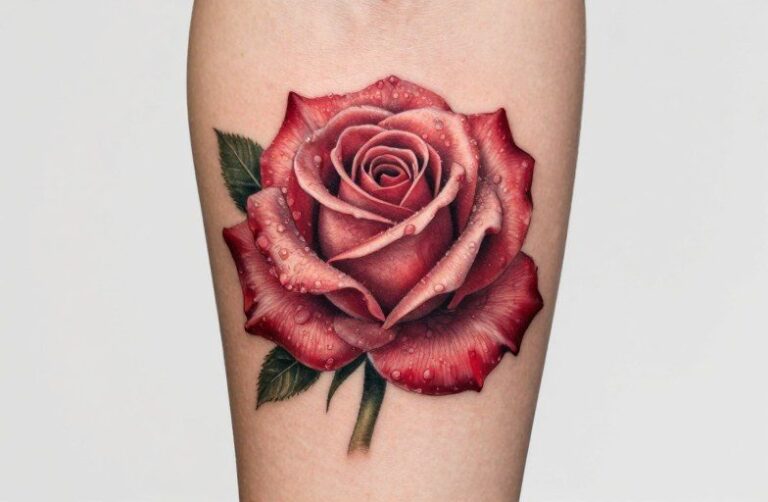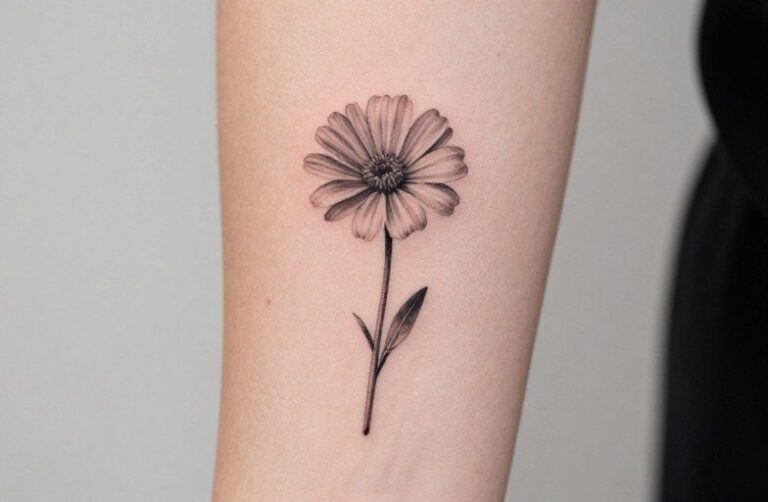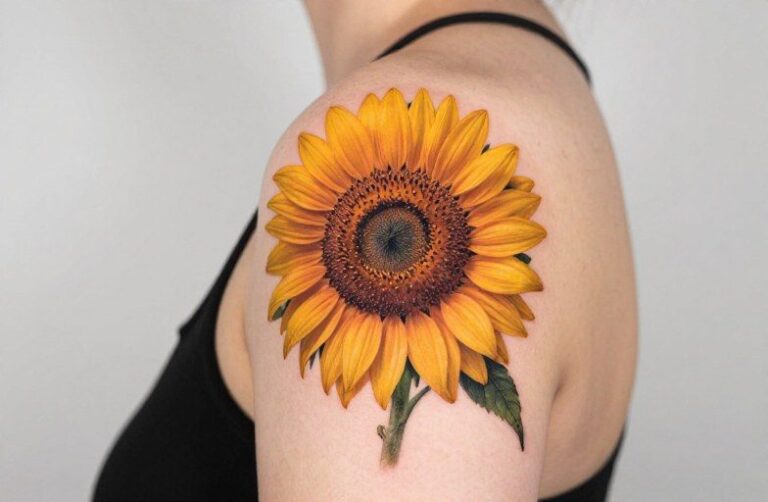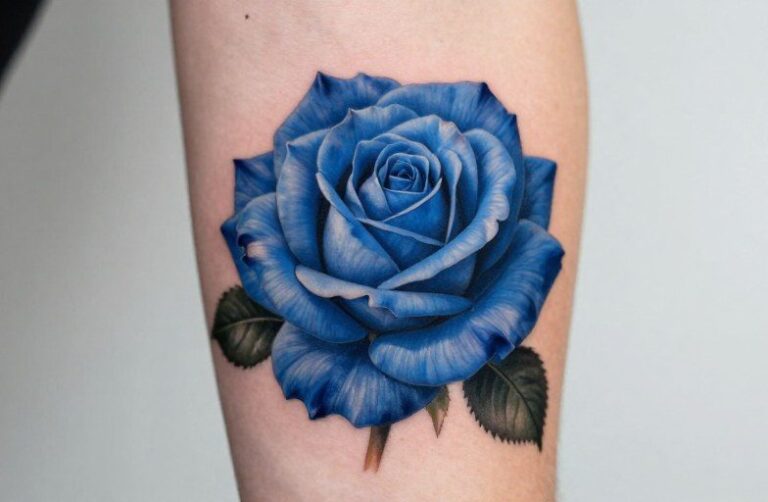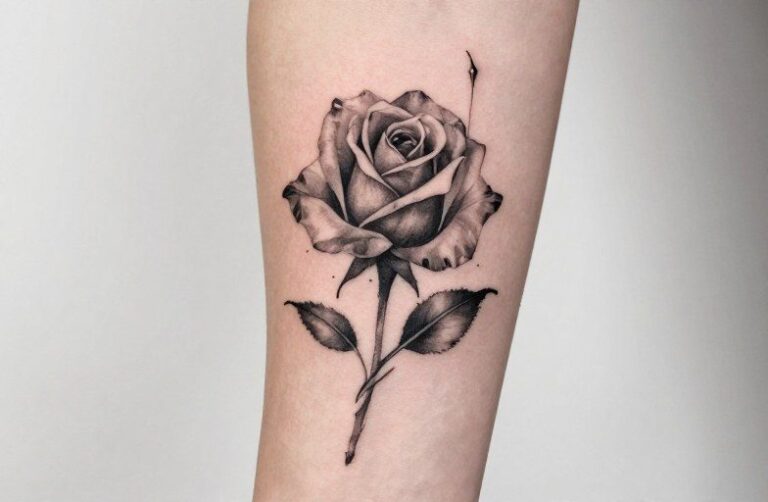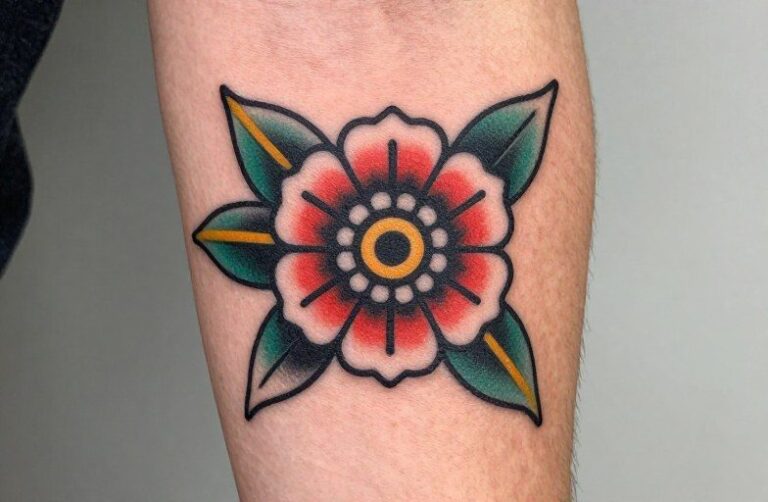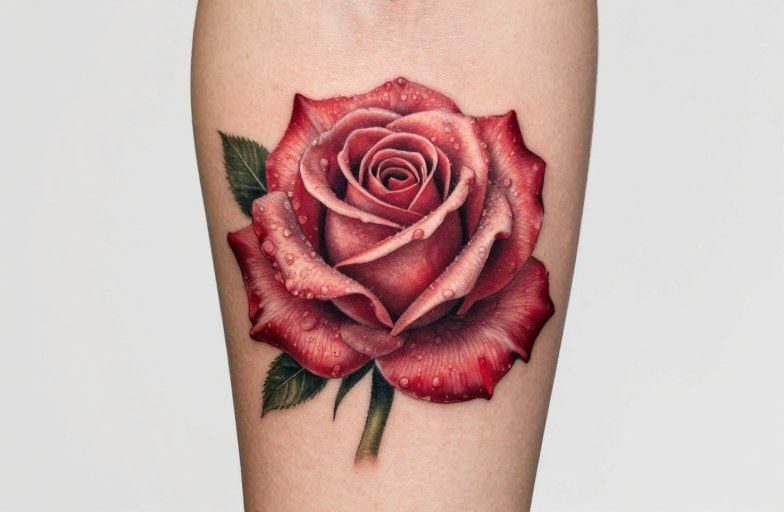
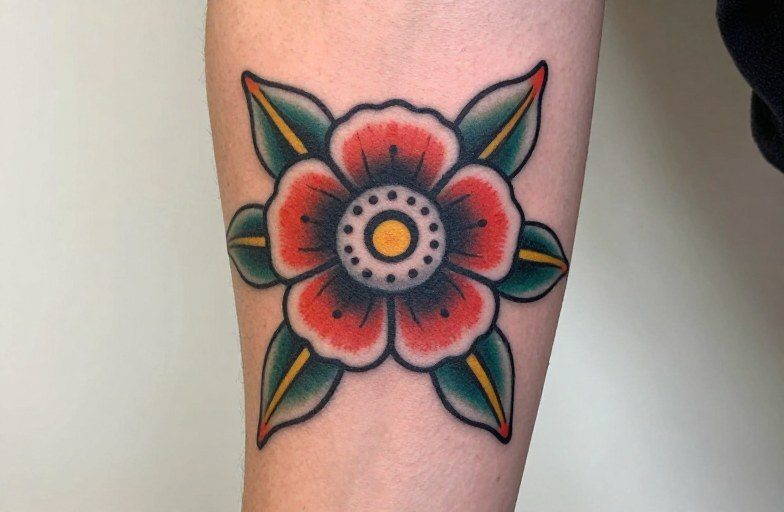
American traditional flower tattoos are built on a specific visual grammar: thick black outlines, saturated but limited color palettes, and flat shading that reads clearly from across a room. The flowers, roses, peonies, chrysanthemums, lotuses, and carnations, are rendered as bold icons rather than botanical illustrations. Petals become geometric wedges. Leaves simplify into teardrop or spade shapes. The goal isn’t realism; it’s immediate recognition and decades of readability.
How It Ages
These florals age better than most tattoo styles, and that’s by design. The heavy linework acts as a fence holding pigment in place. Without that barrier, fine-detail flowers blur into muddy shapes within five to ten years. American traditional’s deliberate restraint, no hair-thin veins, no subtle gradations, means the core image persists.
Color Fading Reality
Red roses stay red longest; it’s the most stable tattoo pigment. Yellows and light greens fade fastest, often muting to a mustard or olive within a decade. Black holds. The smart traditional approach leans on black for structure and uses color as accent rather than foundation. A rose with black leaves and a red bloom will outlast a fully colored piece by years. White highlights? Nearly gone in two to three years on most skin tones. Good artists now skip them or replace with negative space.
Line Spread and Skin Type
- Thicker lines (8-14 needle groupings) spread less than fine lines under the skin
- Oily or sun-damaged skin accelerates blur; the bold traditional style compensates
- Hand or foot placement sees faster breakdown due to cell turnover and friction
- Touch-ups are normal; plan for one at 10-15 years, sooner on high-wear spots
Best Placements
Traditional flower designs adapt to body contours because their shapes are already simplified. A rose mandala on a knee cap, a peony on a shoulder cap, a chrysanthemum on a chest plate, these placements work because the design doesn’t fight the body’s curves.
Classic Spots That Work
Outer upper arms and thighs carry these florals beautifully. The flat muscle planes let the design sit without distortion. Forearms work too, though frequent sun exposure demands sunscreen discipline. The sternum and ribs suit larger compositions, think a bouquet with banner and dagger, but the bony terrain requires an artist comfortable stretching stencil over uneven surfaces.
Placement to Avoid or Reconsider
Fingers and sides of hands: the detail compresses, lines blow out, and the flower becomes unrecognizable within a few years. Inner bicep: less sun damage but more stretch with weight fluctuation, and the soft skin doesn’t hold line as crisply. Neck and face: technically possible, but the traditional flower’s boldness becomes aggressive at that scale and visibility.
Origins & History
The floral motifs in American traditional tattooing carry layered lineage. Sailor Jerry Collins, working in Honolulu from the 1940s through 1970s, popularized many of the rose-and-dagger, rose-and-skull combinations still copied today. His roses derived from earlier European flash, often linked to Victorian illustration and circus banner painting, filtered through a military and maritime clientele.
Japanese tattooing influenced the chrysanthemum’s presence in American traditional work. Some trace it to the brief but intense cultural exchange when sailors visited Yokohama and Nagasaki ports. The chrysanthemum’s association with longevity and death in Japanese culture got stripped away; what remained was the visual punch of radiating petals, perfect for bold rendering.
Peonies entered the mix later, commonly associated with the 1980s and 1990s revival of traditional tattooing, when artists began deliberately expanding the motif library beyond the classic dozen designs. Carnations and lotuses followed, each carrying borrowed symbolic weight that mattered less than their graphic suitability.
Cost & Sessions
Pricing varies by region and artist reputation, but American traditional flower work has some predictable parameters. A palm-sized rose with black and red runs $150-$400 in most US cities. A full forearm bouquet with multiple flowers, leaves, and perhaps a banner or snake companion piece hits $800-$1,500. Chest pieces and full sleeves scale from there.
Session Structure
Single-needle specialists might stretch a small flower across multiple sessions for saturation. Most traditional artists work faster, laying in bold lines and flat color in one sitting. A straightforward rose on the upper arm: two to three hours, done. Larger compositions get outlined in one session, colored in another, less about drama, more about skin trauma management and the artist’s scheduling.
- Tip: flat color heals more predictably than heavy black fill; don’t rush the second pass
- Touch-ups within six months are usually included in original pricing
- Travel for the right artist; this style demands specific technical habits
Choosing the Right Artist
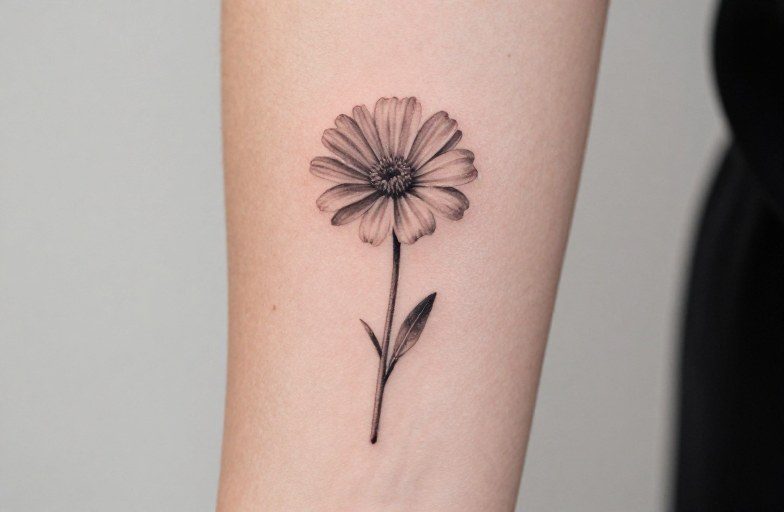
Not every tattooer who “does traditional” actually understands its constraints. Look for portfolios with consistent line weight, not variable. The petals should have confident, single-pass outlines, not sketchy or overworked. Color should sit flat and even, not blotchy or over-saturated to the point of bleeding.
Red Flags in Portfolios
Wobbly petal edges where the line weight changes mid-curve. Grayish shading where black should be solid. Flowers that look like they were drawn from photograph reference rather than built from traditional flash vocabulary. An artist who can’t draw a rose from memory, who needs to look at Google Images, doesn’t have the internalized form language this style requires.
Questions to Ask
- What needle groupings do you prefer for line work? (Should be 7-14, not single needle)
- How do you handle color saturation on darker skin tones? (Competent artists adjust value, not just hue)
- Can you show me a healed photo of a similar piece? (Fresh tattoos lie; healed work reveals truth)
Linework & Technique
The technical backbone of American traditional flowers is specific and unforgiving. Outlines get laid with round shader or round liner groupings, typically 7-14 needles, running at lower voltage than fine-line work. The goal is a consistent, slightly raised line that settles flush after healing. Too shallow and it falls out; too deep and it blows out into a fuzzy channel.
Shading Approach
Traditional flower shading uses “whip shading” or pendulum motion to create gradients that read as flat from distance but have subtle depth up close. Leaves typically get a single dark pass near the stem, fading to nothing at the tip. Petals might have a soft shadow at the base or center, but never the multi-tone modeling of realism. The black is black. The red is red. The green is green. Nuance lives in placement and proportion, not in color complexity.
Color Packing
Solid saturation demands multiple passes at consistent depth. Lazy color packing leaves a speckled, “salt and pepper” healed result that looks aged before its time. Good artists work methodically: small circular motions, stretching the skin taut, wiping frequently to check for missed spots. The traditional palette, Crimson, Golden Yellow, Peacock Blue, Seafoam Green, Ivory Black, gets mixed from a short list. Custom color blending is rare and usually unnecessary.
Final Word
American traditional flower tattoos persist because they solve real problems: they read clearly, they age gracefully, and they carry enough symbolic weight to satisfy without demanding explanation. The rose doesn’t need to mean anything specific to you; its visual power is independent. Choose an artist who respects the style’s constraints rather than one who treats it as a loose aesthetic. The difference between a good traditional flower and a weak one is visible from across the street, and it only becomes more obvious with time.
Frequently Asked Questions
Do American traditional flower tattoos work on dark skin tones?
Absolutely. The key is value contrast, not just color choice. Deep blacks and saturated reds show beautifully. Avoid pale yellows and whites as primary elements; they heal to near-invisibility. A skilled artist adjusts the palette without losing the traditional character.
Can I mix realistic flowers with American traditional style?
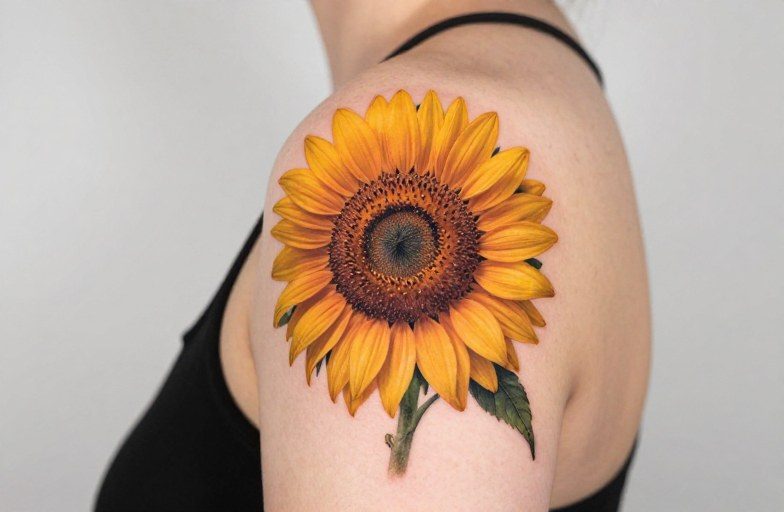
Mixing usually weakens both. Traditional flowers rely on graphic simplification; realism depends on detail and gradation. The hybrid tends to look confused at five years. Commit to one visual language for the piece.
How do I keep the colors from fading fast?
Sunscreen, consistently. UV exposure degrades pigment regardless of quality. Beyond that, moisturized skin holds tattoo clarity longer. Dry, ashy skin makes even fresh work look dull. No special products needed, regular lotion and SPF 30+.
Are traditional flower tattoos more or less painful than other styles?
The style itself doesn’t change pain level, but the technique does. Bold linework requires more passes and firmer pressure than fine-line work. However, sessions are often shorter because the artist works faster. Placement matters far more than style for pain perception.