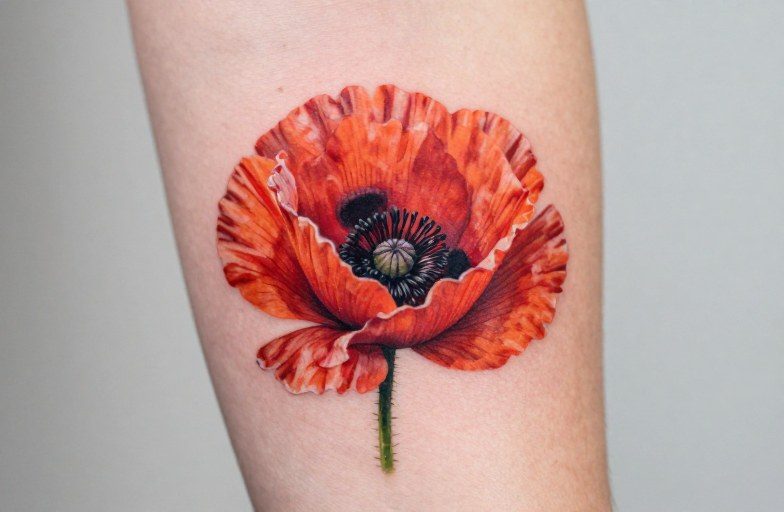
A poppy flower tattoo most commonly signals remembrance, of war dead, of lost loved ones, or of personal pain survived. Beyond memorial, the bloom also carries older associations with sleep, dreams, and the temporary nature of consciousness, rooted in the plant’s actual narcotic properties. The meaning you emphasize depends on color choice, placement, and what you pair it with.
Symbolism & Core Meaning
The poppy operates on two tracks that rarely overlap in the same design. You choose which lane you’re in, or you deliberately collide them.
Remembrance & Memorial
The red poppy as a symbol of war dead solidified after World War I, largely through John McCrae’s poem and the subsequent adoption by veterans’ organizations. In tattoo form, this usually means:
- A single red poppy, often with a name, date, or military insignia
- Clustered blooms suggesting a field (the “Flanders fields” reference)
- Black centers emphasized, sometimes with a subtle cross or dog tag worked into the negative space
The memorial poppy tends toward realism or near-realism. Stylization reads as distancing, which defeats the purpose. Line weight matters here: too fine and the red washes out over time; too bold and it becomes graphic rather than mournful.
Sleep, Dreams & Oblivion
Long before the war association, the poppy meant sleep and death-as-sleep in Greek and Roman contexts. The opium poppy (Papaver somniferum) literally produces unconsciousness. Tattoos drawing on this tradition often use:
- White or pale pink varieties rather than blood red
- Drooping stems, closed buds, or petals falling
- Moon, night sky, or water imagery as companions
This symbolism suits people marking recovery from insomnia, addiction, or trauma, states where “sleep” was either elusive or dangerously excessive. The ambiguity is the point.
History & Cultural Roots
The poppy’s symbolic life spans multiple civilizations, though the connections are often looser than tattoo blogs suggest.
Mediterranean & Near Eastern Origins
In ancient Minoan culture, poppy pods appear in art often linked to goddess worship and ritual use. The Greeks associated the plant with Hypnos (sleep) and Thanatos (death) through the story of Demeter and the nymph Poppy, though this myth itself is a later synthesis, not a fixed ancient text. Sumerian and Egyptian records mention opium poppy cultivation, but primarily as medicine rather than symbol.
Modern Western Adoption
The 1920s-1930s saw organized poppy distribution for veterans’ funds in Britain, Canada, Australia, and eventually the US. The tattoo adaptation followed gradually, accelerating after the Vietnam era when memorial tattoos broadly normalized. Unlike some floral symbols (the lotus, the rose), the poppy’s tattoo history is relatively shallow, perhaps 40-50 years of consistent use rather than centuries.
Mythology & Folklore
Separating actual myth from later invention matters for anyone choosing this symbol seriously.
The Demeter-Poppy connection is genuinely ancient: the goddess of grain supposedly used the plant to soothe her grief over Persephone’s absence. This makes the poppy an unusual dual symbol, both the wound (loss) and the balm (sleep, forgetting). Some trace the “poppy as consolation” motif through medieval European herbals, where it appears as a sedative for physical and emotional pain.
Less solid but commonly associated: the idea that poppies grow from spilled blood. This appears in various European folk traditions, sometimes attached to specific battles rather than universal truth. The WWI connection gave this folk motif a specific, documented anchor it previously lacked.
Asian folklore rarely features the poppy; the lotus, chrysanthemum, and plum blossom dominate instead. A poppy tattoo with Japanese or Chinese stylistic elements (waves, wind bars, specific color flatness) creates a cultural friction worth acknowledging rather than ignoring.
Design Tips & Pairings
The poppy’s physical structure, thin, crumpled petals, a prominent central boss, a hairy stem, creates specific technical challenges and opportunities.
Color Behavior & Aging
Red poppy tattoos are notorious for shifting. The bright vermilion many clients want tends to settle toward magenta or rust within 2-5 years, depending on sun exposure and skin tone. On darker skin, the red may never achieve that initial punch; orange-red or burgundy bases often read better long-term. White poppies virtually disappear on pale skin unless outlined or shaded with gray. Black and gray poppies, while losing the specific flower recognition, actually age more gracefully and allow finer detail in the petal crumpling.
Line versus shading: the poppy’s character lives in the petal texture. Pure linework rarely captures it unless heavily stylized (Art Nouveau approaches, for instance). Most successful poppy tattoos use whip shading or smooth gradients to suggest the papery quality of the petals, with darker values concentrated at the base and the black center.
Companion Elements
- Clocks, pocket watches, dates: Explicitly memorial, can tip into cliché if not personalized
- Skulls: The sleep/death connection made literal; works best with Victorian or neo-traditional styling
- Birds, particularly doves or ravens: Suggests the soul’s departure; ravens add an edge of ambiguity
- Script: Fragile on the thin petals; better on banners or separate adjacent space
- Other flowers: Lavender (also sleep-associated), rosemary (remembrance, completing the Shakespearean trio), or wheat (Demeter, harvest, cycles)
Best Placements
The poppy’s vertical growth habit and relatively narrow profile suit certain locations better than others.
Forearm and calf: The stem runs with the limb’s length; the bloom sits at eye level for easy viewing. These areas handle color well and allow for the detail the flower deserves. The outer forearm offers the best canvas for a single large bloom with visible stem.
Ribcage and side: The curve can follow the body’s line, but the floating rib area is notoriously painful and the skin movement there blurs fine detail over time. Better for bold, simplified designs than delicate realism.
Shoulder cap and upper arm: Traditional for floral work; the rounded surface suits the bloom’s cup shape. Easy to expand into a half-sleeve with additional memorial elements.
Behind the ear and ankle: Trendy but technically punishing. The poppy’s detailed center becomes a blob; the stem must be drastically shortened or curved unnaturally. These spots work for tiny, highly stylized versions only.
Hand and fingers: The memorial poppy specifically appears on hands in some military traditions (the “tattooed poppy” charity movement in the UK). This is statement placement, visible, employment-limiting, and requiring frequent touch-ups as hand ink drops out fast.
Similar & Related Symbols
Choosing between the poppy and alternatives often clarifies what you actually want to say.
The rose dominates memorial tattooing, but carries broader romantic associations that can dilute a specific grief message. The lotus shares the rebirth aspect without the sleep/oblivion or military connections. Forget-me-nots are more literally named for remembrance but lack the poppy’s cultural weight and visual impact. The willow (mourning, flexibility) and cypress (death, eternity) are tree alternatives with similar somber registers but entirely different visual language.
For the sleep/dream aspect, the moon is more universal but less specific; laurel or olive branches suggest peace without the narcotic undertone. The poppy’s particular power is its ability to hold both grief and the desire to escape grief simultaneously, few alternatives manage that tension.
Before You Decide
Consider which poppy you’re actually referencing. The common red field poppy (Papaver rhoeas) is the WWI symbol; the opium poppy (P. somniferum) is the sleep/death/dream plant; the Oriental poppy and Iceland poppy are primarily decorative. Tattoo artists often conflate them visually, but the botanical difference matters if you’re researching or explaining your choice.
Think about timing. Memorial tattoos made immediately after loss sometimes shift in meaning as grief changes; the poppy’s dual nature (remembrance and forgetting) can become uncomfortable if you later want to emphasize enduring presence rather than gentle release. Conversely, the sleep/dream poppy can feel naive or escapist if your circumstances change.
Finally, the poppy’s current cultural visibility, annual remembrance ceremonies, the “California poppy” state identity, opioid crisis associations, means your tattoo will be read against live contexts, not stable historical ones. That’s neither good nor bad, but it’s worth knowing your image will travel through changing meanings rather than resting in fixed symbolism.
Frequently Asked Questions
Does a poppy tattoo always mean someone died?
Not necessarily. While red poppies strongly signal military memorial, white or stylized poppies can emphasize sleep, dreams, or personal rebirth. The meaning depends on color, companions, and your own explanation.
Will a red poppy tattoo stay bright over time?
Red ink is prone to fading and color shift, especially with sun exposure. Expect bright vermilion to settle toward rust or magenta within a few years. Proper aftercare and sunscreen slow but don’t prevent this.
What’s the difference between a poppy and a California poppy tattoo?
California poppies (Eschscholzia californica) are a different species, typically orange-gold, and carry state identity and natural beauty associations rather than the memorial or opium symbolism of true poppies.
Is it disrespectful to get a memorial poppy if I didn’t serve or lose someone in war?
The poppy’s broader use for any lost loved one is widely accepted, but directly copying military insignia or specific regimental imagery without connection can read as appropriation. Stick to the flower itself and personal memorial elements.