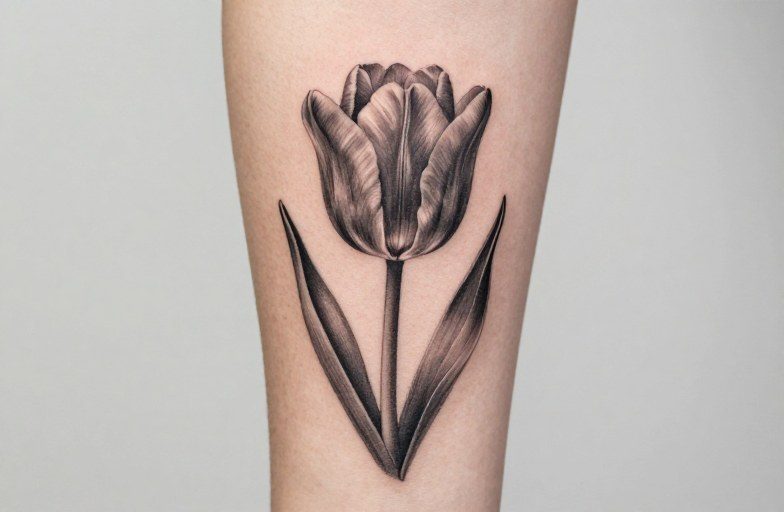
A tulip flower tattoo most commonly signals perfect love, rebirth, and the courage to stand fully in bloom despite a short season. Unlike roses loaded with thorns and centuries of accumulated meaning, tulips carry a quieter, more specific symbolism tied to spring, renewal, and the acceptance of impermanence. The shape itself, cupped petals that open and close with light, lends naturally to body art that ages gracefully when designed with that behavior in mind.
Symbolism & Core Meaning
The tulip’s brief blooming period, typically just one to two weeks in spring, shapes its core symbolism across cultures. This isn’t a flower of eternal, unchanging devotion. It represents love that is intense precisely because it is temporary, and beauty that demands attention now, not someday. That urgency translates well to tattoo form for people marking a specific turning point or a relationship defined by its timing rather than its duration.
Historically, the 17th-century Dutch “tulip mania”, when bulbs reached prices exceeding skilled workers’ annual wages, also grafts associations of desire, speculation, and even folly onto the flower. Some wearers lean into this economic symbolism, marking personal obsessions or the absurdity of value itself.
Single Tulip vs. Bouquet
One tulip alone reads as singular focus: one love, one loss, one moment. A bouquet introduces complexity and relationship. Three tulips traditionally signal the words “I love you” in Victorian floriography. Seven or more can reference the Turkish origin story of the flower’s name, often linked to the word “turban” for the flower’s shape. Placement matters here, a single tulip behind the ear or on the wrist functions as a private symbol; a forearm bouquet invites conversation.
Closed Bud vs. Open Bloom
A tight bud suggests potential, patience, or something withheld. A fully open tulip accepts its own decay. Designs showing the transition, bud to bloom to dropping petals, work particularly well in larger pieces on ribs or thighs where the vertical space accommodates narrative progression. Be specific with your artist about which stage matches your intent; the difference is legible even to casual viewers.
Personal & Modern Meanings
Contemporary wearers often strip away historical layers to land on personal associations. The tulip’s clean silhouette, no thorns, no complex branching, appeals to people seeking floral imagery without the romantic heaviness of roses or the funereal weight of lilies. Minimalist single-line tulips, popular since roughly 2015, function as accessible entry points for first tattoos while still carrying substantive meaning.
- Recovery and sobriety: the spring-after-winter logic resonates with people marking survival
- Immigration and heritage: Dutch, Turkish, and Iranian wearers reference specific national connections
- Queer identity: the tulip’s androgynous shape (neither aggressively masculine nor traditionally feminine in floral coding) appeals across gender expressions
- Professional transition: the brief, intense bloom mirrors career pivots or entrepreneurial leaps
Modern placement trends include the side of the ribcage where the tulip’s natural curve follows the body’s line, and the back of the upper arm where the cupped shape catches light when the wearer moves. These aren’t random choices; they use the body’s geometry to echo the flower’s own.
Color vs Black and Grey
Color choice radically shifts a tulip tattoo’s readable meaning, more so than with many flowers because tulip varieties carry such distinct cultural associations.
Red and Pink
Red tulips declare love openly, less possessive than red roses, more declarative than pink. Deep crimson varieties specifically reference the Turkish legend of star-crossed lovers, though the historical accuracy of that tale is debated. Pink softens the statement into admiration or familial affection, particularly common in mother-daughter matching tattoos.
Yellow and Purple
Yellow once carried negative associations (“sunshine in your smile” but also hopeless love in some European traditions); contemporary wearers largely ignore this, choosing yellow for its visual warmth and its connection to Dutch fields. Purple, historically the most expensive pigment and the most valuable bulb color, signals royalty, ambition, or material success. Black tulips, actually very deep purple, represent the unattainable or the achievement of something long pursued.
Black and Grey Realism
Without color, the tulip’s form must carry all meaning. This works because the silhouette is so distinctive: no other flower shares that simple cup-and-stem geometry. Black and grey ages exceptionally well on tulips compared to more complex flowers; the smooth petal gradients hold their value, and the absence of fine color detail means less blur over time. For large-scale pieces, greywash background with solid black stems creates depth without the maintenance burden of saturated color.
Religious & Spiritual Angles
Islamic art and architecture, particularly from Ottoman-era Turkey, incorporated tulip motifs extensively. The flower appears in mosque tilework, textile borders, and illuminated manuscripts. For Muslim wearers, this connection can signal cultural heritage or spiritual practice without the figurative representation issues that sometimes complicate other floral choices. The tulip’s name in Persian, “lale,” shares letters with “Allah” in Arabic script, a visual pun exploited in calligraphic art though not typically in tattoo form.
Christian contexts are thinner but present. Easter-season blooming aligns tulips with resurrection imagery in European church decoration. Some wearers explicitly connect this to rebirth narratives, though the tulip lacks the formal sacramental status of lilies or roses. Buddhist-adjacent interpretations focus on impermanence, the bloom’s brief life as meditation on non-attachment, though this is more Western Buddhist practice than traditional iconography.
Mythology & Folklore
The tulip’s origin stories are numerous and geographically scattered, which means no single narrative dominates tattoo meaning. Persian folklore often links the flower to the tragic love of Farhad and Shirin, though versions vary significantly and some scholars question whether this association predates modern retelling. Dutch tales of tulips springing from lovers’ blood share DNA with broader European flower-origin myths rather than unique standing.
More useful for tattoo wearers: the practical folklore of tulip growing. The bulbs require cold dormancy to bloom, weeks of darkness and near-freezing temperatures before spring growth. This biological reality supplies metaphor for people who’ve endured difficult periods as prerequisite to their current flourishing. It’s concrete, verifiable, and personally applicable without requiring belief in any specific myth.
The Tulip in Ottoman Symbolism
Ottoman court culture, particularly the “Tulip Period” (1718, 1730), raised the flower to political and aesthetic prominence. Tulip-shaped vessels, architectural elements, and textile patterns from this era inform contemporary Turkish and Turkish-diaspora tattoo choices. The specific visual vocabulary, stylized rather than botanical, differs from Western naturalistic tulip tattoos and carries distinct cultural weight.
Similar & Related Symbols
Understanding what a tulip is not helps clarify what it is. Roses carry thorns and accumulated romantic cliché; tulips offer cleaner lines and less baggage. Lilies dominate funeral contexts and religious iconography; tulips escape that gravity. Cherry blossoms share the impermanence theme but anchor specifically to Japanese cultural contexts and spring’s beginning rather than its full arrival.
Poppies, another spring bloomer, carry opium and wartime remembrance associations that tulips largely avoid. Magnolias predate bees in evolutionary history and carry ancient, almost geological weight; tulips feel more human-scale, more recent, more cultivated. For people choosing between these flowers, the tulip typically wins on specificity of personal timing and cleaner aging in tattoo form.
Pairings work well: tulips with daffodils for full-spring narratives, with snowdrops for survival-through-winter stories, with wheat for agricultural heritage. Avoid pairing with roses unless you intend explicit contrast; the visual and symbolic competition rarely resolves cleanly.
Before You Decide
Consider the tulip’s structural reality in skin. The cup shape, viewed from above, collapses to a rough circle; from the side, it reads clearly as flower but loses interior petal detail. Discuss viewing angles with your artist. The stem’s curve offers natural flow for arm and leg placements but requires space, compressed stems look like broken lines within five years.
Line weight matters enormously. Fine-line tulips trend heavily and photograph beautifully fresh, but the petal edges blur faster than bolder work. If you want longevity without heavy black, ask for “sculpted grey”, varying densities that create form without relying on hairline precision. Budget for touch-ups; tulips show age honestly, which suits their symbolism but may not suit your patience.
Finally, the seasonal association is real in viewer perception even if you intend permanent meaning. A tulip tattoo reads as spring, as beginning, as temporary intensity. Make sure that matches your story, because the flower’s form will keep saying it long after you’ve stopped actively hearing it.
Frequently Asked Questions
Do tulip tattoos age worse than other flower tattoos because of the thin petals?
They age differently, not necessarily worse. The simple cup shape stays readable even as fine detail blurs, which is an advantage over complex flowers like peonies. The risk is in ultra-fine line work that loses its edge; slightly bolder outlines or greywash shading extend clarity significantly.
What’s the best placement for a tulip tattoo if I want it visible but professional?
The upper arm just below the shoulder, the side of the ribcage, or the ankle bone work well. These read as deliberate placement rather than impulsive choice, and cover easily with standard business attire. Avoid the hand or neck for first tattoos in most professional environments.
Can a tulip tattoo work as a cover-up for an older piece?
The solid cup shape and dense color potential in red or purple varieties can cover smaller, darker existing tattoos. The stem offers vertical extension to disguise rectangular old work. Large black areas from previous tattoos limit color options but greyscale tulips handle this better than many subjects.
Is there a difference in meaning between a realistic tulip and a geometric or abstract one?
Realistic tulips lean into the flower’s traditional associations, love, spring, impermanence. Geometric or abstract versions shift toward personal symbolism or aesthetic preference, sometimes severing the botanical connection entirely. The further from recognizable form, the more the meaning depends on your stated intent rather than shared cultural reading.