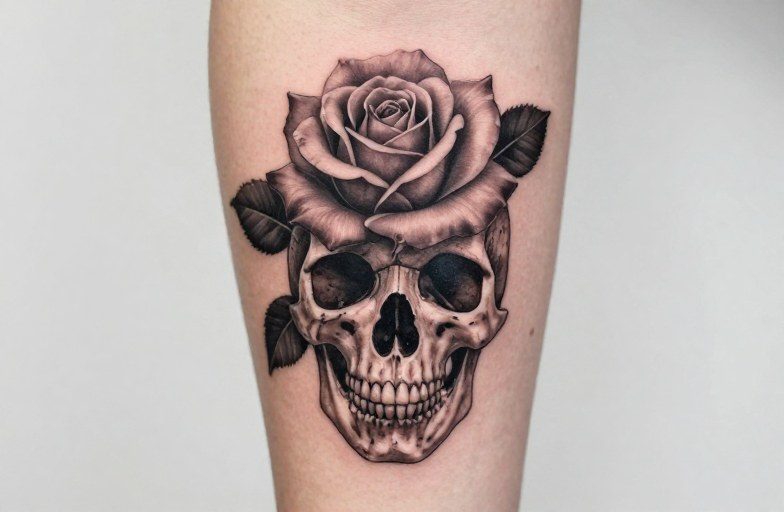
The rose and skull tattoo means the tension between life and death, beauty and decay. It is a visual memento mori: the skull insists that everything ends, while the rose insists that beauty happens anyway. Together, they refuse to choose between optimism and fatalism. The design rewards close attention because every choice, how the rose wraps the skull, whether color enters, where it sits on the body, changes that balance.
Symbolism & Core Meaning
The Memento Mori Tradition
This pairing descends from a long European tradition of pairing symbols of vitality with reminders of death. Skulls in still-life paintings, hourglasses with blooming flowers, the danse macabre, artists kept mortality visible so it would not be ignored. The tattoo continues that function privately. Unlike a painting hung in a home, this one travels with the body it will eventually outlast. Some trace the specific rose-and-skull combination to Mexican folk art and its Día de los Muertos imagery, where marigolds and decorative calaveras celebrate the dead rather than mourning them. The tattoo borrows from both registers: European solemnity and Latin American celebration.
What the Rose Adds
A skull alone can read as aggression, warning, or nihilism. The rose complicates that. It introduces softness, growth, sensuality, the biological fact of reproduction. In the design, the rose might crown the skull, emerge from an eye socket, or wrap the jaw like a vine. Each placement shifts meaning. A rose growing from the cranium suggests life persisting after thought ends. A rose held between teeth implies defiance, beauty weaponized. A wilting rose against clean bone admits that both elements are temporary. The skull does not defeat the rose, nor the rose the skull. They argue and coexist.
Best Placements
High-Visibility vs. Concealed
The forearm and calf carry this design well because they offer enough flat surface for detail without the distortion of joints. The skull’s symmetry reads clearly there. The upper arm, especially the outer bicep, suits a larger composition where the rose can cascade below the skull. Chest pieces allow the sternum to serve as a central axis, skull at center, roses flanking, classic, balanced, technically demanding because of the bone proximity and pain level.
Smaller versions work on the side of the hand, the throat, or behind the ear, but these demand simplification. Fine lines blur faster on hands and fingers. A throat placement commits to visibility permanently; it suits people who have already accepted that this symbolism defines them publicly. The ribcage and stomach offer space but suffer more stretching and weight fluctuation, which can distort circular elements like the skull’s eye sockets over years.
Flow and Body Geometry
Skulls are front-facing and symmetrical; roses are organic and asymmetrical. A good placement exploits that tension. The skull anchors the composition, the rose provides movement. On a rounded surface like a shoulder, the skull sits center with petals wrapping toward the collarbone or deltoid curve. On a flat plane like the shin, the rose might trail below the skull toward the ankle, using the leg’s length.
Design Tips & Pairings
Line Weight and Contrast
Skulls need crisp edges to read as bone. Roses need softer gradation to read as petals. A common mistake is treating both with the same line weight, which flattens the image. Strong, consistent outlines on the skull, especially the jawline, cheekbones, and nasal cavity, preserve its structure as the tattoo ages. The rose benefits from varied line weight: heavier where stems meet the skull, lighter at petal edges, with smooth shading transitions in between.
Pairing elements that complement this core image: pocket watches or hourglasses reinforce time’s passage; snakes add danger and renewal; daggers introduce betrayal or protection. Butterflies, often linked to transformation, can read as too literal when paired with the skull’s obvious mortality. Candles, books, or playing cards extend the vanitas tradition without diluting it.
Background Treatments
Smoke, filigree, or ornamental frames help separate the skull from skin tone, especially on darker complexions where greywash alone might not provide enough contrast. Solid black backgrounds behind a white-highlighted skull create dramatic legibility but require significant skin real estate. Negative space, letting the skin itself serve as the skull’s highlight, ages better than white ink, which yellows or disappears.
Common Variations & Styles
Traditional American
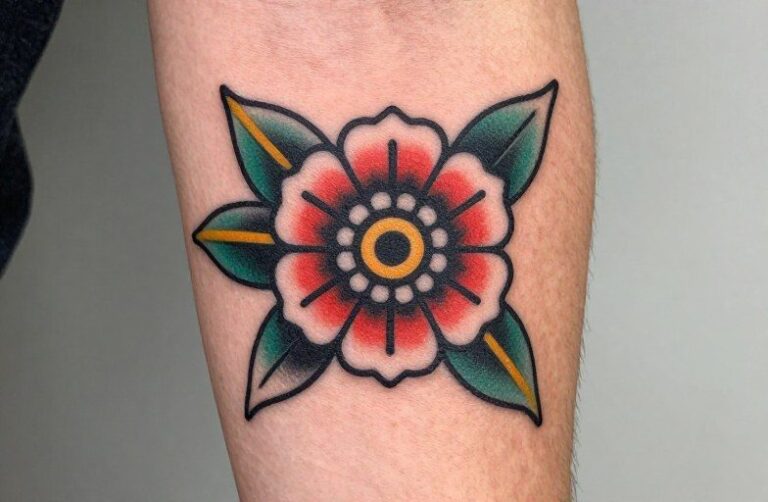
Bold black outlines, limited color palette, the skull simplified to graphic essentials. Roses are stylized, not botanical studies. This style ages exceptionally well because the heavy lines hold. The mood is more celebratory than mournful, closer to Sailor Jerry’s optimism than to European vanitas gloom.
Realism and Neo-Traditional
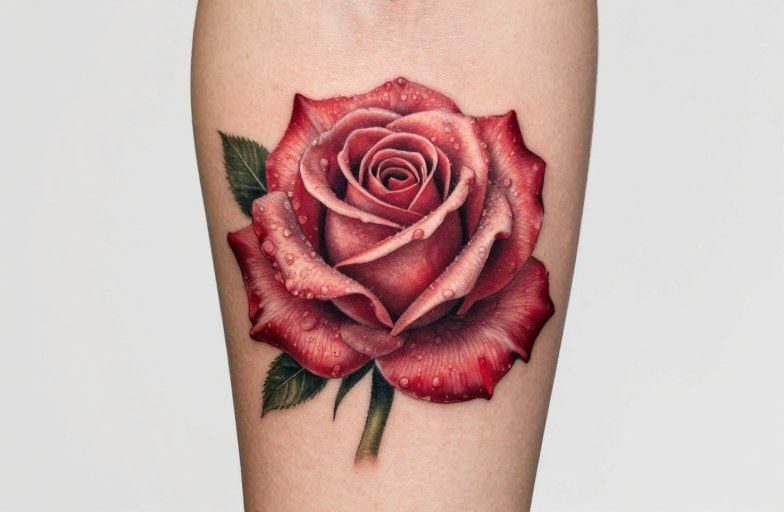
Photographic skulls with anatomical accuracy, roses rendered petal-by-petal with color saturation that mimics actual flowers. These demand large scale and skilled execution. The realism approach risks becoming too literal, an illustration rather than a symbol. Neo-traditional splits the difference: the skull’s structure remains accurate, but colors intensify beyond nature, and decorative elements like gems or ornamental patterns enter the composition.
Other viable approaches include blackwork, where the skull is built from dense pattern rather than greywash; Japanese-inspired, with the skull integrated into a larger sleeve narrative; and minimalist, where a single continuous line forms both elements, a technical showpiece that sacrifices longevity for conceptual elegance.
Color vs Black and Grey
How Pigment Behaves Over Time
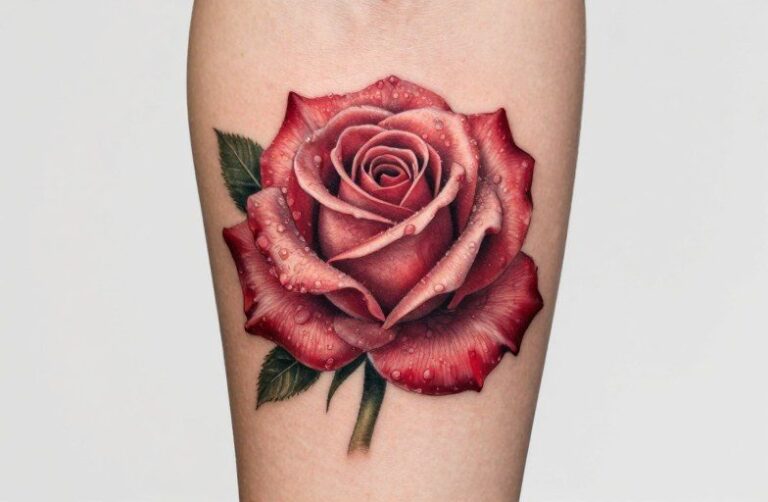
Red roses in color tattooing typically use a combination of warm reds, magentas, and dark burgundy for depth. Red fades toward orange or pink depending on the specific pigment and sun exposure. Cooler reds last longer; orange-based reds shift faster. The skull in a color piece often incorporates warm browns, ivory highlights, and blue-grey shadows to avoid a flat grey appearance.
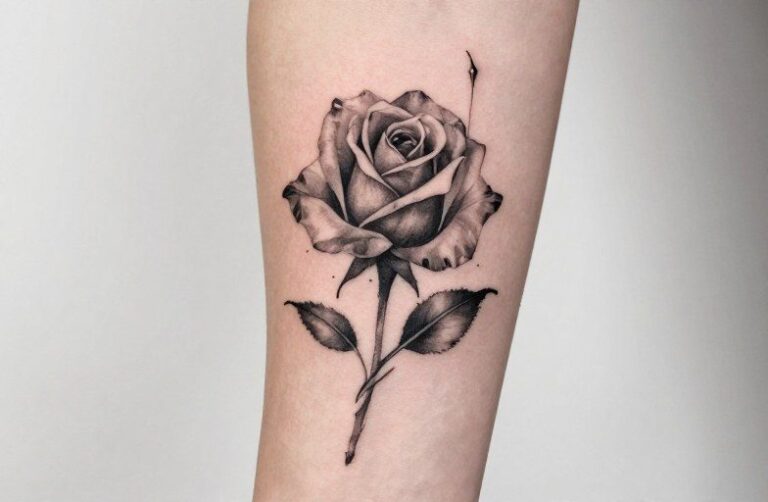
Black and grey relies on dilution technique: pure black for the deepest shadows, progressively lighter washes for mid-tones, skin tone for highlights. This ages with more predictability than color. The rose in black and grey reads as delicate, sometimes more melancholy. The skull gains gravitas without competing hues. On darker skin, black and grey with stronger contrast, darker blacks, more deliberate negative space, prevents the image from muddying as it settles.
Skin Tone Considerations
Color saturation shows most vividly on pale, untanned skin. On medium to deep skin tones, color requires more opaque packing and may need touch-ups sooner. Black and grey adapts across skin tones but demands that the artist understand how melanin interacts with greywash, heavier black, less mid-tone reliance, clearer separation between values.
Who Chooses This Tattoo
Personal Contexts
People arrive at this image after loss, after illness, after periods of risk that clarified what matters. Others choose it younger, as a declaration of philosophy rather than experience. The design accommodates both. It does not require a specific trauma; it functions as a general orientation toward life. Some wear it as a warning to themselves against vanity or complacency. Others as a refusal to pretend death is not real.
The tattoo crosses gender lines without modification. Men and women receive it in roughly equal numbers, though stylistic preferences sometimes diverge, more ornamental, flowing compositions among women in some shops, more aggressive, graphic treatments among men, though these are tendencies, not rules.
Professional and Social Visibility
Because the skull carries aggressive connotations in some contexts, placement affects employability. A hand or throat skull limits certain careers. A shoulder or upper arm skull, easily covered, does not. The rose softens the image but does not neutralize it. The wearer should understand that this pairing reads as serious, sometimes dark, always deliberate.
Final Word
The rose and skull tattoo endures because it addresses something permanent: the fact that consciousness of death shapes how we live. It is not a fashion choice. The best versions respect that weight through technical precision and thoughtful composition. The skull must look like bone, the rose like something that grew and will wilt. Between those two truths, the tattoo does its work, quietly, on the skin, for the decades until the image outlasts the hand that wore it or the hand fades first. Either outcome proves the point.
Frequently Asked Questions
Does a rose and skull tattoo always mean death or danger?
Not primarily. The skull acknowledges mortality, but the rose insists on beauty and life happening alongside it. Most wearers intend balance, not threat.
How well does this design age compared to simpler tattoos?
It ages according to the skill of execution. Heavy black outlines on the skull hold; fine detail in petals may soften. Larger scale with clear value separation ages better than small, intricate versions.
Can the rose be a different flower, or does it have to be a rose?
Roses are traditional because of their layered symbolism, love, secrecy, the briefness of bloom. Other flowers work but shift meaning: marigolds for the dead, lilies for purity, poppies for sleep and war.
Is this tattoo culturally appropriative if I’m not Mexican?
The European memento mori tradition is broadly available. Specific Day of the Dead styling, ornate patterns, marigold colors, sugar-skull decorative conventions, belongs to Mexican cultural practice and should be approached with respect, research, and ideally a Mexican artist’s guidance.