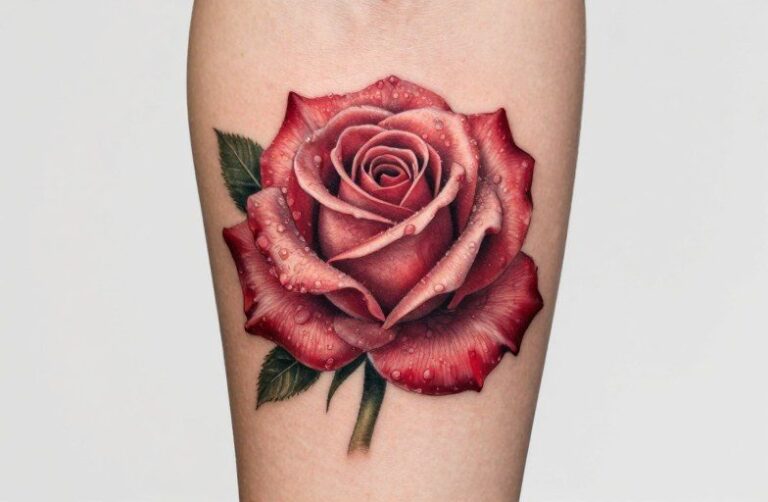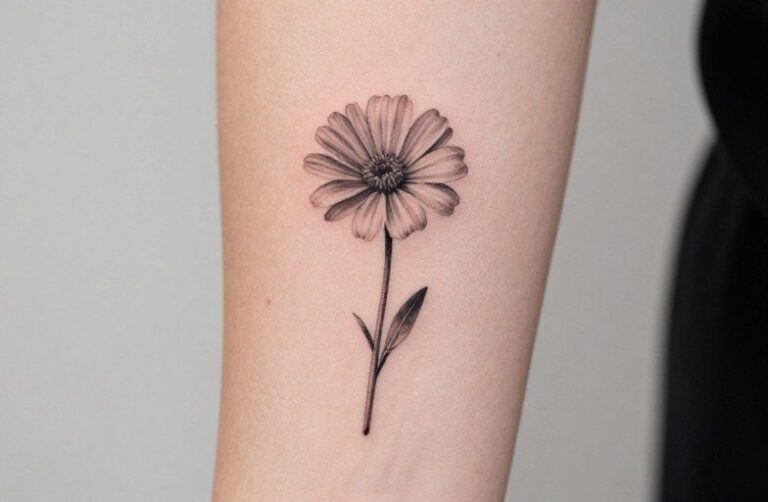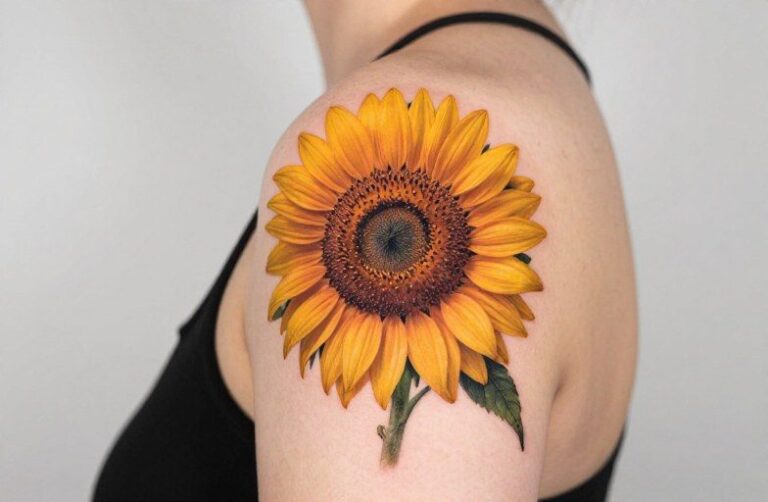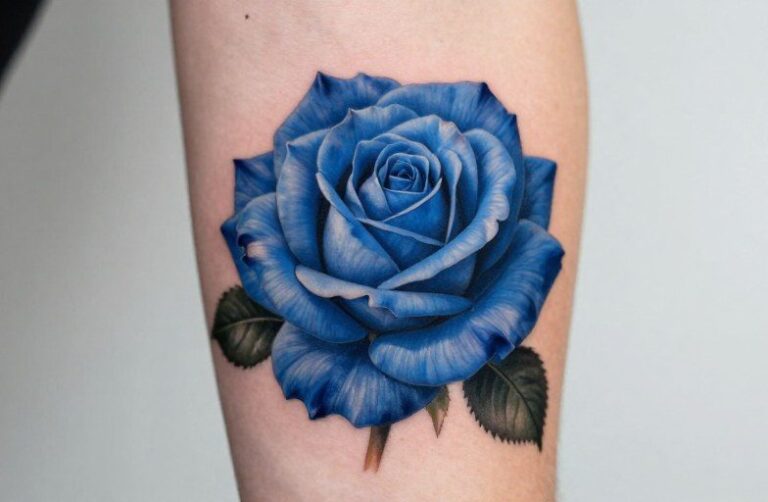
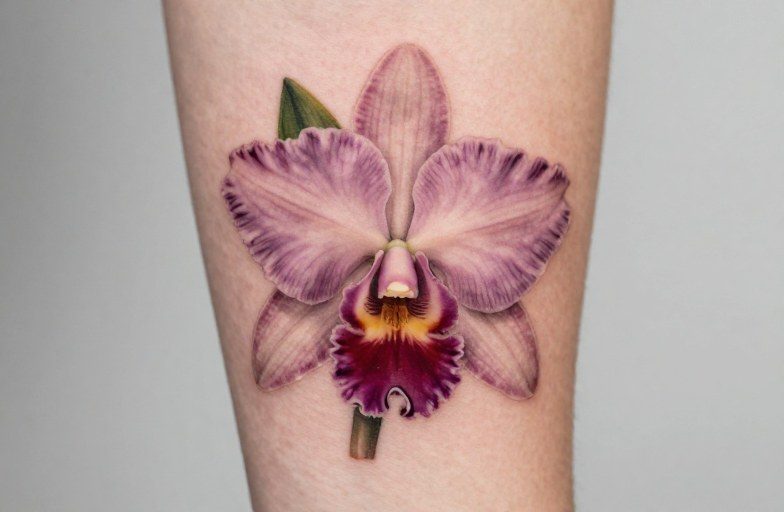
The cattleya orchid tattoo most commonly symbolizes refined beauty, strength through adversity, and a connection to vintage elegance. Unlike generic flower tattoos, it carries specific cultural weight from its mid-20th century heyday as the premier corsage orchid for proms and debutante balls, plus its botanical reputation as a hardy epiphyte that thrives clinging to trees rather than rooted in soil. That tension, delicate appearance, rugged survival, gives this design its emotional range.
Design Tips & Pairings
Cattleyas demand a certain scale to read correctly. The bloom’s signature ruffled lip and broad, overlapping petals collapse into muddy shapes below three inches. For line work, the outer petal edges need confident, unbroken strokes; wobbling here kills the flower’s architecture. The central column, where stamen and pistil fuse, offers a focal point for detail: stippled texture, tiny white ink highlights, or a small contrasting color drop.
Complementary Elements
- Art Deco frames or geometric borders reference the cattleya’s 1940s-50s glamour era without needing literal vintage imagery
- Moths or butterflies create natural pairing logic, since both pollinate orchids in the wild
- Daggers, compasses, or hourglasses juxtapose the flower’s softness with harder symbolism; the contrast works best when both elements share similar visual weight
- Negative-space filigree around the bloom lets the petals breathe while filling background space
Line Weight and Shading Strategy
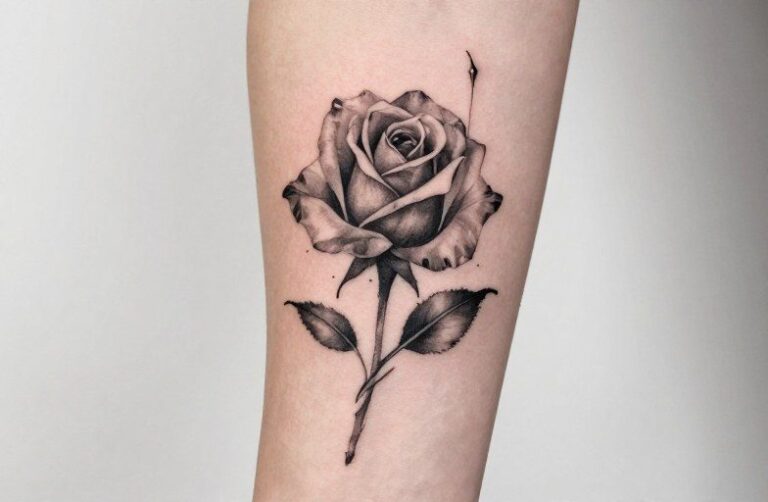
Soft greywash behind the petals creates depth without competing for attention. The lip, the modified petal that serves as a landing platform for pollinators, traditionally carries the boldest color or darkest value in the composition. Some artists build the entire piece around a hyper-saturated lip against muted sepals, which mirrors how actual cattleyas draw pollinators. For black and grey, concentrate darkest tones at the column base and let edges fade to skin tone; this prevents the bloom from looking like a flat decal.
Best Placements
The cattleya’s natural silhouette, one or two large blooms on a slender stem, suits vertical body lines exceptionally well. Rib panels running from hip to underarm follow the stem’s growth direction and give the design room to scale properly. Outer forearms work for single blooms viewed straight-on, though the cylindrical surface distorts the petal spread slightly; a skilled artist compensates by foreshortening the lower petals.
Scaling for Body Curves
Shoulder caps and outer thighs handle the flower’s full spread without warping. Sternum placements center the column beautifully but require the stem to split or curve awkwardly, many designs omit the stem entirely here, floating the bloom between collarbones. Behind the ear, a miniaturized cattleya reads as a clever botanical choice rather than generic flower; the shape’s distinctiveness survives even at one inch if the lip detail holds.
How Aging Affects Placement Choice
The ruffled lip edges blur faster on high-friction spots: inner wrists, finger sides, anywhere that rubs against desk edges or clothing seams. The broad upper petals age more gracefully since their simpler curves tolerate slight spread. For longevity, prioritize locations with stable skin and minimal sun exposure, or commit to touch-up schedules. Color saturation in the lip fades predictably; plan for that by starting slightly bolder than your target tone.
Personal & Modern Meanings
Beyond the vintage glamour association, people gravitate toward cattleyas for specific personal narratives. The orchid family includes species that survive years between rainfalls, storing moisture in pseudobulbs, this biological fact translates into tattoo meaning for those who’ve endured lean periods or emotional drought. The cattleya specifically, among orchids, was bred into hundreds of hybrids during the Victorian orchid mania, so it also carries connotations of human intervention and cultivation: something made more beautiful through deliberate effort.
Contemporary Symbolic Shifts
- Gender transition markers: the cattleya’s labile, showy bloom and historically feminine associations get reclaimed or subverted in trans and non-binary tattoo narratives
- Career milestones in competitive fields (law, finance, medicine) where the flower’s “luxury” signaling communicates arrival or aspiration without literal status symbols
- Recovery from creative blocks, referencing the orchid’s irregular blooming cycle, sometimes dormant for years, then explosive color
Similar & Related Symbols
Other orchid genera carry overlapping but distinct symbolism. Phalaenopsis (moth orchids) dominate supermarket shelves and read as accessible, domestic, slightly generic in tattoo form, fine for beauty, lacking the cattleya’s specific vintage weight. Dendrobiums cluster along stems in a way that suits family or timeline narratives better than the cattleya’s solitary statement blooms. Lady slippers, native to North American woodlands, carry regional identity and conservation subtext.
Non-Orchid Floral Comparisons
Peonies share the cattleya’s lush, layered petal structure but land softer and more romantic. Chrysanthemums offer similar complexity with cultural specificity (Japanese imperial association, European funeral flower) that the cattleya avoids. For someone drawn to the cattleya’s shape but wanting stronger mourning symbolism, the calla lily provides an elegant alternative with clearer death/remembrance coding.
Mythology & Folklore
The cattleya genus itself, named for William Cattley, a British horticulturalist who first flowered the species in 1818, lacks ancient mythological pedigree. Its symbolic weight accumulated through social history rather than divine narrative. The broader orchid family, however, appears in various traditions. In Confucian texts, orchids (lan) represented virtuous scholars in seclusion, their fragrance subtle rather than demanding. Greek sources sometimes linked orchids to fertility through the root’s resemblance to testicles (orkhis in Greek), though this association rarely attaches to the epiphytic cattleya specifically.
20th Century Cultural Layer
The cattleya’s modern meaning crystallized during the 1940s-1960s when it became the standard prom corsage orchid in American culture. This isn’t mythology in the classical sense, but it functions similarly: a shared cultural memory of rite-of-passage elegance. Tattoo wearers sometimes reference this explicitly (vintage prom photography, corsage ribbon styling) or let the flower itself trigger recognition in viewers of a certain generation. The 1970s decline of cattleya corsages, replaced by cheaper, longer-lasting dendrobiums and eventually wrist corsages of mixed flowers, actually sharpened its nostalgic specificity.
Color vs Black and Grey
Color cattleyas offer spectacular range: the lip alone runs from deep magenta through sunset orange to pale yellow with spotted patterning. Natural cattleya colors trend toward purple, lavender, and white with contrasting lips; the electric blues and greens seen in some tattoos require either heavy artistic interpretation or reference to hybrid cultivars specifically bred for those tones.
Color Realism Challenges
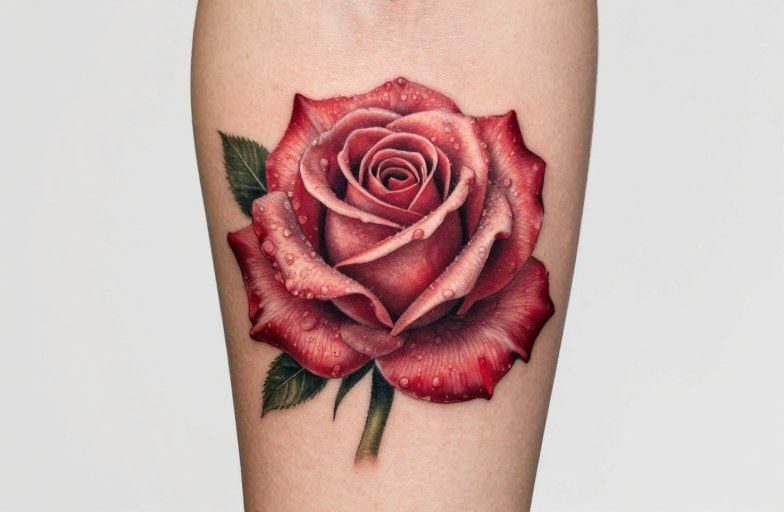
White ink on fair skin matures to a subtle raised texture rather than visible pigment; plan for this by using light grey or pale yellow to suggest white areas. Saturated purples and magentas hold better than pastels, which fade toward indistinguishable grey within five to seven years. The spotted or striped patterning on many cattleya lips demands precise dotwork or whip shading that tests an artist’s color packing consistency.
Black and Grey Interpretation
Stripped of color, the cattleya becomes a study in form: the ruffled lip’s edge reads as organic texture, the column as architectural focal point. Successful black and grey versions often push contrast harder than color equivalents, since they can’t rely on hue separation to define petal layers. Some artists introduce limited red or single-drop color in the lip alone, a technique that references both the flower’s natural patterning and traditional Japanese hikae-e color placement.
The Bottom Line
A cattleya tattoo works best when its specific history, botanical hardiness, mid-century glamour, unmistakable silhouette, aligns with your own story rather than defaulting to generic “beauty.” The design rewards scale and skilled color or tonal handling; rushed or miniaturized, it becomes unidentifiable orchid soup. Choose an artist who shows clean petal edges and confident lip detailing in their floral portfolio, and place it where the stem can follow your body’s natural lines without fighting them. Whether the meaning you attach is resilience, cultivated elegance, or personal transformation, the cattleya’s form gives you enough visual substance to carry that weight for decades.
Frequently Asked Questions
Do cattleya tattoos work for men or are they too feminine?
The vintage glamour association reads feminine to some, but scale, pairing elements, and placement shift this easily. Forearm cattleyas with geometric frames or black and grey execution carry neutral weight. The flower’s botanical structure, bold, architectural, asymmetrical, has masculine coding available if you want it.
How much detail survives when a cattleya tattoo ages?
The central column and lip outline hold longest since they’re darkest and largest. Fine spotting on the lip and thin petal edge lines blur first. Plan for this by building your design around the big readable shapes; the detail is bonus that will soften, not foundation that will collapse.
What’s the difference between a cattleya and a generic orchid tattoo?
Generic orchid tattoos often simplify to a symmetrical, moth-like shape. Cattleyas specifically show a prominent ruffled lip below the column, broader petals with visible veining, and usually a thicker, fleshier stem. If your artist can’t identify these elements, you’re getting a generic flower with orchid-ish coloring.
Can a cattleya cover up an older tattoo?
The bloom’s broad, relatively solid petal areas can mask small dark tattoos underneath, but the ruffled edges and negative space between petals won’t hide much. For cover-ups, artists often use the cattleya’s dense central lip and darker petal bases strategically while extending the design into new skin for lighter areas.