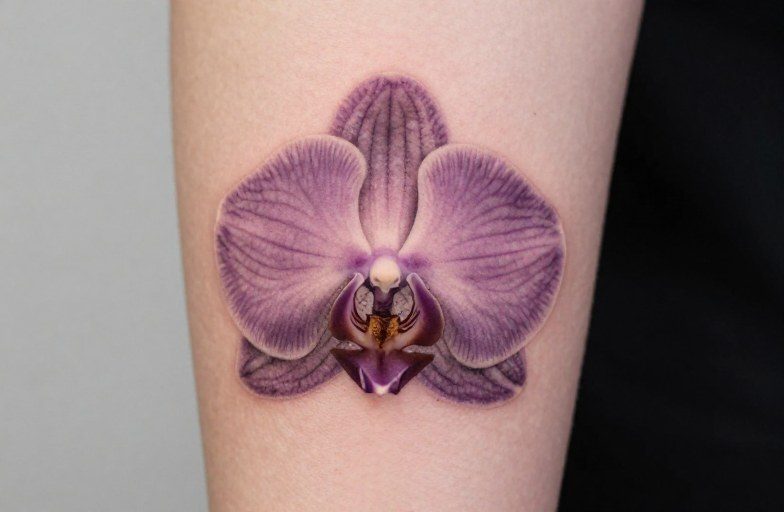
An orchid tattoo most commonly signals rare beauty, refined sensuality, and the kind of strength that doesn’t announce itself. People choose it to mark survival through hardship, celebrate feminine power in its many forms, or simply honor a flower that refuses to grow easily. The meaning tightens or loosens depending on species, color, placement, and what you pair it with.
Personal & Modern Meanings
Today, orchid tattoos function as personal emblems more than coded messages. The flower’s actual biology supports this: orchids grow slowly, demand specific conditions, and can lie dormant for years before blooming again. That resilience maps cleanly onto recovery narratives, addiction, grief, illness, or any long winter that eventually breaks.
Femininity and Power
The orchid’s association with feminine energy runs strong, but it’s not passive. The labellum (that central, often elaborate petal) resembles nothing so much as a deliberate, almost architectural display. In tattoo form, this translates to ownership of one’s own allure, not performance for an audience, but self-possession. Placements that reinforce this: inner bicep, ribcage wrapping toward the back, sternum centered or slightly offset.
Exoticism and the Complicated Kind
“Exotic” carries baggage, and orchid tattoos sometimes wrestle with it. The flower’s colonial history, European collectors stripping habitats, wealthy orchid mania, the whole “rare specimen” framing, can shadow the design. Some wearers reclaim this deliberately; others simply don’t engage the history. Neither choice is wrong, but the tension exists if you want to work with it.
Mythology & Folklore
Greek roots often link the orchid to virility and fertility, the name derives from “orchis,” testicle, referring to the root tubers’ shape. Ancient Greeks reportedly consumed orchid tubers to influence fetal sex, a practice that survives only as curious footnote. Chinese tradition, by contrast, associates the orchid with integrity and noble friendship, ranking it among the “Four Gentlemen” of plants alongside plum blossom, bamboo, and chrysanthemum.
Aztec and Mesoamerican Threads
Vanilla orchids held serious currency in Aztec culture. The Totonac people, who first cultivated it, reportedly paid vanilla as tribute to the Aztec empire. This isn’t the same symbolic weight as the flower itself, but vanilla orchid tattoos sometimes carry this deeper regional resonance for people with Mexican or Central American heritage. The connection is specific, not universal.
Similar & Related Symbols
Lotus and orchid tattoos frequently get compared, but they diverge meaningfully. Lotus rises from mud toward light, transcendence narrative, very linear. Orchid clings to bark, stone, unlikely crevices; its story is adaptation, not escape. For someone who made peace with difficult circumstances rather than leaving them behind, orchid often fits better.
- Peony: Wealth, abundance, romantic luck, more outward-facing than orchid’s inward intensity
- Cherry blossom: Impermanence, the beautiful death, orchid is slower, more about endurance than fleetingness
- Protea: Shared territory with orchid in the “strange beauty” category, but South African in origin, carrying different colonial and ecological weight
- Spider orchid: Specific subspecies, sometimes chosen for its slight menace, the uncanny valley of pretty-but-wrong
Pairing orchid with snake introduces temptation and renewal; with geometric frame, it becomes specimen, clinical and controlled; with script, the flower often overpowers text unless the lettering is substantial and integrated into the composition rather than floating nearby.
Design Tips & Pairings
Orchid anatomy rewards study. The column (fused reproductive structure) and labellum offer focal points that many generic orchid tattoos miss. A good artist will know that Phalaenopsis (moth orchid) has broad, flat petals good for larger compositions, while Dendrobium or Oncidium create more linear, branching forms that travel well along limbs.
Line Work vs. Shading
Clean linework orchids age crisply on hands, fingers, and other high-wear spots where shading blurs. For larger pieces with room to breathe, soft graywash or color saturation can achieve that velvety petal texture. The white highlights that make orchid petals luminous in photographs often yellow or disappear entirely within 5-10 years, plan the design to hold structure without relying on them.
Placement Logic
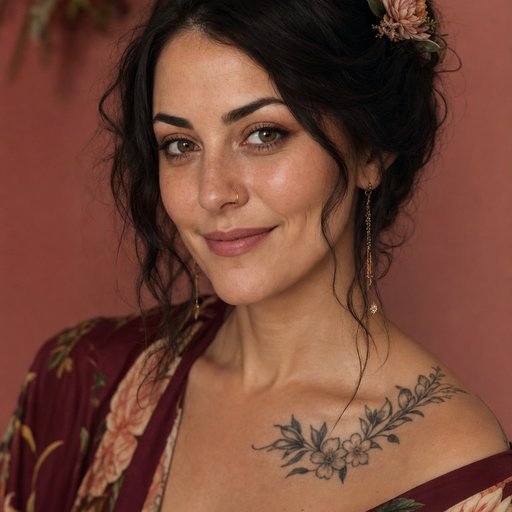
- Clavicle/shoulder: Classic, visible, the bloom appears to grow from the body
- Back of arm, above elbow: Good for trailing varieties, movement with muscle
- Ribcage: Painful, but the curve accommodates natural orchid arch; excellent for larger, more detailed species study
- Thigh: Ample real estate, less sun exposure than forearm, good for color retention
- Foot/ankle: Orchid doesn’t love this placement, detail loss is significant, and the flower’s delicacy reads as damage rather than intention when it blurs
Religious & Spiritual Angles
Orchid lacks the direct scriptural presence of lily or rose, which makes its spiritual use more interpretive, less doctrinal. Some Buddhist practitioners connect orchid to the virtue of refinement without ostentation, appropriate for lay practice, not showy monastic display. In Hindu contexts, orchid sometimes appears in depictions of Parvati or Lakshmi, but this is regional and not universal iconography.
Contemporary Spiritual Use
Modern spiritual tattooing often adopts orchid as a marker of initiated femininity, menarche, coming out, recovery from religious trauma, or simply the decision to treat the body as sacred text rather than borrowed vessel. The absence of heavy institutional meaning becomes feature, not bug. You write your own commentary.
Color vs. Black and Grey
Color choice radically shifts orchid’s register. Purple, the most common natural orchid hue, carries its own associations: royalty, mourning, queer identity depending on shade. Deep purple reads as dramatic; lavender, softer, more nostalgic. White orchids in tattoo form risk becoming blank shapes without strong surrounding contrast, artists often add subtle blue or gray undertone to prevent this.
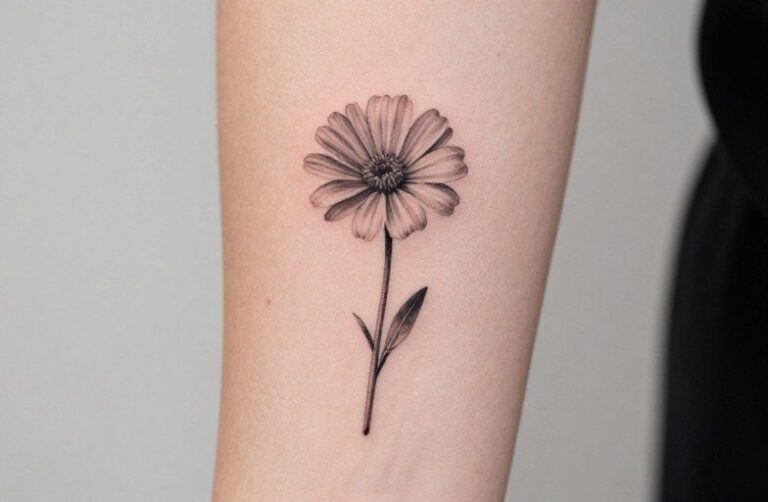
Black and grey orchid tattoos emphasize structure over seduction. The flower becomes botanical illustration, scientific, slightly detached. This can be exactly right for commemorative pieces where sentiment feels dangerous or too raw. A solid black orchid, fully saturated, is rare and visually heavy, striking, but the weight can overwhelm the flower’s characteristic lightness.
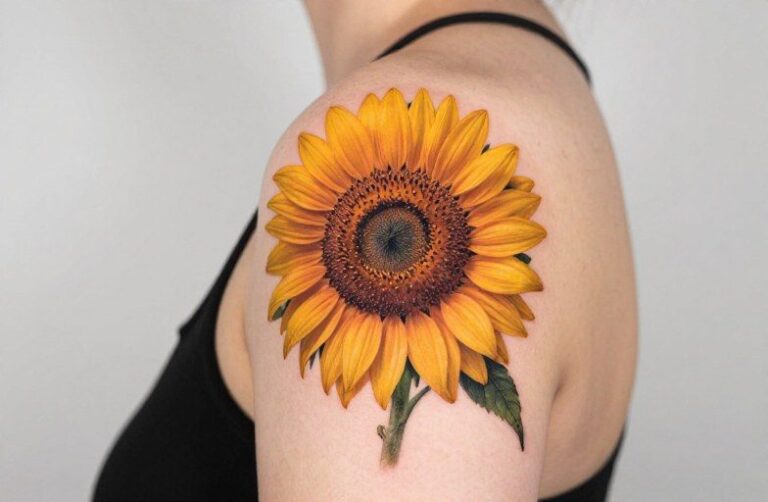
- Yellow/gold: Friendship, new beginnings, but can sicken toward green as it ages
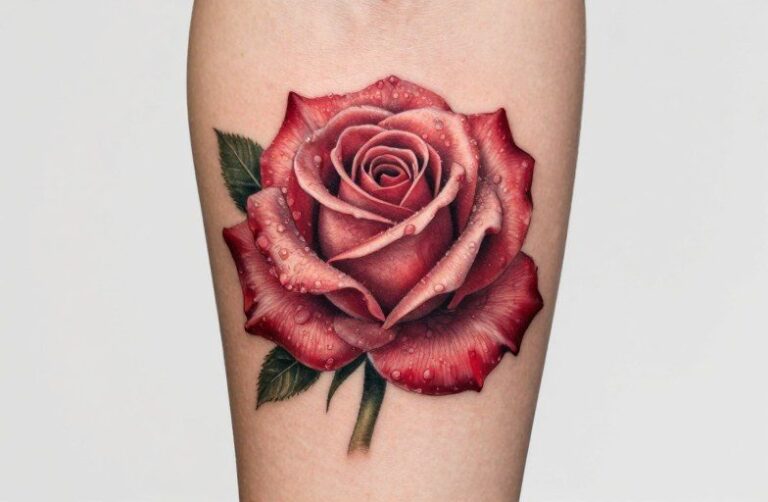
- Red: Passion, rare in nature, often reads as deliberate artificiality
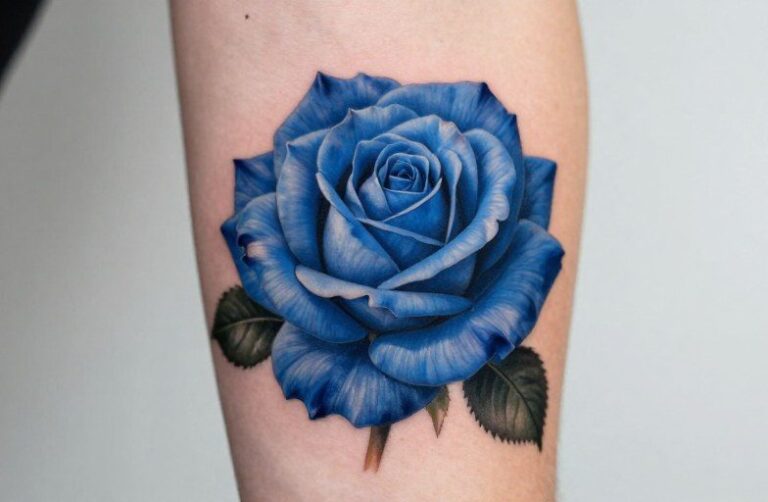
- Blue: Genuine blue orchids don’t exist in nature (dyed or genetically modified); tattoo blue carries this slight unreality, the impossible made visible
- Green: Usually reads as stem/leaf detail rather than bloom, grounding rather than focal
The Takeaway
Orchid tattoo meaning isn’t fixed, but it isn’t empty either. The flower’s actual characteristics, slow growth, specific needs, unlikely persistence, strange beauty, provide genuine symbolic material. Your job is choosing which characteristics to emphasize: the dormancy and return, the architectural oddity, the sensual display, the colonial history, the simple fact of something difficult that rewards patience. The best orchid tattoos know their species, their placement, their color strategy, and their personal reason. The rest is just decoration.
Frequently Asked Questions
Does an orchid tattoo always mean something sexual because of the Greek root?
Not in practice. Most people choosing orchid tattoos today aren’t referencing testicle-shaped tubers. The Greek etymology is interesting context, but contemporary meaning centers on beauty, resilience, and personal significance rather than fertility.
Which orchid species works best for a detailed tattoo?
Phalaenopsis (moth orchid) offers broad, clearly defined petals that hold detail well. Cattleya has more complex ruffled edges. Avoid trying to cram multi-flower Dendrobium clusters into small spaces, individual blooms get muddy.
How well does orchid tattoo color hold up over time?
Purples and deep reds generally age better than yellows or light pinks. White highlights fade fastest. Ribcage and thigh placements see less sun damage than forearms or hands, preserving color longer. Expect to need touch-up at 7-12 years for bold pieces.
Can men wear orchid tattoos without them reading as feminine?
Absolutely. The botanical structure translates across gender presentations. Black and grey execution, larger scale, pairing with non-floral elements like geometric frames or animal skulls, or choosing more angular species like spider orchid all shift the register. Masculinity and flowers aren’t opposed unless you stage them that way.