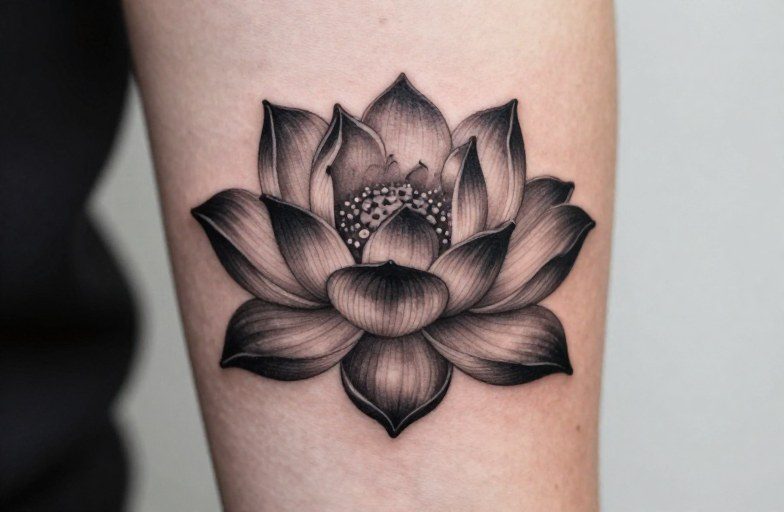
A black lotus tattoo most commonly represents growth through hardship, spiritual awakening born from darkness, and the beauty that persists when color drains away. Unlike its bold counterparts, the black lotus strips the flower to its essential form, no soft pinks or golds to distract from structure and shadow. That visual starkness carries weight: it signals someone who found clarity not despite struggle, but through it.
Who Chooses This Tattoo
People drawn to black lotus imagery tend to share a specific thread in their reasoning. They’ve usually passed through something that changed them, and they want the mark without the sentimentality of brighter palettes. The black lotus appeals to those who find traditional “survivor” imagery too explicit, too on-the-nose.
Common Motivations
- Marking recovery from addiction, depression, or trauma without using overt symbols
- Signaling a philosophical shift, nondual thinking, acceptance of life’s full spectrum
- Commemorating loss while rejecting mournful clichés (no dates, no wings, no script)
- Professional considerations: black ink holds better over decades and reads cleaner in conservative workplaces than color pieces
Gender and Placement Patterns
There’s no real gender skew here, though placement choices diverge. Men often go larger, upper arm, chest panels, thigh, integrating the lotus into geometric or mandala frameworks. Women frequently choose the sternum, ribs, or behind the ear for intimacy and concealment. Both approaches work; the difference is about how visible you want the meaning to be.
Religious & Spiritual Angles
The lotus carries heavy freight across Eastern traditions, and the black variant complicates rather than simplifies that inheritance.
Buddhist and Hindu Contexts
In Buddhist iconography, the lotus rising from mud represents purification through suffering. The black lotus isn’t traditional, classical depictions favor blue, white, pink, or gold corresponding to specific Buddhas and bodhisattvas. Some practitioners view black lotus imagery as inauthentic appropriation; others, particularly in Tibetan traditions where wrathful deities appear dark, find resonance. If you’re practicing, talk to your teacher. If you’re not, understand you’re borrowing from a living tradition and act accordingly.
Western Esotericism
Occult and tarot-adjacent circles have adopted the black lotus as a symbol of hidden knowledge or the unconscious made conscious. This usage is modern, largely 20th-century, often linked to ceremonial magic traditions that recontextualized Eastern symbols. The connection is tenuous historically but established enough that tattoo artists recognize the reference. Be aware that carrying it may signal affiliations you don’t hold.
History & Cultural Roots
The lotus as motif stretches back millennia, but the black variant is a relatively recent visual development in tattoo culture.
Origins of the Lotus Symbol
Ancient Egyptian art featured the blue lotus (Nymphaea caerulea) in funerary contexts, often linked to rebirth and the sun’s cycle. In South Asian traditions, the lotus appears in temple carvings, manuscript illuminations, and textile patterns from at least the 1st millennium BCE. The flower’s actual biology, roots in mud, bloom above water, made it an obvious metaphor for transcendence. Black pigment in these traditions served background or outline functions, never the flower itself.
When Black Lotus Emerged in Tattooing
Blackwork and neo-tribal movements of the 1990s-2000s pushed pure black ink to foreground. The black lotus emerged from this shift: same symbolic content, stripped palette. Japanese irezumi sometimes used near-black lotus in monochrome sleeves, but the standalone black lotus as personal symbol is largely a Western tattoo phenomenon of the last two decades. No single artist or shop claims invention; it evolved organically as clients requested darker, more minimal alternatives to colorful Eastern-inspired pieces.
Personal & Modern Meanings
Beyond tradition, the black lotus accumulates individual significance through placement, surrounding imagery, and the specific darkness each wearer references.
What “Darkness” Means Here
The black lotus doesn’t glorify suffering. Its power is in sequence: mud first, then stem, then bloom. People choose it to say the struggle was real, not decorative. The blackness can represent depression, grief, addiction, burnout, betrayal, or simply the ordinary grinding difficulty of a life that didn’t go as planned. The flower form insists that something grew from it, something structured, symmetrical, open.
Combinations That Shift Meaning
- With geometric patterns: order imposed on chaos, rationality after breakdown
- With skulls or hourglasses: memento mori, beauty within mortality
- With water or wave elements: return to source, emotional processing
- With script or lettering: usually weakens the piece; the lotus already speaks
- Single stem vs. full bloom: stem emphasizes process, bloom emphasizes arrival
Best Placements
Where you put a black lotus changes how it reads and how it ages.
High-Detail Areas
The sternum and upper back offer flat planes for fine petal work. These spots hurt more, sternum especially, bone proximity makes the vibration intense, but the result rewards the commitment. Ribs work for vertical compositions, though the canvas curves and breathes, so design must account for movement. Expect some distortion over years as skin stretches and settles.
High-Mobility and Concealment
Inner forearm and wrist get sun, friction, and frequent movement. Black ink holds up better than color here, but fine lines still blur. Behind the ear and along the hairline offer concealment but limited space, simple, graphic lotus shapes work best, not layered petals. Thigh and calf provide meaty, stable surfaces where detailed blackwork stays crisp for decades. These spots also hide easily under professional clothing.
Scale Considerations
Small black lotus tattoos (under 2 inches) tend to muddy over time. The lotus form relies on negative space between petals to read clearly. At minimum, go palm-sized or accept that it’ll soften into a black blob in fifteen years. Large-scale pieces allow for true blackwork saturation, solid blacks, whip-shaded grays, the full range of monochrome technique.
Similar & Related Symbols
Clients sometimes arrive asking for black lotus when another symbol serves better, or combine it with elements that dilute or confuse the message.
Alternatives Worth Considering
- Black dahlia: similar structure, more overtly gothic, less spiritual baggage
- Wilted or broken lotus: more explicit about damage survived, less triumphant
- Black rose: overused, harder to execute originally, carries romantic connotations that may not fit
- Chrysanthemum in black and gray: Japanese funeral associations, heavier mortality weight
- Minimalist seed or pod: pre-bloom potential, more subtle, less recognized
Symbols That Pair Well
The unalome, a spiral leading to a straight line and dot, maps spiritual journey visually and pairs naturally with lotus imagery. Moon phases work: waxing, full, waning, new, cycling through darkness. Ouroboros, less so; the snake eating its tail contradicts the lotus’s upward growth. Water ripples or koi maintain the aquatic origin without overloading. Avoid too many elements; the black lotus’s strength is restraint.
Final Thoughts
The black lotus succeeds as tattoo imagery because it carries weight without demanding explanation. It doesn’t need to be decoded; its darkness is visible, its floral structure familiar. That accessibility is also its risk, it’s popular enough now that execution matters enormously. A generic black lotus from a flash sheet reads as decoration. One drawn to your body’s contours, with petal edges that catch light differently than the centers, with blacks that aren’t flat but alive with gray variation, that reads as yours.
Take time finding an artist who works in blackwork specifically, not just someone who “can do it.” Look at their healed pieces, not fresh photos. Ask about needle grouping for the solid blacks, larger groupings (11-15 round shaders) pack black faster but less precisely; smaller (3-5 liners) give control but take longer and cost more. The technical choices shape how your meaning holds.
And be honest about what you’re marking. The black lotus isn’t about pretending the mud didn’t happen. It’s about refusing to let the mud be the final form.
Frequently Asked Questions
Does a black lotus tattoo always mean something negative or dark happened?
Not necessarily. Some people simply prefer blackwork aesthetically or want the lotus form without religious color associations. But most who choose this specific variant are drawn to its implication of growth through difficulty, even if their ‘darkness’ was ordinary struggle rather than trauma.
How well does a black lotus tattoo age compared to a colored one?
Black ink generally holds better over time than color, especially pinks and yellows that fade fastest. However, fine petal details can still blur. Go large enough for negative space to remain visible, and protect the piece from sun exposure to keep blacks dense.
Is it culturally appropriative to get a black lotus if I’m not Buddhist or Hindu?
The lotus is widespread across cultures, but the black variant’s strongest associations are modern Western tattoo culture rather than specific religious practice. Still, understanding the symbol’s roots matters. Avoid combining it with sacred elements like specific mudras or deity imagery unless you’re practicing that tradition.
Can a black lotus cover up an older tattoo?
Often yes, depending on the existing piece. Black lotus designs with dense black centers and layered petals can mask older work beneath. The lotus’s radial structure also adapts well to covering irregular shapes. Consult an artist experienced in cover-ups, some will design specifically to incorporate old lines into new shadow.