A tulip tattoo most commonly signals perfect love, rebirth, and the acceptance of life’s fleeting nature. Unlike roses with their thorny drama, tulips offer a quieter symbolism, one that can shift from romantic devotion to personal resilience depending on color and context. The flower’s brief blooming period, historically driving Dutch market mania, adds a layer of meaning about beauty that doesn’t last forever and the wisdom of appreciating it while it does.
Symbolism & Core Meaning
The tulip’s signature curve, petals that open with morning light and close again at dusk, has made it a natural emblem for renewal and the cyclical nature of existence. In Persian origin stories, the flower grew from the blood of a star-crossed lover, cementing its association with passionate devotion that transcends death.
Color as Language
Red tulips carry the strongest romantic charge, signaling deep love and desire. Purple connects to royalty and spiritual nobility, a holdover from when the pigment was prohibitively expensive. Yellow, once associated with unrequited love in Victorian floriography, now reads more commonly as cheerful friendship and sunshine. White tulips work for memorial pieces and fresh starts; black or very dark purple varieties suit mourning and the acceptance of finality. Pink splits the difference between red’s intensity and yellow’s openness, making it a frequent choice for family pieces and self-love work.
The Impermanence Factor
Unlike roses that can be dried and preserved, cut tulips continue growing in the vase, bending toward light until they droop and drop. This biological reality feeds into tattoo meaning: the flower refuses to be static, even in death. That quality appeals to people marking transitions, divorce, recovery, relocation, career changes, who want to acknowledge that movement itself has value.
History & Cultural Roots
The tulip’s journey from Central Asian wildflower to global icon tracks through several cultures worth understanding before committing to skin.
Ottoman and Persian Lineage
The flower’s name derives from the Turkish word for turban, “tülbend,” referencing the bloom’s folded shape. Ottoman court culture, particularly during the 18th-century “Tulip Period,” raised the flower to national symbol status. Persian poetry and art used the tulip as a metaphor for the burning cheek of the beloved, linking it to divine love in Sufi tradition. Some trace the red tulip specifically to martyrdom symbolism in Shia Islam, though this association varies regionally.
The Dutch Tulip Mania Legacy
The 1630s speculative bubble around tulip bulbs, where single rare bulbs traded for the price of Amsterdam canal houses, left permanent cultural residue. For some, tulip imagery carries cautionary weight about greed and economic irrationality. For others, the mania represents humanity’s willingness to assign extraordinary value to beauty. Either reading offers tattoo potential, particularly for finance professionals, historians, or anyone who has personally crashed and rebuilt.
Religious & Spiritual Angles
Beyond the Sufi associations, tulips appear in Christian contexts where their three petals and three sepals (often interpreted as six petals total) connect to the Trinity. This numerology made them popular in Netherlandish still-life painting, where flowers in general served as memento mori reminders. The tulip’s brief blooming window fit this vanitas tradition precisely.
In contemporary spiritual tattooing, the tulip’s emergence from bulb, months underground, then sudden visible growth, resonates with rebirth narratives across traditions. The flower doesn’t require religious affiliation to carry this weight; the biological process speaks plainly enough. Some choose tulips to mark sobriety anniversaries, surviving illness, or other returns to visible life after hidden struggle.
Similar & Related Symbols
Understanding adjacent flowers helps clarify when a tulip specifically serves better than alternatives.
Tulips vs. Roses
Roses carry more aggressive romantic signaling, thorned, layered, associated with possession and conquest. Tulips present softer edges, less defensive architecture. For memorial pieces honoring mothers, sisters, or platonic soulmates, tulips often communicate love without the sexual charge roses can bring. The rose’s cultural saturation also means tulips read as more deliberate choices, less default.
Tulips vs. Lotus
The lotus shares the rebirth theme but anchors it specifically to Eastern spiritual frameworks, Hindu, Buddhist, Egyptian, that may not align with the wearer’s background or intention. Tulips offer European and Middle Eastern lineage for those seeking Western floral symbolism. The lotus also requires water context; tulips grow from dry earth, a different metaphorical starting point for people who have emerged from emotional drought rather than murky waters.
Pairing Possibilities
Popular combinations include tulips with bumblebees (pollination, productivity, environmental awareness), with hourglasses (time’s passage), with geometric frames (contrast between organic and structured), and with script in Persian or Dutch depending on ancestral connection. Skulls paired with tulips create explicit vanitas pieces; the flower’s softness against bone makes the composition work without becoming cartoonish.
Design Tips & Pairings
Tulip tattoos age distinctly depending on technical choices made at the needle.
Line Work vs. Color Saturation
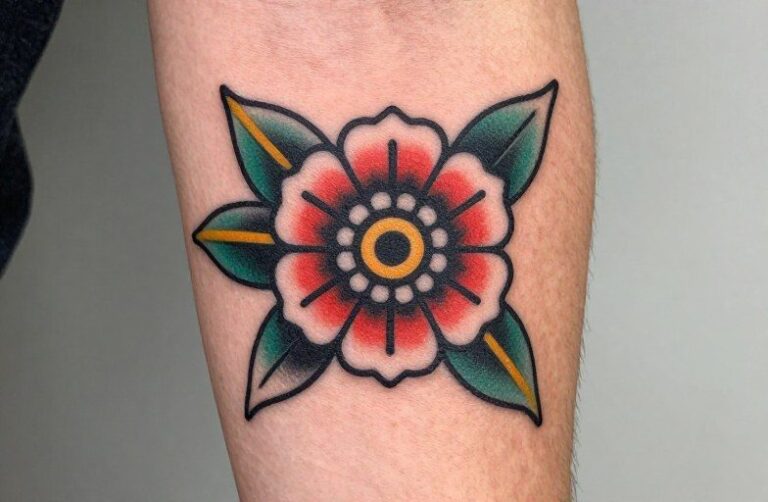
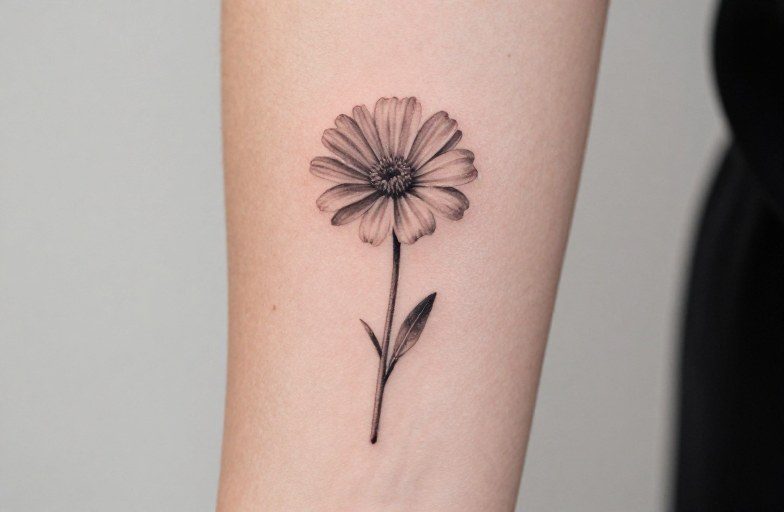
Single-needle fine line tulips trend heavily on social media but face real longevity challenges. The flower’s defining feature, smooth, unbroken petal edges, blurs faster than designs with natural texture variation. For pieces expected to last decades, slightly heavier line weight (3RL minimum) or strategic stippling within petals provides insurance against the “faded sticker” effect. Watercolor-style tulips without outlines age particularly poorly; the color simply has nowhere to hold as skin texture changes.
Black and Gray Considerations
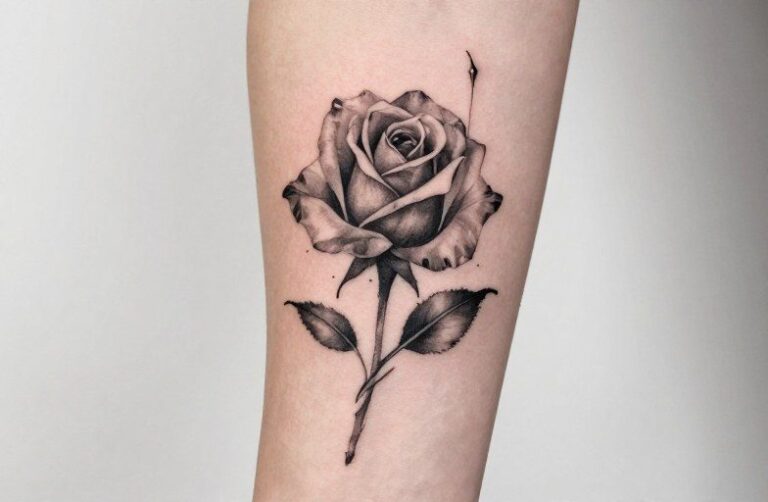
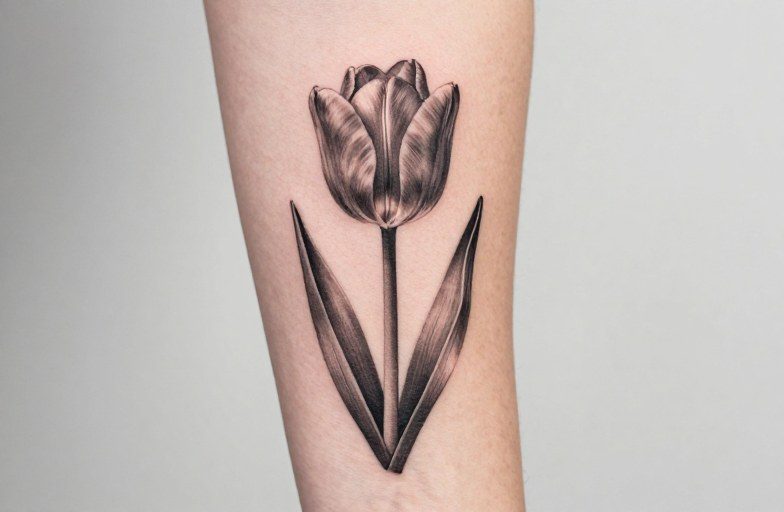
Without color, tulips rely entirely on shape recognition. The cup-and-stem silhouette must remain readable. Black and gray pieces succeed when artists use contrast between dark interior petal folds and highlighted edges rather than attempting to “paint” the flower in muted tones. Negative space becomes crucial, where the skin itself reads as light hitting the petal.
Stem and Leaf Handling
The tulip’s broad, waxy leaves offer design opportunity but also risk. Leaves positioned awkwardly can read as phallic or simply unbalanced. Curving stems create movement; straight vertical stems read more formal, almost funerary. Leaf curl direction matters for flow on body contours, forward-curling leaves wrap around limbs differently than backward-curling ones.
Best Placements
Tulip proportions suit certain locations better than others.
- Forearm and calf: The vertical stem format fits naturally. Single large tulips or small bouquets both work; the cylindrical muscle shape complements the flower’s architecture.
- Ribcage: Curving stems follow the floating rib contour. This placement accommodates larger compositions with multiple blooms and leaves, though healing requires patience given the movement and friction zone.
- Shoulder cap: A single tulip viewed from above, looking down into the cup, creates an unusual perspective piece. The rounded muscle shape echoes the bloom’s form.
- Behind the ear: Miniature single tulips fit here but require extremely clean line work. The area’s oiliness and hair contact affect long-term clarity.
- Hand and fingers: Generally discouraged for tulips specifically. The flower’s detail demands more space than finger skin allows; knuckle placement distorts the silhouette with every fist.
Upper arm outer bicep offers perhaps the most versatile canvas: enough flat surface for detail, enough muscle movement to give the stem life, and manageable healing for first-timers.
Final Word
A tulip tattoo works best when chosen for specific resonance rather than general prettiness. The flower’s historical weight, from Persian poetry to Dutch financial collapse to Victorian coded messages, gives it substance that outlasts trend cycles. Technical execution matters enormously: this is not a design that forgives sloppy line work or poorly planned color. Work with an artist who has rendered botanicals before, who understands how petals fold rather than flatten, and who will be honest about whether your desired size and placement can sustain the detail you want. The tulip’s meaning is ultimately fixed by what you bring to it, but its visual success depends on craft that respects the flower’s particular geometry.
Frequently Asked Questions
Do tulip tattoos only work for women?
Not at all. The tulip’s clean lines and historical associations with power and commerce give it plenty of masculine and neutral resonance. Placement and styling matter more than the flower itself.
How much does a tulip tattoo typically cost?
Small single-needle pieces might start around $150-250, while detailed multi-flower compositions with color saturation run $400-800 or more depending on artist tier and location. Botanical specialists often charge premium rates.
Can a tulip tattoo cover up an older piece?
The flower’s broad petal shapes can work for cover-ups, but light-colored tulips (yellow, white, pink) won’t hide dark existing ink. Deep red or purple tulips with dense black linework offer better coverage potential.
What season should I get a tulip tattoo for easiest healing?
Spring and fall beat peak summer and winter. Moderate temperatures reduce sweat and sun exposure risks while avoiding the dry-skin cracking that harsh heating can cause during winter healing.