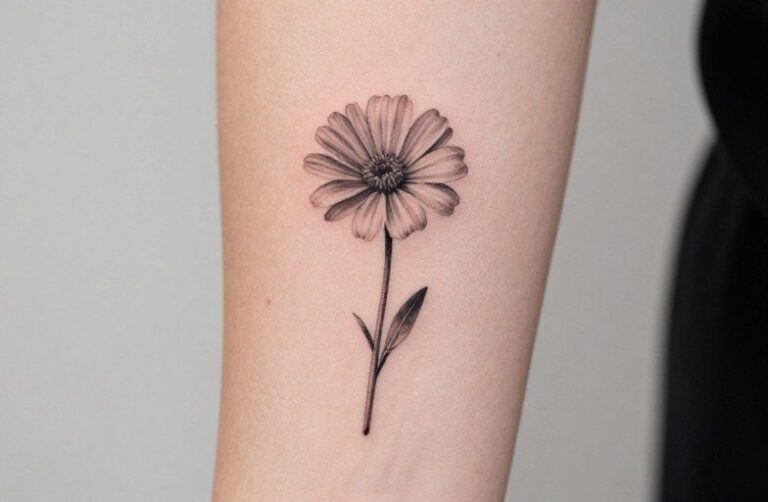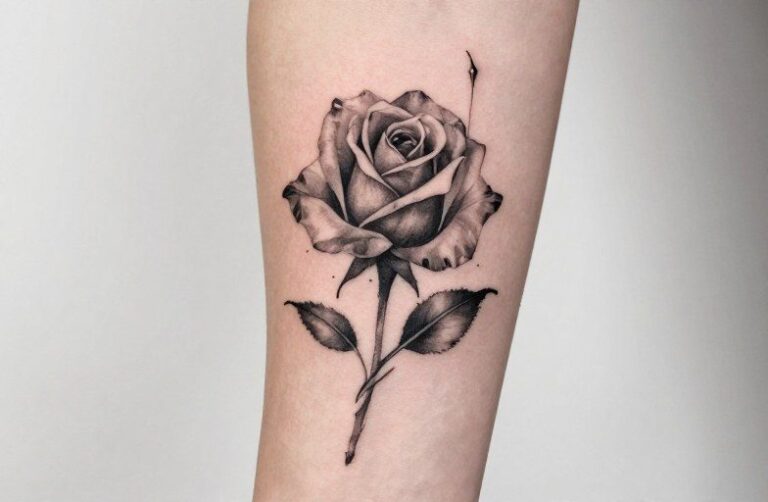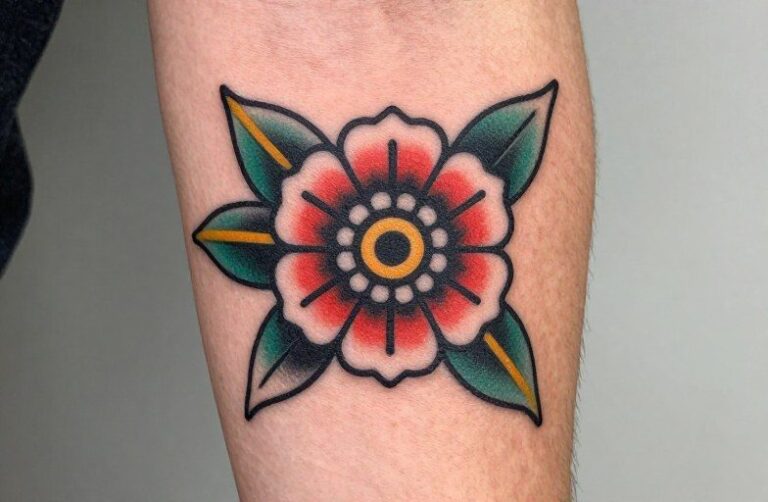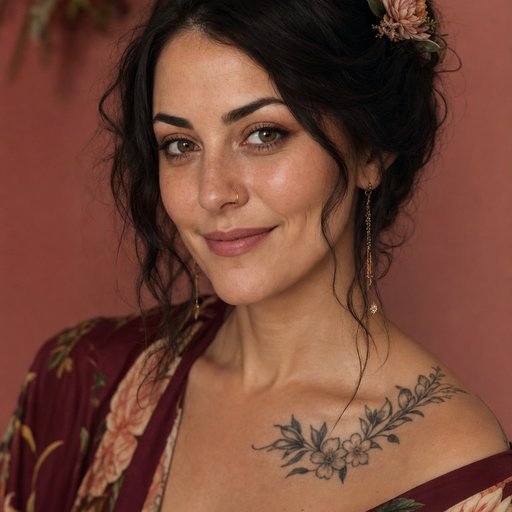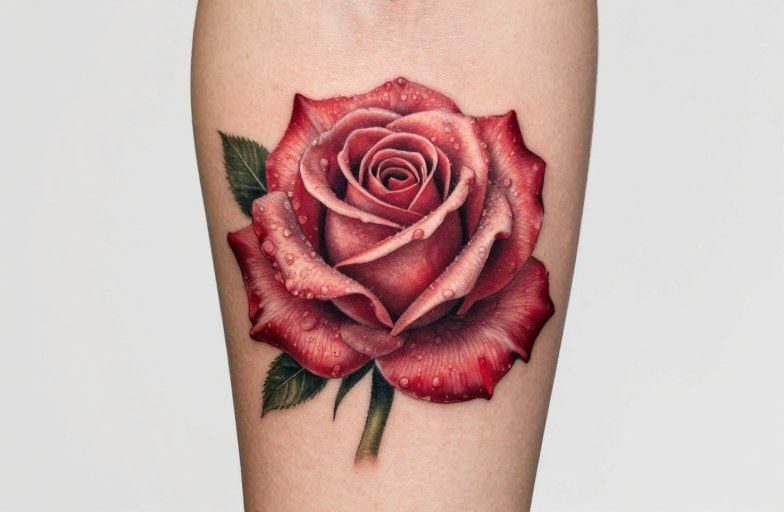
The daisy tattoo most commonly signals innocence, purity, and new beginnings. But there’s a harder edge too, daisies push through cracks in pavement, survive frost, and close at night only to reopen. That duality makes the design surprisingly versatile, attracting people who want something delicate in appearance but grounded in stubborn persistence.
Design Tips & Pairings
Placement changes everything with a daisy. Small enough for behind the ear or along the collarbone, the design also scales well to a full shoulder piece or thigh composition. The flower’s natural radial structure draws the eye outward, which tattooists use to their advantage.
Linework vs. Shading Approaches
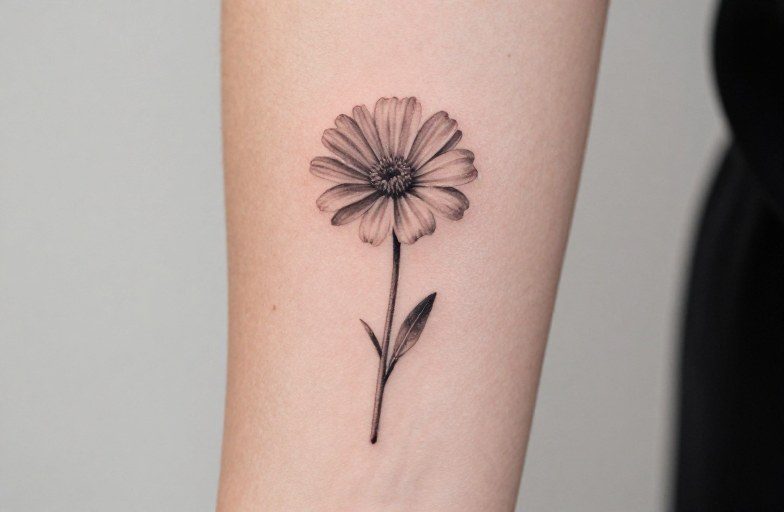
A single-needle outline daisy reads clean and graphic, almost botanical-illustration style. That approach ages well because there’s less ink to blur. Soft grey wash behind the petals creates depth without heaviness, though that background will fade faster than the black lines defining the edges. For something more illustrative, stippled shading mimics the textured center of the flower without the muddying risk of solid black fills.
Common Pairings That Actually Work
- Bee or butterfly: Natural companions that reinforce the garden/outdoor theme without cluttering the composition.
- Text banners: The curved stem lends itself to ribbon integration, though the lettering needs to be large enough to stay legible as it ages.
- Multiple flowers in various stages: Bud, bloom, and wilting daisy can suggest progression or the passage of time.
- Geometric framing: A circle or triangle behind the flower contains the organic shape and gives it a contemporary feel.
Chains of small daisies work beautifully as armbands or anklets, but remember: bands that wrap completely can distort as skin shifts with age. A gap in the back preserves the shape better long-term.
Who Chooses This Tattoo
There’s no single demographic. Parents get daisies for children born in April (the birth flower). People marking recovery or fresh starts after disruption often gravitate toward the “new beginning” association. Others simply love the visual, it’s a flower that reads feminine without being frilly, simple without being boring.
Men sometimes hesitate, assuming the daisy is too soft, but paired with bolder elements or rendered in heavy blackwork, it holds its own. The punk and grunge scenes have long adopted the daisy ironically or as a counterpoint to harder imagery.
Size and Commitment Level
The daisy suits first-timers because it’s recognizable even at small sizes and doesn’t require massive time in the chair. That said, a tiny daisy on a finger or hand will need touch-ups; those areas see constant friction and sun exposure. Someone testing the waters might do better with a slightly larger version on the upper arm or ribcage where the skin stays more protected.
Color vs Black and Grey
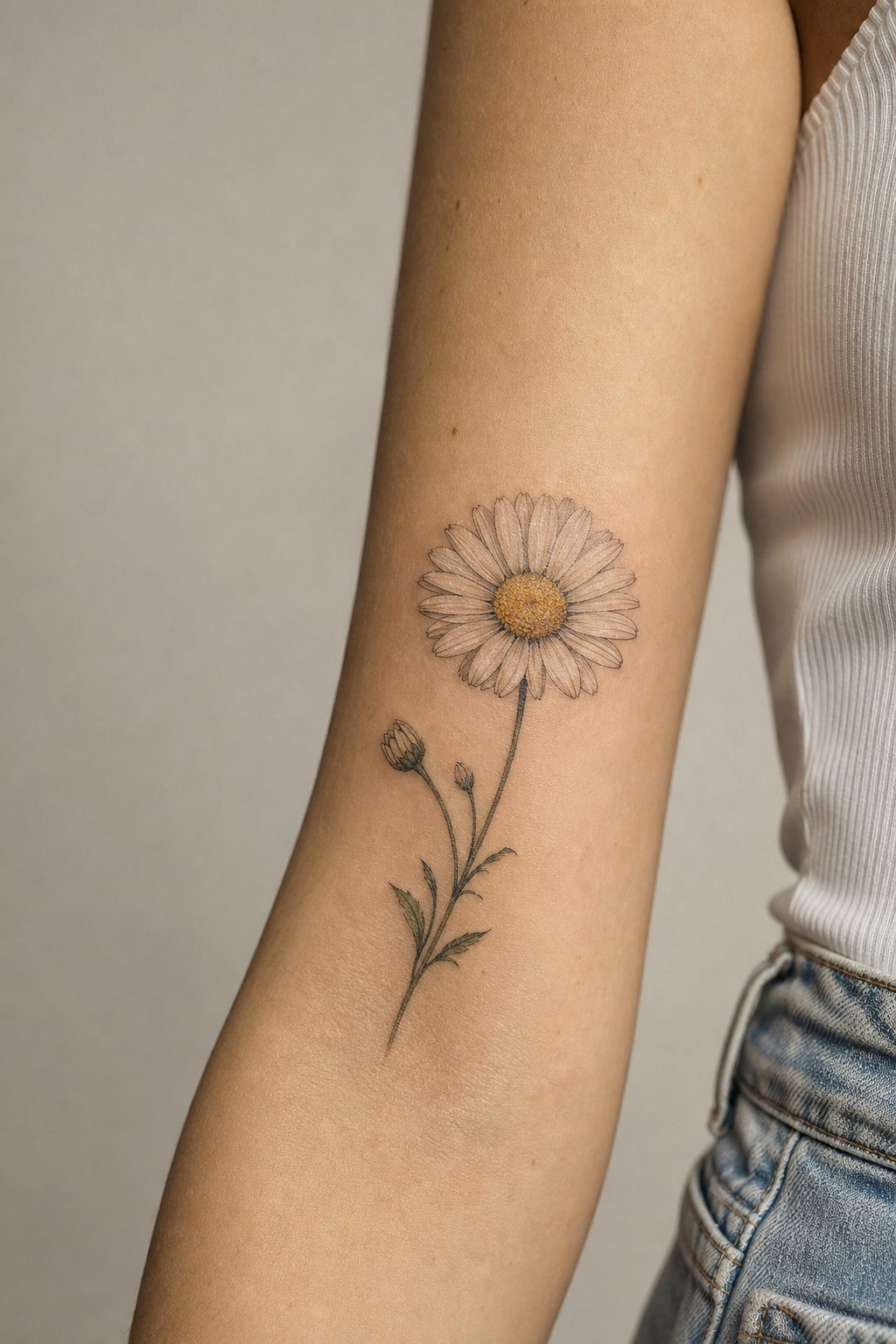
Classic white-petal daisies with yellow centers are the expected colorway, but white ink presents real challenges. On lighter skin, white reads as raised scar tissue once healed. On darker skin, it can disappear entirely or heal to a greyish tone. Experienced tattooists often substitute very light grey or pale blue to suggest white without the technical problems.
Yellow centers hold better than white petals but still fade faster than black. Expect the bright pop to soften within 2-5 years depending on sun exposure and placement.
Alternative Color Directions
- All black and grey: Timeless, reads clearly from distance, ages most predictably.
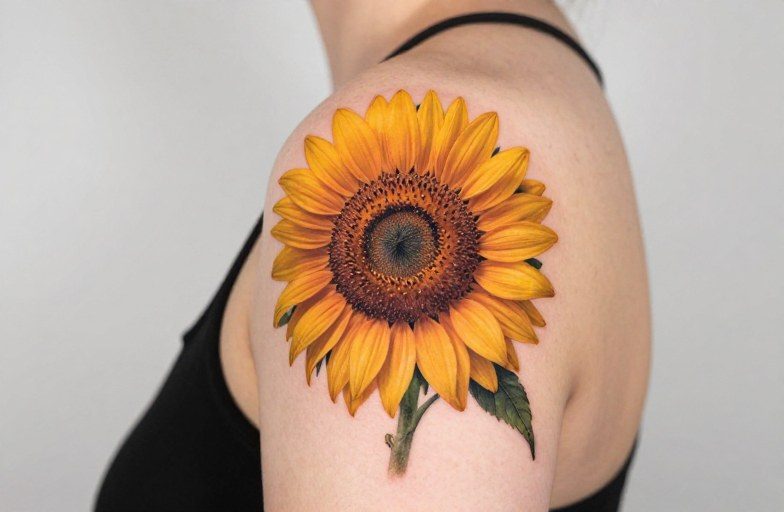
- Muted earth tones: Olive greens, dusty pinks, or sepia shading feel vintage and avoid the toy-brightness of primary colors.
- Neon or saturated: Trendy but high maintenance; these pigments often shift or fade unpredictably.
Black and grey daisies with selective color accents, just the center in yellow, or a single petal edge in red, create focal points without the upkeep of full color.
How It Ages on Skin
Fine petal lines are the vulnerability. A daisy with twenty thin strokes per petal will blur into a solid shape faster than one with bolder, more spaced linework. The center’s dotwork or stippling tends to hold better because it’s denser ink packed into a small area.
On high-movement areas like wrists or ankles, the flower’s circular symmetry helps, it doesn’t have a “top” that looks wrong if it shifts slightly. Compare that to a directional design like an arrow or script that becomes obviously crooked with skin migration.
Touch-Up Realities
Most daisy tattoos need refreshment at 5-10 years, sooner if sun-exposed. The good news: they’re straightforward to reinforce. A tattooist can re-establish the petal edges without reworking the whole piece, making maintenance less intensive than with complex color portraits or heavy black fills.
Religious & Spiritual Angles
Christian tradition often links the daisy to the innocence of the Christ child or the purity of the Virgin Mary, particularly in medieval European art. The flower’s appearance in annunciation paintings wasn’t decorative, it carried specific symbolic weight about untouched virtue.
In modern spiritual practice, daisies sometimes appear in rituals around clarity and truth (the “he loves me, he loves me not” petal plucking has older divination roots). Some contemporary pagan practitioners use the flower in spring equinox celebrations, though associations vary widely by tradition and shouldn’t be presented as universal.
Secular Spirituality
Even without religious framework, the daisy functions as a quiet resilience symbol. It doesn’t demand attention like a rose or lotus. That humility itself becomes meaningful for people who’ve survived through steadiness rather than dramatic transformation.
Mythology & Folklore
Norse mythology connects the daisy to Freya, goddess of love and fertility, though the specifics are often muddled in popular retelling. The flower’s association with childbirth and motherhood appears across several European folk traditions, possibly stemming from its profusion in spring meadows.
The Roman origin story, of a nymph transforming to escape unwanted attention, surfaces frequently in tattoo shop conversation, but historical sourcing is thin. Better documented is the Victorian “language of flowers,” where daisies signified loyal love and discretion. That coded floral messaging system makes the daisy a subtle choice for commemorating relationships without public declaration.
Regional Variations
The oxeye daisy, common in North America, is technically an invasive species in many areas, which doesn’t diminish its cultural presence but adds an interesting tension: a flower symbolizing natural innocence that’s actually an aggressive colonizer. Some tattooists and clients play with that irony deliberately.
Final Word
A daisy tattoo works because it carries weight without heaviness. The design accommodates minimalists and maximalists, first-timers and collectors, color enthusiasts and blackwork devotees. Its real strength is structural: the radial form stays legible as it ages, the symbolism stretches from childhood innocence to weathered persistence, and it pairs with almost any style from American traditional to fine-line botanical.
Choose it for the meaning, choose it for the shape, or choose it because you simply like how it looks. The daisy doesn’t demand justification. It just grows.
Frequently Asked Questions
Does a daisy tattoo always have to be white and yellow?
Not at all. Black and grey versions are common and age better. Some people choose purple, pink, or blue petals for personal significance, or to match a specific flower variety like the African daisy.
What’s the best placement for a first daisy tattoo?
The upper arm, outer forearm, or ribcage offer good visibility with relatively stable skin. Avoid fingers, feet, or inner palms for a first piece, these spots heal poorly and fade fast.
How much detail can a small daisy tattoo hold?
Less than you think. Below two inches, fine petal lines blur together within a few years. Simplify the design: fewer petals, bolder outlines, and minimal interior detail if you’re going small.
Can a daisy tattoo cover up an older tattoo?
The open center and light-colored petals make daisies challenging for cover-ups. Dark, dense versions with heavy black shading can work, but consult a tattooist experienced in cover-up work rather than assuming the flower’s shape will solve the problem.