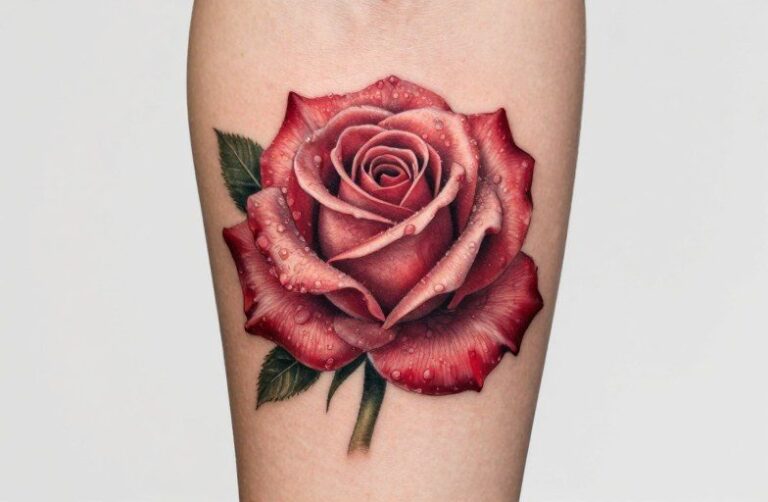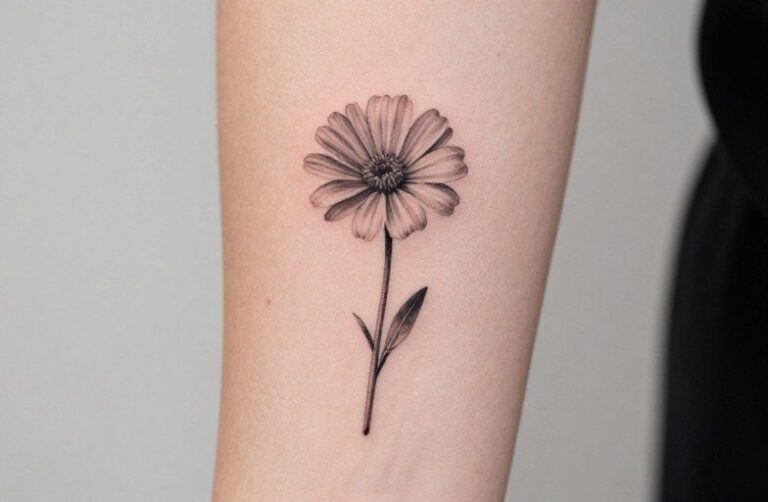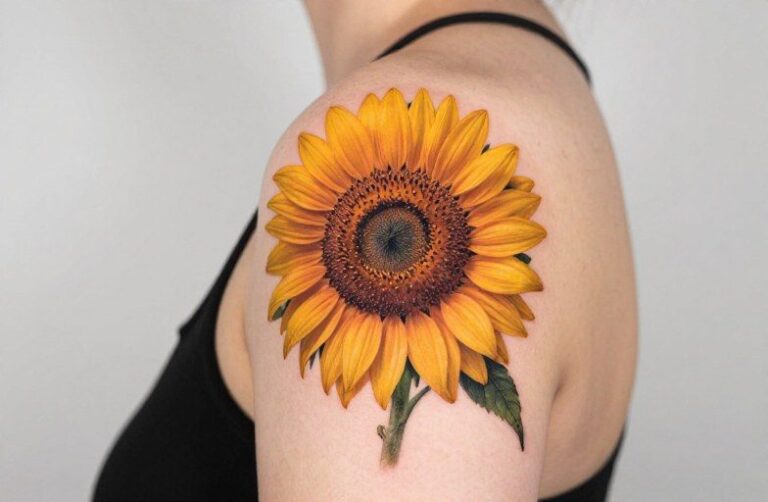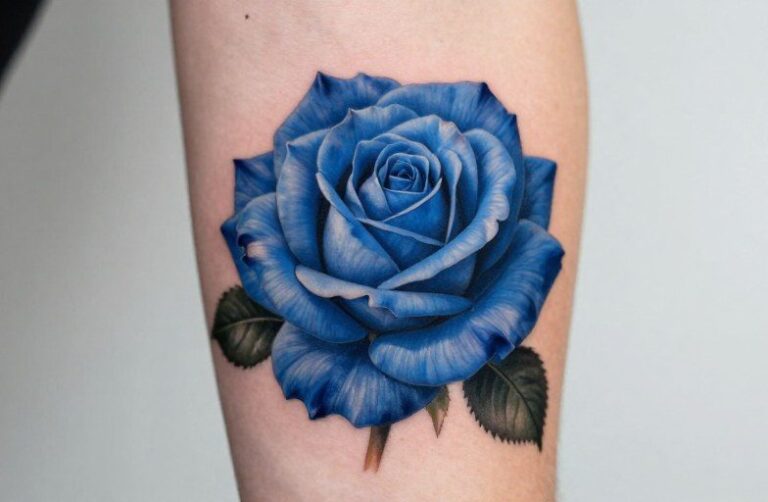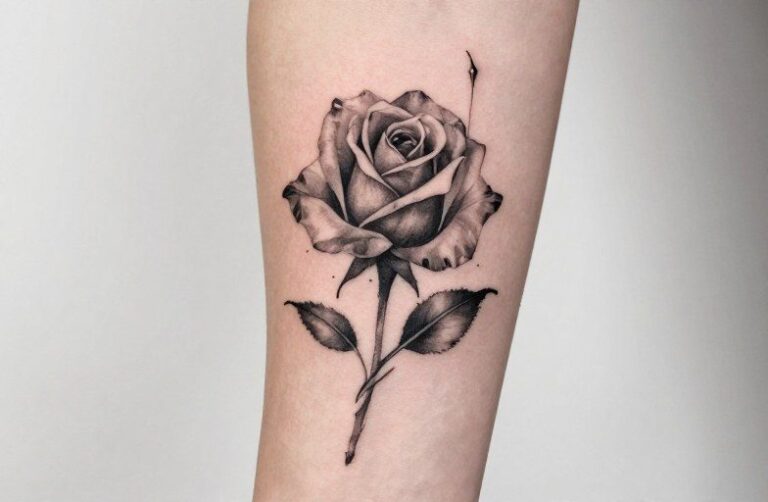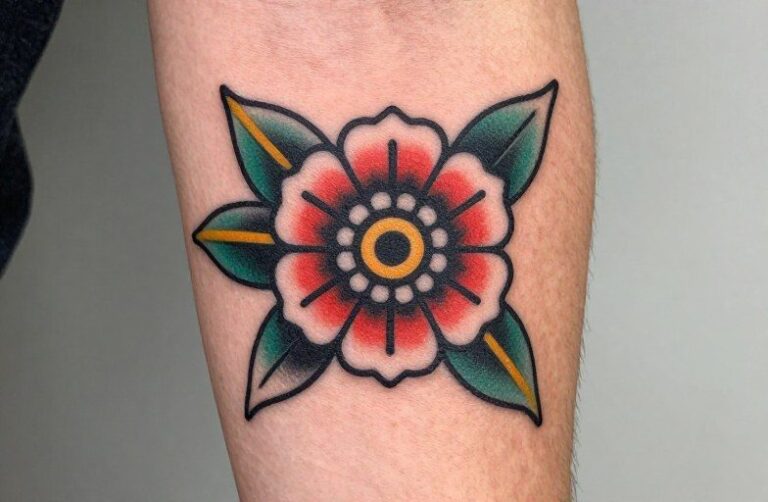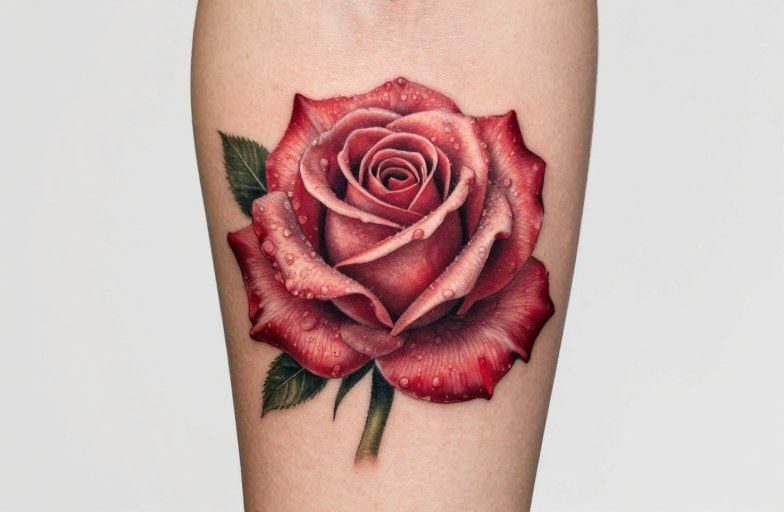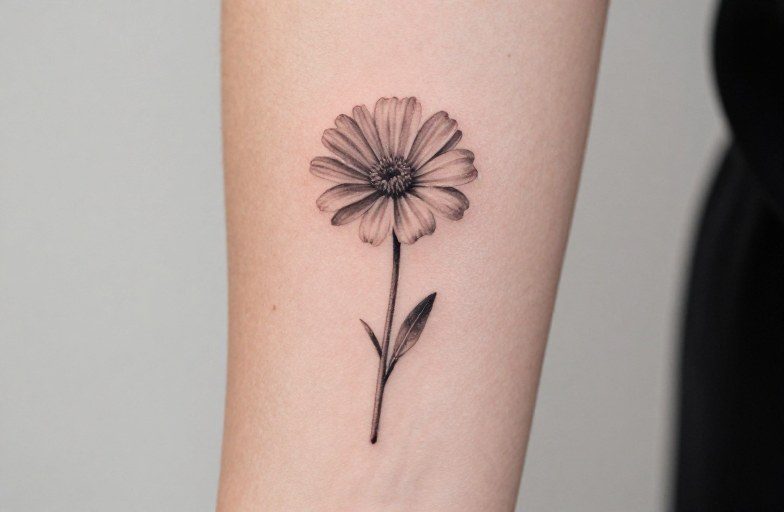
The anemone tattoo most commonly signals anticipation, fragile beauty, and protection against ill fortune. Its meaning splits along two paths: the Greek root anemos (wind) gives it associations with change and fleeting moments, while the deep red varieties, particularly in European traditions, connect to forsaken love and mourning. Most people drawn to this flower aren’t looking for a single fixed meaning, they’re responding to its visual tension: delicate petals, dark center, a plant that closes at night and reopens with morning light.
History & Cultural Roots
European Symbolism
In Victorian England, the anemone entered the language of flowers as a symbol of forsakenness. Red anemones specifically carried this weight, often linked to the myth of Adonis. The flower’s brief blooming period, sometimes just a few weeks in early spring, made it a natural emblem for transient beauty and the melancholy of things that pass too quickly. This association stuck in Western European art and decorative traditions, where anemones appear in vanitas paintings alongside skulls and hourglasses.
White anemones, by contrast, developed a softer reputation in some regions, symbolizing sincerity and trust. The color distinction matters for tattoo design: someone choosing deep crimson versus pale pink is tapping into different emotional registers, even if they don’t know the Victorian specifics.
Middle Eastern and Eastern Mediterranean Associations
Palestinian and broader Levantine traditions often link the red anemone to blood and sacrifice, commonly associated with martyrdom and national identity. The flower’s spring bloom coincides with seasonal remembrances. In tattoo work, this connection surfaces when clients request the flower alongside specific dates, names, or regional symbols, not as generic decoration, but as personal or political commemoration.
Mythology & Folklore
The Adonis Connection
The anemone’s most enduring myth traces it to the death of Adonis, the beautiful youth loved by Aphrodite. In the standard version, his blood mingles with her tears to create the red flower. Some trace it to earlier Near Eastern dying-god myths with similar vegetative resurrection themes. For tattoo purposes, this narrative gives the anemone a specific role: it’s not just “love” but love cut short, beauty destroyed, and the painful persistence of memory. Pairing it with Adonis’s traditional symbols, boar imagery, hunting gear, or Aphrodite’s dove, makes this reference explicit.
Protection and Folk Belief
European folk traditions often credited the anemone with protective qualities. Carrying the flower supposedly warded off evil, and in some regions, placing it near doorways prevented illness. The mechanism varied: some said the plant’s toxicity repelled harm, others that its association with death made it a kind of inoculation against fate. Tattoo clients sometimes reference this obliquely, wanting the flower as a shield without articulating the full folk logic. This works best when the design incorporates protective framing, thorns, geometric borders, or enclosing shapes that suggest containment.
Design Tips & Pairings
Line Work vs. Color Realism
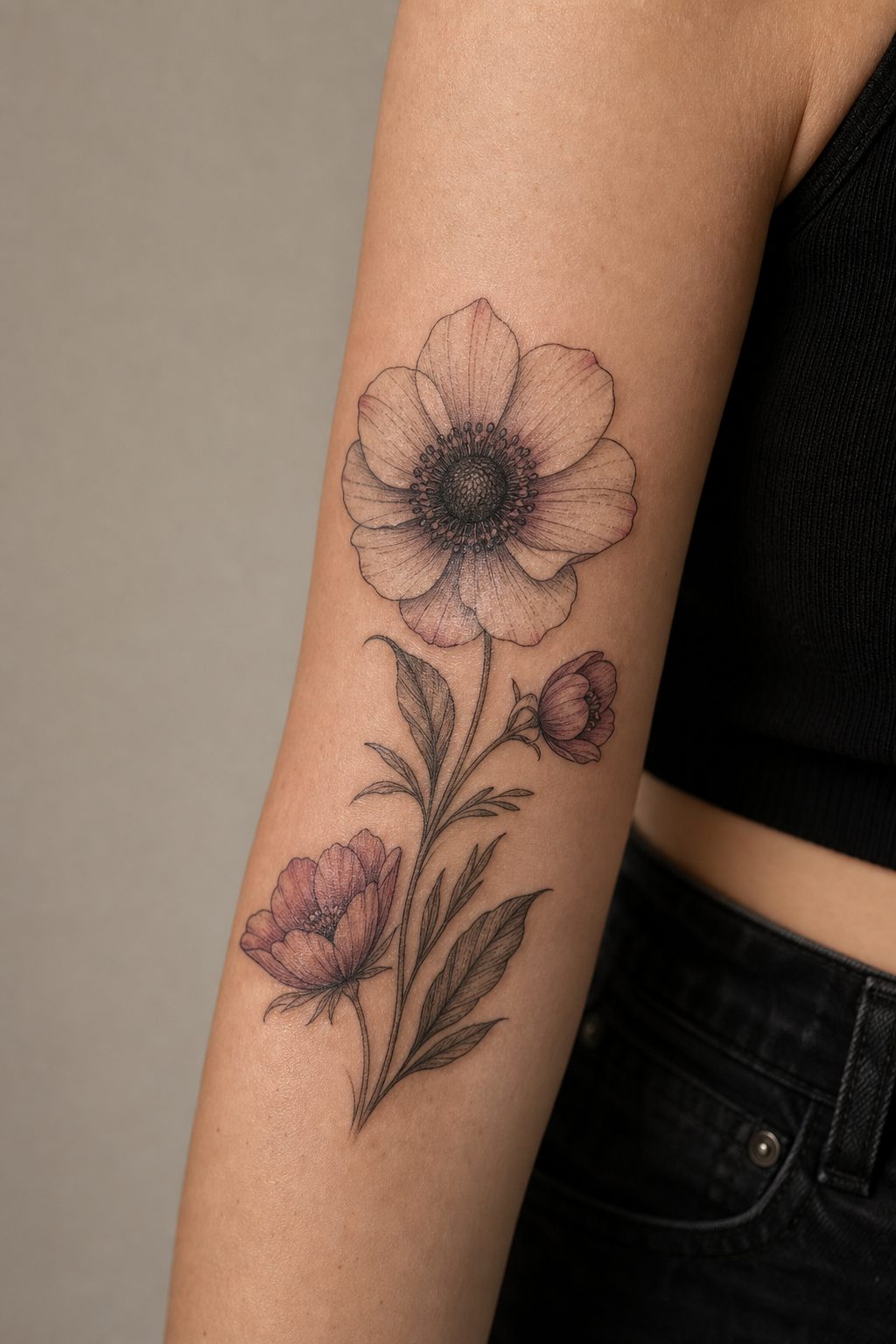
Anemones suit both approaches, but the technical demands differ. The flower’s structure, multiple layers of thin petals radiating from a dense central disk, rewards precise line work. Single-needle or tight three-needle groupings capture the petal edges and the subtle veining that runs from base to tip. Without this detail, anemones flatten into generic daisy-like shapes.
- Black and grey: Emphasize the contrast between petal transparency and the dark center; use negative space for highlights
- Color realism: The red-purple spectrum dominates, but some species show blue, white, or yellow; reference specific species for accuracy
- Watercolor style: The flower’s natural delicacy can handle loose washes, but the center needs structural definition to avoid mush
Color aging deserves attention. The deep reds and purples that make anemones striking are also the pigments most prone to fading and blurring. Expect significant softening by year five without touch-ups, especially on high-movement areas. Black and grey versions hold their structure longer but lose the specific emotional punch of the red.
Common Pairings and Compositions
Single anemone designs work for small placements, but the flower’s radial symmetry often looks isolated without context. Popular additions include:
- Other spring flowers (hellebore, crocus, early cherry blossom) to reinforce seasonal themes
- Bones, skulls, or timepieces for vanitas compositions
- Wind or breath motifs, swirling lines, smoke, abstract motion, to reference the etymology
- Geometric frames or art nouveau borders that contain the organic form
Butterflies and moths pair well technically (similar scale, shared delicacy) but risk cliché unless the species choice is specific and meaningful.
Personal & Modern Meanings
Contemporary anemone tattoos rarely hew to single traditional meanings. More often, clients combine elements: the flower’s wind-association for someone who moved cities repeatedly, its brief bloom for a recovered period of illness, its protective folk history for anxiety management. The mourning connection surfaces in memorial pieces, sometimes with dates or initials integrated into the stem or hidden among petals.
A newer trend connects anemones to neurodivergence and sensory sensitivity, the flower’s reactive closing as a metaphor for needed withdrawal. This meaning circulates in online communities rather than traditional symbolism, but it’s no less valid for tattoo purposes. The image functions as a private signal or a conversation starter, depending on placement visibility.
How It Ages on Skin
The Center Problem
The anemone’s dark central disk is technically challenging. It needs to read as dense and dimensional, not as a flat black hole. Over time, this area tends to spread and lose the subtle stamen detail that makes it botanically recognizable. Experienced artists often leave micro-highlights or use dark grey rather than pure black, sacrificing initial contrast for longevity. Ask to see healed photos of similar floral centers from your artist’s portfolio.
Petal Thinness and Blowout Risk
Those delicate petal edges are where blowout shows most obviously. On thin skin, inner wrist, ankle bone, collarbone, the needle can deposit ink too deep, creating permanent feathering that destroys the crisp silhouette. This limits how small you can go while maintaining readability. As a rough guide: anemone designs below two inches in diameter often age into indistinct blobs unless they’re simplified to icon-level abstraction.
Best Placements
The anemone’s vertical orientation (stem, single bloom, possible bud) suits forearm, calf, and rib placements. Side-of-thigh works for larger compositions with multiple flowers. The shoulder cap allows for radial arrangements where the bloom faces outward.
- Forearm: High visibility, good for medium-size single blooms with stem detail; expect sun exposure fading
- Ribcage: Accommodates vertical compositions with breathing movement that animates the flower; significant pain for the thin skin over bone
- Ankle/foot: Popular but technically problematic; the flower’s detail doesn’t survive well here, and healing is complicated by footwear friction
- Behind ear: Possible for tiny stylized versions, but the anemone’s identifying characteristics usually get lost at this scale
Hand and finger placement is generally inadvisable. The anemone’s specific charm lies in its structural complexity, which finger skin can’t hold.
Before You Decide
Research which anemone species you actually want. The European wood anemone (Anemone nemorosa) differs from the poppy anemone (Anemone coronaria) in petal count, center structure, and color range. Mediterranean variants show stronger reds; Japanese species trend toward softer pink and white. Your artist needs reference images of the specific plant, not generic “anemone” stock photos, to capture accurate detail.
Consider the seasonal reality: anemones are spring flowers, brief and early. A tattoo invoking their symbolism is implicitly aligning with transience, with beginnings that don’t last. This suits some life stages better than others. The design’s emotional weight shifts depending on if you’re marking something survived, something anticipated, or something lost, and that context should inform color, pairing, and placement choices more than any fixed symbolic dictionary.
Frequently Asked Questions
Does the color of an anemone tattoo change its meaning?
Red traditionally signals forsaken love or sacrifice, while white leans toward sincerity and trust. Purple and blue varieties are less culturally loaded, allowing more personal interpretation. In practice, most modern wearers choose color for aesthetic or emotional resonance rather than strict symbolic adherence.
How painful is an anemone tattoo compared to other floral designs?
Pain depends on placement and detail level, not the flower itself. Anemones require fine linework that takes longer than bolder designs, meaning extended sessions on sensitive areas. The ribcage and ankle, common placements, rank high on pain scales due to thin skin over bone.
Can an anemone tattoo work in a sleeve with other flowers?
Yes, but consider scale and season. Anemones are small to medium blooms; pairing them with oversized roses or peonies creates visual imbalance. They work best with other spring flowers at similar scale, or as accent pieces in larger botanical arrangements with consistent lineweight.
What’s the difference between an anemone and a poppy tattoo?
Botanically they’re distinct genera, though both have dark centers and papery petals. Poppies carry stronger opiate, sleep, and wartime memorial associations. Anemones offer more ambiguity, anticipation, wind, protection, transience, without the poppy’s heavy cultural freight. Visually, anemones have more numerous, narrower petals and a less pronounced seed pod.