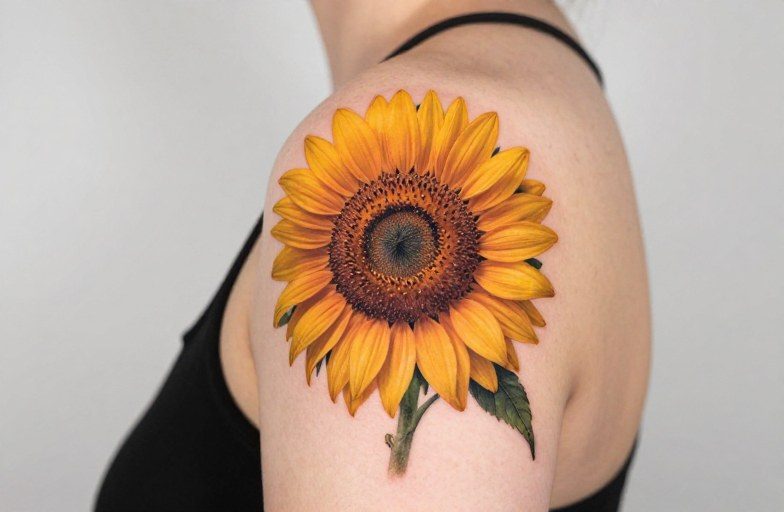
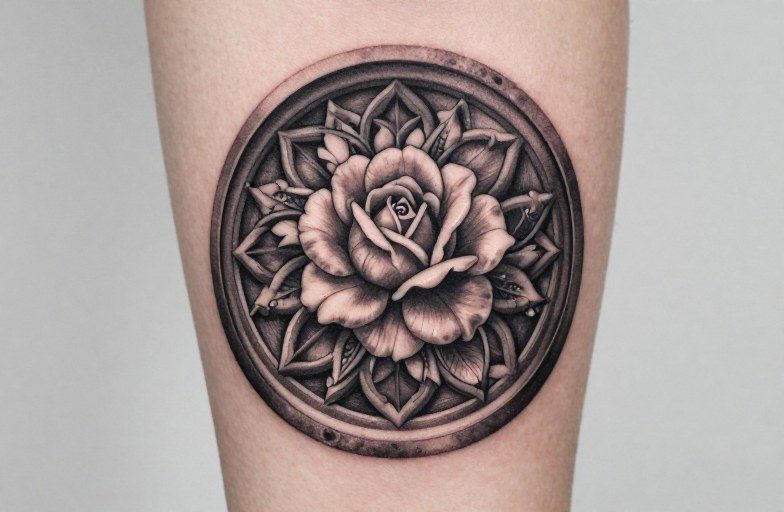
A rose window tattoo carries the architectural DNA of Gothic cathedrals: radial symmetry, tracery lines, and the suggestion of light streaming through colored glass. On skin, it becomes a meditation on order within chaos, the spiritual made visible, and the human impulse to frame transcendence in geometric form. Most wearers gravitate toward it for its visual gravity rather than strict religious affiliation, though the sacred roots remain palpable.
Symbolism & Core Meaning
The rose window’s circular form evokes wholeness, cyclical time, and the cosmos. Medieval builders often linked it to the Virgin Mary (the “Mystical Rose”), but contemporary tattooing has loosened that tether. Today it functions as a symbol of seeking, structure for something larger than the self, without demanding doctrinal commitment.
Light and Fragmentation
Glass catches light; skin does not. This translation loss is actually part of the tattoo’s poignancy. The inked rose window becomes a fixed shadow of something fleeting, a permanent record of luminous experience. That tension, static image versus remembered radiance, gives the design its emotional weight. Many choose it after loss or transition, not as mourning but as mapping: here’s where I stood, here’s what I saw.
Geometry as Vocabulary
The mathematical precision matters. Petals radiate in multiples of four, eight, twelve, or sixteen. Each number carries traditional associations (four for the evangelists, twelve for the tribes or apostles), but most modern wearers respond to the feeling of order rather than the catechism. The mandala-like quality overlaps with Eastern traditions, creating unexpected hybrid readings.
Color vs Black and Grey
This choice defines the tattoo’s entire character. Color references the literal source, stained glass saturated with cobalt, ruby, emerald. Black and grey abandons that reference for something more architectural, more stone-and-shadow.
Color: The Glass Illusion
Bold color packing mimics the leaded glow of actual windows. Saturated magentas and deep ultramarines hold reasonably well on pale skin, though yellows and soft greens fade fastest. The real challenge: color realism demands generous scale. Below four inches, individual panes blur into mud. Watercolor-style bleeding between “panes” can suggest light diffusion, but strays from the structural clarity that makes a rose window recognizable.
Black and Grey: Tracery and Negative Space
Stippling and fine linework reproduce the stone framework, the “mullions” and “tracery”, with striking accuracy. Negative space becomes the “glass,” letting skin tone stand in for light. This approach ages more gracefully; there’s no color to shift or dull. Dotwork softens over years into a haze that can actually enhance the atmospheric quality, suggesting dust-moted light rather than crisp modern glass.
How It Ages on Skin
Rose windows are detail-dense, and detail is what time attacks first. The finest tracery lines, those elegant stone filigrees, spread and blur as skin changes. Plan for this: slightly heavier initial linework than you’d want for a micro-tattoo, but not so heavy that the delicacy collapses into cartoonish boldness.
The Spreading Problem
On high-mobility areas (inner bicep, ribs, thighs), radial designs distort asymmetrically as skin stretches and compresses. The geometric perfection that makes the image compelling becomes its vulnerability. Aging also affects color differently: reds and blues typically hold their value, while the thin black outlines separating “panes” may soften into the adjacent color fields, losing the lead-came definition.
Scale as Longevity Strategy
Minimum viable size: palm-sized for simplified versions, significantly larger for anything with recognizable petal tiers. The back, outer thigh, or flat chest plate offer the stable real estate this design craves. Attempting intricate tracery on fingers or behind the ear courts rapid degradation into unrecognizable smear.
Best Placements
The circular form creates natural centering. It commands space rather than tucking into it.
- Upper back center: The classic cathedral location translated to body. Ample flat plane, visible in mirrors, frames the spine as architectural support.
- Chest, dead center: Over sternum, the rose window aligns with the heart’s territory without literal heart imagery. Pain is significant here; the commitment itself becomes part of the meaning.
- Outer thigh: Large canvas, moderate pain, stable skin. Excellent for full-color work with room to breathe.
- Shoulder cap: The natural curve complements the radial form. Slightly smaller scale works here because the body’s rounding reinforces the circular illusion.
Avoid wrapping the circle around cylindrical limbs, forearms, calves, unless you’re prepared for perspective distortion that undermines the geometric integrity. Partial arcs (half rose windows emerging from a sleeve edge) can work, but demand careful design to avoid looking like a circle that got cut off.
Mythology & Folklore
The Gothic rose window itself is often linked to earlier circular forms: the Roman oculus, the wheel windows of early Christian basilicas, possibly even pre-Christian sun disks. Some trace specific petal counts to numerological systems borrowed from medieval mysticism. The twelve-petal variant commonly associated with the Virgin connects to the “sealed rose” imagery in liturgical poetry.
Cross-Cultural Echoes
Beyond European Gothic, similar radial forms appear in Islamic geometric screens, Hindu yantras, and Buddhist mandalas. This convergence isn’t direct influence so much as parallel discovery: humans circle the sacred. Tattooing can make that convergence explicit, combining Gothic tracery with lotus-petal outer rings or Islamic arabesque infill. Such hybrids require genuine understanding of both traditions; superficial pastiche reads as tourist consumption.
Who Chooses This Tattoo
No single demographic dominates. The rose window attracts architecture students and former altar servers, but also mathematicians, pattern-seekers, and people who’ve stood in Chartres or Notre-Dame at particular hours of light. It’s gender-neutral in practice despite the Marian associations, men often gravitate toward the structural black-and-grey interpretations, women toward color, but the split isn’t clean enough to predict.
The Recovering Religious
A significant subset: those formed by Catholic or Episcopal tradition who no longer participate, yet retain aesthetic and emotional imprinting. The rose window becomes a way to keep the beauty without the orthodoxy, to honor the architecture of belief without inhabiting it. This isn’t rebellion; it’s curation.
The Geometry Devoted
Conversely, some wearers have zero religious background but respond to sacred geometry’s mathematical elegance. For them, the rose window is a particularly ornate expression of universal pattern, proof that humans across centuries converged on similar solutions for framing awe.
The Bottom Line
The rose window tattoo succeeds when it respects its own complexity. Simplified too far, it becomes a generic flower mandala with pretensions. Executed with attention to actual tracery geometry, scale appropriate to the body’s changes, and color choices that acknowledge how ink lives differently than light, it becomes something rare: a design that carries genuine historical weight without demanding historical belief. The best versions don’t merely quote cathedrals; they translate the experience of standing before one into the permanent, walking present of skin.
Frequently Asked Questions
Does a rose window tattoo require religious belief?
Not at all. Many wearers value the geometric beauty and architectural history without any doctrinal attachment. The design functions equally as spiritual symbol, aesthetic choice, or personal milestone marker.
How much detail can realistically be included in a small rose window tattoo?
Less than most reference images suggest. Below three to four inches, intricate tracery blurs together. Simplified versions with bold panes and minimal filigree work better at smaller scales than attempts at photorealistic stone lace.
What’s the typical healing challenge with color-heavy rose windows?
Large saturated color fields can scab thickly and risk patchy healing. Following your artist’s aftercare precisely matters more than usual, as uneven healing in one “pane” disrupts the entire symmetrical composition.
Can a rose window tattoo incorporate personal symbols into the panes?
Absolutely, and this is a common customization. Replacing standard geometric panes with specific imagery, floral motifs, animals, celestial bodies, maintains the structural form while individualizing the content. Discuss the balance with your artist; too much variation can undermine the cohesive radial effect.