Japanese flower tattoos layer specific symbolic weight onto botanical imagery drawn from centuries of art tradition. A cherry blossom signals impermanence and the beauty of brief life; the peony stands for wealth, bravery, and masculine nobility; the chrysanthemum represents longevity and the imperial line; the lotus points to spiritual awakening and purity rising from difficulty. These aren’t interchangeable decorations, each flower carries fixed associations that Japanese tattooing (irezumi) has refined since the Edo period.
Who Chooses This Tattoo
People drawn to Japanese flower tattoos usually arrive with some existing connection to the imagery, not a vague attraction to “Asian aesthetics.” The choice tends to split into two camps: those with Japanese heritage seeking cultural reclamation, and those from outside the tradition who’ve done enough homework to understand the weight of specific symbols.
Heritage Wearers vs. Cultural Adopters
Japanese-Americans and Japanese nationals abroad sometimes choose chrysanthemums or cherry blossoms to mark family connection, memorial dates, or seasonal associations tied to personal history. The chrysanthemum in particular carries national resonance, it’s the imperial seal, visible on passports and official documents. For adopters, the bar sits higher: poorly researched cherry blossom sleeves with incorrect petal structure or random kanji additions read as costume, not commitment. Solid work demands understanding why the flower matters, not just that it looks cool.
Gender and Traditional Associations
Historically, certain flowers carried gendered connotations in irezumi. Peonies paired with lions or foo dogs signaled masculine strength and prosperity. Cherry blossoms, with their softer visual weight, appeared across genders but often framed feminine beauty and the transience of youth. Contemporary tattooing has largely dissolved these boundaries, what matters now is the specific combination and the wearer’s intent, not rigid gender assignment.
Best Placements
Japanese flower tattoos reward large, flowing skin areas where the natural curves of the body can guide stem and petal movement. The tradition favors composition over isolated stamps.
Arm and Leg Sleeves
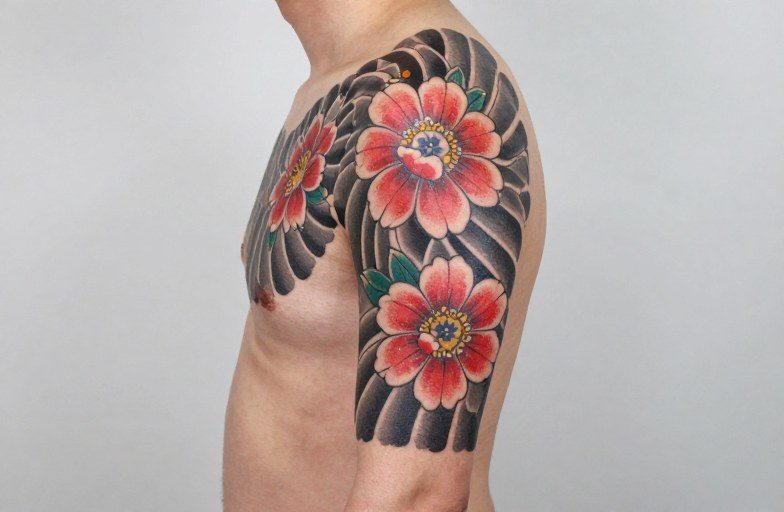
Full sleeves offer the canonical format. Flowers wind around muscle structure, peeking from behind waves, dragons, or other secondary elements. The upper arm’s deltoid curve accommodates peony blooms especially well, the round flower head echoes the shoulder’s mass. Forearms suit cascading cherry blossom branches that can extend toward the wrist or retreat toward the elbow. Line work here needs to account for how the design reads at rest versus with the arm bent; a good artist maps both positions.
Back Pieces and Chest Panels
The back’s broad canvas allows for full chrysanthemum gardens or lotus ponds with water and koi. Chest panels (munewari) traditionally leave the center strip bare, with flowers and imagery flowing across pectorals and wrapping toward the ribs. This placement demands serious commitment, it’s visible in any open collar, and the sternum area hurts significantly during application. Rib placements specifically challenge flower tattoos: the skin stretches and compresses with breathing, which can distort petal symmetry if the artist doesn’t compensate.
Mythology & Folklore
Japanese flower symbolism intertwines with religious and folk narratives rather than existing as pure decorative code.
Buddhist and Shinto Roots
The lotus emerges directly from Buddhist iconography, often linked to the concept of enlightenment rising unstained from muddy water. Temple art shows deities seated on lotus thrones. In tattoo translation, the lotus frequently pairs with Buddhist figures or appears in memorial pieces for deceased family members. The chrysanthemum’s longevity association connects to Shinto reverence for the emperor as divine descendant, with the flower’s sixteen petals appearing in imperial regalia. Some trace it to a legendary Chinese herb of immortality that mutated into the chrysanthemum form in Japanese retelling.
Yakuza and Folk Associations
Peonies earned their “king of flowers” status partly through their visual boldness, large, saturated, unapologetic. In Edo-period woodblock prints, they often surrounded lions in protective compositions. This pairing migrated into tattoo iconography as shorthand for courageous prosperity. Cherry blossoms, meanwhile, carried samurai resonance: the brief bloom paralleling the warrior’s expected short, beautiful death. The flower’s military association persisted into WWII, complicating its symbolism for some contemporary wearers who prefer to emphasize the aesthetic over the martial.
How It Ages on Skin
Japanese flower tattoos age distinctively based on color choice, line weight, and the specific flower’s structural complexity.
Color Fading and Ink Behavior
Red pigments, heavily used in peonies and cherry blossoms, historically showed faster fading than blues and blacks, though modern organic reds have improved stability. The soft pink washes of cherry blossom petals particularly challenge long-term retention; what reads as delicate gradation fresh often muddies to a uniform pale red within a decade. Chrysanthemums with their dense petal layers hold crisper definition longer because the structural lines create visual clarity even as color softens. Yellows and golds, common in chrysanthemum centers, remain among the least stable pigments, frequently shifting toward mustard or disappearing entirely.
Line Work and Shading Longevity
Traditional tebori (hand-poked) application creates softer, less uniform lines than machine work, which paradoxically ages more gracefully, there’s no hard edge to blur. Machine-done Japanese flowers with bold black outlines (sumi) maintain graphic punch but can develop a “stamped” look as skin texture changes with age. The stippled or whip-shaded backgrounds common in irezumi backgrounds tend to hold better than solid color fields, which can patch and heal unevenly.
Similar & Related Symbols
Japanese flower tattoos rarely stand alone in traditional composition. Understanding their common pairings clarifies meaning and design logic.
- Peony and Lion/Shishi: The classic “karajishi” pairing, courage and prosperity combined. The lion (actually a foo dog derivative) protects the wealth symbolized by the flower.
- Cherry Blossom and Waves: Transience meeting constant motion. The waves (often with koi) provide narrative context, struggle, persistence, life’s flow, against which the brief bloom gains poignancy.
- Chrysanthemum and Dragon: Imperial longevity paired with raw power. Dragons in Japanese iconography differ from Chinese versions: three-clawed, more serpentine, associated with water and rainfall rather than pure celestial authority.
- Lotus and Buddhist Figures: Fudo Myoo, Kannon, or Jizo bosatsu often appear with lotus bases or halos. These compositions demand accurate iconographic knowledge, wrong attributes or postures signal ignorance.
- Maple Leaves (Momiji): Seasonal counterpart to cherry blossoms, representing autumn’s mature beauty and the wisdom of age rather than spring’s fleeting youth.
Common Variations & Styles
Contemporary Japanese flower tattoos operate across several stylistic registers, each with different technical and cultural demands.
Traditional Irezumi
Full color, bold outlines, narrative backgrounds of wind, water, or clouds. Flowers serve as secondary elements within larger compositions rather than standalone pieces. The aesthetic demands patience, traditional sleeves take years to complete in multiple sessions. Colors sit saturated and flat, with minimal realistic shading. Cherry blossoms in this style show distinctive five-petal structure with notched tips, never the rounded generic blooms of stock imagery.
Neo-Japanese and Illustrative
Contemporary artists blend Japanese compositional flow with Western realism, watercolor techniques, or black-and-grey approaches. Single-flower designs become viable, an isolated peony on a thigh, a lotus floating on abstract brushstroke waves. These pieces risk cultural dilution but offer more placement flexibility. The critical distinction: even stylized versions should preserve accurate botanical structure. A peony with incorrect petal layering or a lotus with rose-like form betrays the source tradition.
Blackwork and Sumi Variations
Monochrome Japanese flowers emphasize line rhythm and negative space. Tebori blackwork produces a velvety, organic texture impossible to replicate with machines. Sumi-only chrysanthemums read as especially refined, the flower’s complexity must communicate through line weight variation alone, without color to separate petal from petal. This approach suits those who want the cultural reference without the long-term color maintenance commitment.
Key Takeaways
Japanese flower tattoos reward specificity over generic exoticism. Know which flower you’re choosing and why, cherry blossom transience, peony prosperity, chrysanthemum longevity, lotus spiritual emergence. Prioritize large, flowing placements where the design can breathe and move with your body. Expect color softening, especially in reds and yellows, and choose line weight accordingly. Pair flowers with cognate symbols (waves, lions, Buddhist figures) only if you understand the relationship. Most importantly, seek artists with demonstrated fluency in Japanese compositional conventions, not just someone who can copy a Pinterest image. The tradition carries enough depth to justify genuine engagement; surface-level adoption disrespects the source and produces weaker tattoos.
Frequently Asked Questions
Can I get a Japanese flower tattoo if I’m not Japanese?
Yes, but do the homework. Learn the specific flower’s meaning, avoid sacred imagery you don’t understand, and choose an artist who actually knows Japanese compositional conventions rather than someone replicating generic Asian-themed flash.
Which Japanese flower tattoo hurts the most?
Rib and sternum placements cause the most pain regardless of flower choice, but dense petal areas like chrysanthemums require longer sessions, extending discomfort. Large solid color fields in peonies also demand more needle time than line-based designs.
How do I tell if an artist actually knows Japanese tattooing?
Look for accurate petal structure, proper background element relationships, and knowledge of tebori history even if they work by machine. Their portfolio should show flowing compositions, not isolated stamps. Ask why specific flowers pair with specific secondary elements.
Will a black and grey Japanese flower look as good as color?
Black and grey ages more predictably and avoids color-fading issues, but it demands stronger line work to maintain petal separation. Color carries more immediate visual impact and cultural authenticity to traditional irezumi, though sumi-only pieces have their own refined aesthetic.