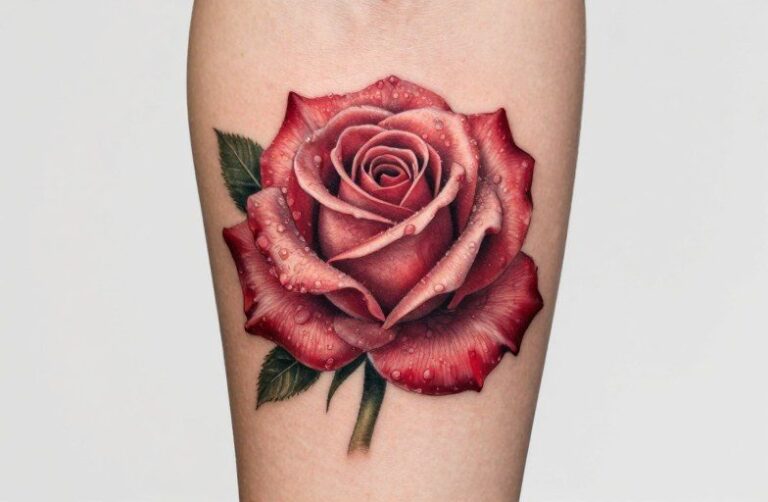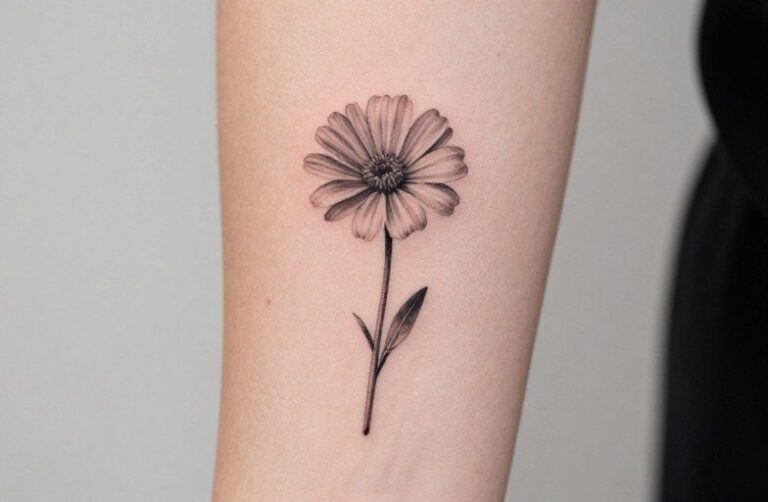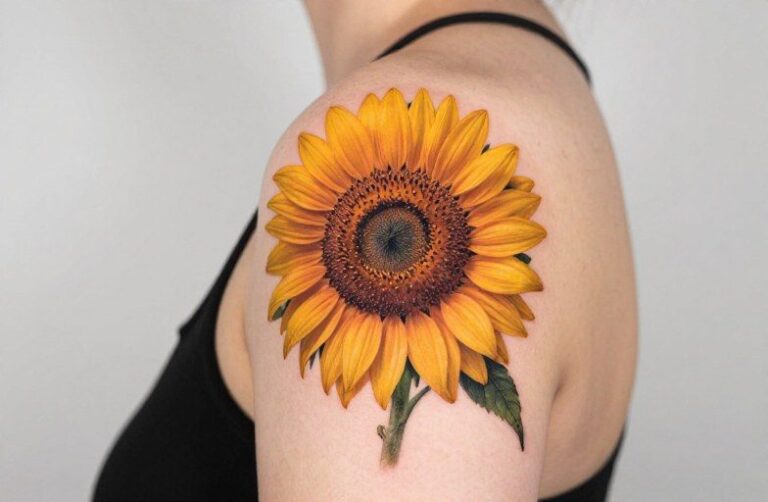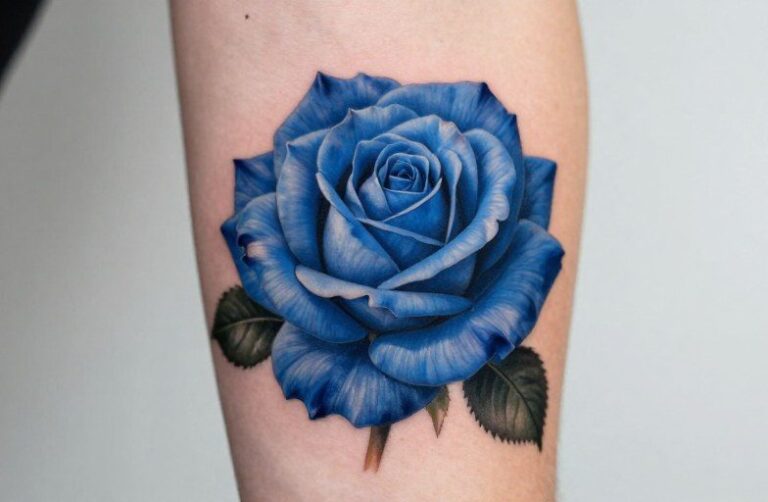
The forget me not flower tattoo most commonly signals remembrance, keeping someone present in memory after death or distance. Beyond mourning, it also speaks to loyalty, faithful love, and connections that persist through time. The small blue bloom carries emotional weight disproportionate to its size, which partly explains its staying power in tattoo culture.
Color vs Black and Grey
Blue Ink: The Traditional Route
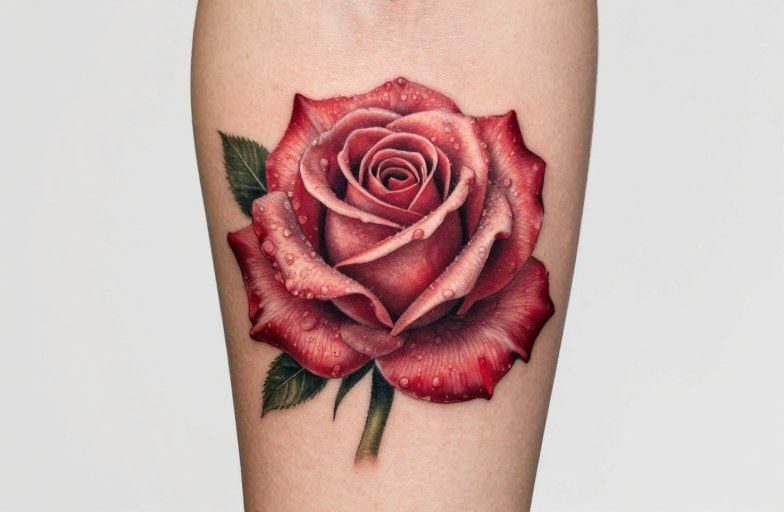
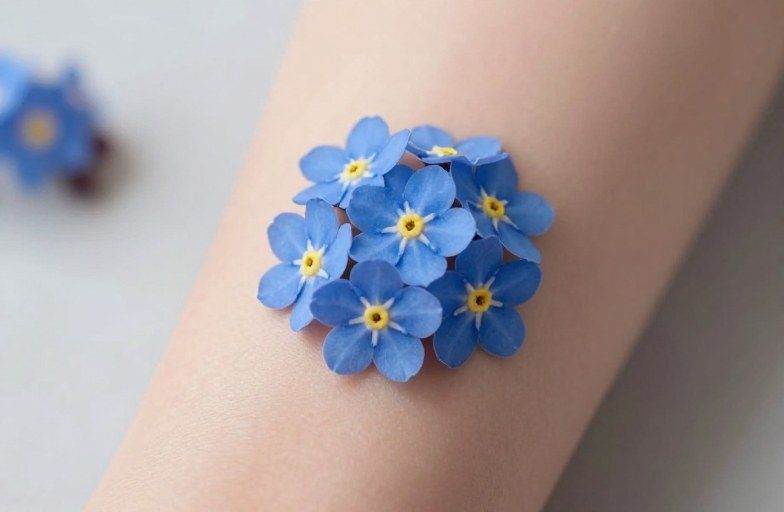
True forget me nots are a distinctive sky-to-cornflower blue with yellow or white centers. Color realism captures this immediately recognizable palette, but blue pigments demand careful consideration. Cobalt and azure inks tend to hold better than lighter sky blues, which can fade toward grey within a few years. Saturated dark blues keep their saturation longer, especially on lighter skin tones where the color reads clearly.
Color packing in small floral designs requires a steady hand. The petals are tiny; blowout risks run higher when working at miniature scale. A skilled artist will build the blue in layers rather than saturating in one pass, preserving the delicate edge quality that makes the flower read correctly.
Related reading: forget me not flower tattoo | small simple flower tattoos | dogwood flower tattoo meaning | cosmos flower tattoo meaning
Black and Grey Interpretations
Stripped of color, the forget me not becomes more ambiguous, readable as generic small flower to the untrained eye. That anonymity can be intentional. Some people prefer the symbolism to stay private, visible only to those who know what to look for. Black and grey also ages more predictably; without color shift concerns, the tattoo settles into a consistent tonal range over decades.
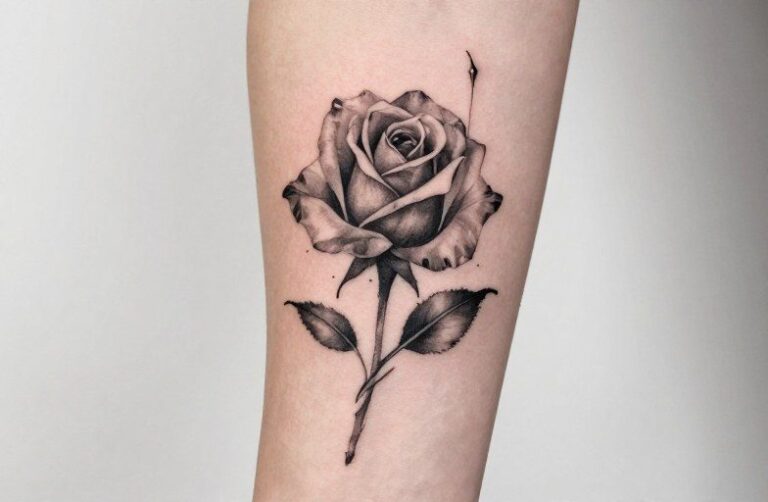
Dotwork and stipple shading suit this flower particularly well. The technique mimics the soft, almost dusty texture of actual forget me not petals. Fine single-needle linework can render the five-petaled structure with botanical accuracy even without color.
Common Variations and Styles
Botanical Realism
Scientifically accurate rendering shows the flowers in loose clusters on thin, hairy stems, with alternate oval leaves. This approach works best at medium scale, at least palm-sized, to accommodate the detail. Artists often source pressed specimens or high-resolution botanical photographs to nail the radial symmetry and the slight notch at each petal’s tip.
- Watercolor backgrounds behind realistic blooms create depth without heavy black outlines
- Single-flower focus versus trailing stem designs change the composition’s flow dramatically
- Negative space highlights within petals add dimension without overcomplicating small pieces
Stylized and Folk Interpretations
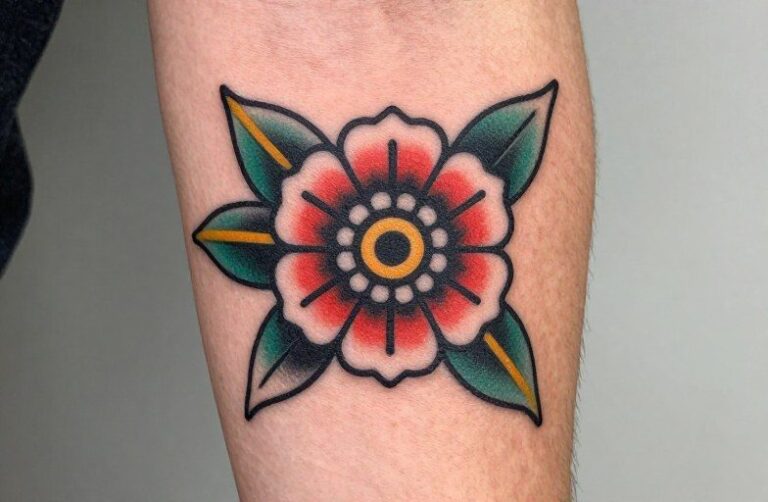
Traditional American tattooing simplifies the flower into bold blue petals with heavy black outlines, sometimes pairing it with banners or hearts. Neo-traditional work pushes the color saturation higher, adding ornamental details or jewel tones. Minimalist line-art versions reduce the bloom to a single continuous stroke, recognizable to the initiated, abstract to others.
Geometric framing has gained traction: the organic flower contained within a triangle, circle, or hexagon. The contrast between soft natural form and rigid structure creates visual tension that reads as contemporary without abandoning the core symbolism.
Design Tips and Pairings
Placement and Scale
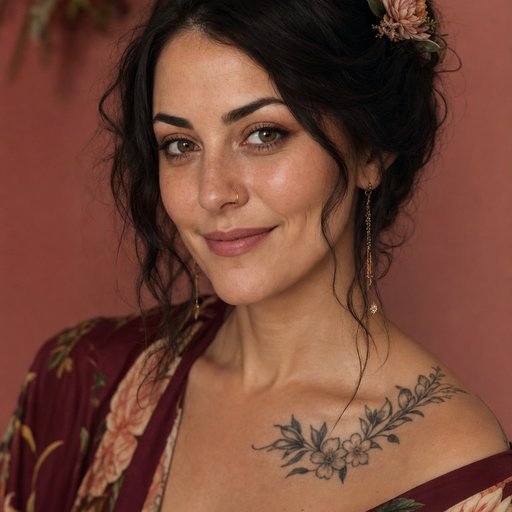
Placement shapes how the tattoo functions. Behind the ear, the forget me not becomes a whisper, visible when hair is up, hidden otherwise. The inner forearm offers more real estate for a small cluster with stem and leaves. Rib and collarbone placements follow the body’s natural lines, the trailing stem echoing bone structure.
I generally advise against going too small. A single flower needs at least two to three inches to hold detail through aging. Clusters with stems and leaves demand more space. The temptation to shrink these tattoos comes from the flower’s actual size in nature, but skin is not paper. Ink spreads, lines soften, and what reads as delicate at six months can become muddy at six years.
Meaningful Pairings
Pairing options extend the meaning without diluting it:
- With a name or date: direct memorial function, though consider whether you want that specificity permanently visible
- With a honeybee or butterfly: pollination imagery, life cycles, transformation alongside remembrance
- With a lock and key: secrets held, or love that persists despite barriers
- With a compass or anchor: finding direction through loss, or staying grounded in memory
Lettering integration demands careful planning. Script weaving through stems works better than text floating above or below the image. The flower’s natural curves should guide the eye through any words rather than fighting them for attention.
Who Chooses This Tattoo
Memorial Contexts
The most frequent motivation: marking loss. Parents, siblings, partners, friends, sometimes pets. The flower’s name itself performs the desired function, a verbal plea made visual. People often time these tattoos around anniversaries of death, though the impulse can strike years later when grief shifts from acute to integrated.
Multiple small forget me nots sometimes represent several losses, or a cluster where one bloom differs, marking a particular relationship within a larger family of grief. This requires careful color planning to avoid visual confusion.
Non-Memorial Meanings
Not everyone carrying this flower mourns. Long-distance relationships, military deployment, immigration and separation from homeland, these separations while both parties live also fit the symbolism. Some choose it as a self-reminder: don’t forget who you were, who you aimed to become. The Alzheimer’s awareness connection, often linked to the flower though not exclusively tied to it, draws some people specifically to that cause.
Couples occasionally get matching or complementary forget me nots, though this carries obvious risk if the relationship ends. The image’s association with enduring love can feel ironic in retrospect.
How It Ages on Skin
Structural Challenges
Small, detailed tattoos face predictable challenges. The fine lines separating petals can blur as skin loses elasticity and ink particles migrate. Blue pigments, particularly lighter shades, are more prone to photodegradation than blacks, sun exposure accelerates fading significantly.
What holds up:
- Slightly larger scale than initially tempting, more room for lines to soften without losing definition
- Darker blue values rather than pastel tints
- Placement on areas with less movement and sun exposure (upper inner arm, thigh, torso)
- Black outlines or grey shading to maintain structure even if color fades
Maintenance Expectations
Touch-ups are normal and expected, especially for color realism. Plan for a refresh at five to ten years depending on placement and your skin’s characteristics. The yellow centers often need attention first, they’re typically the lightest, smallest detail in the design.
Aftercare matters disproportionately for these small color pieces. Scabbing that pulls out fine detail can ruin a miniature flower more easily than a bold design. Follow your artist’s instructions precisely, and resist the urge to pick.
Personal and Modern Meanings
Layered Interpretation
The historical symbolism, often linked to medieval German legends of a knight drowning while gathering the flowers for his lover, persists but no longer dominates. Contemporary wearers layer their own meanings atop this foundation. The flower functions as a flexible symbol, specific enough to carry weight, open enough to accommodate individual narrative.
Some communities have adopted the forget me not for particular purposes. Mental health awareness campaigns use it alongside other symbols. Some trans and non-binary people have found resonance in the flower’s plea to be remembered as oneself. These uses don’t erase older meanings but add layers, and the wearer’s own reason always takes precedence over any official association.
Private vs Public Meaning
The tattoo doesn’t require public explanation. Its power often lies in private significance, the glance in a mirror that reconnects wearer to purpose or person. You don’t owe anyone the story, and the flower works as well as a quiet personal anchor as it does a visible statement.
That said, placement can calibrate visibility. Behind the ear or on the rib keeps it close. The forearm or wrist invites question, which you can answer or deflect as you choose. Consider this social dimension when planning, not because you must share, but because you should control whether you do.
Before You Decide
The forget me not endures because it does heavy work in a small package. It acknowledges pain without dwelling in it, names love without sentimentality, and fits wherever you need it, physically and emotionally. Choose an artist who understands botanical structure and respects the scale. Give it good placement, protect it from sun, and let it settle into your skin’s story at its own pace. The meaning you bring to it will outlast any trend.
Frequently Asked Questions
Does the forget me not tattoo always mean someone died?
No. While memorial use is common, people also choose it for living separation, long-distance relationships, personal reminders, or loyalty symbolism. The meaning depends on the wearer’s intention, not a fixed rule.
What’s the best size for a forget me not tattoo?
At least two to three inches for a single flower with detail, larger for clusters with stems and leaves. Going too small risks muddled lines as the tattoo ages and settles into skin.
Do forget me not tattoos work on dark skin tones?
Yes, though color choice matters. Deep, saturated blues and strong black outlines read more clearly than light or pastel shades. A skilled artist can adjust value contrast to ensure the design holds over time.
How long does blue ink last in forget me not tattoos?
Darker blues can hold well for a decade or more with proper care and sun protection. Lighter sky blues tend to fade faster, often shifting toward grey within several years. Plan for touch-ups every five to ten years depending on placement and lifestyle.
Can I add a forget me not to an existing tattoo?
Yes, the small scale and flexible composition make it a good filler or accent piece. It works woven into existing floral arrangements, tucked into gaps in larger designs, or trailing from other elements. Discuss integration with your artist to ensure consistent style and flow.