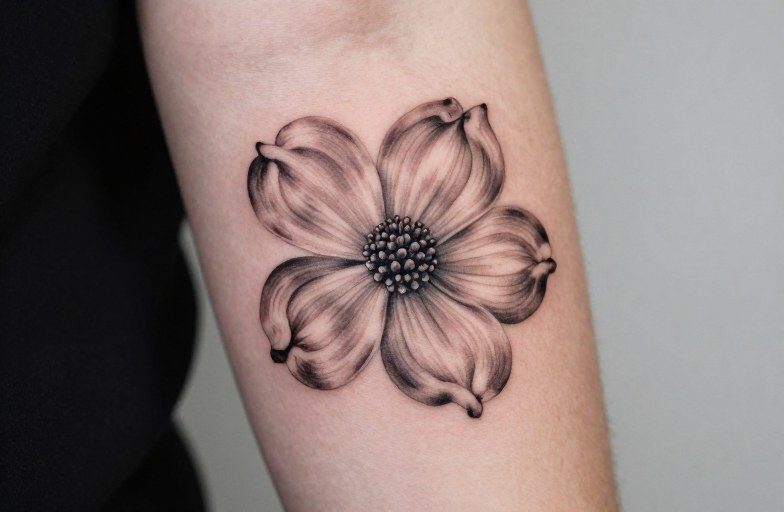
The dogwood flower tattoo most commonly signals faith, resilience, and the ability to endure hardship without breaking. For many, it layers Christian symbolism, the crucifixion narrative, over a more universal reading of delicate beauty that outlasts harsh conditions. The design appeals to people who want something visually soft that still carries weight, and it works across a range of styles from fine-line botanical studies to bold traditional pieces.
Symbolism & Core Meaning
Four petals, notched at the tips, form the dogwood’s signature cross-like shape. That geometry alone gives the flower its symbolic punch. The center cluster of tiny flowers, the actual reproductive parts, reads visually as a crown of thorns in the Christian telling, or simply as concentrated life force in a secular reading.
Endurance Through Hardship
Dogwood trees bloom early, often while late frosts still threaten. The flower’s brief but intense display, followed by the tree’s modest summer presence, maps neatly onto experiences of surviving something difficult and carrying the mark of it. This makes the tattoo particularly resonant for people marking recovery from illness, loss, or major life disruption, not because the flower “cures” anything, but because it visualizes the pattern of blooming after damage.
Regional Identity
In the American Southeast, the dogwood is state flower or tree to North Carolina and Virginia, and strongly associated with the broader region. A dogwood tattoo can function as permanent homesickness insurance, or as a quiet signal of origin to those who recognize it. The identification runs deeper than generic “southern pride” imagery, it’s specific to the Appalachian and Piedmont landscapes where the understory tree dominates spring forests.
Mythology & Folklore
The most widespread narrative, commonly associated with the flower but not traceable to any single historical text, claims the dogwood once grew large and strong enough for timber, and was cursed to remain small and twisted after being used for the crucifixion cross. The petal notches represent nail wounds; the center, the crown of thorns. Some trace this story to 19th-century American hymnody and folk preaching rather than biblical source material.
Separately, Indigenous uses of dogwood bark, often linked to traditional medicine practices, create a different symbolic layer for some wearers, though this requires careful handling to avoid appropriative use of specific ceremonial meanings not one’s own.
Common Variations & Styles
How you render the dogwood changes what the tattoo communicates as much as the choice of subject itself.
Botanical Realism vs. Stylized
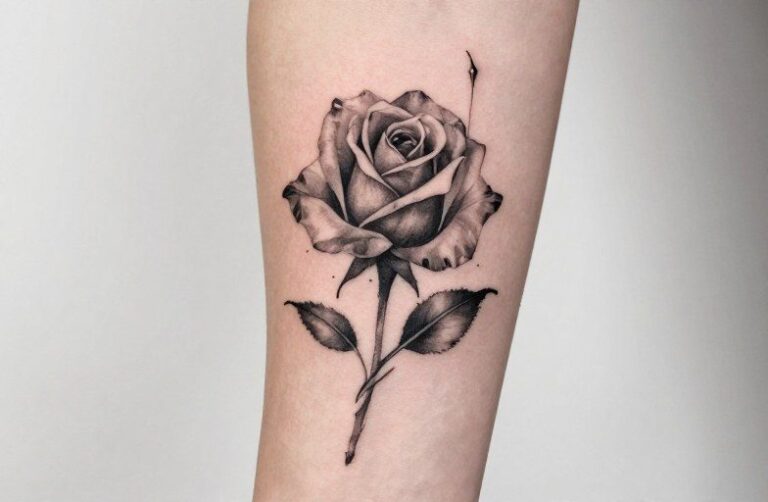
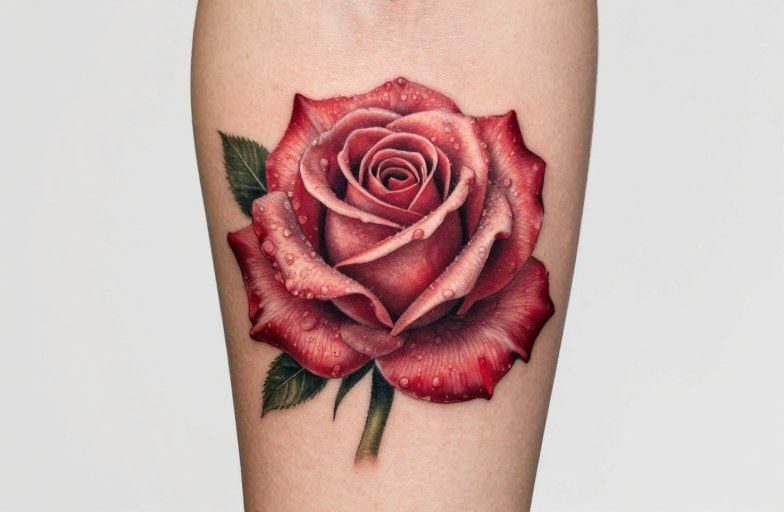
Hyperrealistic dogwood tattoos, with veining visible on white or pink petals and accurate green bracts, read as nature documentation, appreciation of the thing itself. Traditional or neo-traditional treatments with bold outlines and limited color shift the meaning toward folk symbolism, the flower as icon rather than specimen. Japanese-influenced approaches sometimes pair dogwood with other regional flora, creating hybrid compositions that don’t fit neatly into either symbolic tradition.
Color Choices and Aging
- White dogwood: Most common, most directly tied to the Christian narrative. White ink and light pinks fade faster than darker pigments, requiring touch-up planning.
- Pink varieties: Slightly softer symbolic reading, more purely aesthetic. The ‘Cherokee Brave’ cultivar’s deep pink holds more visual punch over time.
- Black and grey: Removes the color-coded religious association entirely, emphasizes form and endurance symbolism. Ages more predictably than color work.
Placement matters for longevity: inner arm and upper chest hold detail better than hands or feet, where the fine lines of realistic petal work tend to blur within a few years.
Religious & Spiritual Angles
The Christian reading dominates American awareness of dogwood meaning, but it’s not the only spiritual framework. The flower’s early spring emergence aligns with pagan and secular celebrations of renewal and return. For wearers without Christian affiliation, the cross-shaped petal formation can read as coincidence or as absorbed cultural vocabulary rather than active religious statement.
Some people split the difference: wearing the dogwood as memorial tattoo for a religious parent or grandparent, honoring the symbol’s meaning to that person without fully claiming it as their own. This creates a second-generation symbolic use that’s increasingly common as tattooed generations age.
Who Chooses This Tattoo
There’s no single demographic, but patterns emerge. People with connections to the southeastern United States, whether current residents or transplants, often gravitate toward the design as regional marker. Those who’ve experienced significant health challenges sometimes select it for the endurance narrative, particularly if they encountered dogwood imagery during that period, hospital art, chapel visits, spring recovery walks.
The tattoo also appears as parent memorial, the flower’s brief blooming season mapping onto the grief of losing someone who was central but is now absent. Less commonly, it’s chosen purely for aesthetic reasons by people who simply respond to the flower’s structure, though most wearers do know at least the surface level of symbolic association.
Similar & Related Symbols
Understanding what the dogwood isn’t helps clarify what it is.
Near Alternatives
- Cherry blossom: Japanese tradition, impermanence and beauty’s briefness. More internationally recognized, less specifically American, no Christian layer.
- Magnolia: Also southern, but grander, more overtly feminine in conventional reading, less tied to hardship narrative.
- Dogwood branch with berries: Shifts timing to fall, changes meaning toward provision and persistence rather than spring renewal.
Combinations and Accents
Crosses integrated with dogwood petals make the Christian reading explicit. Names and dates worked into the design push it toward memorial function. Pairing with scripture reference, often John 19 or similar crucifixion passages, completes the religious framing. Without these additions, the flower retains more ambiguity, which many wearers prefer.
Final Thoughts
The dogwood flower tattoo works because it carries multiple readable meanings without requiring explanation. Someone seeing it can register it as pretty, as southern, as religious, or as personally significant without knowing which layer matters most to the wearer. That flexibility is its strength and its limitation, it doesn’t announce itself as aggressively as some symbols, which suits people who want their tattoos to invite question rather than declare position.
What holds up over time is the form itself: four petals, notched, surrounding a dense center. Whether rendered in fine lines that will need refreshing or bold traditional weight that ages more forgivingly, the dogwood remains recognizable even as the specific circumstances of its choosing fade from immediate memory. The tattoo becomes, like the tree, something that persists in the understory, present, specific, not demanding attention but holding its ground.
Frequently Asked Questions
Does a dogwood tattoo have to be religious?
No. While the Christian crucifixion narrative is commonly associated with the flower, many people wear it for regional identity, personal endurance, or simply aesthetic preference. The meaning depends on your intention and any accompanying elements like crosses or scripture.
Where’s the best placement for a dogwood flower tattoo?
Upper arm, forearm, and upper chest hold fine detail well and allow for naturalistic sizing. The shoulder blade works for larger branch compositions. Avoid hands and feet if you want realistic petal detail to last, these areas blur faster due to movement and sun exposure.
How much does a dogwood tattoo typically cost?
A small simple design might run $150-300, while detailed multi-flower pieces with color can reach $500-800 or more depending on artist rates and location. Botanical realism generally costs more than stylized traditional work due to time required.
What’s the difference between dogwood and cherry blossom tattoos?
Cherry blossoms carry Japanese cultural associations of impermanence and mono no aware (pathos of things). Dogwood is specifically American, tied to Christian and southeastern U.S. symbolism, and emphasizes endurance rather than transience. Visually, dogwood has four notched petals; cherry blossom has five rounded ones.