Flower tattoos carry layered symbolism rooted in culture, botany, and personal association. A peony on a shoulder reads differently than a peony on a ribcage, and a black-line rose ages into something softer than a fully saturated one. Understanding what specific flowers have meant historically, and how those meanings shift with placement, color, and style, helps you choose something that won’t feel arbitrary in ten years.
Religious & Spiritual Angles
Flowers have served as spiritual shorthand for centuries, though the connections are often more tangled than tattoo culture admits.
The Lotus and Sacred Geometry
The lotus rising from mud is commonly associated with Buddhist and Hindu traditions, but its meaning fragments across contexts. In some Buddhist schools, it represents purity of mind; in others, the gradual unfolding of enlightenment. The eight-petaled lotus often linked to the Noble Eightfold Path is a specific design choice, not a universal default. A lotus paired with unalome symbols creates a different spiritual claim than a lotus standing alone. For tattooing, the lotus also offers practical advantages: its radial symmetry works well on curved surfaces like knees and shoulders, and its layered petals give artists room to show depth with line weight variation.
Christian and Pagan Threads
The rose, particularly the five-petaled wild rose, has medieval Christian associations with the Virgin Mary and the wounds of Christ. Some trace it to the rosary itself. Meanwhile, the lily, often linked to resurrection and purity, appears in older European folk traditions as a death flower, placed on graves. The chrysanthemum in Japanese Buddhist practice is connected to funerals and the imperial family, a dual meaning that can surprise Western wearers. None of these symbols translate cleanly across bodies or belief systems; the spiritual weight depends on what the wearer actually holds, not what a chart assigns.
Similar & Related Symbols
Flower tattoos rarely exist in isolation. The surrounding imagery reframes the bloom entirely.
- Skulls with roses: The pairing is often linked to Mexican Día de los Muertos traditions, but the specific flower matters, marigolds (cempasúchil) are the traditional choice, not roses. A rose with a skull carries more European memento mori baggage.
- Snakes and flowers: The Garden of Eden association is obvious, but Japanese irezumi uses snakes with peonies or cherry blossoms to represent protection against evil or the cycle of destruction and renewal.
- Clocks or hourglasses: These pairings with wilting flowers emphasize impermanence. A fully bloomed flower with a stopped clock reads differently than a bud with a running one.
- Daggers and swords: Often read as betrayal or sacrifice, but the flower type changes the tone. A dagger through a rose suggests romantic pain; through a lily, something more ceremonial or funereal.
Butterflies and bees are frequent companions, though the ecological relationship varies. Bees pollinate; butterflies don’t reliably. A bee with a flower suggests active participation, industry, mutual dependence. A butterfly with a flower reads more as transient beauty, coincidence, the fleeting moment.
Design Tips & Pairings
Color choice in flower tattoos does more than match natural appearance, it shifts symbolic register and affects how the piece ages.
Color as Symbol and Practical Choice
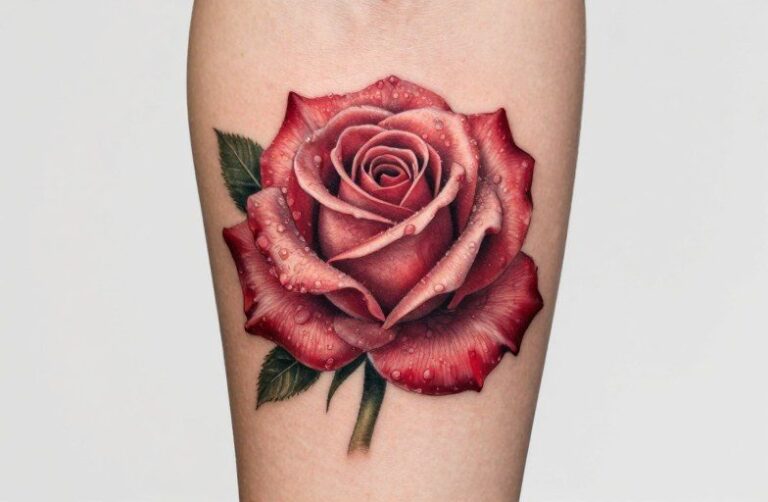
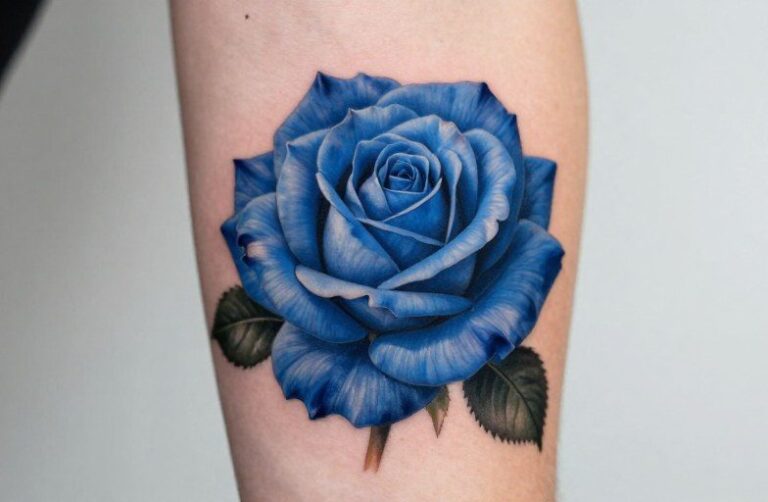
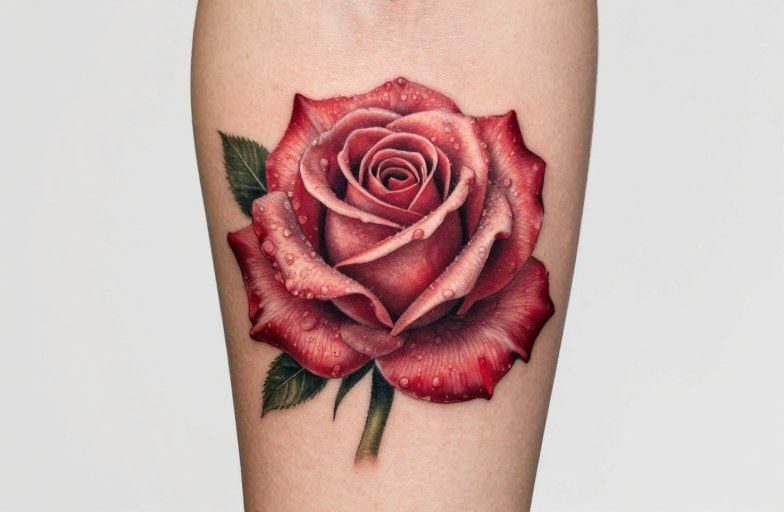
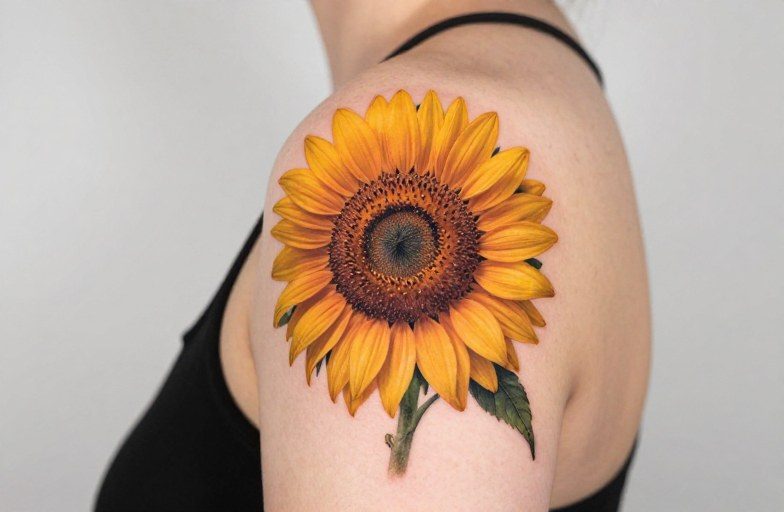
Red roses carry passion and romantic love in Western contexts; yellow roses traditionally signify friendship, though some older sources associate them with jealousy. White roses suggest purity or new beginnings. Black roses don’t occur in nature, so they immediately signal artifice, gothic subculture, or memorial. For longevity, saturated reds and oranges generally hold better than pastels or very light yellows, which can fade to skin tone within a few years on lighter complexions. Dark purples and blues sometimes heal with muddy undertones depending on the ink batch.
Line Work vs. Shading
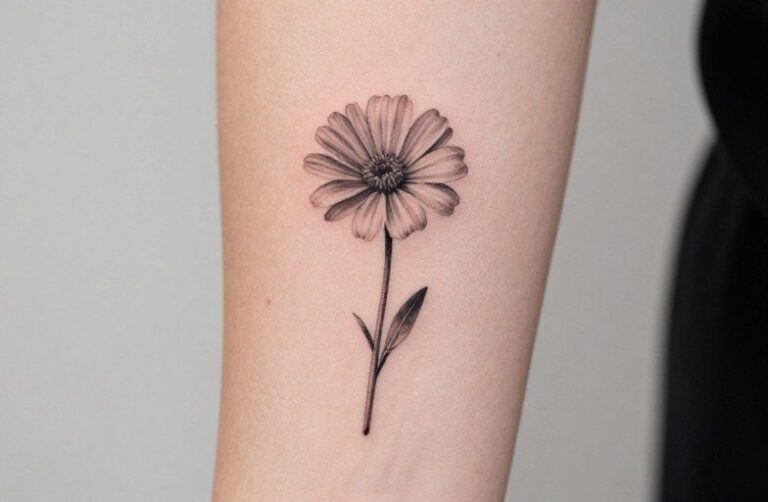
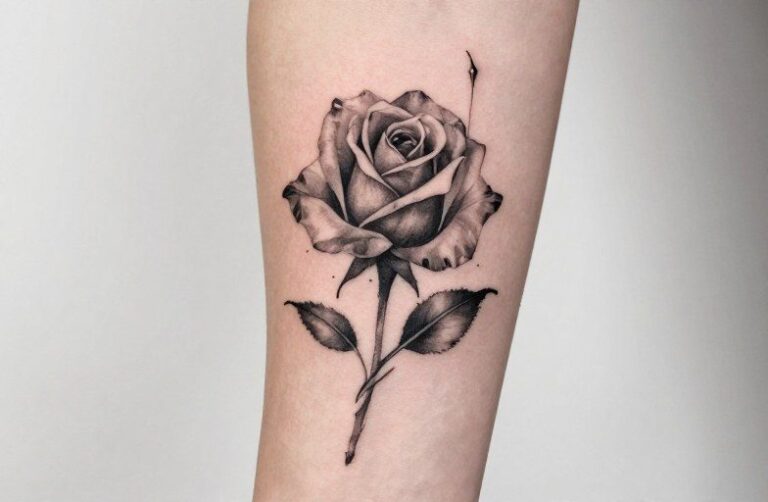
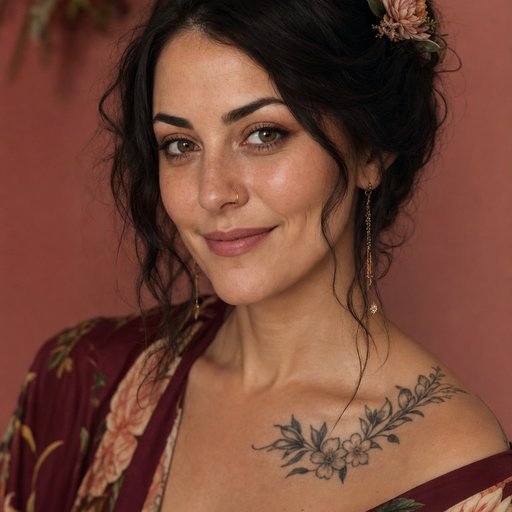
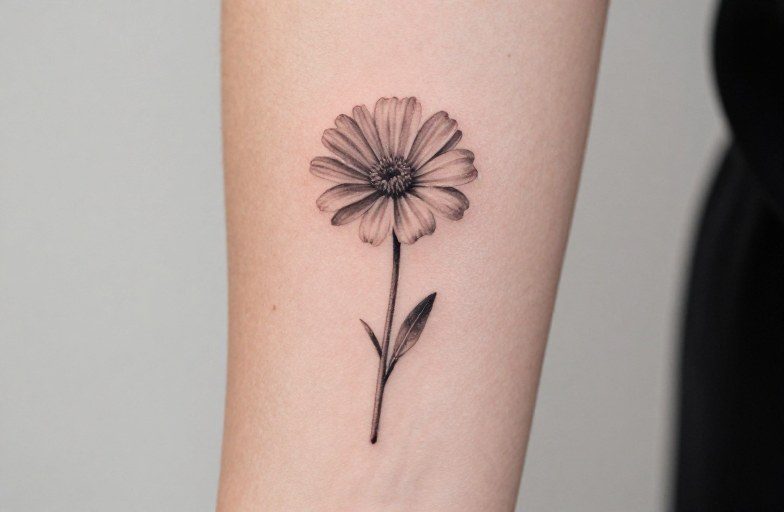
Single-needle fine line flowers have dominated recent years, but the style carries risks. Thin lines blur faster, especially on high-movement areas like wrists and ankles. A fine-line peony may look delicate at six months and indistinct at six years. Bold traditional or neo-traditional approaches with heavier outlines and limited color palette age more predictably. Japanese tebori-style shading creates soft gradients that mimic natural petal texture but requires specialists and longer sessions. Watercolor-style flowers without outlines are the fastest to degrade; the lack of structural lines means blur affects the entire image, not just detail.
Best Placements
Where a flower goes changes how it’s read and how it survives.
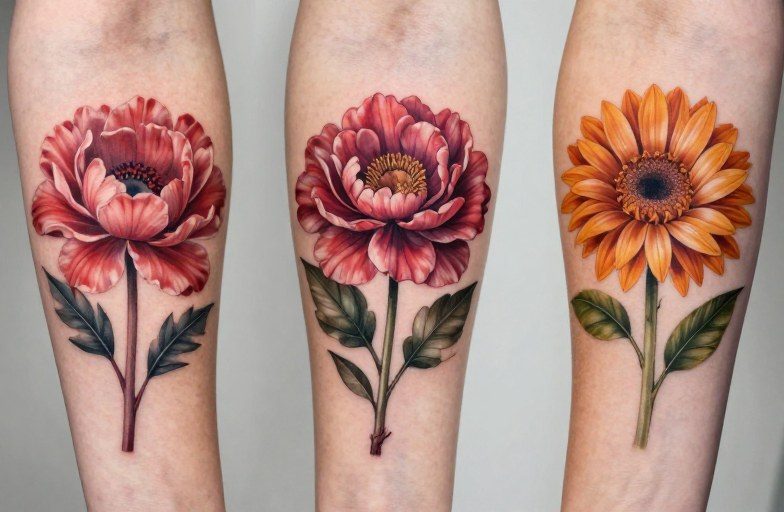
- Forearms and calves: Flat, stable skin that shows well and ages moderately. Larger blooms like peonies and chrysanthemums work here; the surface area allows for detail without crowding.
- Ribs and sternum: Painful, but the vertical space suits stemmed flowers, lilies, tulips, irises, with natural upward movement. The proximity to the heart lends itself to roses and other love-associated blooms, though this reading is more cultural reflex than fixed meaning.
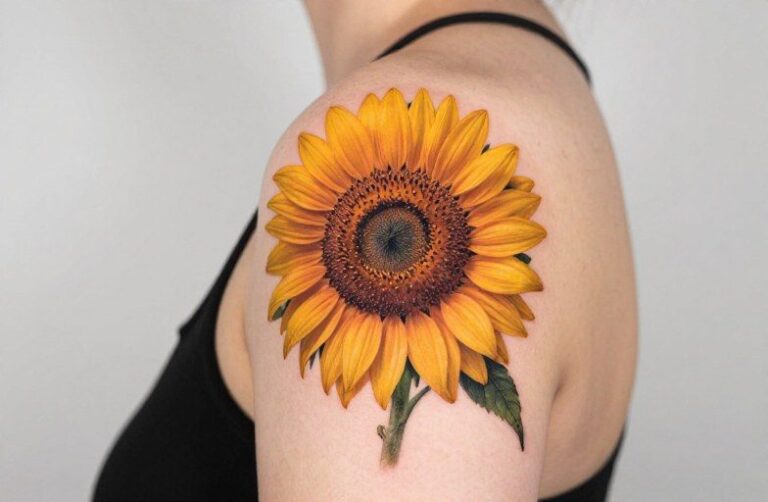
- Shoulders and upper back: The curve of the shoulder blade mirrors the curve of many flower forms. Lotus designs and mandala-adjacent flowers sit well here. The skin is relatively stable, though sun exposure can be an issue for pieces that extend toward the neck.
- Hands and fingers: Small, simple flowers only. Finger tattoos blur and fade rapidly; a detailed rose becomes a pink smudge. Single-petal designs or minimal buds are more honest choices.
- Feet and ankles: High wear, poor healing, significant fade. Any flower here should be designed with bold lines and limited fine detail. The traditional “ankle bracelet” of small flowers is a maintenance commitment.
Behind the ear and on the neck are visible, statement placements. A flower there is harder to conceal for professional contexts, which may or may not matter to you, but the placement itself becomes part of the meaning, public, not private.
Common Variations & Styles
Style conventions carry their own symbolic weight beyond the flower itself.
Traditional and Neo-Traditional
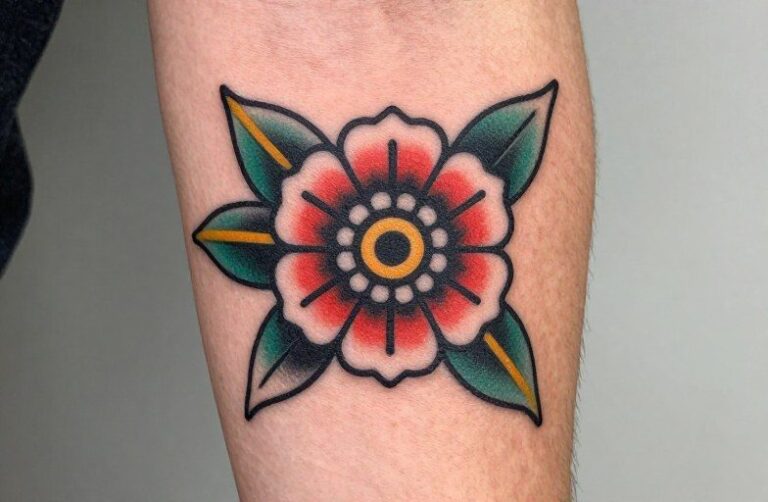
American traditional roses, with their heavy black outlines, limited shading, and saturated reds or yellows, read as tough, timeless, slightly masculine-coded in historical context. Neo-traditional allows more color variation, more naturalistic petal structure, but keeps the bold outlines. These flowers don’t pretend to be botanical illustrations; they’re symbols first, flowers second. A traditional rose means something closer to “tattoo culture itself” than to a specific garden variety.
Japanese and Botanical Realism
Japanese peonies, cherry blossoms, and chrysanthemums follow specific compositional rules, wind bars, waves, negative space usage, that affect meaning. A peony in a Japanese sleeve surrounded by waves and wind suggests protection and prosperity; the same peony in photorealistic grayscale on a bicep reads as appreciation of beauty, possibly memorial. Botanical realism demands technical precision; the artist must understand how petals overlap, how light falls, how stamens protrude. Errors in realism are obvious. Stylized work has more forgiveness.
Personal & Modern Meanings
Contemporary flower tattooing has loosened from fixed symbolism into more personal territory, though the old associations still echo.
Birth flowers are a common framework, carnations for January, violets for February, daisies for April, but the system is inconsistent across sources. Some lists use different flowers; some months have multiple options. The personal meaning comes from the choice to use a birth flower at all, not from the flower’s inherent properties. Similarly, memorial flowers, often linked to funeral arrangements or a deceased person’s favorites, derive meaning from relationship, not mythology.
Some modern wearers choose flowers for their ecological or regional significance: native wildflowers for home states, endangered species for environmental commitment, invasive species for complex commentary on belonging and displacement. A California poppy carries different weight for someone born there versus someone who moved there; the tattoo doesn’t resolve that ambiguity, it holds it.
Gender associations have shifted too. Roses were once heavily feminine-coded in mainstream American tattooing; now they appear across gender presentations, often with deliberate subversion of old norms. The meaning is in the choice to reclaim or reject the coding, not in the flower itself.
Final Word
Flower tattoos work because they’re legible, everyone recognizes a rose, a lotus, a sunflower, but that legibility is a double edge. The symbols are so available that they risk emptiness without personal grounding. The best flower tattoos come from knowing why this specific flower, in this specific style, in this specific place, at this specific time. The historical meanings are a starting point, not a destination. A peony for prosperity means nothing if you don’t care about prosperity; a wilted rose for lost love means everything if you do. The tattoo will age with you. The question is whether you’ll still recognize what it meant when you look at it in twenty years.
Frequently Asked Questions
Do flower tattoos have to mean something specific, or can they just be decorative?
They can absolutely be decorative. A flower chosen for pure aesthetic appeal is valid. The risk comes when you later wish it carried more weight, hard to retrofit meaning onto a purely visual choice.
Which flower tattoos fade the fastest?
Light yellows, pale pinks, and watercolor styles without outlines fade fastest. Fine-line details in petals and stamens blur within a few years on high-movement or sun-exposed skin.
Can I combine multiple flowers with different meanings in one tattoo?
Yes, but consider whether the meanings complement or conflict. A rose with a lily creates a different narrative than a rose with a thistle. The arrangement and interaction between blooms matters as much as the individual symbols.
Are there flowers that tattoo poorly or are hard to execute?
Orchids and lilies with complex internal structures challenge artists in small sizes. Dandelions and other seed-head flowers are popular but difficult to keep delicate; they often heal heavier than intended.