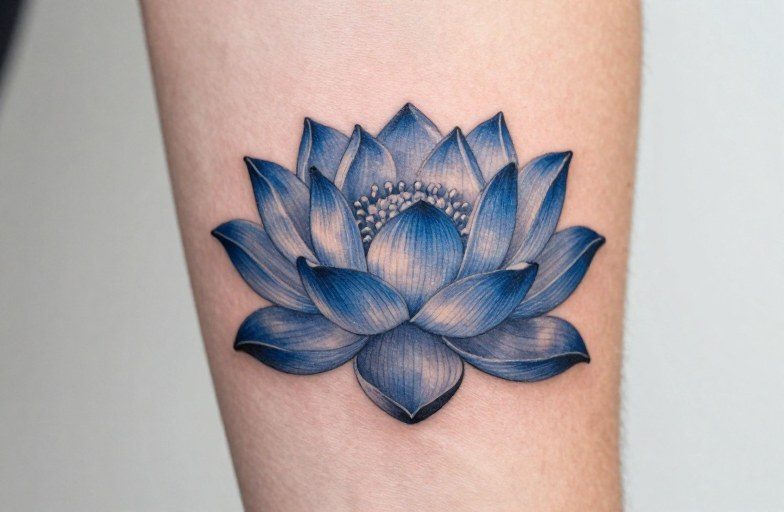
The blue lotus tattoo carries layered meaning rooted in ancient Egyptian and Buddhist symbolism, where this rare flower represented rebirth, spiritual awakening, and the triumph of rising through murky conditions toward light. On skin, it functions as a mark of personal transformation, resilience, or quiet devotion to growth. The blue variety specifically, distinct from the more common pink or white lotus, adds notes of mystery, the unconscious, and cosmic or nocturnal energy to the broader lotus vocabulary of purity and enlightenment.
Symbolism and Core Meaning
The lotus grows with its roots deep in mud, its stem through water, its bloom above the surface. That biological fact shapes every symbolic reading. The blue lotus, Nymphaea caerulea, carries specific associations often linked to ancient Egyptian ritual and art, where it appeared in scenes of birth, death, and the afterlife. Some trace it to solar mythology; the flower’s daily opening and closing made it an emblem of cyclical renewal, though scholars debate the exact timing and significance.
In Buddhist contexts, the lotus broadly represents purity of body, speech, and mind rising from worldly attachment. The blue lotus specifically, sometimes called the “wisdom lotus,” connects to the victory of the spirit over the senses, the mind’s capacity to transcend rather than merely endure. That distinction matters for placement and design choices. A blue lotus positioned over the heart reads differently than one ascending the spine or floating on a forearm.
Related reading: blue lotus tattoo meaning | lotus color meaning | lotus flower tribal tattoo | strength lotus flower tattoo
The Color’s Specific Weight
Blue in tattoo ink behaves distinctively. Cobalt and sapphire pigments sit deeper in the visual field than warm colors, creating a receding, contemplative quality. Psychologically, blue signals depth, calm, and distance. Combined with lotus structure, the color pushes the symbol toward introspection rather than celebration, less “I overcame,” more “I am still becoming.”
Color vs Black and Grey
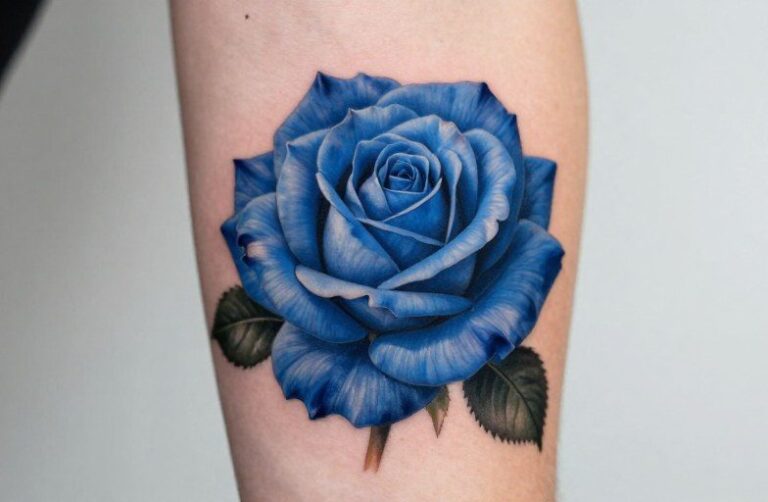
Color blue lotus tattoos demand technical consideration. Blue pigments, especially lighter cerulean or sky tones, fade faster than black and grey. A fully saturated navy or royal blue holds longer but limits the subtle gradation that makes lotus petals appear dimensional. Many artists solve this with a hybrid approach: black and grey structural shading with selective blue placement, perhaps the flower’s center, a single petal edge, or water surrounding the bloom.
What Fades and What Holds
- Light blue washes: tend to fade fastest, especially on high-sun areas like shoulders, forearms, and hands
- Deep blue linework: holds structure comparable to black, though undertones may shift toward green or grey as the tattoo ages
- Black and grey with blue accent: the most stable long-term strategy, preserving readability even as color shifts
- White highlights on blue petals: often disappear within a few years, becoming invisible against lighter skin tones
Skin tone affects perceived saturation. On darker skin, blue lotus designs benefit from deeper saturation and bolder outlines to maintain visual presence. On very fair skin, lighter blues can appear luminous but risk washing out over time.
Common Variations and Styles
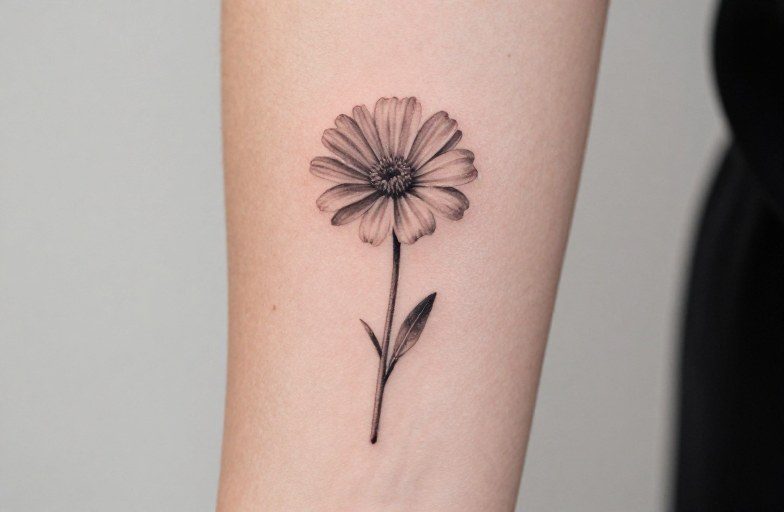
The blue lotus adapts across tattoo vocabulary, but certain approaches dominate. Single-needle fine line renders the petals with botanical precision, emphasizing the flower’s geometric perfection, each petal overlapping in strict mathematical sequence. This style suits smaller placements: wrist inner surface, behind the ear, along the collarbone. The trade-off is longevity; fine lines blur faster, and blue pigment in thin lines can disappear into a hazy suggestion.
Traditional and Neo-Traditional Approaches
Japanese-influenced work treats the lotus as part of a larger water-garden or koi composition, often with deep blue petals against grey-green leaves, the whole image wrapped around an arm or leg. American traditional compression, bold black outline, limited color palette, heavy saturation, flattens the flower into an emblem rather than a study. Both approaches age better than delicate alternatives because they rely on structural boldness over subtle color transition.
Geometric and Abstract Interpretations
Some designs fracture the lotus into dotwork mandalas or sacred geometry, the blue appearing as a single central point or gradient wash within otherwise black linework. Others reduce the flower to negative space, the blue skin showing through a black outline of petals. These variations shift meaning toward meditation, order, and cosmic pattern rather than organic growth.
Personal and Modern Meanings
Contemporary wearers rarely approach the blue lotus through strict religious adherence. More commonly, it marks specific life transitions: recovery from addiction, surviving depression, leaving a destructive relationship, or simply a commitment to ongoing self-work. The flower’s daily cycle, submerging at night, emerging clean each morning, resonates with people rebuilding routine and stability.
Some choose it after travel to Southeast Asia or Egypt, the tattoo functioning as compressed memory rather than spiritual declaration. Others connect it to sleep and dream work, given the blue lotus’s historical association with altered states and nighttime. That meaning requires careful handling; the flower’s actual psychoactive properties are mild and disputed, and tattoo imagery referencing drug experience can read differently than intended as the wearer ages.
Who Chooses This Tattoo
The blue lotus crosses gender lines more evenly than some floral designs, perhaps because its symbolism emphasizes action and transformation over passive beauty. You will find it among therapists, social workers, and nurses who witness daily struggle and want a private marker of why they continue. Artists and musicians gravitate toward it as well, drawn to the creative tension between structure, the petals’ perfect geometry, and fluidity, water, color, growth.
Placement Patterns
The upper back between shoulder blades offers a natural canvas for the lotus’s radial symmetry, the spine echoing the stem. Inner forearms allow self-viewing, the tattoo functioning as a personal anchor rather than public statement. Ankles and feet connect to the root-in-mud symbolism literally, though these placements hurt more and fade faster. Sternum and rib placements have gained popularity, the flower’s center aligning with the heart or solar plexus, though the curvature of ribs challenges the symmetry that makes lotus designs visually satisfying.
Similar and Related Symbols
Understanding the blue lotus means distinguishing it from close relatives. The unalome, a Buddhist symbol of the path to enlightenment, sometimes incorporates a lotus at its terminus; combining the two amplifies the spiritual trajectory but narrows the meaning toward specifically Buddhist practice. The om symbol paired with lotus does similar work. The Egyptian ankh with blue lotus connects to afterlife and rebirth mythology, though this combination risks aesthetic clutter unless handled with restraint.
The standard pink or white lotus carries broader, more universally recognized associations. Choosing blue specifically signals a desire for distinction, for the nocturnal and mysterious over the openly radiant. Water lilies, Nymphaea species without the sacred associations, look similar but carry no symbolic weight. Botanical accuracy matters if the meaning is the point.
Before You Decide
Research your artist’s healed work, not just fresh photos. Blue lotus tattoos require confident color packing and smooth gradient work; ask to see examples of blue flowers specifically, not just color work generally. Consider how the blue will interact with your existing tattoos or future plans. Cool tones recede, which can create visual holes in a predominantly warm-color collection.
Think about scale. The lotus’s layered petal structure needs minimum size to read clearly; below two inches, it becomes a blue blob as it ages. Conversely, large back pieces demand enough surrounding elements, water, leaves, geometric framework, to prevent the flower from floating awkwardly in empty space.
Finally, sit with the meaning long enough to know whether you want the symbol for what you’ve survived, what you’re becoming, or both. The blue lotus accommodates all these readings, but clarity about your own intention shapes every downstream decision: color saturation, placement, accompanying imagery, and whether you want it visible or concealed.
Frequently Asked Questions
Does a blue lotus tattoo have to be religious?
No. While the symbol carries historical weight in Egyptian and Buddhist traditions, most contemporary wearers choose it for personal rather than doctrinal reasons. Recovery, transformation, and ongoing growth are the most common meanings I see in consultation.
How long does blue ink last in a lotus tattoo?
Deep blues hold for years with proper care and sun protection. Light blues and white highlights fade faster, often within several years. Black and grey with blue accents offers the most stable long-term approach.
What is the best placement for a blue lotus?
The upper back and inner forearm work well for visibility and symmetry. Avoid areas with constant sun exposure or friction if you want color to hold. The sternum and ribs are popular but challenging for the artist due to curvature.
How do I choose between color and black and grey?
Consider your skin tone, existing tattoos, and patience for touch-ups. Color makes the nocturnal, mysterious quality explicit. Black and grey with blue accents preserves the symbol while minimizing maintenance.