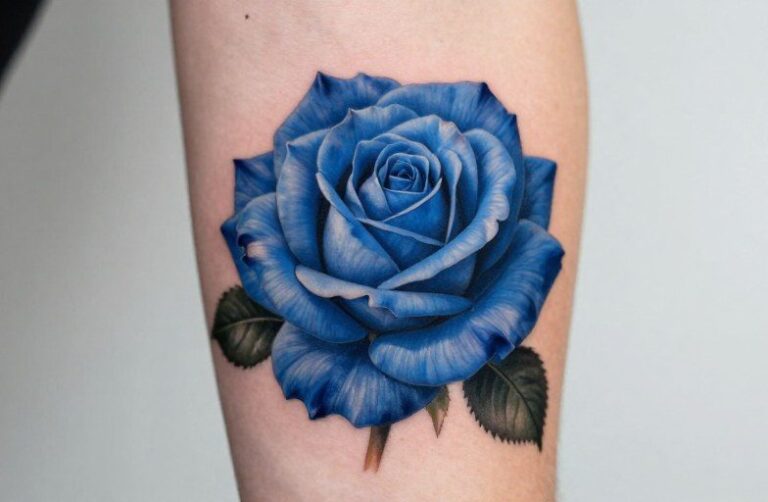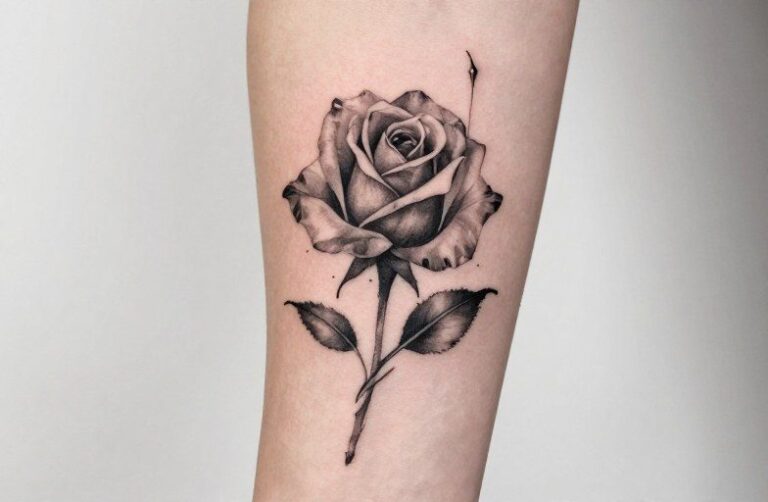
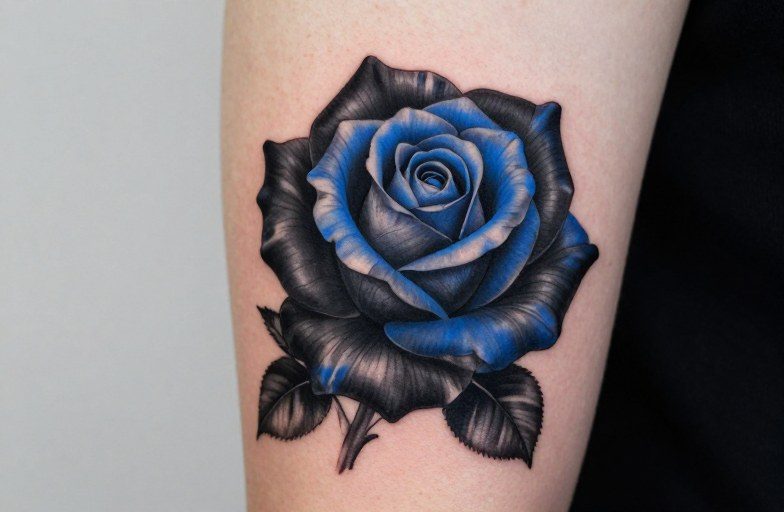
The black and blue rose tattoo carries a layered, sometimes contradictory symbolism. Black roses traditionally signal death, farewell, or rebellion against romantic norms. Blue roses, biologically impossible in nature until recent genetic engineering, represent the unattainable, mystery, or a fresh start after hardship. Combined, these two colors create a tension between mourning and hope, between what is lost and what might still be imagined.
Symbolism & Core Meaning
Most people who choose this design aren’t picking a single, tidy meaning. The color pairing invites multiple readings that often coexist in the same piece.
Loss and What Comes After
Black ink dominates the mourning associations. In Victorian floriography, a truly black rose meant tragic romance or the end of something significant. The blue layered in softens that finality. Where a solid black rose can feel like a period at the end of a sentence, the blue introduces a question mark, grief that hasn’t settled, or a belief that something follows. This makes the design common among memorial pieces where the wearer isn’t ready to claim closure.
The Unattainable Made Visible
Blue roses don’t exist without human intervention. That artificiality becomes part of the meaning. Some wearers choose this pairing to mark a love or goal they know is impossible, or a version of themselves they’re trying to engineer into existence. The black keeps it grounded in reality; the blue insists on reaching anyway.
- Black dominant: grief, rebellion, finality, protection
- Blue dominant: hope, mystery, rarity, new beginnings
- Equal balance: unresolved tension, living with contradiction
Mythology & Folklore
Roses carry heavy symbolic freight across cultures, though specific black-and-blue combinations rarely appear in traditional tales. The colors draw from separate streams that merge in modern tattooing.
Where the Black Rose Appears
In Irish folklore, the black rose is often linked to rebellion and nationalist movements, particularly in songs and political imagery from the early twentieth century. Turkish legend sometimes traces it to a tragic love ending in death, though these stories vary widely by region and teller. The flower also appears in alchemical texts as a symbol of putrefaction, the necessary rotting stage before transformation. None of these origins are tidy, and tattooers rarely reference them directly, but the accumulated weight of “black rose = something ended” persists in Western visual culture.
The Blue Rose’s Impossible Journey
In Chinese folklore, the blue rose commonly represents a quest for the unattainable. A Tang dynasty tale, whose exact dating remains debated among scholars, describes an emperor demanding a blue rose from his gardeners, with the one who succeeded earning his daughter’s hand. The story typically ends in failure or deception, reinforcing the flower’s association with frustrated desire. Japanese stories sometimes use the blue rose for miraculous but dangerous gifts. These tales don’t pair blue with black, but they establish the blue rose’s core meaning: beautiful, desired, and fundamentally unnatural.
Religious & Spiritual Angles
The black and blue rose lacks direct canonical status in major religions, but both colors carry spiritual associations that wearers sometimes draw upon.
Christian and Catholic Contexts
The Virgin Mary is often linked to roses, specifically the mystic rose (rosa mystica). Blue in Marian imagery represents heavenly grace and truth. Black roses appear in some medieval European devotionals as symbols of Christ’s suffering or the darkness before resurrection. A black and blue rose can quietly reference this liminal space, Holy Saturday, the day between crucifixion and resurrection, without explicit religious iconography. Some Catholic wearers use the design to mark personal dark nights of the soul with implicit hope.
Contemporary Spiritual Use
Outside formal religion, the pairing appears in New Age and eclectic spiritual practice as a symbol of shadow work: the psychological process of integrating repressed or painful aspects of self. The black holds the shadow; the blue suggests the integration isn’t complete but actively underway. This usage tends to be personal rather than traditional, with meaning built by the wearer rather than inherited from established practice.
How It Ages on Skin
This color combination presents specific technical challenges that affect how the tattoo looks at five, ten, and twenty years.
Black Behavior
Black ink is the most stable pigment in tattooing. Dense black lines hold crisp edges for decades. However, solid black fill can soften and develop a slightly blue-gray cast over time as the ink disperses in the dermis and the body’s immune system slowly breaks down certain pigment particles. This natural shift means a black rose may read as very dark blue-gray by retirement age, which can actually harmonize with the intentional blue rather than clash.
Blue Fading and Color Choice
Blue pigments vary enormously in longevity. Cobalt-based blues (common in brighter, more electric shades) tend to hold better than organic blues that lean turquoise or teal. Navy and midnight blues fade toward gray; sky blues can wash out to near-invisibility on lighter skin tones. A skilled artist will select the blue specifically for its aging properties, often choosing a slightly darker value than the final desired look to account for predictable lightening.
- Line-heavy designs age more legibly than heavy color wash
- Blue as accent/highlight around black petals preserves readability
- White highlights (often added to blue petals) typically disappear within 2-5 years
- Skin tone significantly affects blue visibility; darker skin requires denser blue saturation
Common Variations & Styles
The black and blue palette adapts across tattoo genres with different emotional results.
Graphic and Neo-Traditional
Heavy black outlines with limited blue shading produce a bold, readable design that ages well. This approach emphasizes the rose’s silhouette and reads as more assertive, even aggressive. The blue functions as a deliberate accent rather than a dominant element. Common in American traditional influenced work, where the black serves the graphic punch and the blue adds dimension without softening the overall impact.
Realistic and Soft Color
Photorealistic black and blue roses require careful value control. True black in nature is rare; most “black” roses are deep burgundy. Tattooers translating this to skin often use dark blue-blacks and layered blue-gray washes to suggest velvet depth. The result is moodier, more melancholic, and tends to attract wearers drawn to the memorial or romantic-tragic aspects. These pieces demand larger scale to achieve the subtle gradations, small realistic roses often muddy as the blue blends into the black.
Abstract and Geometric
Some designs deconstruct the rose into geometric panels or negative space, using black for structure and blue for selected segments. This approach distances the image from literal floral meaning and pushes toward pure symbolism. The rose becomes a container for the color story rather than the main event.
Best Placements
Scale and visibility matter with this color pairing. The black provides anchor and readability; the blue needs enough space to register as intentional color rather than shadow.
Forearms and outer upper arms offer excellent visibility and moderate sun exposure. The blue remains perceptible, and the black stays dense. These locations suit medium-scale designs where the rose can be 3-5 inches at its widest point.
Thighs and ribs accommodate larger, more detailed work. The rib placement particularly suits the memorial or intimate meanings often attached to this design, though the skin’s movement and thinner dermis there can cause slightly more color diffusion over time.
Hands, fingers, and necks present problems. Small scale compresses the color separation; black overwhelms blue quickly. Sun exposure on hands accelerates blue fading dramatically. These placements work only with simplified, graphic versions where the blue is minimal and structural rather than descriptive.
Back pieces and chest panels allow full narrative context, incorporating clocks, names, or additional elements that clarify the specific meaning for the wearer. The black and blue rose functions as emotional centerpiece rather than isolated symbol.
Before You Decide
Consider what balance you want between the two colors. A rose that reads mostly black with blue undertones carries different weight than one where blue dominates with black shading. Bring reference images of both to your consultation, and discuss with the artist how the specific blue pigment will age on your skin tone.
Think about whether you want the rose recognizable as a flower or abstracted toward symbol. Literal roses invite literal questions; abstracted or geometric versions let you control how much you explain.
The black and blue rose works best when the contradiction is intentional, when you’re not trying to resolve grief into hope, or mystery into clarity, but comfortable letting both exist in the same image. The tattoo doesn’t need to mean one thing. It needs to mean your thing, clearly enough that you still recognize it in the mirror decades from now.
Frequently Asked Questions
Does a black and blue rose tattoo always mean someone died?
Not necessarily. While black roses carry mourning associations, the blue addition often shifts the meaning toward mystery, the unattainable, or hope after difficulty. Many wearers choose it for romantic or personal transformation symbolism without any death connection.
Will the blue color fade completely over time?
Quality blue pigment in a well-executed tattoo typically fades toward lighter or grayer tones rather than disappearing entirely. Proper aftercare and sun protection significantly slow this process. Cobalt-based blues generally outlast organic turquoise shades.
Can this design work on darker skin tones?
Yes, but the blue needs to be selected and saturated carefully. Darker blues and teals show more reliably than light or pastel blues. A knowledgeable artist will adjust the value range and may use more black negative space to ensure the blue reads as color rather than shadow.
What’s the difference between a black and blue rose and a black rose with blue accents?
Color dominance changes the emotional register. A black rose with blue accents reads as primarily mourning with a hint of hope or mystery. A more evenly balanced or blue-dominant design feels more open, questioning, or forward-looking. Discuss this ratio explicitly with your artist.