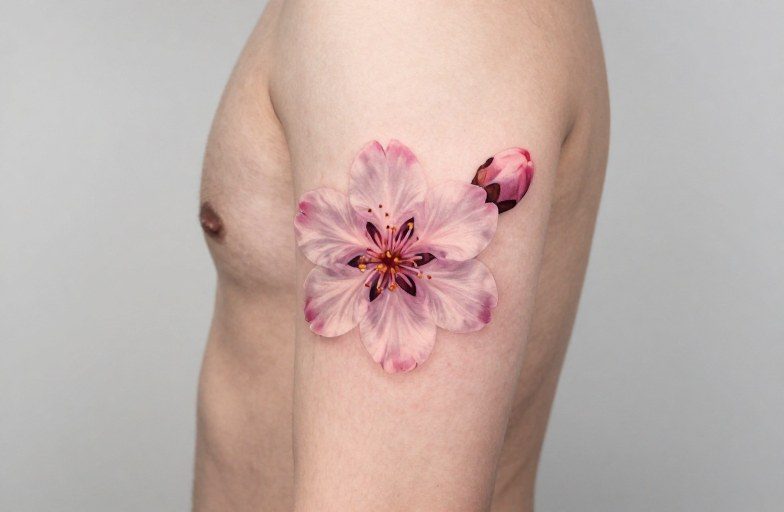
Cherry blossom tattoos carry meaning that runs deeper than the flower’s surface beauty. the bloom represents mono no aware, the Japanese concept of impermanence and the bittersweet awareness that nothing lasts. For men drawn to this symbol, it often becomes a meditation on mortality, the weight of sacrifice, and the value of moments that pass too quickly. The design works across styles and placements, from full sleeves to chest pieces, and carries different resonance depending on cultural context, color choice, and personal intent.
Mythology and Historical Roots
The Samurai Connection
In Japanese tradition, cherry blossoms and samurai share a symbolic bond that is often linked to the warrior’s ethos. The flower’s brief life, roughly two weeks from peak bloom to scattered petals, mirrors an idealized warrior path: live fully, die young, leave nothing unfinished. Historical texts suggest samurai carried the image as a reminder that death could arrive any day, and that a life spent in service held more value than a long one wasted.
This association runs through recorded history, not merely modern tattoo marketing. For men choosing this symbol today, the samurai connection offers a framework for thinking about discipline, loyalty, and the acceptance of endings. The falling petal, separate from the branch, carries particular weight, representing a life completed rather than one cut short.
Spirits, Trees, and Natural Boundaries
Folklore often linked cherry trees to spirits or deities of rice and harvest. Some regional stories describe the tree as a dwelling place for souls, or as a boundary between worlds. These roots give the tattoo an additional layer for men drawn to animist or nature-centered spirituality. The trunk anchors; the blossoms release. That tension between holding on and letting go plays out visually in how the design gets composed on skin.
Religious and Spiritual Dimensions
Buddhist Interpretations
Buddhist thought readily adopted the cherry blossom as a teaching tool. The flower’s rapid cycle illustrates the Three Marks of Existence: impermanence (anicca), suffering (dukkha), and non-self (anatta). For men with Buddhist practice or leanings, the tattoo can function as a portable reminder of these principles, not decorative, but devotional.
The specific placement matters here. A chest piece sits near the heart, aligning with compassion and the aspiration for enlightenment. A forearm placement keeps the reminder visible during daily activity, integrating practice into ordinary life. Some men pair the blossom with other Buddhist imagery, prayer wheels, lotus bases, or sutra text, though the cherry flower itself carries sufficient weight to stand alone.
Shinto and Purity
Shinto, Japan’s indigenous spiritual tradition, emphasizes purity and the sacredness of natural phenomena. Cherry blossoms appear at shrine festivals, marking renewal and the temporary suspension of ordinary rules. The spiritual angle here is less about personal mortality and more about participation in cycles larger than oneself. Men drawn to this interpretation often choose designs with environmental context, wind, water, moonlight, rather than isolated blooms.
Cultural History and Modern Complications
From Aristocratic Poetry to Popular Art
The cherry blossom’s cultural prominence solidified during Japan’s Heian period (794, 1185), when aristocratic poetry made the flower a central metaphor for beauty’s fragility. This was not universal across all Japanese culture at the time; commoners had different symbols, but the aristocratic association gave the blossom lasting prestige.
By the Edo period (1603, 1868), the flower had democratized somewhat, becoming a popular subject in woodblock prints that circulated widely. These prints influenced early Japanese tattooing, which developed its own visual vocabulary for cherry blossoms. The traditional irezumi style rendered them with specific petal counts, branch angles, and background elements that signaled seasonal context.
Military and Nationalist Co-option
Men considering this tattoo should know the harder history. Imperial Japan weaponized the cherry blossom symbol during the 20th century, most notoriously with kamikaze pilots who flew with blossom branches or painted them on aircraft. The “falling petal equals noble death” narrative got pushed into propaganda. This does not invalidate the symbol’s older meanings, but it adds complexity that some wearers engage with directly and others prefer to avoid. A thoughtful artist can help navigate this; some men choose to pair cherry blossoms with explicit anti-war imagery, or to emphasize the life-affirming mono no aware interpretation over the military one.
Design Choices and Related Symbols
Alternatives and Complements
Men drawn to cherry blossoms often consider these alternatives or complements:
- Plum blossom (ume): Blooms earlier, in winter cold, representing endurance and quiet perseverance rather than dramatic transience. Harder visually, thicker branches, more angular petals.
- Peony: The “king of flowers” in Japanese tattoo tradition, associated with wealth, honor, and masculine power. Often paired with cherry blossoms in sleeve work to balance hard and soft, enduring and fleeting.
- Maple leaf (momiji): Autumn’s counterpart to spring’s cherry bloom. Similar meditation on seasonal change, but with warmer color palette and different emotional register, more nostalgic, less urgent.
- Chrysanthemum: Imperial symbol, longevity, perfection. The chrysanthemum’s many layered petals create denser visual weight; cherry blossoms read lighter, more open.
- Wind bars or swirls: Not a flower, but a common companion element. Represents the forces that scatter petals, adding motion and narrative to static designs.
These pairings matter for men building larger compositions. A cherry blossom with peony and wind bars creates a classic Japanese sleeve with balanced masculine and feminine energy. Cherry blossom alone, perhaps with a single falling petal, reads more minimalist and contemporary.
Color Versus Black and Grey
The stereotypical cherry blossom is pink, which some men hesitate to request. Several valid approaches exist. Traditional Japanese color work uses a specific pink, slightly muted, never bubblegum, that reads as established convention rather than gendered choice. The surrounding imagery (black branches, grey background, possibly darker companion elements) balances the overall effect.
White cherry blossoms (shirozakura) offer an alternative with different symbolic weight: purity, grief, or specific regional varieties. These work beautifully in black and grey with white ink highlights, or in color with subtle cream and pale yellow tones.
Black and grey cherry blossoms sacrifice color accuracy for tonal drama. The challenge is maintaining the flower’s delicacy without washes of pink or white to suggest petal texture. Skilled artists solve this through negative space for highlights, stipple shading to create soft edges without solid black fill, and contrast with heavily saturated background elements that make the lighter flower pop. Black and grey ages more predictably than color, which matters for men thinking long-term. Pink pigments, particularly lighter magentas, are notorious for fading unevenly or shifting toward peach or grey. If you want color that holds, discuss specific pigment brands with your artist; some lines have better track records for floral pinks than others.
How It Ages on Skin
Line Work and the Fine Petal Problem
Cherry blossoms demand fine line work for petal edges, and fine lines blur. This is not opinion; it is how skin changes over decades. The tattoo’s longevity depends heavily on initial line weight, slightly heavier than you might expect for “delicate” flowers, without crossing into cartoonish territory. Petal structure matters too: designs with clear internal petal divisions (veins, notches, slight overlaps) hold readable form longer than solid-color petals. Placement affects aging as well. Areas with frequent movement or sun exposure (hands, forearms facing upward, collarbone points) degrade faster. Upper arm outer surface, thigh, or back pieces age more gracefully.
Shading and the Muddy Risk
Soft, airbrush-style shading that looks stunning fresh can resolve into indistinct grey blobs over ten to fifteen years. This is particularly true for cherry blossoms, where the visual appeal depends on contrast between light petals and darker elements. Artists who understand long-term healing often use harder edges than fashion dictates, trusting that time will soften them appropriately. Ask to see healed photos from five or more years prior, not just fresh work, when evaluating an artist for this subject.
What to Remember
A cherry blossom tattoo for men is not a contradiction or a trend to justify. It is a symbol with genuine historical depth, spiritual flexibility, and visual adaptability. The key is intentionality: know which layers of meaning you are engaging, whether the samurai ethos, Buddhist practice, Shinto reverence, or simply the aesthetic tradition of Japanese tattooing. Be aware of the symbol’s 20th-century military co-option and decide how, or whether, to address it. Work with an artist who understands not just how to render the flower beautifully fresh, but how to build it to last.
The best cherry blossom tattoos do not shout. They hold their meaning quietly, visible to the wearer and legible to those who recognize the vocabulary. In a medium crowded with aggressive imagery, choosing transience and beauty is itself a kind of strength.
Frequently Asked Questions
Are cherry blossom tattoos only for women?
No. In Japanese tattoo tradition, cherry blossoms carry specific masculine associations through samurai culture and warrior philosophy. The symbol’s meaning depends on context and intent, not gender.
What does a falling cherry blossom petal symbolize?
In traditional interpretation, a falling petal represents a completed life rather than one cut short. It connects to the samurai ideal of dying at the right moment, fully realized, rather than lingering past purpose.
Should I get color or black and grey for a cherry blossom tattoo?
Black and grey ages more predictably and avoids pink pigment fading issues. Color requires more maintenance but connects to specific traditional meanings. Discuss pigment brands and long-term healing with your artist before deciding.
How do I avoid the military/nationalist associations?
Some men pair cherry blossoms with explicit anti-war imagery or emphasize the Buddhist mono no aware interpretation. Others engage directly with the complexity. A skilled artist can help navigate this through compositional choices.