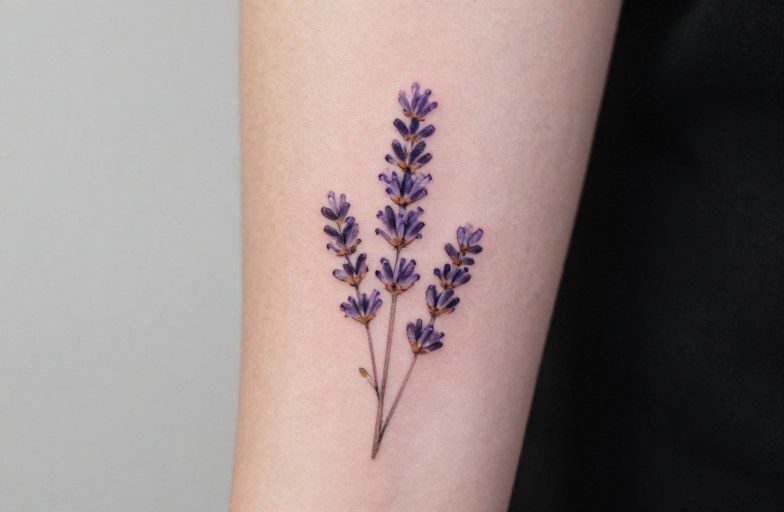
A single lavender stem in fine line or a tiny cluster tucked behind the ear carries more weight than its size suggests. Minimalist lavender tattoos have settled into a sweet spot between decorative and meaningful, appealing to people who want botanical ink without the heavy shading of traditional floral work. The plant itself offers natural geometry, slender stalks, small buds arranged in whorls, narrow leaves, that translates cleanly into simplified form. That structural clarity makes lavender unusually forgiving for minimal approaches, whether you prefer pure black line or muted color.
Color Choices
Most lavender tattoos default to some version of purple, but the range within that choice matters for how the piece ages and reads from a distance.
Single Needle Black and Grey
Stripped of color entirely, lavender becomes a study in silhouette and negative space. A good artist can suggest the soft texture of flower spikes through stippling or the lightest grey wash, keeping the lines themselves razor-thin. This approach avoids the fading and blurring that plague light purples, and it suits placements where you want the tattoo to stay legible as a small shape rather than a colored blob. Black and grey also pairs naturally with existing minimalist collections, fine line moons, small text, geometric accents.
Muted Purples and Soft Greens
If you want color, steer toward dusty, desaturated tones rather than bright violet. Lavender’s actual flower color varies from pale grey-purple to deeper blue-violet, and tattoo pigments that hew closer to these natural shades age better than neon or pastel alternatives. The green of stems and leaves should stay equally quiet, olive, sage, or grey-green rather than kelly or emerald. Ask your artist to show healed photos of their purple work; some purple pigments fade toward blue or grey unpredictably depending on brand and skin chemistry.
Trending Variations
Minimalist lavender has branched into several distinct visual approaches that keep the core subject fresh.
Single-stem vertical compositions dominate, often extending two to four inches along the forearm, rib, or ankle. These read as elegant and unhurried, the negative space around the stem doing as much work as the line itself. Bud-only clusters, three to five tiny flowers without stem or leaf, have gained traction for finger tattoos and other micro placements. Some artists are experimenting with lavender as a continuous line drawing, the stem, leaves, and flower spikes rendered without lifting the needle, creating a flowing, almost calligraphic quality. Another variation treats the lavender as a pattern element rather than a specimen: tiny repeated sprigs forming a bracelet around the wrist or a scattered handful trailing up a shoulder.
Popular Styles
Not all minimalist work looks the same. The stylistic frame you choose affects the tattoo’s personality significantly.
Fine Line Botanical
This is the default for most lavender pieces: hair-thin lines, careful attention to botanical accuracy, minimal or no shading. The best examples capture the slight curve of a mature stem, the way leaves alternate and taper, the dense cylindrical arrangement of the flower spike. Artists who specialize in this style often work from pressed specimens or high-resolution photographs rather than generic flash. The result feels observed rather than invented, alive even in extreme simplification.
Abstract and Geometric Reduction
Some collectors prefer lavender reduced to its essential geometry, a straight vertical line with small circles or diamonds at intervals, a single triangle suggesting the flower spike, or the stem rendered as a delicate arc with no detail at all. These work best when the reference is clear enough to read without explanation but abstract enough to feel contemporary. The risk here is over-reduction: a line with dots may become ambiguous with age, reading as wheat, grass, or simply abstract marks.
Best Placements
Lavender’s vertical habit makes it naturally suited to certain body contours, though creative placement can subvert that expectation.
Along the outer forearm, a single stem follows the bone line gracefully, visible when desired but easy to cover. The inner upper arm offers softer skin and a more private context, the tattoo revealed selectively. Behind the ear and along the hairline, tiny lavender sprigs have become almost a signature placement, feminine without being saccharine, visible with hair up or swept aside. The ankle and top of the foot accommodate the vertical form well, though foot tattoos require honest conversation about longevity; that skin takes abuse, and fine lines spread faster there than almost anywhere else.
For those building larger collections, lavender fills gaps between existing pieces with organic softness, countering the hard edges of geometric or script work. A small sprig floating in the space between a wrist piece and a forearm band can unify otherwise disconnected tattoos.
Tips for Choosing
The gap between a beautiful lavender tattoo and a disappointing one often comes down to decisions made before the needle touches skin.
Reference Quality Matters
Bring your artist specific, high-resolution photographs of the lavender variety you have in mind. English lavender (Lavandula angustifolia) has a different silhouette than Spanish or French types, shorter stems, tighter flower spikes, greyer foliage. If the botanical accuracy matters to you, say so. If you prefer a stylized or fantasy version, say that too. Misaligned expectations produce the most common disappointment in floral tattoos.
Scale Realism
Minimalist lavender tempts people toward extremely small sizes, but certain details become physically impossible below a threshold. The individual flowers in a lavender spike are tiny; at half an inch tall, they become indistinguishable dots. A stem with leaves and a recognizable flower section generally needs at least two inches of height to read as lavender rather than generic plant. Discuss minimum size with your artist based on their needle grouping and line confidence.
How to Personalize It
Beyond the basic form, several modifications can make a lavender tattoo specific to your context without abandoning minimalism.
Incorporating a significant number of stems, perhaps matching a birth date, anniversary, or the count of family members, creates personal meaning through repetition rather than symbolism. A single stem bent at a specific angle can suggest resilience or adaptation without requiring literal imagery. Some choose to pair lavender with a tiny companion element: a honeybee in matching scale, a small pair of scissors (for the harvest), or a simple linen ribbon suggesting the traditional bundles dried for scent.
Text integration works when handled with restraint. A single word in fine script, parallel to the stem or curving gently with it, reads as unified rather than cluttered. The word should be short, names, dates, or single concepts like “rest” or “return.” Longer phrases fight the vertical simplicity that makes lavender tattoos successful.
Before You Decide
Minimalist tattoos age differently than bold traditional work. Fine lines soften, spread slightly, and lose the crispness of fresh ink. Lavender’s delicate structure is particularly vulnerable to this process. Ask to see healed photos from your artist at one year and three years if possible. Consider whether your design retains its identity with slightly thicker lines and reduced detail.
Also weigh the commitment of purple pigment. If you choose color, understand that touch-ups may be necessary to maintain the tone, and that some purples shift unpredictably as they settle. Black and grey offers lower maintenance at the cost of the immediate color association that makes lavender recognizable to casual viewers.
Finally, sit with the image. The appeal of minimalist lavender is partly its quietness, it’s not trying to shock or impress. That restraint should feel sustainable over years, not merely fashionable in the moment. The best minimalist botanicals grow more satisfying as they settle into the skin, becoming part of you rather than decoration on you.
Frequently Asked Questions
How well does fine line lavender tattoo hold up over time?
Fine line work softens and spreads slightly on everyone, but lavender’s simple structure ages better than intricate designs with heavy detail. Expect crisp lines to settle into a gentler version of themselves within two to five years. Black and grey lasts longer than light purple, which may need refreshing to maintain its tone.
Can a minimalist lavender tattoo be covered up later if I change my mind?
Small, light tattoos are generally easier to cover or modify than large dark pieces, but minimalist lavender’s fine lines and scattered placement can actually complicate cover-up design. The negative space around the tattoo becomes part of the visual field. Plan for the possibility by avoiding extremely sparse placement if you tend to change preferences.
What’s the typical price range for a small minimalist lavender piece?
Pricing varies enormously by city and artist reputation, but expect small fine line botanicals to start around $80-150 at minimum shop rates, scaling to $200-400 for established specialists. The time involved is shorter than complex work, but you’re paying for precision and steady hand control that takes years to develop.
Is there any cultural significance I should be aware of with lavender tattoos?
Lavender carries associations across multiple cultures, often linked to calm, cleanliness, and protection in European folk traditions, and commonly associated with devotion in some Victorian floriography. No single culture holds exclusive claim, but if you’re drawn to lavender for a specific heritage connection, researching that tradition directly honors the reference more than generic symbolism.