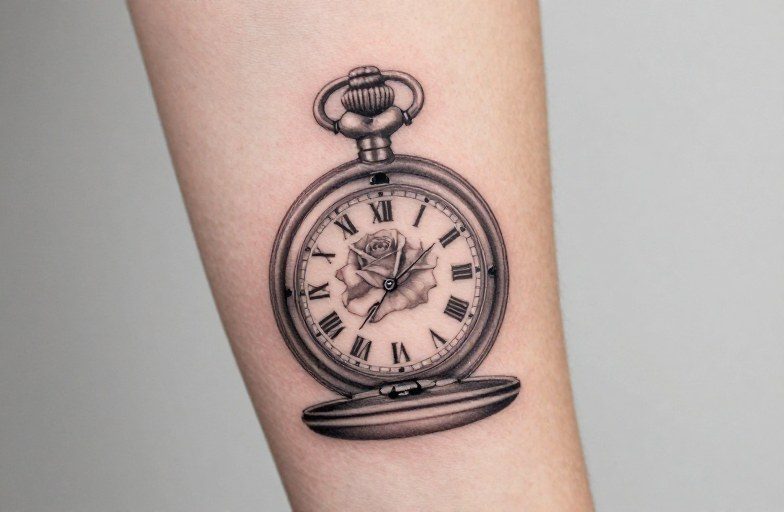
The pocket watch and rose tattoo typically signals a meditation on time and mortality, love that endures against the clock, a moment frozen, or life measured in beauty. The watch grounds the design in human timekeeping, while the rose insists that beauty matters precisely because it does not last. Together they create a tension: precision against decay, mechanism against organic life.
Symbolism & Core Meaning
The Pocket Watch: Control and Its Limits
Pocket watches emerged as personal timepieces, carried close to the body, consulted deliberately rather than glanced at. In tattoo form, they often represent a specific moment, stopped hands point to an hour and minute that mattered. Some choose Roman numerals for classical weight; others prefer clean Arabic numbers for readability at small sizes. The chain, when included, can suggest inheritance or connection, but also entanglement. A broken watch face speaks to time interrupted; a cracked crystal suggests fragility beneath the precision.
The Rose: Beauty Under Pressure
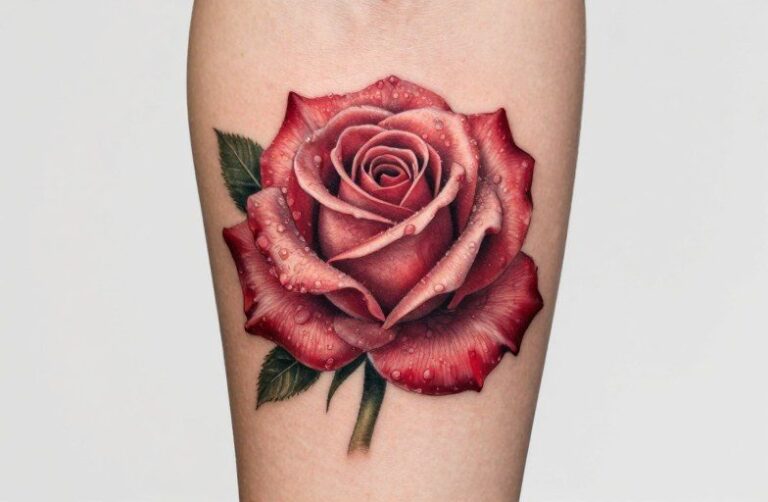
Roses in tattooing carry layered associations depending on color and state. A bud suggests potential; full bloom, presence or peak experience; wilting petals, acceptance of ending. Thorns complicate the image, protection, pain as price, love that draws blood. When paired with the watch, the rose refuses to let time remain abstract. It makes the passage personal, bodily, scented, vulnerable.
The Combination: What Changes
Together, these elements do not simply add meanings but transform them. The watch without rose can feel technical, even cold. The rose without watch risks sentimentality. Their intersection produces something more specific: memento mori updated, not as skull-and-bone warning but as tender acknowledgment. The design suits memorial work without requiring names or dates, though many include them. It also works for survivors marking time since transformation, sobriety, diagnosis, departure.
History & Cultural Roots
European Origins
The pocket watch itself descends from 16th-century spring-driven clocks, miniaturized for portability. Tattooed imagery of timepieces often links to Victorian mourning customs, where hair jewelry and memento mori objects kept the dead present. Rose symbolism in Western tattooing solidified through sailor traditions and later Chicano black-and-grey work, where flowers framed religious and familial subjects. The specific pairing of watch and rose became visible in tattoo culture during the 1990s and 2000s, as photo-realism and neo-traditional styles converged.
Contemporary Spread
Today the motif appears across traditions: Japanese-influenced pieces might wrap the watch in wind bars and falling petals; neo-traditional work emphasizes bold outlines and limited, saturated palettes; fine-line approaches reduce both elements to whispered suggestion. The design’s adaptability has kept it current without diluting its core recognizability.
Design Tips & Pairings
Complementary Elements
Popular additions include:
- Banners and script: Names, dates, or short phrases arc across or beneath the composition. Script must be large enough to hold, tiny lettering blurs within five to seven years.
- Doves or swallows: These traditional birds extend the memorial reading, suggesting souls departed or returned.
- Maps or coordinates: Ground the timepiece in place, specifying where a moment occurred.
- Skulls: Push the memento mori aspect explicit, though this risks visual clutter if the watch and rose already compete for detail.
Line Weight and Detail Density
Photo-realistic pocket watches demand fine lines for gear teeth, chain links, and glass reflection. These details fade. The most enduring versions simplify: suggest the mechanism rather than catalog it. Rose petals benefit from confident, varied line weights, thick outlines hold, internal texture can be stippled or washed rather than hairline-dependent. For smaller pieces, consider a single rose bud beside a simplified watch face rather than attempting full realism at three inches.
Color vs Black and Grey
Black and Grey: The Classic Treatment
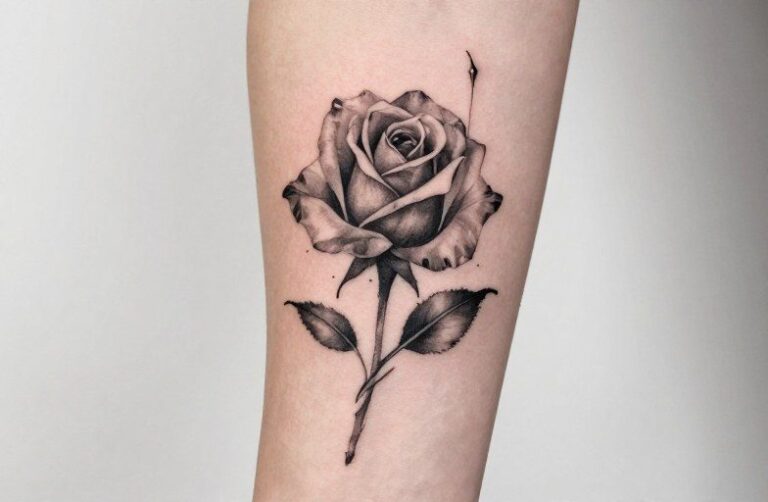
This approach dominates the design for good reason. The metallic sheen of a pocket watch translates naturally through black ink gradations; white highlights suggest glass and polish. Roses in greyscale read as traditional, timeless, slightly melancholic. Healing tends to be forgiving, no color to migrate or surprise-shift. The limitation becomes warmth: without red, the rose loses some living urgency.
Color: Strategic Choices
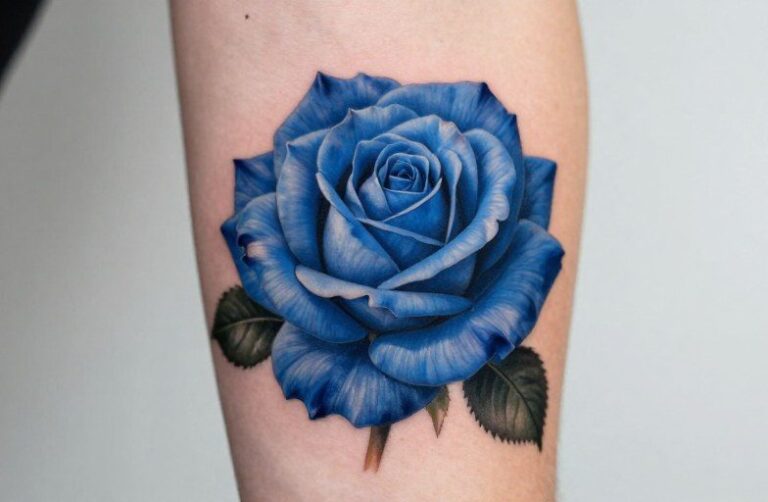
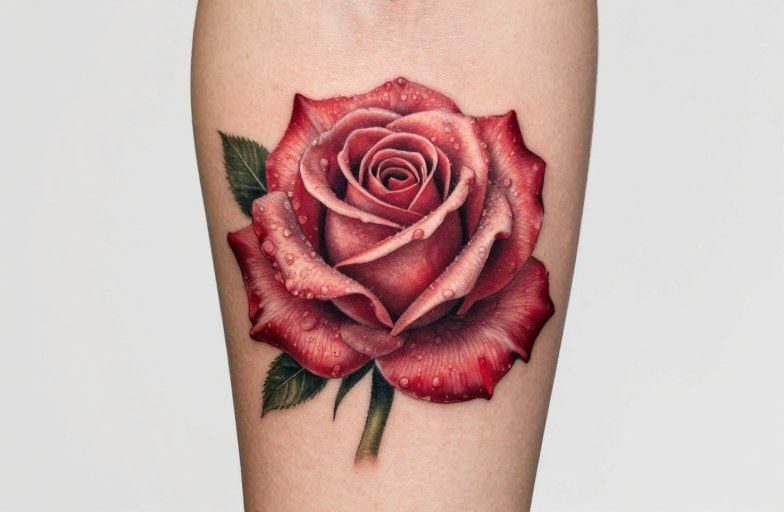
When color enters, it usually concentrates in the rose. Deep crimson or burgundy maintains dignity; bright pink risks candy sweetness against the watch’s gravity. Some artists use limited color, red rose, warm gold on the watch case, everything else in grey, to create focal hierarchy. Blue or black roses subvert expectations, suggesting the impossible or mournful, but require explanation to read clearly. Color saturation demands more frequent touch-ups, especially on high-movement placements.
Who Chooses This Tattoo
Common Motivations
Memorial work remains the most frequent driver: parents, partners, siblings marked by a stopped moment. Others mark personal survival, cancer, accident, addiction, with the watch measuring time since and the rose affirming life continued. Some choose it for purely aesthetic reasons, drawn to the mechanical-organic contrast, the balance of masculine and feminine coding in traditional tattoo iconography. The design crosses gender lines more evenly than many motifs, though execution style often signals differently, delicate linework and soft color versus heavy black shading and bold scale.
Age and Experience Considerations
First-timers sometimes gravitate toward this design for its apparent straightforwardness, but the detail level can mean longer sessions than anticipated. Experienced collectors often use it as a transition piece, bridging gaps in larger work or filling a significant single spot. The meaning, when present, tends to deepen with the wearer’s years; a twenty-year-old’s memorial and a sixty-year-old’s carry different weight in the same skin.
Best Placements
Flat and Visible: Forearm, Calf, Upper Arm
The watch face reads best on relatively flat planes where circular distortion stays minimal. The forearm offers visibility for personal significance, easy self-viewing, and enough width for detail. Calf provides similar flatness with more vertical space for hanging chains or trailing stems. Upper arm allows scaling up, accommodating fuller roses and more elaborate watch mechanisms.
Curved and Contained: Ribs, Chest Plate, Thigh
Ribs follow the body’s curve; a watch face here distorts unless designed with that arc in mind. Chest pieces center the composition over the heart, literalizing the emotional reading. Thigh offers substantial canvas but less daily visibility, some prefer this privacy, others regret the concealment. Hands and fingers generally fail for this motif; the detail crushes beyond recognition, and the symbolism deserves more space than knuckles allow.
Healing Realities by Placement
Forearms heal relatively simply, with moderate friction from sleeves. Calf tattoos suffer from sock abrasion and slower circulation. Chest work on men heals across pectoral movement; on women, beneath-breast placement risks moisture and pressure. Ribs heal slowly, hurt substantially, and demand careful sleeping position discipline. These practical factors matter as much as aesthetics for a design meant to last decades.
The Takeaway
The pocket watch and rose tattoo endures because it addresses something human and unavoidable: time passes, beauty fades, and we mark both in our skin. Its strength lies in specificity, a stopped hand, a particular bloom, a chosen color, rather than vague profundity. Whether memorial or survival marker, aesthetic choice or inherited tradition, it works best when the details matter to the person wearing them. The watch keeps its time; the rose keeps its thorns. Together they make a design that ages honestly, showing its years without losing its point.
Frequently Asked Questions
Does the time on the pocket watch need to mean something specific?
The stopped hands usually point to a significant hour and minute, a birth time, death time, or moment of transformation. Some choose merely for visual balance, but the specific reading adds depth that justifies the detail work.
How well does fine-line pocket watch detail hold up over years?
Fine lines in mechanical elements blur and soften. Simplified versions with bolder outlines age more gracefully. Expect touch-ups on gear teeth and chain links within five to ten years if rendered photorealistically.
Can a pocket watch and rose work as a cover-up tattoo?
The rose’s organic shapes and the watch’s dark interior spaces can mask older work, but success depends on the existing tattoo’s density and color. Black tribal or heavy old work may limit how light the watch face can read.
Is this design considered overdone or cliché in tattoo culture?
The motif is common, but execution and personal significance distinguish individual pieces. A generic flash version feels different from a custom piece with specific time, specific rose variety, and meaningful additions.