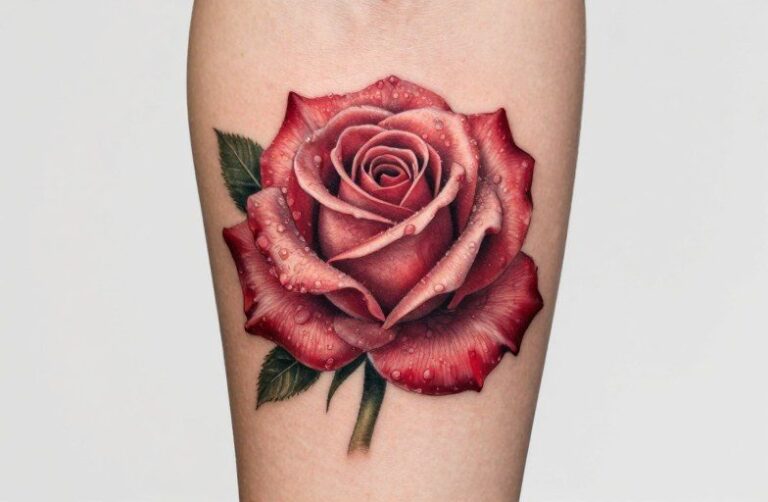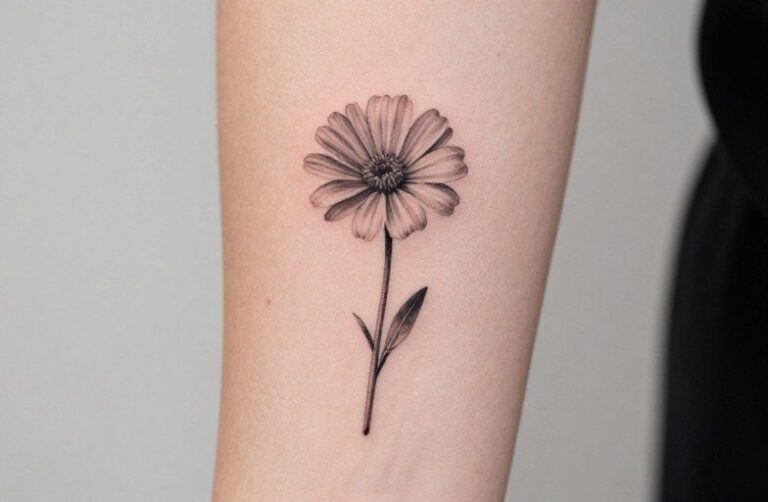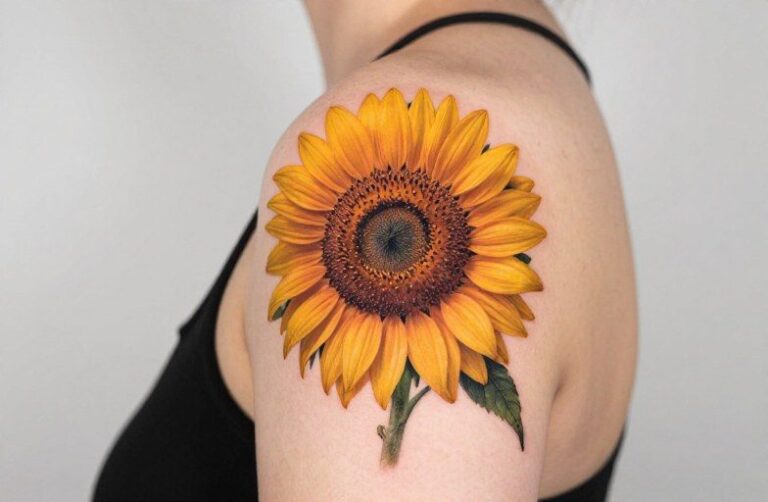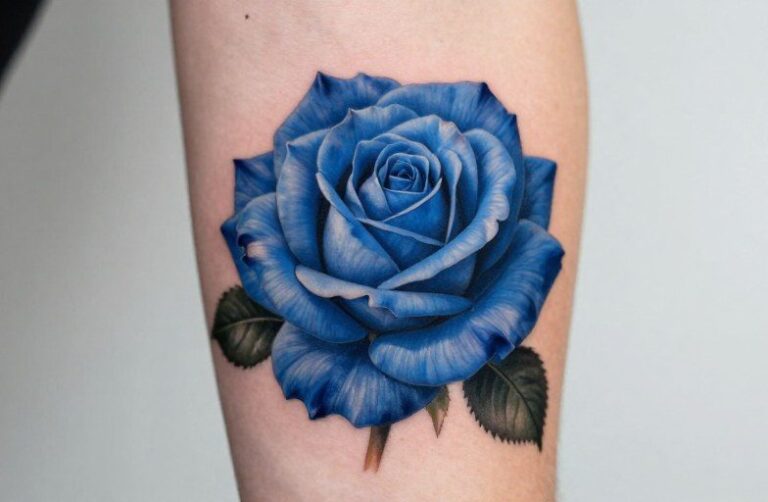
The enchanted rose tattoo most commonly represents beauty preserved under pressure, love that endures through curse or hardship, and the urgency of time running out. Borrowed from the glass-dome rose of fairy-tale tradition, it carries a specific visual grammar: the bloom is perfect but trapped, lovely yet imperiled. That tension gives the design its emotional weight and its popularity among people marking personal transformation, romantic commitment, or a reckoning with mortality.
Symbolism & Core Meaning
The Glass Dome as Barrier and Vessel
The cloche or bell jar isn’t decorative filler, it’s the symbol’s engine. In tattoo form, the dome separates the rose from the world, creating a pocket of suspended time. Some read this as protection, others as isolation. The glass can represent emotional walls built after hurt, or a relationship kept deliberately sacred and apart from daily wear. Cracked or broken domes appear in designs where the wearer wants to mark release: the moment protection became prison, and the choice to shatter it.
Falling Petals and the Countdown
Petals drifting downward turn the rose into a clock. In two-dimensional tattoo work, artists handle this through negative space (un-inked skin showing through) or desaturated color to suggest the petal has already begun its drop. A full, lush bloom with no fallen petals reads as hope or preservation; a single petal on the ground introduces urgency; a stem bare but for one clinging petal speaks to final chances. These aren’t arbitrary aesthetic choices, they’re narrative positions the wearer selects consciously.
Design Tips & Pairings
Color Strategy and Aging Reality
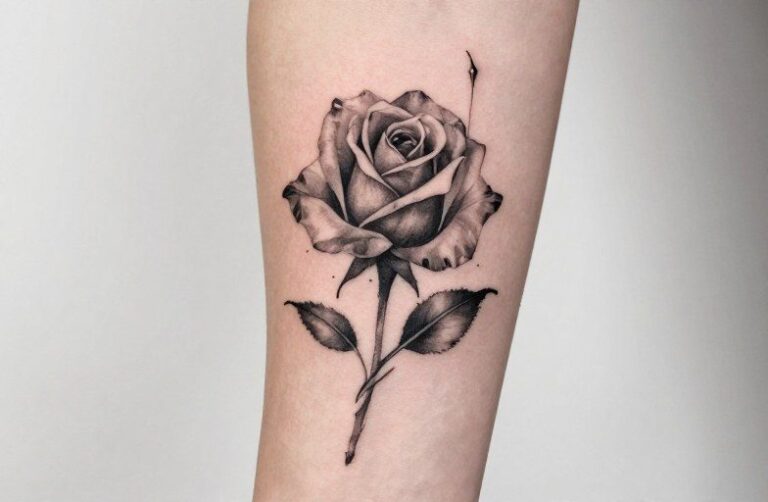
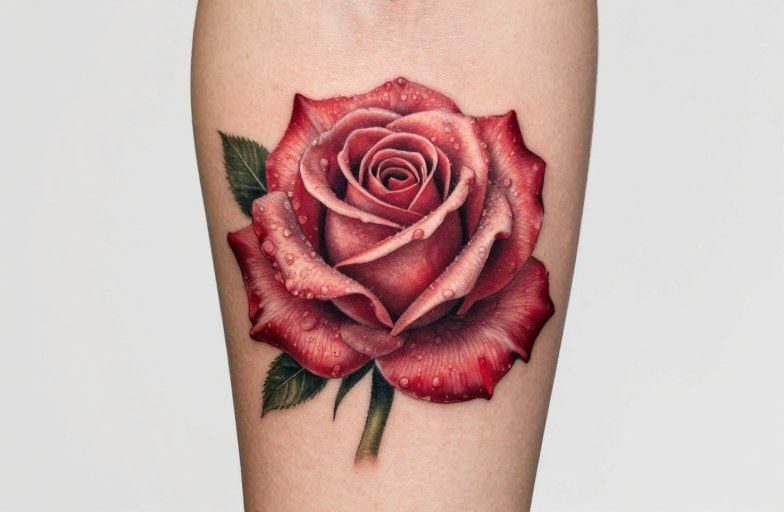
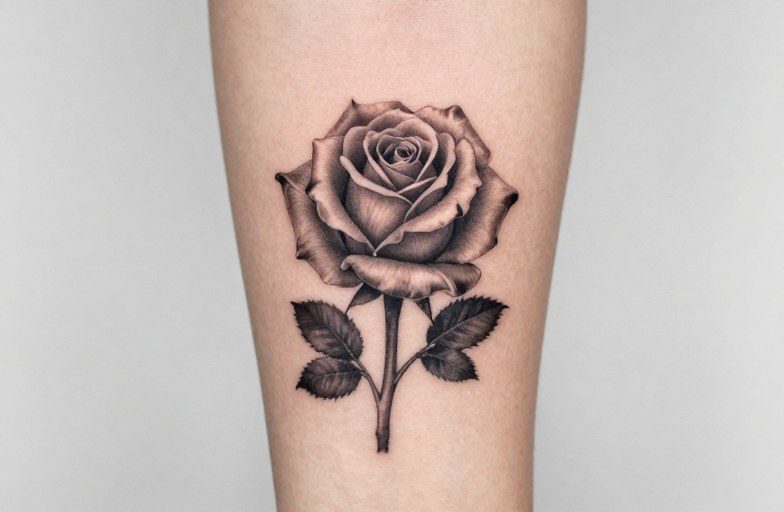
Red dominates for obvious reasons, but the specific red matters. Deep crimson holds saturation better over decades than bright fire-engine tones, which tend to orange out as iron-based pigments degrade. Burgundy and oxblood age into wine-like browns that still read as “rose” rather than “faded blob.” Purple roses, associated with enchantment and royalty in floriography, shift unpredictably; some purples hold, others gray into muddy lavender. Black and grey versions sacrifice the fairy-tale color cue but gain longevity and a more melancholic, literary tone.
Pairings that actually work with this specific motif:
- Clock faces or pocket watches, literalizes the time element without over-explaining
- Cracks or fracture lines in the glass, adds visual tension and suggests imminent change
- Thorny stems wrapping fingers or wrists, connects the protected bloom to the vulnerable body
- Handwritten text, only when the script is genuinely personal; generic fonts cheapen the symbol
- Butterflies or moths, life cycles, fragility, the creature attracted to beauty that cannot last
Line Weight and Shading Approach
The dome demands technical precision. A wobbly ellipse ruins the illusion of glass immediately. Experienced artists build the dome with multiple ellipses in light greywash, then add specular highlights (the bright spots where light hits glass) in solid white or near-white. Without these highlights, the dome reads as plastic or opaque. The rose itself typically gets heavier saturation to pop against the softer grey tones, creating depth that suggests the flower exists inside, not on the surface of, the container.
Who Chooses This Tattoo
There’s no single demographic. The enchanted rose attracts people who’ve experienced a before-and-after: recovery from illness, surviving a relationship’s collapse, committing to someone after believing that door was closed. Parents sometimes choose it for children grown and gone, the beauty they made, now living elsewhere. Younger wearers often connect it to animated film nostalgia, but the tattoo persists into their thirties and forties because the symbol outgrows its source.
What unites most choices is a specific emotional structure: something precious, something threatened, and a conscious decision to keep it visible rather than hidden. The tattoo doesn’t hide on the ribcage or behind the ear. It wants to be seen, which tells you something about the wearer’s relationship to whatever they’re marking.
Common Variations & Styles
Neo-Traditional and American Traditional
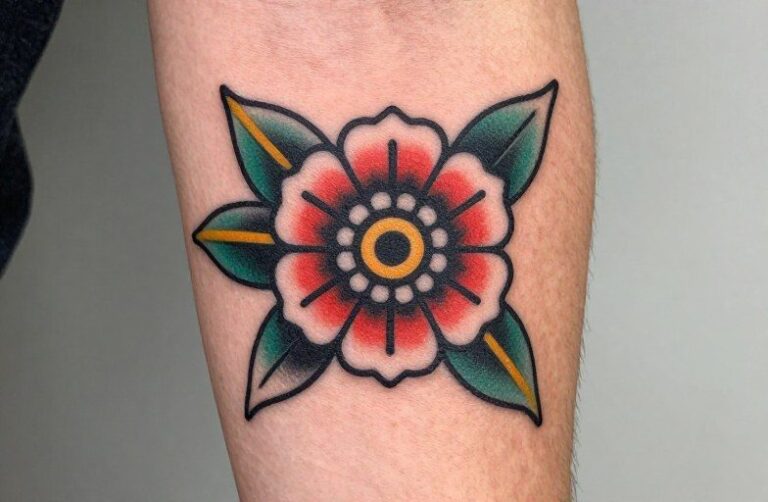
American traditional simplifies the dome to bold black outlines with limited red and green, often losing the glass effect entirely in favor of a graphic badge-like shape. Neo-traditional recovers the dimensional glass through smoother gradients and more anatomically convincing roses, sometimes adding ornamental frames or art nouveau whiplash curves. Both styles prioritize readability from a distance over photorealistic detail.
Realism and Fine-Line
Single-needle and fine-line approaches can achieve astonishing delicacy in the petals, but the dome becomes a serious challenge. Thin lines struggle to maintain the crisp ellipse needed for convincing glass; blowout (ink spreading under the skin) destroys the precision that makes the dome read as transparent. Realism requires a larger minimum size, typically palm-sized or bigger, to render both rose and container with sufficient detail. Small fine-line enchanted roses often sacrifice the dome for a floating bloom with a few suggestive highlight dots, which changes the meaning significantly.
Biomechanical and Dark Surrealism
Less common but striking: roses growing through mechanical domes, or glass filled with liquid rather than air. These variants push the symbol toward body horror or ecological commentary, the bloom either parasite or survivor in hostile architecture. The core tension, organic beauty against artificial constraint, remains, but the emotional register shifts from romantic to something more unsettling.
History & Cultural Roots
The glass-dome rose as a visual motif is often linked to late nineteenth-century European fairy tales and their subsequent illustration traditions. The specific combination of preserved flower under glass appears in literary sources before animated film popularized it globally. Some trace it to Victorian mourning customs: flowers preserved under glass domes as keepsakes, a practice that transformed organic decay into permanent display. The overlap between romantic and funerary preservation creates the symbol’s productive ambiguity, this could be love or loss, or both simultaneously.
Earlier rose symbolism spans multiple cultures without the glass element. In Persian poetry, the nightingale and rose represent lover and beloved, the bird singing itself to death. Medieval European iconography used the rose for the Virgin Mary and for secrecy (sub rosa). The enchanted rose borrows this accumulated weight and adds the modern anxiety of time pressure, the deadline, the ticking clock made visible.
Best Placements
Scaling to Body Location
The forearm offers the most natural viewing angle for a dome-shaped design, the ellipse sits comfortably across the cylindrical form without extreme distortion. Inner biceps work well for medium scales, the curve accommodating the dome’s base while the upper petal cluster extends toward the shoulder. Thighs provide the flat real estate needed for larger, more detailed pieces, particularly when the stem extends and wraps.
More challenging locations:
- Ribs and sides, the body’s curvature distorts the ellipse; artists must compensate with foreshortening that looks correct only from one specific angle
- Hands and fingers, too small for the full motif; simplified versions lose the glass effect entirely
- Feet and ankles, poor ink retention in these areas means fine detail blurs faster; the dome’s precision is especially vulnerable
Composition with Existing Work
The enchanted rose integrates into floral sleeves more easily than into unrelated thematic collections. Its vertical orientation (stem down, bloom up) makes it a natural gap-filler between larger pieces. When placed among other roses, the glass dome distinguishes it as “the one that matters,” which can be the point or can create unwanted hierarchy depending on the wearer’s intent.
Final Word
The enchanted rose tattoo works because its meaning is built into its structure, not pasted on through caption or explanation. The glass, the bloom, the falling petal, the trapped air, these elements compose a complete sentence about beauty under threat. Choose it for something you cannot afford to lose, or for something you finally released. Either way, the symbol holds. The question is whether you want to be the one preserving, or the one breaking the glass.
Frequently Asked Questions
Does an enchanted rose tattoo always reference the animated film?
Not necessarily. While many people discover the image through film, the glass-dome rose predates it in mourning customs and literary illustration. The tattoo’s meaning depends on what the wearer brings to it, not its pop-culture origin.
How well does the glass dome effect hold up over years?
The greywash and white highlights that create glass transparency are vulnerable to sun exposure and skin changes. A well-executed dome can last a decade with proper care, but touch-ups eventually become necessary to maintain the illusion of depth and transparency.
Can the enchanted rose work as a cover-up tattoo?
It’s challenging. The dome requires clean, un-inked skin to achieve transparency effects, and the rose’s detailed petals don’t hide underlying darkness well. Small, faded old tattoos beneath the stem area might be manageable, but the dome itself needs virgin skin.
Is there a traditional meaning for the number of falling petals?
No established tradition governs petal count. Some choose three for personal symbolism (past, present, future or family members), others let the artist determine what flows compositionally. The visual suggestion of decline matters more than any specific number.