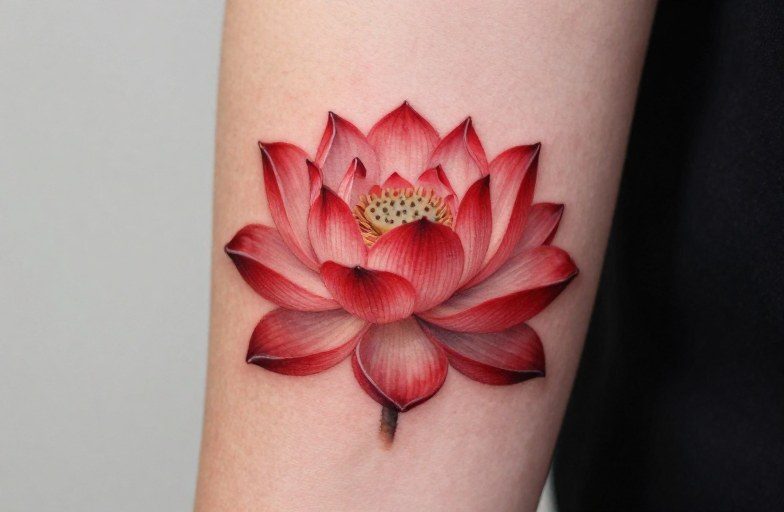
The red lotus tattoo carries a focused, potent meaning: love in its most unconditional form, compassion that extends beyond the self, and the hard-won clarity of spiritual awakening. Unlike the general purity associated with white lotus flowers, the red variant narrows the symbolism to matters of the heart and emotional courage. Someone wearing this design has usually marked a significant emotional transformation or a commitment to living with open-hearted intensity.
How It Ages on Skin
Color Fading and Placement Realities
Red ink sits in a tricky middle ground for longevity. It fades faster than black or dark blue, but holds better than yellow or white. On sun-exposed skin, forearms, hands, collarbones, expect noticeable softening within five to eight years. Under clothing, on ribs, upper thighs, or back pieces, that same red stays punchy for a decade or more.
Line weight matters enormously. Fine-line red lotus petals blur and feather as the ink disperses under skin. Bold outlines, at least three needle passes deep, give the red something to hold its shape against. Shading in red (as opposed to black and grey wash) ages poorly; it muddies into a single flat tone rather than maintaining dimensional depth. Most artists building a red lotus for longevity will use black or dark grey for shadow work, letting the red sit on top as pure color.
- Inner bicep and upper back: best color retention, minimal sun exposure
- Forearm and ankle: moderate fading, plan for touch-ups
- Hands and feet: red ink breaks down fastest here, often requiring reinforcement within three to five years
- Watercolor-style red lotus: the diffuse edges become unrecognizable faster than structured designs
Skin Tone Considerations
True red reads differently across complexions. On very fair skin, it stays vivid but can look inflamed during healing, sometimes alarming clients. Medium and deeper skin tones often need a slightly orange-leaning red to prevent the ink from healing to a muddy burgundy. Experienced artists adjust their red mixtures, some adding a touch of orange or magenta, to ensure the post-heal color matches the intention.
Symbolism & Core Meaning
The Heart-Rooted Lotus
In Buddhist and Hindu iconography, lotus color carries specific assignments. The red lotus, sometimes called the Padma in Sanskrit contexts, connects to the heart chakra and to Avalokiteshvara, the bodhisattva of compassion. This isn’t decorative spirituality, the red marks active, engaged love rather than passive purity. The flower grows from mud, opens in morning light, closes at night. That cycle mirrors emotional resilience: the capacity to stay open despite murky origins.
Love here isn’t romantic exclusively. Parental devotion, friendship forged through hardship, self-acceptance after struggle, all fit under the red lotus umbrella. The color choice signals intensity. Someone who wants calm detachment picks white or blue. Red commits to feeling fully.
The Open Bloom vs. Closed Bud
Stage of bloom changes the reading. A fully open red lotus suggests arrival, completion of a transformation, love presently flourishing. The closed bud, petals still wrapped tight, indicates potential or ongoing struggle. Partially opened designs split the difference, often chosen by people mid-process: recovering from grief, rebuilding trust, emerging from depression. Placement reinforces this. A bud on the ribs, hidden, keeps the meaning private. An open bloom on the forearm declares it.
Who Chooses This Tattoo
Patterns emerge without being rigid. Parents memorializing children or honoring adoption frequently select red lotus, the heart-connection overriding any religious framework. People who’ve survived betrayal or abandonment sometimes choose it as a reclamation, proof they can still love openly. Others mark sobriety anniversaries, the red representing the blood-beat of life regained.
Age demographics skew slightly older than typical first-tattoo clients. The red lotus rarely serves as impulse ink; it usually follows a deliberation period, sometimes years. Couples occasionally get matching designs, though artists report more solo requests, this symbol tends toward individual emotional narrative rather than relationship branding.
Similar & Related Symbols
Color Variants and Their Distinctions
Confusion between lotus colors is common. White lotus emphasizes spiritual purity and mental clarity, often linked to the Buddha’s own birth narratives. Pink lotus, sometimes conflated with red, traditionally represents the historical Buddha himself and the highest spiritual attainment. Blue lotus speaks of wisdom and knowledge, the victory of spirit over senses. The red stands apart for its emotional, heart-first orientation.
- Red lotus + flames or fire: intensifies passion, sometimes references Kundalini energy
- Red lotus + mandala background: spiritual practice made visible, meditation commitment
- Red lotus + broken chain or cracked stone: love or compassion that survived imprisonment, abuse, or suppression
- Red lotus with blackened, dying petals: grief work, love that outlasts death
Non-Lotus Alternatives
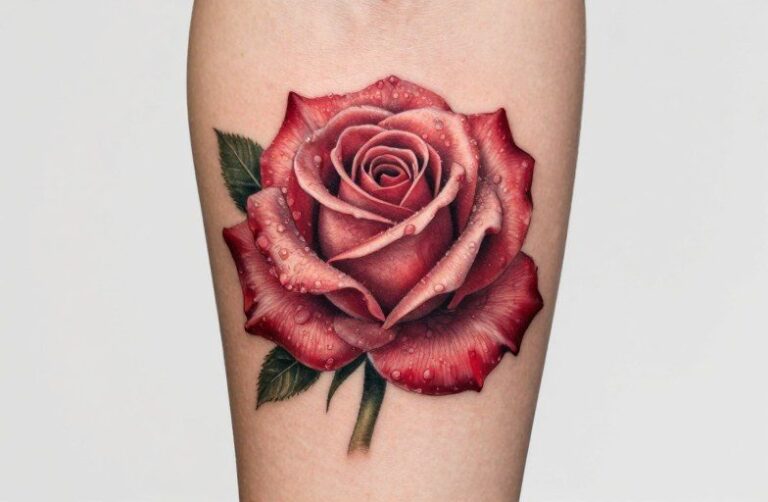
Clients sometimes arrive wanting red lotus energy but prefer different botanicals. The red rose carries Western romantic baggage that lotus avoids. The Japanese camellia (tsubaki) shares the “love from difficult origins” narrative but requires more cultural context to read correctly. The lotus remains the most internationally legible symbol for this specific combination: heart-centered, spiritually grounded, resilient.
Personal & Modern Meanings
Contemporary wearers increasingly detach the red lotus from its Eastern religious origins, treating it as a broadly spiritual rather than specifically Buddhist or Hindu emblem. This doesn’t necessarily dilute the meaning, many find the heart-chakra framework useful without adopting full doctrinal practice. The symbol functions as a visual shorthand for “I choose to stay open despite what happened.”
Some integrate the design into larger mental health narratives. The lotus rising from mud parallels therapeutic language about growth through difficulty. Red specifically acknowledges that this growth hurt, that feeling was part of the process. It’s become quietly common among people who’ve done substantial therapeutic work and want a marker of that labor.
Gender associations are minimal. Unlike some floral designs that skew feminine in Western perception, the red lotus maintains relatively neutral ground. Men often pair it with geometric elements or darker backgrounds; women more frequently choose softer watercolor treatments. The core symbol transcends these styling differences.
History & Cultural Roots
Asian Religious Traditions
The lotus as sacred symbol appears across ancient Egyptian, Hindu, and Buddhist sources, though the color-coded systematization developed most distinctly in Mahayana Buddhist traditions. The red lotus’s association with Avalokiteshvara emerged during the early centuries CE, often linked to texts describing the bodhisattva’s compassion as actively engaged rather than contemplatively distant. In some East Asian lineages, red lotus imagery accompanied funeral rites, representing the deceased’s compassionate heart continuing beyond physical death.
Hindu connections often trace to Lakshmi and Brahma, though the red variant specifically is more commonly associated with love deities and the heart’s creative power. The flower’s actual biology, growing in stagnant water, blooming unstained, shaped these attributions organically rather than through arbitrary assignment.
Adoption into Western Tattoo Practice
The red lotus entered Western tattoo vocabulary significantly during the 1990s and 2000s alongside broader interest in Eastern spirituality, yoga practice, and mindfulness culture. Early Western interpretations sometimes flattened the color distinctions, treating all lotus flowers as generically “spiritual.” Contemporary artists and clients now generally understand the red’s specific heart-connection, though accurate usage remains uneven. Japanese tattoo traditions (irezumi) rarely featured lotus prominently; the symbol’s tattoo prevalence stems more from Southeast Asian and South Asian diaspora influence, plus New Age spiritual commerce, than from classic Japanese or Western tattoo canons.
The Takeaway
The red lotus tattoo means what it has always meant: love that persists through difficulty, compassion chosen actively, a heart that opened rather than hardened. On skin, it demands respect for red ink’s particular aging behavior, bold lines, protected placement, realistic expectations about touch-ups. The symbol works because it’s specific. White lotus is pure; blue is wise; red is brave. That bravery, the choice to keep feeling despite knowing the cost, is what people mark when they choose this design. Whether rooted in religious practice or personal symbolism, the red lotus remains one of tattooing’s most emotionally precise botanical choices.
Frequently Asked Questions
Does a red lotus tattoo always have religious meaning?
No. Many wearers choose it for purely personal symbolism, survived hardship, renewed capacity for love, or emotional growth. The religious framework is available but not required for the design to carry weight.
How much does a red lotus tattoo typically cost?
Simple designs run $150-$400; detailed multi-session pieces with background work reach $800-$2,000. Red ink requires more saturation passes than black, which can add slightly to session time and cost.
Can you cover an old tattoo with a red lotus design?
Sometimes, but red ink alone won’t mask dark existing work. Artists usually need to incorporate black or darker elements for the cover, using red as accent rather than primary coverage. Laser fading first expands options significantly.
What’s the difference between a red lotus and a red rose tattoo?
The rose carries Western romantic and memorial associations more heavily. The lotus adds the “growth through difficulty” narrative and broader spiritual resonance. Red lotus reads as more interior, less performatively romantic.