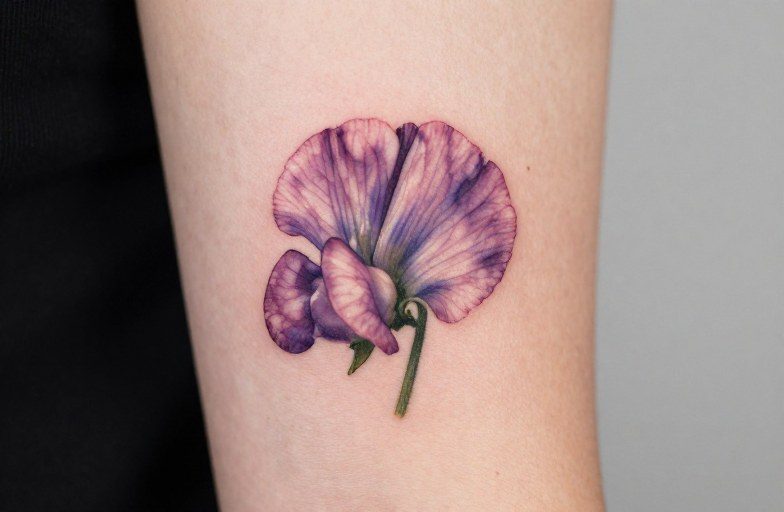
A sweet pea flower tattoo most commonly signals tender goodbye, the beauty of fleeting moments, or April birth-month identity. The layered meaning pulls from Victorian flower language, where gifting sweet peas said “thank you for a lovely time” or conveyed departure without harshness. On skin, that softness translates to a design that reads as gentle, nostalgic, and quietly personal rather than loud or aggressive.
Symbolism & Core Meaning
What the Victorian Language of Flowers Actually Said
Floriography, the coded messaging system of 19th-century Britain, assigned sweet peas specific, narrow meanings. “Departure” or “blissful pleasure” dominated, depending on context and accompanying blooms. A single sweet pea often carried the weight of a farewell; a cluster suggested gratitude for shared happiness. This isn’t vague romanticism, it’s documented in floral dictionaries printed during the 1800s, where meanings were standardized enough to be taught and recognized.
That specificity matters for tattoo choices. Someone marking a divorce, a move across continents, or the end of a career phase can use the sweet pea as a precise emotional marker rather than generic “loss.” The flower says: this ending had beauty in it.
Modern Associations: Birth Month & Fragility
April’s birth flower status, established in early 20th-century American floral marketing, gives the sweet pea a second life as birthday ink. Unlike roses or lilies with broader cultural saturation, sweet peas carry niche recognition, people who know, know. That selective visibility appeals to wearers who want personal significance without universal legibility.
The flower’s actual physical fragility, thin petals, short vase life, tendency to wilt dramatically, also feeds symbolic use. Tattoos of sweet peas often mark something beautiful that didn’t last, or that required careful tending. The metaphor writes itself without needing explicit captioning.
- Core meanings: farewell, gratitude, April birth, ephemeral beauty
- Less common: delicate strength (the vine climbs aggressively despite soft appearance)
- Rarely: “pleasure” in the hedonistic sense, from older floriography variants
History & Cultural Roots
From Sicilian Wildflower to Cultivated Icon
Native to Sicily, southern Italy, and the Aegean islands, Lathyrus odoratus was first noted by European botanists in the late 1600s. Francisco Cupani, a Franciscan monk, documented it in 1695 and sent seeds to England and Holland. The flower’s rapid scent-driven popularity led to Victorian breeding programs that exploded color and form variation. By the 1880s, sweet pea shows and competitions were common in English gardening circles.
This trajectory, from wild Mediterranean plant to status symbol of British horticultural obsession, shapes how the tattoo reads. It carries colonial botanical history lightly, often unconsciously, but the association with cultivated refinement persists. A sweet pea tattoo doesn’t read as rugged or primitive; it codes as domesticated beauty, human-selected and human-tended.
Regional Variation in Symbolic Weight
In New Zealand, sweet pea tattoos sometimes connect to the annual flower shows that became social fixtures in the early 1900s. On the American West Coast, they’re often linked to grandmother gardens and specific coastal climates where they grow reliably. These regional attachments aren’t universal but explain why some wearers feel the design more intensely than others. The tattoo’s meaning thickens with actual lived proximity to the plant.
How It Ages on Skin
The Fine Line Problem
Sweet pea petals are thin, layered, and translucent, qualities that make them visually striking and technically challenging. Line-only designs with minimal shading tend to blur faster than bolder botanicals like roses or peonies. The small gaps between petal outlines, often drawn with single-needle or tight grouping work, can close up over 5-10 years as ink spreads slightly under skin.
That doesn’t mean avoid line work. It means plan for touch-ups or accept the softening as part of the metaphor. A sweet pea that blurs slightly isn’t ruined; it arguably becomes more true to the flower’s actual character. But clients should know this going in, not discover it at year eight.
Placement and Scale Reality
Upper arms, outer thighs, and ribs offer enough flat or gently curved surface for the flower’s ruffled structure to read clearly. Fingers, wrists, and behind-the-ear placements compress the design too aggressively. The sweet pea’s visual identity depends on those layered, slightly irregular petal edges, space that needs room to breathe. Small tattoos (under 2 inches) often lose the specific flower identification entirely, reading as generic “small flower” even to botanical enthusiasts.
- Best longevity: moderate size (3+ inches), some shading to create depth, placement on low-friction skin
- Riskiest: pure line work under 2 inches, high-friction areas (hands, feet, inner arm)
- Color retention: pinks and purples hold reasonably well; pale yellows and whites fade fastest and may need reinforcement
Design Tips & Pairings
Complementary Elements That Work
Sweet peas climb by tendrils, and tattoo compositions often use that growth habit to wrap around limbs or thread through larger pieces. The vine structure provides natural movement that standalone blooms lack. Tendrils can connect to other floral elements, frame script, or simply occupy negative space with organic lines.
Common pairings include:
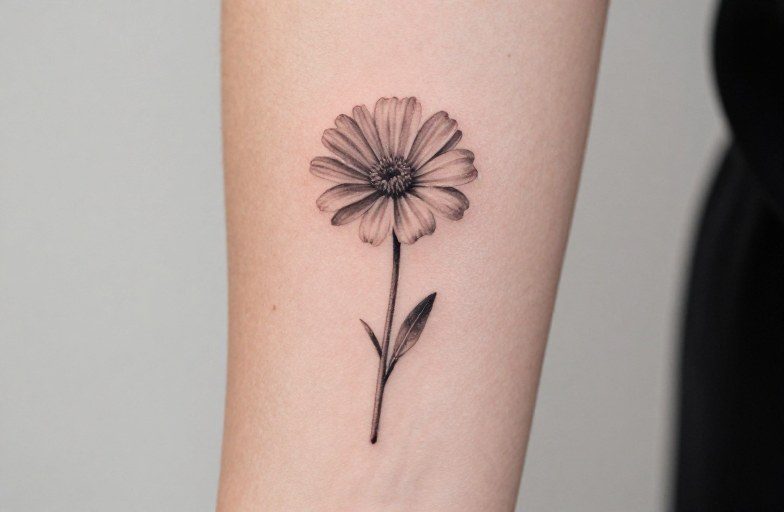
- Other April flowers (daisies, though less historically grounded) for birth-month emphasis
- Butterflies or moths, playing on the ephemeral theme without being heavy-handed
- Antique ribbon or script banners, leaning into Victorian floriography aesthetics
- Bee or hummingbird, referencing the flower’s actual pollinators and adding scale contrast
Style Compatibility
Traditional American tattooing struggles with sweet peas, the flower’s soft edges and color gradients fight against bold outlines and limited palettes. Neo-traditional and illustrative styles handle it better, allowing blended color and finer detail. Watercolor techniques can work but risk muddying the petal definition that identifies the flower. Japanese styles rarely incorporate sweet peas; the plant isn’t part of that visual vocabulary and looks grafted-on rather than integrated.
Personal & Modern Meanings
Contemporary wearers stretch the sweet pea beyond its historical definitions. Memorial tattoos for lost friendships, rather than romantic relationships or deaths, use the farewell meaning precisely. Transitional markers: end of fertility, retirement from a sport, leaving a religious community. The flower’s gentleness suits these non-tragic endings where the pain is real but not catastrophic.
Some choose it for the scent memory alone. Sweet peas have a distinctive, intense fragrance that triggers childhood or grandparent associations for people who grew up with garden exposure. The tattoo becomes a sense-memory anchor, visual trigger for olfactory recall. This isn’t in the symbolic dictionaries but operates as lived, individual meaning.
There’s also a quiet trend among people recovering from eating disorder treatment or chronic illness, using the flower’s fragile-but-climbing nature as embodied metaphor. The sweet pea vine is actually tenacious, root-hardy, capable of overwhelming trellises. That physical reality undercuts the purely delicate reading and offers a more complex self-image.
Color vs Black and Grey
What Color Adds
Sweet pea cultivars run from deep maroon through soft pink, lavender, white, and bicolor combinations. Color ink allows specific cultivar reference, someone might want the exact shade of a grandmother’s garden variety. The flower’s natural color gradients, with darker standards and lighter wings, give tattooists opportunity for dimensional work that flat color can’t achieve.
Healing considerations: purples and deep pinks generally settle well. Pale yellows and creams often require more passes and may heal to skin-tone invisibility on lighter complexions. Darker skin tones carry purples and magentas vibrantly but may lose subtle pink distinctions.
Black and Grey Solutions
Without color, the tattoo depends entirely on line precision and shading gradation to read as sweet pea rather than generic blossom. Soft grey wash can suggest the petal’s translucency; heavy black shading kills it. Some artists use whip-shading or pepper techniques to create that delicate texture. The result is often more atmospheric, less immediately identifiable, but can feel more timeless and less “garden club.”
Black and grey also ages more predictably. Color variation won’t fade unevenly; the whole piece softens together. For placement on sun-exposed skin or for wearers who won’t commit to sun protection, this practical advantage matters.
Final Word
The sweet pea flower tattoo works best when chosen for its specific, layered history rather than generic floral appeal. It carries weight of documented meaning, farewell, gratitude, April, fleeting beauty, that more common blooms lack. On skin, it demands technical respect: enough size, thoughtful placement, and realistic expectations about how fine detail ages. Get it right, and you have a design that communicates precisely without shouting. Get it wrong, and you’ve got a pretty flower that could be anything. The difference is in the details you demand from your artist and the honesty you bring to why you’re marking this particular plant permanently.
Frequently Asked Questions
Does a sweet pea tattoo always mean goodbye?
Not necessarily. While farewell is the strongest historical meaning, many people choose it for April birth-month identity or garden nostalgia. Context and accompanying elements usually clarify the personal intent.
How big should a sweet pea tattoo be to stay recognizable?
Aim for at least 2.5 to 3 inches in the flower’s longest dimension. Smaller than that, the layered petal structure compresses into a generic blossom shape even with skilled execution.
Can sweet peas work in a sleeve with bolder flowers?
Yes, but they function best as filler or transition elements rather than focal points. Their softness provides contrast against heavier roses or peonies, and their tendrils can thread between larger designs naturally.
Do sweet pea tattoos need color to read correctly?
Color helps identification but isn’t mandatory. Black and grey can work with careful shading that preserves the petal’s thin, layered quality. The risk is always that it becomes “small flower” rather than specifically sweet pea.