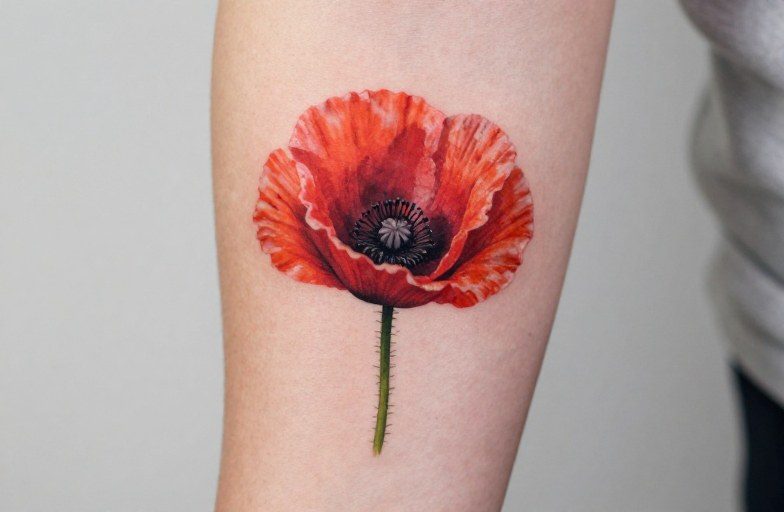
A wild poppy tattoo most commonly signals remembrance, especially for lives lost in war, but the flower’s symbolism stretches further back to sleep, dreams, and the fragile boundary between life and death. In contemporary tattooing, people also choose it to mark personal loss, resilience through hardship, or simply an attraction to its vivid, delicate structure. The meaning you carry depends heavily on which symbolic thread you pull and how the design gets executed.
Mythology & Folklore
Greek and Roman Roots
The wild poppy’s connection to sleep and death originates with Hypnos and Thanatos, the twin gods of sleep and peaceful death, often depicted with poppies in classical art. The flower’s sap was likened to the letting go of consciousness, gentle, inevitable, not violent. Some trace the association to Demeter, who received poppies to ease her grief for Persephone’s annual descent to the underworld. This isn’t a single fixed myth but a cluster of associations that accumulated over centuries, making the poppy a flexible symbol for transitions rather than endings.
European Folk Beliefs
In rural European traditions, poppies growing on graves were sometimes seen as the sleeper’s dream continuing, or as a barrier keeping the dead at rest. Picking poppies from a battlefield was considered ill-omened in certain regions. These beliefs rarely surface directly in modern tattoo choices, but they color why the flower still feels slightly melancholic even in bright color.
Design Tips & Pairings
Line Work vs. Color Realism
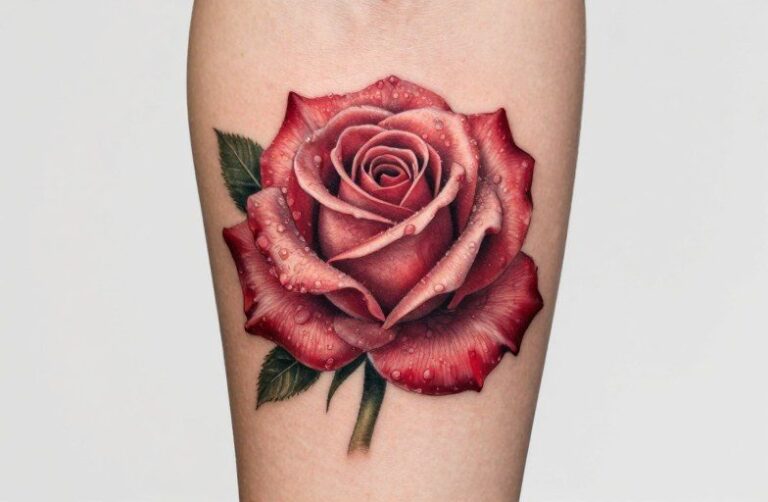
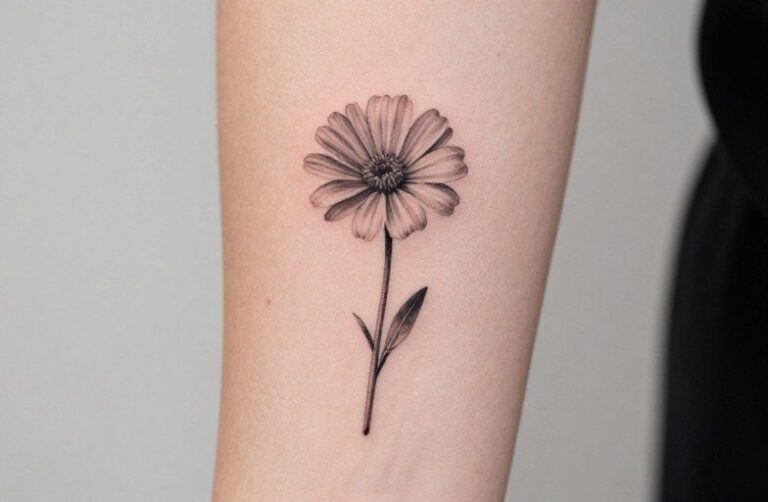
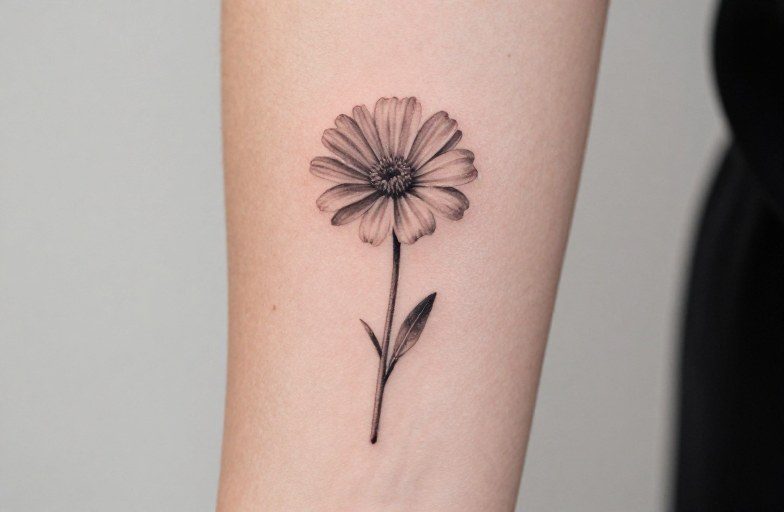
Wild poppies tattoo beautifully in several approaches. Fine-line single-needle work captures the tissue-paper delicacy of actual petals, though this style demands an experienced hand, wobbly lines here look like mistakes, not looseness. Traditional bold-line with saturated red and black reads immediately from distance and ages more forgivingly; the red will soften toward coral or pink over five to ten years, but the structure holds. Watercolor-style splashes behind realistic poppies can look striking fresh, yet the background often muddies faster than the flower itself. For longevity, consider limiting watercolor effects to smaller accent areas rather than full fields.
Common Pairings
- Crossed stems or wreaths: Directly signal military remembrance, especially with specific dates or regimental numbers.
- Bee or butterfly: Emphasizes the poppy as a living, pollinated thing rather than a cut symbol, life continuing.
- Broken stem or falling petals: Visual shorthand for interrupted life, often chosen for memorial pieces.
- Barbed wire or rifle: Explicit war imagery; use deliberately, as this pairing dominates the meaning.
- Script or names: Keep lettering simple and legible; elaborate fonts compete with the flower’s natural lines.
Best Placements
The wild poppy’s long, hairy stem and nodding flower head suit vertical placements particularly well. The outer forearm allows the stem to follow the bone line naturally, with the bloom settling near the wrist or inner elbow depending on orientation. Ribs and side pieces work for larger compositions with multiple flowers, though the stem’s curve must be drawn to complement body movement, not fight it. Behind the ear, a single small poppy reads as intimate and private, visible when hair is up, hidden otherwise. Ankles and feet are popular but present challenges: skin there holds ink less reliably, and the poppy’s fine details blur faster than on the upper body. For color saturation that lasts, the thigh or upper arm offers the most stable canvas.
Personal & Modern Meanings
Beyond Military Remembrance
While the red poppy remains tied to wartime loss in Commonwealth countries, individuals increasingly adapt it for personal grief, addiction recovery, suicide loss, or the death of a parent. The poppy’s brief blooming period, often just days, resonates with people who’ve experienced sudden loss or who want to mark that beauty and pain coexist tightly. Some choose it simply for aesthetic reasons, drawn to the color contrast against skin, and that’s valid too. The tattoo doesn’t require a tragedy to justify it.
Resilience and Contradiction
There’s a specific tension in the wild poppy: it colonizes disturbed ground, thrives in battlefields and construction sites, yet looks impossibly fragile. That contradiction attracts people who’ve rebuilt after disruption, divorce, relocation, career collapse. The flower becomes less about mourning and more about what grows despite destruction. In black and grey, this reading strengthens; in full color, the memorial association typically dominates.
Religious & Spiritual Angles
Christian Contexts
The poppy holds no fixed place in Christian iconography, though some link it to the blood of Christ through color association, or to the “sleep in Christ” mentioned in Thessalonians. These connections are loose and personal rather than doctrinal. A wild poppy near a cross or praying hands reads as individual synthesis, not established tradition. If you’re seeking specifically Christian floral symbolism, the lily or rose carry clearer institutional weight; the poppy offers more ambiguity, which some prefer.
Eastern and Contemporary Spiritual Use
In some Buddhist-influenced interpretations, the poppy’s brief life and soporific effect connect to mindfulness of impermanence, though this is a modern Western borrowing rather than classical Buddhist symbolism. The flower’s use in sleep and dream imagery also appeals to people exploring liminal states, lucid dreaming, or psychedelic integration. These are contemporary associations, not ancient transmissions, but they shape how people actually relate to their tattoos now.
Who Chooses This Tattoo
Military veterans and their families remain the most visible group, particularly in the UK, Canada, Australia, and New Zealand where the red poppy is culturally central to Remembrance Day. Beyond that demographic, the wild poppy attracts people drawn to botanical accuracy over stylized flower clichés, it’s recognizable but not as ubiquitous as roses or lotuses. Artists and designers often appreciate its structural elegance. People marking specific dates of loss choose it for the memorial flexibility. And some simply grew up in rural areas where poppies grew wild in ditches, carrying personal geography rather than symbolic weight. The choice rarely falls to a single category; most people layer meanings.
The Takeaway
A wild poppy tattoo carries genuine symbolic depth, but that depth is wide rather than deep, a pool with many entry points. The red variety will always whisper of remembrance; the black or white variants shift toward sleep, dreams, or pure form. How you compose it, where you place it, and what accompanies it determines which meaning speaks first. Work with an artist who understands botanical structure, not just flower clichés, and let the flower’s actual characteristics, nodding head, hairy stem, brief bloom, inform the design rather than fighting them for a prettier image. The best poppy tattoos look like they might drop a petal if you breathed on them.
Frequently Asked Questions
Does a wild poppy tattoo always mean someone died in war?
Not necessarily. While strongly linked to military remembrance in Commonwealth countries, many people choose it for personal loss, resilience, or simply the flower’s aesthetic. Context and accompanying imagery usually clarify the specific meaning.
How well does red poppy ink hold up over time?
Red pigments generally fade faster than black and grey, softening toward pink or coral within five to ten years. Sun exposure accelerates this, so consider placement and aftercare if longevity matters to you.
What’s the difference between a wild poppy and an opium poppy tattoo?
Visually, wild poppies (Papaver rhoeas) have smaller, crinkled petals and a simpler center; opium poppies (Papaver somniferum) show larger, smoother petals with a prominent seed pod. Symbolically, the opium poppy carries stronger connotations of sleep, dreams, and addiction recovery.
Can a wild poppy work in black and grey instead of color?
Absolutely. Black and grey shifts the emphasis toward form, texture, and the flower’s melancholic associations rather than the immediate red of remembrance. It also ages more consistently with less noticeable fading.