The Japanese cherry blossom tattoo, or sakura, carries a layered meaning rooted in the concept of mono no aware, the gentle sadness of things passing. It speaks to beauty that is intense precisely because it cannot last. The blossoms appear for roughly two weeks each spring, then fall. That brief window makes them a symbol of life’s transience, but also of living fully while the moment holds.
There is no single fixed meaning. The tattoo can mark a personal loss, celebrate recovery, honor Japanese heritage, or simply express an aesthetic preference for the form. What separates it from generic floral work is the cultural weight: the sakura has been a poetic and philosophical image in Japan for over a thousand years, and the tattoo carries that resonance whether the wearer intends it or not.
Best Placements
The sakura’s natural shape, branching, asymmetrical, delicate, determines where it works best on the body. The design needs room to breathe. Crowding it onto a finger or behind an ear usually loses the branch structure that gives the image its movement.
Arm and Shoulder Placement
The upper arm, wrapping toward the shoulder cap, is the most common placement. The branch can follow the deltoid curve, with blossoms scattering down toward the bicep. This allows for a natural fall of petals. Forearm placement works too, but the straight canvas suits a more vertical branch composition. Inner forearm skin holds fine line work well, though it sees more sun over a lifetime.
Back and Torso Options
A full back piece can hold an entire tree in bloom, with trunk at the spine and branches reaching across the shoulder blades. The rib cage offers a long, curved surface that suits a hanging branch with blossoms drifting downward. Rib tattoos hurt more and heal slower due to movement and friction from clothing, but the placement is visually striking. Hip and thigh placements work similarly for larger compositions.
- Upper arm/shoulder: best for medium-sized branching designs
- Forearm: suits vertical compositions, visible but coverable
- Rib cage: dramatic hanging branches, higher pain, longer healing
- Back: only placement for full tree or multi-branch scenes
- Thigh: good for larger work, less sun exposure than arms
Color vs Black and Grey
This choice changes the tattoo’s emotional register more than most designs.
Color Realism
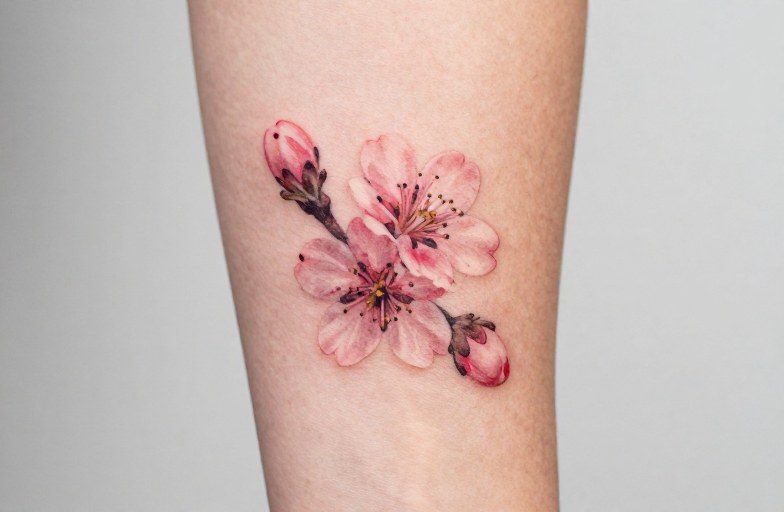
Pink sakura tattoos dominate the market, ranging from soft pastel to saturated magenta. Real blossoms vary from nearly white to deep pink, so there is no single “correct” shade. Color allows for subtle gradation in the petals, darker at the center, pale at the edges. The downside: pink and red pigments fade faster than black, especially on sun-exposed skin. A color sakura on a forearm or hand will need touch-ups within five to seven years. Yellows and light greens for leaves fade even faster.
Black and Grey
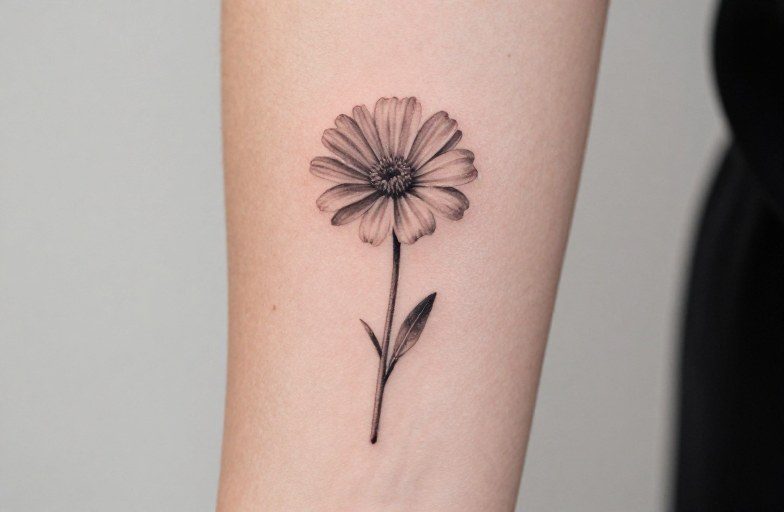
Black and grey sakura tattoos draw from sumi-e ink wash painting traditions. The petals become negative space or soft grey wash, with the branch in bold black. This approach ages better. The contrast between dark branch and light skin creates the blossom shape even as grey tones soften. For someone wanting the symbol without the maintenance, black and grey is the pragmatic choice. It also reads as more solemn, less decorative.
Design Tips & Pairings
The sakura rarely stands alone in Japanese tattoo tradition. Its meaning shifts depending on what surrounds it.
Traditional Pairings
With koi: the fish swimming upstream against falling blossoms creates a narrative of perseverance amid beauty and loss. With geisha or oiran: the pairing evokes the floating world (ukiyo) of pleasure and impermanence. With samurai armor or weapons: the warrior’s death in bloom, a classic motif from Edo-period prints. With waves or water: petals on water surface, the passage of time made visible.
Stylistic Choices
Wind bars (kaze-basami) can frame the composition and suggest motion. Falling petals, hanafubuki, flower snow, extend the design beyond the main branch and help the tattoo integrate with the body’s contours. Some artists add subtle background grey wash to suggest mist or distance. Others keep the background clean, letting the negative space do the work.
Line weight matters. The branch should be bold enough to read from a distance; the petals can be fine. A common mistake is making everything equally delicate, which causes the design to blur together as it ages. The branch anchors the composition. Without that structural weight, the tattoo becomes mushy in ten years.
Mythology & Folklore
The sakura appears in Japanese narrative across many centuries, though specific origin stories are often linked to particular regions rather than a single national myth.
Historical and Literary Roots
The blossoms are commonly associated with saigyo, the twelfth-century poet-monk who wandered Japan writing of cherry blossoms and renunciation. Samurai culture adopted the flower as an emblem of makoto, sincerity unto death, because the blossom falls at its peak rather than withering on the branch. Some trace the military connection to the Meiji period, when the government promoted sakura as a national symbol of sacrifice.
The konohana-sakuya-hime, a Shinto deity of Mount Fuji and cherry trees, is sometimes invoked in connection with the flower. Her story involves fire and miraculous survival, which some tattoo wearers reference when choosing the design after personal trauma. The deity’s presence in the image is usually subtle, an artist might include her symbol rather than her figure.
Seasonal and Festival Context
Hanami, the custom of viewing blossoms, dates to the Nara period and was initially associated with plum blossoms. The shift to cherry viewing became dominant by the Heian era. This history matters for tattoo meaning: the sakura is not merely “pretty flower” but a specific cultural practice of gathering, drinking, and contemplating mortality together. A tattoo referencing hanami might include sake cups, picnic cloths, or figures in traditional dress.
Similar & Related Symbols
Understanding what the sakura is not helps clarify what it is.
The plum blossom (ume) blooms earlier, in winter, and represents endurance and quiet perseverance rather than fleeting beauty. It is a harder, more austere symbol. The chrysanthemum (kiku) is associated with the imperial family and longevity; its petals are dense and orderly where sakura petals are loose and irregular. The lotus, though sometimes confused with sakura in Western tattooing, is Buddhist, South Asian in origin, and symbolizes purity rising from mud, an entirely different conceptual framework.
Within Japanese tattooing, the maple leaf (momiji) serves as the autumn counterpart to spring sakura. The two sometimes appear together to represent the full cycle of seasons and the passage of a complete year. Peonies (botan) represent wealth and masculine courage, and often appear with shishi lions; they are structurally heavier and more opulent than the airy sakura.
Who Chooses This Tattoo
No single demographic owns the sakura. What patterns do emerge in shops are worth noting without overstating them.
Common Motivations
People who have experienced significant loss often gravitate to the blossom’s explicit memento mori quality. The tattoo becomes a way to carry grief without naming it directly. Others choose it during transitions, graduation, divorce, recovery, marking a period that felt beautiful and brief. Japanese-Americans and Japanese nationals sometimes use the sakura as a cultural marker, though this varies enormously by individual.
Gender and the Design
Western tattooing has historically marketed the sakura as feminine, but Japanese traditional work (irezumi) shows it equally on male bodies, particularly as part of larger back pieces. The gendering is a Western shop phenomenon, not an inherent quality of the symbol. Men choosing the design today sometimes pair it with harder imagery, skulls, dragons, armor, to offset perceived delicacy, though this is a stylistic choice rather than a cultural requirement.
The Bottom Line
The Japanese cherry blossom tattoo works because its meaning is specific but spacious. It does not demand a particular life story. The cultural history gives it weight; the visual form gives it flexibility. What matters is execution: the branch structure must be strong, the petal work precise, and the aging trajectory considered before the needle touches skin. A well-done sakura tattoo will look like a branch in wind twenty years later. A poorly planned one will look like a pink smear. Choose your artist for their line work and their understanding of Japanese compositional principles, not just their color palette. The meaning is in the form as much as the symbol.
Frequently Asked Questions
Does a Japanese cherry blossom tattoo have to be pink?
No. Black and grey sakura tattoos draw from sumi-e painting tradition and often age better. Pink is common but not culturally required. The branch structure matters more than petal color.
How well do cherry blossom tattoos hold up over time?
Fine petal details and light pink ink fade faster than bold black lines. The branch should be heavy enough to remain visible as color softens. Sun protection significantly extends the lifespan of color work.
Is it cultural appropriation to get a sakura tattoo if I’m not Japanese?
The sakura is widely recognized as a Japanese national symbol, but tattoo wearers generally approach it respectfully. Avoid combining it with unrelated religious imagery or treating it as mere decoration without understanding its meaning.
What’s the difference between cherry blossom and plum blossom tattoos?
Plum blossoms (ume) are five-petaled, bloom on bare branches in winter, and symbolize endurance. Cherry blossoms (sakura) have notched petals, bloom in clusters, and represent impermanence. They are visually and conceptually distinct.