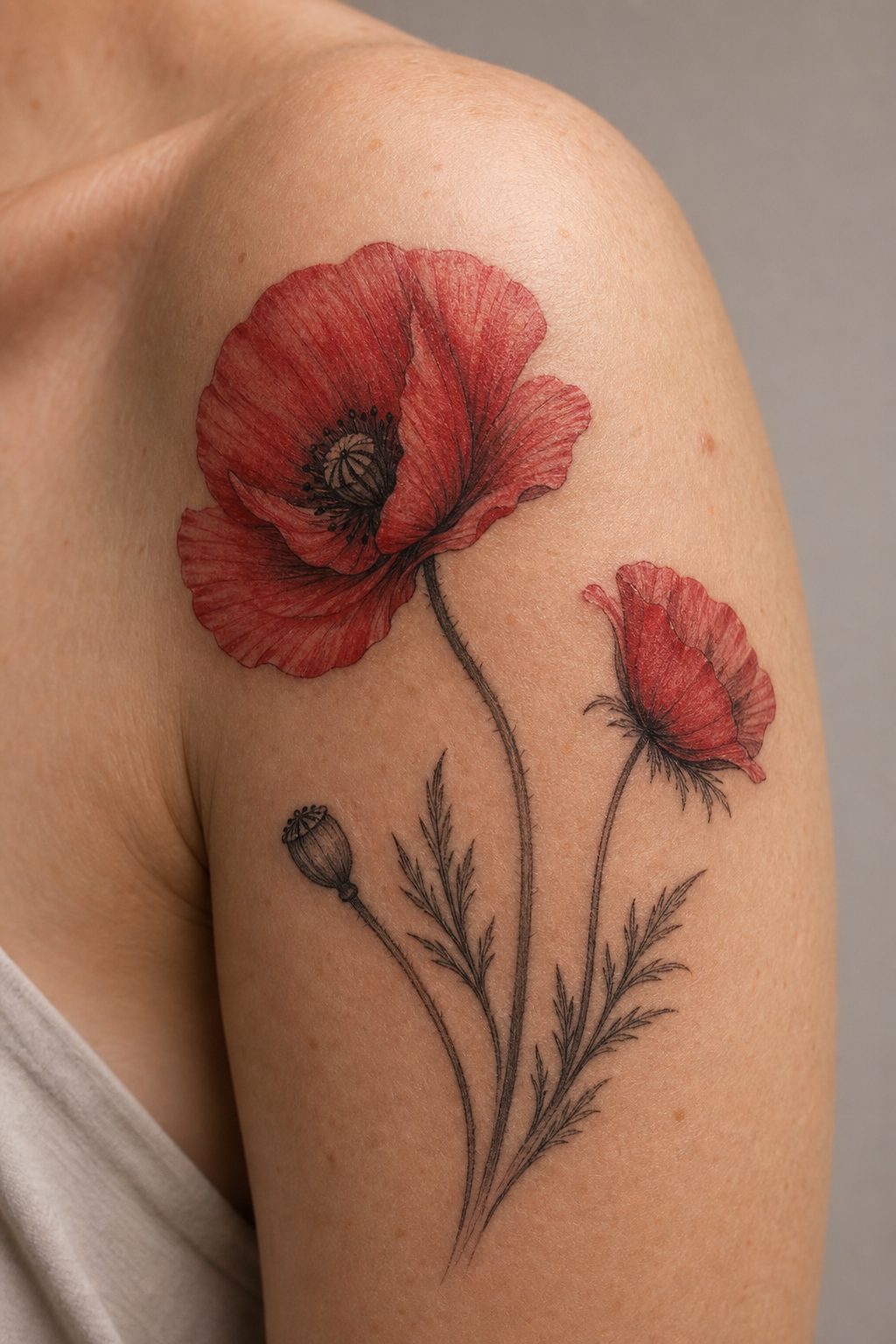
A poppy tattoo most commonly signals remembrance of the dead, especially soldiers lost to war. Beyond memorial, the bloom has long stood for sleep, dreams, and the fragile boundary between life and death. On skin, it works as a quiet tribute or a personal emblem of resilience through loss.
Religious & Spiritual Angles
Christian Symbolism
In Christian tradition, the poppy’s blood-red color often links to the Passion of Christ and the sacrifice of martyrs. The flower’s brief blooming period, sometimes just a single day, mirrors the transience of earthly life and the promise of resurrection. Some trace the association to the plant’s sedative properties, connecting it to the “sleep of death” that precedes eternal life. Stained glass and medieval manuscripts occasionally show poppies at the foot of the cross, though this imagery is less common than the lily or rose.
Eastern Spiritual Traditions
Buddhist and Hindu contexts treat the poppy with more ambiguity. Its opium derivative disrupts consciousness, making it a symbol of illusion and attachment to be transcended. In certain Tibetan thangka paintings, red poppies appear near depictions of worldly temptation. The tattoo wearer drawing from these traditions usually emphasizes the flower’s impermanence rather than its narcotic properties, aligning with core teachings on non-attachment.
Symbolism & Core Meaning
Remembrance and Memorial
The First World War cemented the poppy as the West’s primary memorial flower. Lieutenant Colonel John McCrae’s 1915 poem “In Flanders Fields” described red poppies blooming among soldiers’ graves, and the image stuck. Today, a poppy tattoo frequently marks military service, honors a specific fallen person, or acknowledges ancestral sacrifice. Placement matters here: over the heart carries obvious weight, while the forearm keeps the tribute visible during daily gestures like a handshake or salute.
- Single poppy: individual loss, personal grief
- Cluster or wreath: collective remembrance, unit or family bonds
- Wilted or drooping bloom: grief still active, absence rather than celebration
- Crossed with a date: specific commemoration, often a death anniversary
Sleep, Dreams, and the Underworld
Before its wartime association, the poppy belonged to Hypnos and Thanatos, sleep and death in Greek conception. The opium poppy’s sap induces both states, blurring the line between them. A tattoo emphasizing this older meaning might show the flower with closed eyes, moon imagery, or swirling patterns suggesting dream-states. This reading appeals to those who’ve experienced profound loss, chronic illness, or periods of necessary withdrawal from active life.
Who Chooses This Tattoo
The poppy attracts distinct groups with little overlap in motivation. Military families and service members dominate the memorial usage, often coordinating with Remembrance Day or Veterans Day observances. These pieces tend toward documentary realism: accurate petal structure, specific red tones, sometimes unit insignia integrated into the design.
A second group comes to the poppy through literary or artistic channels. The flower appears in Homer, in Victorian flower-language dictionaries, and in countless paintings from Van Gogh to Georgia O’Keeffe. These wearers often choose stylized or abstracted versions, prioritizing aesthetic impact over botanical accuracy. They’re less likely to explain the meaning unprompted; the tattoo functions as a private reference.
Third, people in recovery sometimes select the poppy as a marker of survived addiction, particularly to opiates. This usage carries obvious tension, the plant is both poison and source of the poison, and requires careful handling by the artist to avoid glorifying the substance while honoring the struggle.
Mythology & Folklore
Greek and Roman Sources
The gods of sleep and death received poppy offerings in ancient ritual. Hypnos and Thanatos, twin brothers in Hesiod’s genealogy, were often depicted with poppy crowns or holding the flower. The association with Demeter is equally old: after Persephone’s abduction, the goddess of grain ate poppy seeds to numb her grief and continue the agricultural cycle. Some trace the Eleusinian Mysteries’ use of opium to this myth, though archaeological evidence remains contested. A tattoo referencing this strand might pair the poppy with sheaves of wheat or a torch.
European Folk Beliefs
Rural European traditions treated the poppy with cautious respect. Carrying the flower supposedly revealed hidden treasure by causing the bearer to yawn near buried gold, sleep and hidden wealth linked through the same plant. Conversely, picking poppies from a graveyard invited nightmares or possession by the dead. These beliefs survive fragmentarily in tattoo imagery: a poppy with roots visible might reference the underworld connection, while a poppy with coins or keys draws on the treasure-lore.
How It Ages on Skin
The poppy presents specific challenges for long-term readability. Its petals are thin, overlapping, and depend on subtle color gradation for their effect. In black and grey, these layers collapse into indistinguishable dark masses within five to seven years without careful planning. The solution is aggressive contrast: the artist must establish clear value separation between each petal edge, often using negative space or concentrated black lines where the natural flower shows only soft transition.
Color poppies age more gracefully but face their own problems. The signature red is notoriously difficult to maintain. Cadmium-based pigments, once standard, have been largely replaced by organic alternatives that shift toward orange or pink as they fade. Purple and white varieties hold their tone better but lack the immediate recognition factor. Yellow poppies, common in California species, fade fastest of all, often returning to skin-tone within three years.
Line weight matters enormously. A single-needle outline that looks delicate at six months will bleed and blur by year three. Experienced artists working in this subject typically use 7-9 round liners for primary structure, reserving finer needles for texture details well inside the form. The center of the poppy, the seed pod and stamens, provides the most stable element over time, which is why many aged poppy tattoos read more clearly at the core than at the petal edges.
Color vs Black and Grey
Red and Its Variants
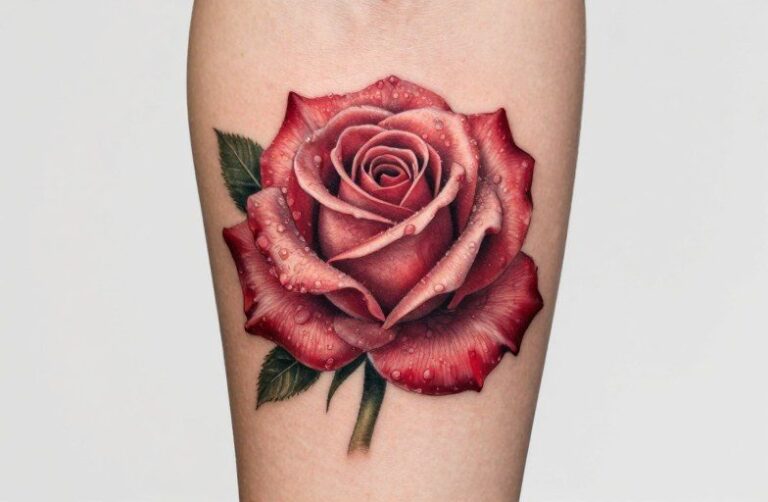
Scarlet remains the default for a reason: it triggers immediate recognition and carries the full weight of wartime memorial tradition. Deep crimson works better on medium to dark skin tones than bright orange-red, which can appear inflamed or unfinished. Burgundy and wine shades offer a subdued alternative that ages toward brown rather than pink. For the California or Iceland poppy, yellow and orange provide regional specificity but require the wearer to accept faster fading.
Black and Grey Strategies
Without color, the artist must rely on structure and contrast. High-contrast blackwork poppies, where petals are carved from solid black with white highlights, last decades but sacrifice botanical subtlety. A softer approach using whip shading and dotwork can suggest the flower’s texture but demands larger scale, too small, and the dots merge into mud. The seed pod’s ribbed surface actually translates better in black and grey than in color, which is why many monochrome designs emphasize the center over the petals.
White ink highlights, once popular for suggesting petal sheen, have proven unreliable. They yellow on most skin tones within two years and can create a scarred appearance. Most artists now avoid them in favor of skin-tone negative space or simply accepting that the poppy will read as a dark form rather than a luminous one.
The Takeaway
The poppy tattoo operates on multiple registers simultaneously: public memorial and private symbol, botanical accuracy and stylized emblem, color statement and monochrome form. Its meanings are specific enough to carry weight yet flexible enough to accommodate personal narrative. The technical demands are real, this is not a design that forgives lazy execution, but the payoff is a piece that remains legible and resonant across decades. Choose your color knowing how it will shift, scale it large enough for the structure to survive, and trust the flower’s own long history to do the symbolic work.
Frequently Asked Questions
Does a poppy tattoo always mean someone died?
No. While memorial is the most common reading, the poppy also represents sleep, dreams, artistic influence, or personal survival. Context and accompanying imagery usually clarify the wearer’s intent.
What’s the best placement for a poppy tattoo?
The upper arm, thigh, and ribcage provide enough flat surface for petal detail. Finger or wrist placements force extreme simplification and lose the flower’s layered structure within a few years.
How much detail can a small poppy tattoo hold?
Below two inches, petal edges blur together and the seed pod becomes a dark oval. For recognizable structure, plan at least three to four inches in the longest dimension.
Can a poppy tattoo cover old scars?
The flower’s layered petals work well for concealment, but scar tissue doesn’t hold ink predictably. Plan for a touch-up session after full healing, and expect the color to settle differently over raised areas.