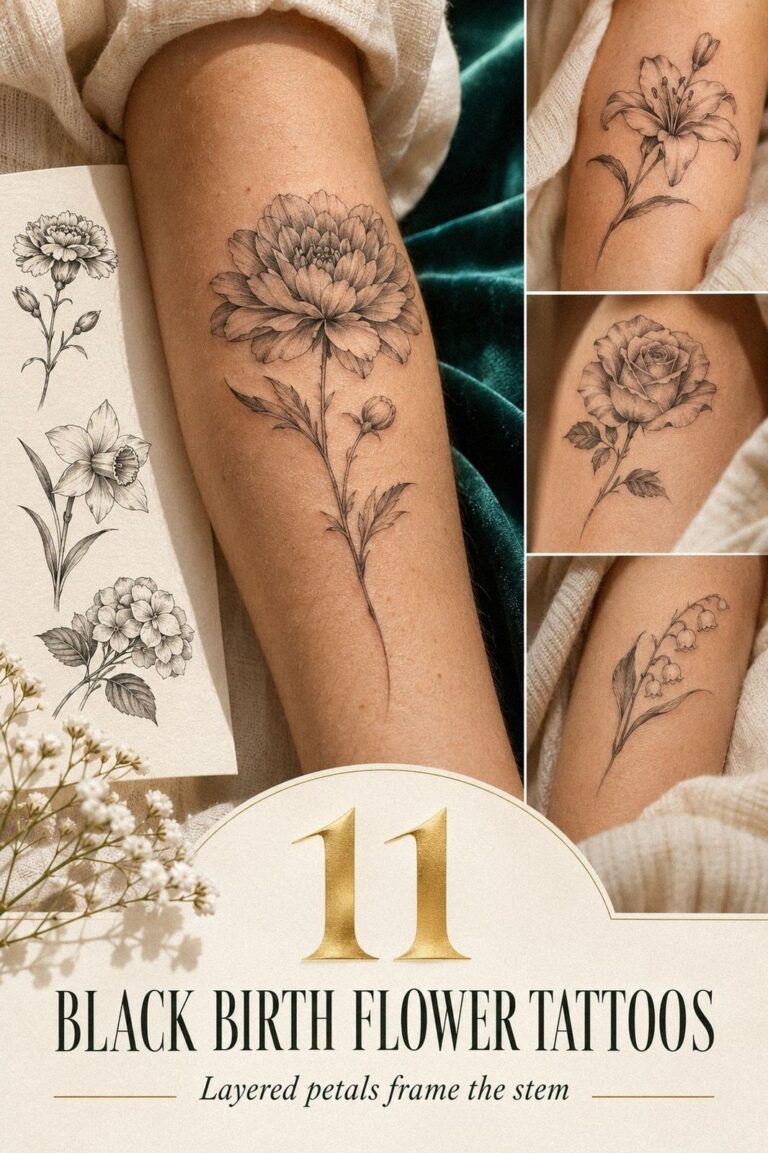
Fine line daisy tattoos can stay private when you choose a tucked-away placement and a readable shape. I once made the mistake of shrinking a flower until its petals blurred together. Now I’d keep the design crisp, symbolic, and slightly bolder than expected.
This guide covers 11 daisy tattoo ideas for skin that deserves something delicate, meaningful, and personal without feeling predictable.
Start With the Private Placement
Before choosing petals, decide how often you want the tattoo seen. A private placement can still feel expressive when you know where to look, and that restraint gives the design an understated confidence.
Your budget should cover more than the appointment itself. Consider the artist’s portfolio, consultation time, aftercare products, and possible touch-ups before deciding whether the design feels worth the cost.
I’d also think about your daily habits. A meaningful daisy can feel sleek on the wrist, quietly romantic beneath a sleeve, or surprisingly fierce behind the ear!
Small Fine Line Daisy Tattoo On Wrist
A small wrist daisy is an understated choice when you want your ink visible to you but easy to cover. The rounded petals and dotted center give the design a playful look without making it loud.
Ask your artist to keep the stem clean and the center dark enough to stay readable as the lines soften. A single-needle outline can look elegant on fresh skin, but it still needs enough spacing.
The inner wrist offers more privacy than the top of the hand. A watch or long sleeve can cover it quickly, while your hand position still lets you glance down at the flower.
If you’re choosing your first piece, compare this scale with other tiny fine line flower tattoo ideas. You’ll see how a minimal flower can still feel striking when the silhouette carries the meaning.
The Wrist Privacy Rule
Your wrist moves constantly, so you’ll want a design with fewer tiny details than a larger piece. I’d skip an overly intricate center here, even if it looks tempting on a stencil.
Keep the placement toward the inner wrist if you want more privacy. That balance feels meaningful without turning every introduction into a tattoo conversation!
Fine Line Daisy Tattoo With Birth Flower Details
A daisy paired with a birth flower gives your tattoo a more personal story. A single stem can keep the composition graceful, while the second bloom adds symbolic weight.
You can use your birth month flower, a family member’s flower, or a small leaf that represents a place you love. The best version has one clear focal point rather than an ornate cluster.
The Two-Bloom Balance
Your artist should vary the flowers slightly instead of making them identical. A fine line stem can connect both blooms, but the daisy should remain the clearest shape.
I’d choose one bold black center and let the second flower stay lighter. Too much equal detail makes the design feel crowded, while selective contrast keeps it expressive.
For more symbolic ideas, browse these minimalist fine line flower tattoo designs. The value is in finding a reference that helps you explain your own story, not copying every detail.
The most charming version has one clear focal point, not a tiny bouquet fighting for attention. Your birth flower can feel vibrant without becoming overly ornate.
Fine Line Daisy Tattoo Along The Collarbone
A collarbone daisy works because the natural curve gives the stem a flowing direction. The small rounded petals can sit just below the bone, following your anatomy instead of crossing it awkwardly.
This placement feels flowing and slightly secretive, especially when your shirt covers the upper edge. It’s a strong choice when you want something visible on your terms.
The Collarbone Curve Method
Your artist should position the collarbone placement while your body is relaxed, not while you’re lifting your shoulders. That small adjustment matters.
But you’ll also want to consider sun exposure, straps, and how often your shoulder is uncovered. A delicate tattoo needs UV protection if you want the linework to stay polished.
If you’re comparing placements, these fine line flower tattoo ideas for women include similar proportions. I’d choose this location when the privacy is worth it to you, especially if you prefer a feminine but not overly sweet result.
The cleanest version has one daisy, one stem, and controlled negative space. That restraint gives the tattoo an elegant presence without making it disappear.
Fine Line Daisy Tattoo With Stem Script
A daisy with script woven into the stem gives your tattoo a direct emotional message. Use a name, date, short word, or handwriting sample that still matters when the trend has moved on.
The upper-back placement keeps the design private while the lettering adds a personal detail. A handwritten script can make the piece feel raw and emotionally specific.
The Stem Lettering Rule
Your artist can curve the black ink stem gently around the script, but the text needs enough separation to remain readable. I’d avoid long quotes in this size.
One meaningful word will look sharper than six cramped letters that fade into the petals. That choice is often more stylish than adding extra flourishes.
You’ll want to bring a handwritten reference instead of relying only on a typed font. Your own uneven strokes can make the piece feel daring and expressive.
For a softer botanical direction, compare it with a fine line wildflower tattoo. Your daisy can remain the main subject while the script acts like a private note.
Fine Line Daisy Tattoo Behind The Ear
Behind-the-ear daisy tattoos are compact, edgy, and easy to hide with your hair. Choose a rounded bloom, a tiny stem, a side-facing flower, or a more graphic outline.
The design should still read when it’s viewed from a few feet away. That keeps the result iconic rather than merely tiny.
The Behind-the-Ear Scale Test
Your artist may recommend slightly stronger black outline ink than you expected because this area has limited skin and frequent movement. I’d skip a crowded bouquet here.
Think about headphones, glasses arms, hair products, and how often the area rubs against fabric. A dainty tattoo may take less time, but the placement still deserves careful aftercare.
Ask your artist to show the stencil beside your ear so you can judge the scale. For another petite option, save these small fine line flower tattoos before your appointment.
This is one of the most private choices in the list. Your hair can cover it in seconds, but a tucked strand reveals a whimsical surprise!
Fine Line Daisy Tattoo In A Botanical Bouquet
A wrist bouquet lets your daisy sit inside a larger botanical composition. Surrounding stems give the main bloom a graceful boundary, while the flower stays recognizable through slightly stronger visual weight.
Keep the daisy clearer than the supporting leaves. The result can feel bold without becoming heavy.
The Negative-Space Bouquet
Your artist can combine a black botanical bouquet with open skin between each stem. That negative space keeps the arrangement crisp instead of turning it into a dense patch.
I’d choose two or three supporting elements, not every flower you like. A bouquet needs hierarchy, and the strongest version usually feels more powerful because it leaves something out.
You’ll also want to ask how the design will look when your wrist bends. A stem that seems flowing on a flat reference can look broken when it crosses a crease.
If you love a fuller floral direction, compare this layout with a fine line flower crown tattoo. Your version doesn’t need to become a crown; the reference can simply help you understand repeated stems.
Fine Line Daisy Tattoo Encircling The Ankle
An ankle daisy that curves around the bone creates a delicate band without looking like a traditional bracelet. The flower can sit at the front or outer ankle, with a thin stem following the natural circle.
This placement feels feminine, graceful, and easy to cover with socks or trousers. It’s also a smart choice when you want a vintage botanical mood with a modern outline.
The Ankle Wrap Check
Your artist should place the ankle linework while you’re standing and sitting because the skin shifts between both positions. I’d avoid wrapping the design too tightly.
A small opening keeps the piece lighter and makes future touch-ups simpler. That matters when you’re weighing the long-term cost of maintenance.
You’ll want to know that feet and ankles can feel more intense than areas with more cushioning. Shoes and socks can also create friction during healing, so follow your artist’s instructions carefully.
The strongest ankle version isn’t the most detailed one. It’s the one with a clear daisy, a steady curve, and enough open skin to keep the silhouette timeless.
Fine Line Daisy Tattoo With Tiny Shading
Tiny shading can give a fine line daisy more depth without turning it into a heavy blackwork piece. Small grey marks can suggest the center and petal overlap while keeping the flower light.
The effect is subtle, but it adds a sophisticated finish. Used carefully, shading can make a delicate daisy feel more dimensional without losing its clarity.
The Three-Tone Shading Rule
Your artist might use soft grey shading inside only a few petals. I’d avoid shading every section equally.
The eye needs a light area, a darker center, and untouched skin to understand the form. Too much grey can make a small daisy look blurry before it has fully healed.
You’ll want to ask whether the artist works with healed fine line tattoos, not only fresh photographs. A healed portfolio gives you a more honest view of the final sharpness.
Compare outline-only and shaded options with fine line flower tattoo references before you commit. A little shading can be worth it when the artist has consistent healed results.
Fine Line Daisy Tattoo On The Finger
A finger daisy is bold because the placement is small but highly visible. The rounded petals can sit on the side of the finger, near the knuckle, or on top where the flower reads most clearly.
Choose this idea only if you’re comfortable with a tattoo that may need future maintenance. The placement has a gritty practicality that other options don’t.
The Finger Longevity Decision
Your artist should explain that finger tattoo ink can soften or fade faster because hands face washing, friction, sunlight, and constant movement.
I’d choose a simple daisy with a strong center instead of an intricate flower with fragile details. The cost of a touch-up is easier to anticipate when the original design is straightforward.
You’ll want to consider your work, jewelry, and how often your hands are exposed. A side placement can feel more private, while the top of the finger is more empowering.
If you’re drawn to tiny designs, compare this with tiny fine line flower tattoo inspiration. A clean silhouette often beats extra detail when the available skin is limited.
Fine Line Daisy Tattoo In Profile
A profile daisy gives you a more unusual view of the flower. Instead of showing a full round bloom, the design turns slightly sideways, with petals overlapping along one edge.
This profile can feel stylish without becoming difficult to recognize. It’s a strong option for someone who wants a daisy that feels personal rather than standard.
The Healed-Image Standard
Your artist should show you the healed tattoo result beside the original stencil whenever possible. I’d trust a slightly softer healed result more than a dramatic fresh photo.
Fine lines can widen with time, and a readable silhouette matters more than extreme delicacy. That’s where the real value of a portfolio becomes clear.
You’ll want to ask how much the artist plans to simplify the stencil. A profile flower may need fewer petals, stronger spacing, and a clearer stem than the reference suggests.
For another symbolic floral idea, look at fine line peony tattoo designs. Your daisy can stay small while still feeling unique.
This is my favorite choice for someone who wants a fine line daisy tattoo that doesn’t look like the first result in a search. The profile is elegant and slightly unexpected, but it still reads as a flower immediately.
Fine Line Daisy Tattoo With Moon Accents
A daisy with moon accents gives the upper-arm design a symbolic direction. The crescent marks can support the flower without becoming a competing centerpiece.
Keep the moon small and the spacing deliberate. A sacred detail can stay personal without explaining itself to everyone who sees it.
The Orbit-and-Flower Layout
Your artist can place a crescent moon accent above the petals, with two or three dots creating a gentle arc. I’d avoid a crowded celestial cluster.
One crescent and a few carefully spaced dots will look more timeless than a full constellation squeezed around the flower. That keeps the composition sleek and readable.
You’ll want to decide whether the moon represents change, protection, cycles, or simply visual contrast. A sharp moon feels edgy; a rounded one feels more whimsical.
For another symbolic floral idea, compare this with a fine line lotus flower tattoo. Your daisy doesn’t need the same structure, but the reference may help you decide how much meaning the surrounding symbols should carry.
The upper arm gives you more flexibility than the finger or ankle. A sleeve can cover the tattoo, while a short sleeve reveals the full composition, making this option romantic and practical.
Borrow Georgia O’Keeffe’s Single-Bloom Focus
Georgia O’Keeffe’s flower studies are a useful reminder that one bloom can carry an entire visual idea. You don’t need a crowded design when the single-bloom focus already feels intentional.
For a tattoo, that can mean enlarging the petals slightly, simplifying the stem, and giving the center enough contrast. The result may feel minimal while still holding emotional weight.
I’d use that approach when you want a daisy that feels classic rather than trendy. One strong shape can be more memorable than a page full of competing symbols.
Can Fine Line Daisy Tattoos Stay Readable?
Yes, but the design needs enough scale, spacing, and contrast. A readable tattoo usually ages better than one built around impossibly faint details.
Ask to see healed work from the same artist and discuss how your chosen placement moves. Skin texture, friction, sunlight, and line thickness all affect the final result.
A delicate tattoo doesn’t have to be fragile. It can stay fierce when the silhouette is clear and the artist knows what to simplify!
Black Ink or Muted Color?
Black ink is usually the clearest choice for small petals and narrow stems. A small amount of muted color can feel vibrant, but your artist should show healed examples in that pigment.
If you’re considering color, ask about fading, touch-ups, and how the shade will interact with your skin tone. The best value comes from choosing a pigment with a track record, not simply the prettiest fresh result.
For the most timeless design, keep the daisy black and let one accent carry the color. That approach can look ethereal without losing definition.
Visible Ink vs. Private Ink
Visible placements let you enjoy the tattoo throughout the day, while private placements give the design a quieter emotional role. Neither choice is automatically better.
The wrist, finger, and ankle are easier to notice but face more friction. The upper back, upper arm, and collarbone offer more control over when the tattoo appears.
I’d choose private ink when the meaning feels intimate, and visible ink when you enjoy the reminder. Both can be empowering when the decision belongs entirely to you.
How Much Should You Budget for a Fine Line Daisy Tattoo?
A fine line daisy may be small, but the artist’s skill still matters. Ask about the minimum, consultation process, aftercare, and possible touch-up policy before you book.
A typical US fine line daisy tattoo may cost about 100 to 300 dollars, depending on size, placement, artist, and region. Some shops have a minimum of roughly 50 to 100 dollars, while hourly rates may run about 100 to 250 dollars.
The cheapest option isn’t always the best option. A skilled artist with healed botanical work may offer better long-term value than a rushed appointment with a lower starting price.
Why Fine Line Daisies Still Feel Personal
The appeal of a fine line daisy tattoo isn’t only the flower’s shape. It’s the tension between something recognizable and something private.
A daisy can symbolize joy, loyalty, memory, or a person whose presence still follows you. The result can feel haunting in the best way, especially when the meaning stays yours.
I’ve learned that the strongest small tattoos usually have one clear idea. A crisp daisy with one meaningful placement can feel more powerful than a crowded composition built from every reference you saved.
Your artist matters as much as your design. Look for clean linework, healed photographs, consistent spacing, and a studio that treats hygiene seriously.
If you’re still comparing styles, browse fine line wildflower tattoo ideas and note which details keep attracting your eye. Your final choice should feel personal, not borrowed.
There’s also a practical side. Surface healing often takes about 2 to 3 weeks, while complete healing can take about 2 to 3 months.
During that time, gentle washing, light moisturizing, and avoiding direct sun and swimming are common aftercare priorities. Follow the instructions your artist gives you.
Fine lines can widen over time, especially when the design is too small or placed where friction and UV exposure are constant. Solid black areas and sensible placement generally age more reliably than extremely faint details.
That doesn’t mean your tattoo must be heavy. It means delicate should still be readable, vintage-inspired if you want it, and suited to real life.
The Questions Worth Answering First
Where can I buy a fine line daisy tattoo design?
You don’t need to buy a finished design from a marketplace. Save references, then ask a qualified artist to create a custom stencil around your placement, skin, and preferred scale. Your artist’s portfolio should show original fine line flower tattoo work, healed results, and clean studio practices.
Is there a disclosure for these tattoo ideas?
There are no product recommendations or purchasing links in this guide. You’re using the references to discuss your own design with an artist. If you contact a studio, check its policies, consultation process, and portfolio before booking a custom tattoo.
How much does a fine line daisy tattoo usually cost?
A typical US fine line daisy tattoo may cost about 100 to 300 dollars, depending on size, placement, artist, and region. Some shops have a minimum of roughly 50 to 100 dollars, while hourly rates may run about 100 to 250 dollars. Ask what the quoted price includes before you decide whether the appointment feels worthwhile.
Are fine line daisy tattoos a good idea for a first tattoo?
Yes, especially when you choose a readable design and a tolerable placement. The forearm, thigh, and shoulder are often easier areas than the ribs, feet, hands, or sternum. Your first tattoo should feel meaningful, but you’ll also want a design that gives your artist enough skin area.
How do I choose a tattoo artist for fine line daisies?
Look for crisp linework, healed photographs, consistent botanical shapes, and clear hygiene practices. Ask how the artist handles tiny petals and whether they’ll simplify your reference when needed. You’re choosing a long-term collaborator, not only a drawing style.
How much do fine line daisy tattoos hurt?
Pain varies by person and placement. Ribs, feet, hands, and the sternum can feel more intense, while the forearm, thigh, and shoulder are often more tolerable. You’ll want to tell your artist if you need breaks, especially during a first tattoo appointment.
How long does a fine line daisy tattoo take to heal?
The surface usually takes about 2 to 3 weeks, while complete healing can take about 2 to 3 months. Wash gently, moisturize as directed, and avoid direct sun and swimming during early healing. Your artist’s instructions should take priority over general aftercare guidance.
What color works best for a fine line daisy tattoo in 2026?
Black ink remains the clearest choice when you want delicate petals and reliable contrast. A small amount of muted color can feel vibrant, but your artist should show healed examples in that pigment. For the most timeless result, keep the daisy black and let the placement carry the personality.
What’s the best placement for a fine line daisy tattoo?
The wrist, collarbone, upper back, and upper arm offer a strong balance of visibility and privacy. Your wrist and hand are more exposed to friction, while the upper back and upper arm are easier to cover and may preserve the design more comfortably over time.
Where I’d Start First
If I had to pick one, I’d start with the profile daisy on the upper arm. Its stronger silhouette gives fine lines room to age without losing the flower’s character. Pin the unique fine line daisy tattoo for later and take the healed reference to your artist.