Egyptian lotus art tattoos represent rebirth, creation, and the cyclical return of light. The blue lotus, Nymphaea caerulea, emerged each morning from the Nile’s murky waters to open toward the sun, making it one of the most potent visual metaphors in ancient Egyptian iconography. Unlike the Asian lotus with its eight-petaled perfection, the Egyptian version carries distinct regional symbolism tied to solar worship and the afterlife.
Symbolism & Core Meaning
The Solar Connection
At dawn, the blue lotus flower rises above the water’s surface and spreads its petals toward the rising sun. Ancient Egyptian artists depicted this moment repeatedly in tomb paintings and temple reliefs, often linking the flower to the sun god Ra. The closed bud at night and open bloom by day mapped neatly onto beliefs about death, the underworld journey, and morning resurrection. For tattoo collectors, this translates to a symbol of personal renewal, surviving darkness, emerging changed.
Creation and Fertility
Some creation myths describe the first lotus rising from the primordial waters of Nun, its petals opening to reveal the newborn sun. The flower also appears in scenes of birth and celebration, associated with the goddess Isis and maternal protection. A tattoo drawing on this angle might pair the lotus with an ankh, a shen ring, or stylized water ripples to emphasize the generative aspect.
Common Variations & Styles
Period-Specific Renderings
The Egyptian lotus changed character across dynasties. Old Kingdom examples tend toward geometric simplification, long stems, triangular petals, rigid symmetry. New Kingdom artists introduced more naturalistic curves, overlapping petals, and subtle shading. For tattoos, the Old Kingdom style translates exceptionally well to bold line work and stipple shading. The New Kingdom naturalism suits softer greywash and smoother gradients. Papyrus-style renderings with flat color blocks and heavy black outlines remain popular for their immediate readability.
Combined Motifs
- Lotus with a scarab beetle, emphasizing the rebirth cycle
- Lotus emerging from a ka vessel, linking to the soul’s sustenance
- Lotus columns simplified into architectural bands wrapping around limbs
- Multiple buds and blooms in sequence, suggesting life stages
Some collectors opt for a single, isolated bloom in the manner of a botanical illustration; others want the full Nile scene with water lines, fish, and sky symbols. The former ages cleaner. The latter demands more skin real estate and a patient artist comfortable with illustrative density.
Similar & Related Symbols
The Papyrus Plant
Papyrus and lotus frequently appear together in Egyptian art, representing the Two Lands of Upper and Lower Egypt. Where the lotus symbolizes rebirth and solar cycles, papyrus carries connotations of vitality and marshland abundance. Tattoos pairing both plants create a more geographically specific statement than a standalone lotus. The visual rhythm differs too, papyrus fans outward in a triangular burst, while lotus petals cup inward or flare in a more radial pattern.
Asian Lotus Overlap
Many people conflate the Egyptian and Asian lotus, but the symbols diverge significantly. The Buddhist lotus emphasizes spiritual purity rising from worldly attachment. The Egyptian version is more solar and regenerative, less about detachment and more about cyclical return. Ink-wise, Asian lotus tattoos often feature mandala geometry, fine dotwork, or watercolor backgrounds. Egyptian lotus work benefits from bolder outlines, flatter color planes, and hieroglyphic or architectural framing.
Best Placements
Vertical Spaces
The lotus’s natural growth habit, stem rising, bloom opening, makes it ideal for vertical placements. The outer forearm, from wrist to elbow ditch, accommodates a single stem with bud and open flower. The side of the calf works similarly. Rib placements running parallel to the body’s long axis preserve the botanical logic while allowing for larger scale.
Curved Adaptations
Shoulder caps and upper chest panels require more inventive composition. A skilled artist will curve the stem to follow muscle anatomy rather than forcing straight verticality. The bloom itself can tilt to face outward or upward depending on visibility needs. Smaller designs behind the ear or on the hand lose the stem detail but can still communicate the symbol through a simplified petal cluster.
Avoid wrapping the full design around a limb unless you’re prepared for significant distortion as the flower turns. The Egyptian lotus reads best when the face of the bloom remains relatively flat to the viewer.
Color vs Black and Grey
Historical Color Accuracy
The blue lotus was not actually blue in the way modern ink mixes blue. Ancient Egyptian artists used a range of blues, from lapis-derived ultramarine to cheaper mineral pigments that leaned greenish or grey. The petals in tomb paintings often appear pale blue with yellow-green centers and red or pink accents at the petal base. A color tattoo pursuing historical accuracy might use a muted, slightly dusty palette rather than saturated royal blue.
Black and Grey Longevity
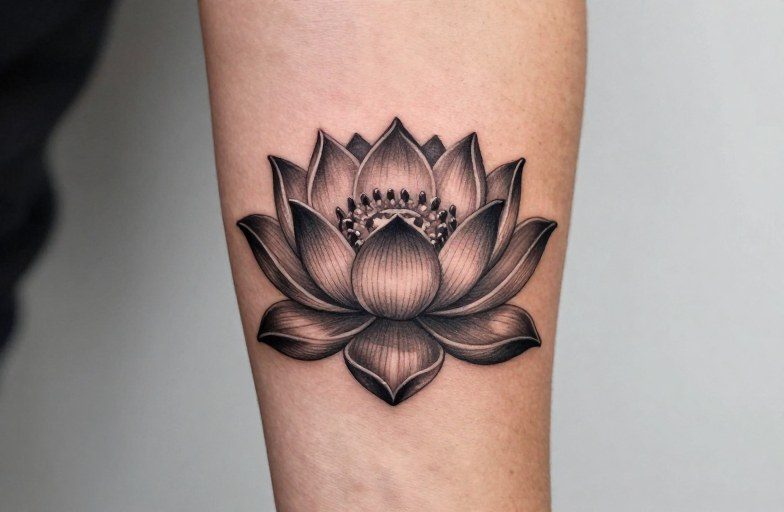
Black and grey Egyptian lotus tattoos age reliably. The strong petal outlines and negative-space highlights that define the form hold up for years without the muddying that plagues softer color blends. If you want color, consider limiting it to small accents, the center of the flower, a single petal edge, water lines beneath. Full floral saturation in bright blue and yellow will require touch-ups within five to seven years, especially on sun-exposed skin.
Religious & Spiritual Angles
Kemetic Reconstruction
Practitioners of Kemeticism, the modern revival of ancient Egyptian religion, sometimes adopt the lotus as part of a larger symbolic vocabulary. In this context, the tattoo functions as a devotional marker rather than purely aesthetic choice. Placement and accompanying symbols may follow specific religious conventions. If you’re drawn to the lotus for spiritual reasons rather than visual appeal, researching Kemetic practice will deepen your design decisions.
Secular Appreciation
Not everyone wearing this symbol claims religious affiliation. The lotus’s visual power and historical weight attract collectors interested in ancient art, botanical illustration, or personal symbolism without doctrinal attachment. This is common and accepted. The key is understanding the source culture enough to avoid clumsy mashups, placing an Egyptian lotus inside a Japanese wave, for instance, creates visual confusion rather than meaningful fusion.
The Takeaway
Egyptian lotus art tattoos carry genuine symbolic density: rebirth, solar cycles, creation from chaos, protection in transition. The design succeeds across scales from small botanical studies to large back pieces, though it rewards artists who understand Egyptian compositional conventions. Black and grey execution emphasizes the architectural quality of the petals; selective color can evoke specific historical palettes. Placement should respect the flower’s vertical growth habit or adapt it thoughtfully to body curvature. Whether your connection is spiritual, historical, or purely visual, this symbol offers enough substance to support a tattoo you’ll still respect decades later.
Frequently Asked Questions
What’s the difference between an Egyptian lotus and a regular lotus tattoo?
The Egyptian blue lotus (Nymphaea caerulea) has narrower, pointed petals and carries solar and rebirth symbolism distinct from Asian lotus meanings. Visually, it’s often rendered with longer stems, more architectural geometry, and sometimes paired with hieroglyphic elements.
Does an Egyptian lotus tattoo need to include color to look authentic?
No, black and grey work captures the form beautifully through strong outlines and strategic negative space. Historical Egyptian art itself used limited color palettes, so muted or monochrome approaches are entirely valid.
How well does fine detail in Egyptian lotus tattoos age over time?
Fine line work and small stippled details tend to soften and spread within five to ten years. For longevity, prioritize bold petal outlines and readable contrast over delicate interior shading, especially on high-movement areas like wrists or ribs.
Can an Egyptian lotus be combined with modern elements without losing its meaning?
Yes, but thoughtfully. Geometric framing, abstract backgrounds, or minimal line adaptations work well. Avoid mixing unrelated cultural symbols, like pairing it with Japanese koi or Buddhist mandalas, which creates visual dissonance rather than meaningful fusion.