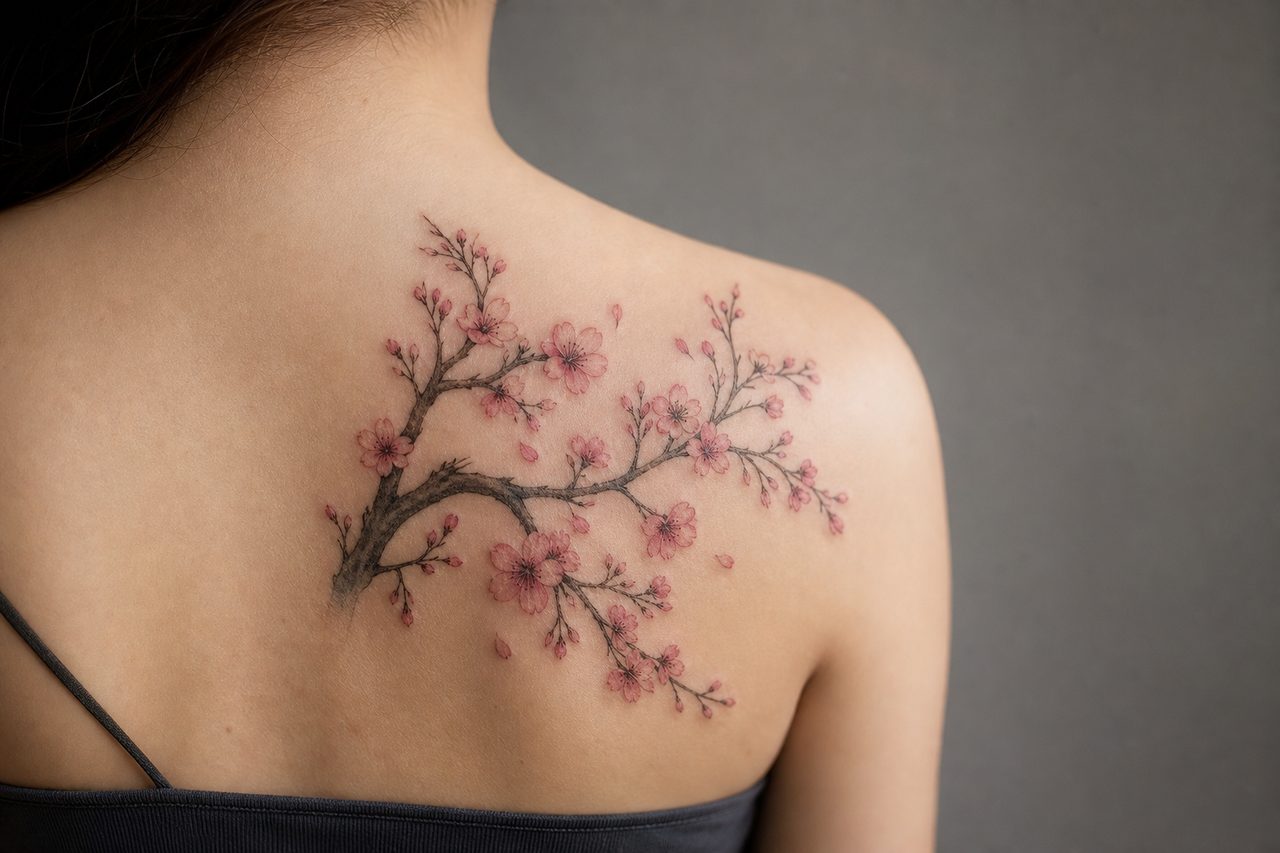
A cherry blossom tree tattoo primarily signals awareness of impermanence, the Japanese concept of mono no aware, the bittersweet knowledge that beauty exists because it ends. The image also carries weight around renewal, the courage to live openly, and the tension between individual fragility and collective strength when rendered as a full tree rather than scattered petals.
Symbolism & Core Meaning
The Single Petal vs. the Full Tree
A single falling blossom reads differently than a gnarled trunk erupting in pink. The isolated petal emphasizes personal transience, one life, one moment. The complete tree introduces endurance and lineage: the trunk persists, the flowers return annually. This distinction matters for placement and scale. A single petal works behind the ear or on the wrist; a full tree demands the back, thigh, or ribcage to let the trunk breathe.
Mono No Aware and Western Interpretation
Western wearers often latch onto the “live for today” reading, which flattens the concept. Mono no aware contains grief alongside appreciation. The sadness of loss isn’t a bug, it’s the feature that makes the beauty register. Good cherry blossom tattooing captures this duality: some petals falling, some still attached, the branch never static.
- Full bloom: peak experience, celebration, risk of hubris
- Scattered petals: aftermath, memory, acceptance
- Bud stage: potential, anticipation, the unlived
- Bare branch with one bloom: resilience, late beauty, defiance
Mythology & Folklore
Japanese Origins
Cherry blossoms in Japan are often linked to samurai culture, where the flower’s brief life paralleled the warrior’s expected death. The sakura became a symbol of noble transience rather than mere decay. Some trace the military connection to the Meiji era, when the government actively promoted the image for nationalist purposes, worth knowing if you’re drawn to the samurai association specifically.
Chinese Connections
In Chinese tradition, the cherry blossom (distinct from plum blossom in symbolism, though frequently confused) carries associations with feminine beauty and the dominance of love over political authority. The Japanese and Chinese lineages diverge significantly; conflating them in tattoo discussion usually signals surface-level research. If your design pulls from both, the visual language needs to account for the tension rather than pretend seamless fusion.
Who Chooses This Tattoo
The demographic spans wider than most floral motifs. Younger wearers often arrive after personal loss, breakup, death, health scare, seeking visual language for what words flatten. Older clients, particularly women entering new life phases, sometimes use the blossom to mark release: children leaving, careers ending, identities shifting. Men choosing cherry blossoms have increased noticeably in the last decade, typically integrating the tree with geometric or architectural elements to offset perceived softness.
Placement patterns reveal intent. Collarbone and shoulder placements suggest display and social readability. Ribs and hips indicate private significance, revealed selectively. Full back pieces often commemorate specific people or periods, using the tree’s annual return as metaphor for ongoing relationship with memory.
How It Ages on Skin
Line Work and Pink Ink Reality
Cherry blossoms tax aging particularly hard. The soft pinks, magenta bases with white highlights, fade faster than black or blue. Within five to seven years, unprotected pink often muddies toward flesh-tone or grey. White ink, used for petal highlights and glow effects, frequently disappears entirely on lighter skin or yellows unpredictably on darker tones.
Line strategy matters enormously. Petals defined by thin black outlines hold structure; petals shaped purely by color bleeding tend to blob. A skilled artist builds each petal with a “wireframe” of grey or diluted black, then lays color inside. This reads as softer than hard black outlines but preserves definition through fading.
The Trunk’s Advantage
The tree’s trunk and branches, typically rendered in black or dark grey, age reliably. Contrast between stable dark structure and vulnerable light color actually serves the metaphor, if the design’s conceptually coherent. A trunk that outlasts its blossoms mirrors the original symbolism.
- Expect touch-ups on pink areas every 3-5 years with normal sun exposure
- SPF on tattooed skin isn’t optional; it’s structural maintenance for this palette
- Watercolor-style cherry blossoms age worst; traditional or neo-traditional approaches hold
- Large-scale pieces with negative-space petals (skin showing through) avoid pink fade entirely
Religious & Spiritual Angles
Buddhist Readings
Buddhist interpretation, particularly in Japanese Zen, treats cherry blossoms as anicca made visible, the teaching that all conditioned phenomena are impermanent. The flower doesn’t symbolize impermanence; it literally embodies it. This matters for spiritual wearers: the tattoo functions less as reminder and more as participation in the truth being marked. Some practitioners find this grounding; others experience it as intensifying anxiety around mortality, depending on their relationship with the teaching.
Secular Spirituality
Non-religious wearers frequently describe the blossom as permission to stop deferring life, travel, expression, connection. The spiritual register here is existential rather than doctrinal: the flower’s brief existence argues against postponement. Tattoo artists working with this motivation should probe whether the client wants celebration or urgency; the visual treatment differs. Celebration favors fullness, abundance, upward growth. Urgency often reads better in falling petals, asymmetrical composition, wind-swept branch angles.
Color vs Black and Grey
Color cherry blossoms carry obvious cultural and sensory accuracy. The pinks possible with modern pigment range from dusty rose to near-neon, with Japanese-influenced work favoring softer, more muted tones than Korean or Western interpretations. The “correct” pink doesn’t exist, historical Japanese woodblock prints varied enormously based on printer, era, and fading.
Black and grey cherry blossoms solve the aging problem but introduce a different one: without color, the flower becomes generic to viewers unfamiliar with the shape. The five-petaled structure alone doesn’t communicate cherry specifically; plum, apple, and peach blossoms share similar silhouettes. Artists compensate through accompanying elements, specific branch curvature, occasional bud structure, Japanese calligraphy, or architectural framing.
Single-needle and fine-line approaches have popularized delicate cherry blossoms, but the technique demands perfect aftercare and realistic expectations. These pieces look stunning at six months and frequently disappointing at six years. Heavier saturation with slightly bolder lines sacrifices immediate Instagram impact for longevity.
Before You Decide
Ask yourself what phase the blossom represents. A tattoo capturing only full bloom risks reading as denial; one showing only decay risks fixation. The most sustainable cherry blossom designs contain temporal multiplicity, buds, open flowers, falling petals, perhaps bare branch, allowing the image to accompany you through changing relationship with its meaning.
Consider the tree’s gendered history. Feminine association is strong, not inherently limiting, but worth conscious navigation. Men adding cherry blossoms sometimes overcompensate with aggressive framing, skulls, daggers, flames, undermining the subtlety that makes the symbol effective. Better approaches integrate with mountain landscapes, wave patterns, or architectural elements that respect the flower’s character without apologizing for it.
Finally, research your artist’s healed portfolio specifically for floral color work. Fresh cherry blossoms are easy; healed ones separate competent from excellent. The question isn’t whether they can make it look beautiful today, but whether they’ve solved the pink-fade problem on skin like yours over years.
Frequently Asked Questions
Does a cherry blossom tree tattoo always mean something sad?
Not necessarily sadness alone. The core concept is mono no aware, beauty and impermanence intertwined. Many wearers emphasize the celebration side, the urgency to live fully. The meaning depends on which visual elements dominate: falling petals lean melancholy, while buds and full blooms emphasize potential and presence.
How big does a cherry blossom tree tattoo need to be to look good?
Single blossoms or small branches work at 3-4 inches. Full trees need significant real estate, 10 inches minimum for the trunk to develop character and branches to spread naturally. Crushing a tree into too small a space turns petals into unrecognizable pink blobs within a few years.
Can dark skin tones carry cherry blossom color well?
Absolutely, but the approach changes. Deep magentas and crimson bases show better than soft pinks. White highlights typically don’t read on darker skin and should be avoided or replaced with skin-tone negative space. Find an artist with documented healed color work on skin similar to yours.
What’s the difference between cherry blossom and plum blossom tattoos?
Plum blossoms (five petals, no notch) bloom in winter and carry connotations of endurance through hardship. Cherry blossoms (five petals with a small notch at the tip) bloom in spring and emphasize transience. The visual difference is subtle but culturally distinct; conflating them in a design intended as culturally specific reads as uninformed.