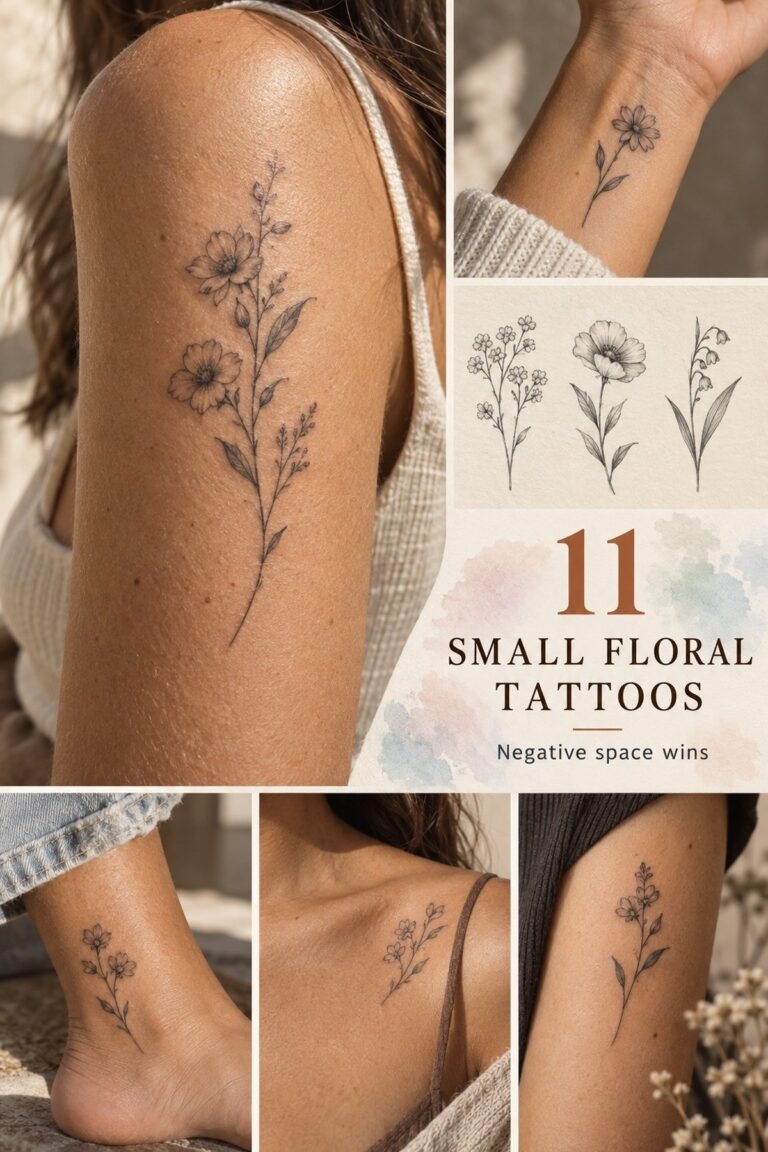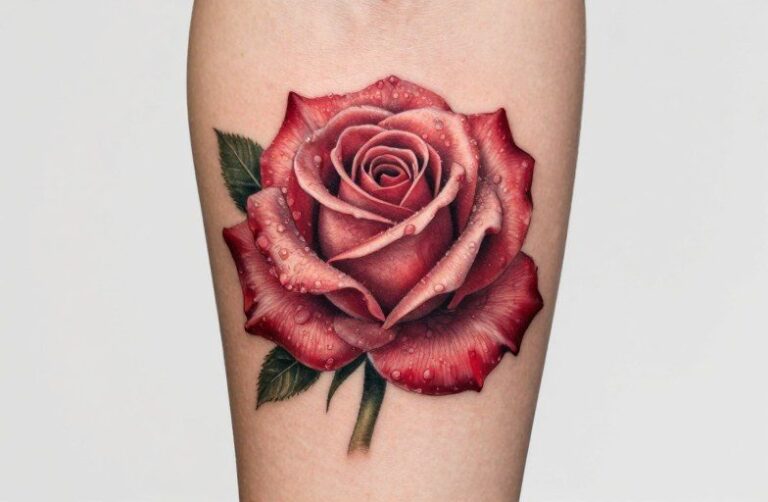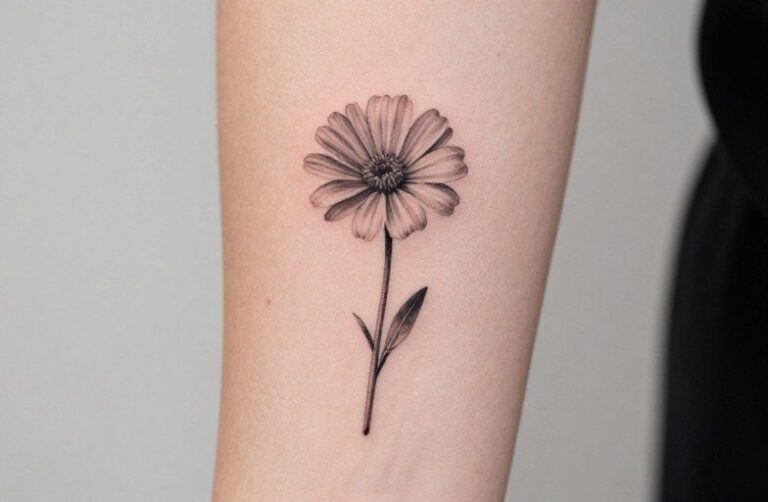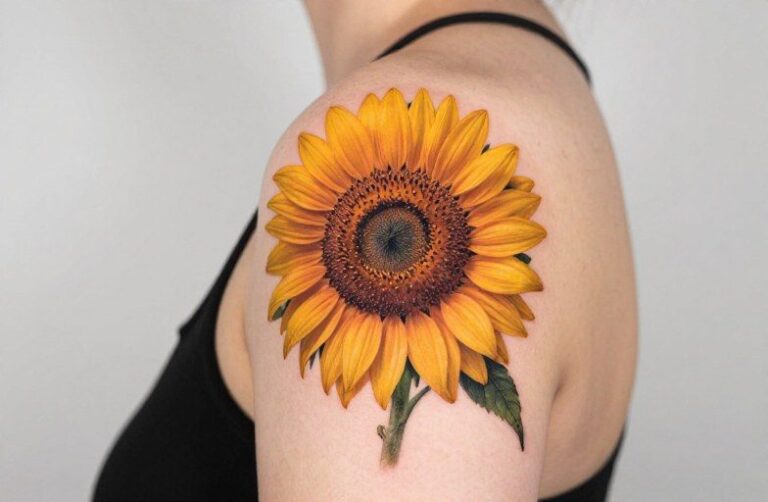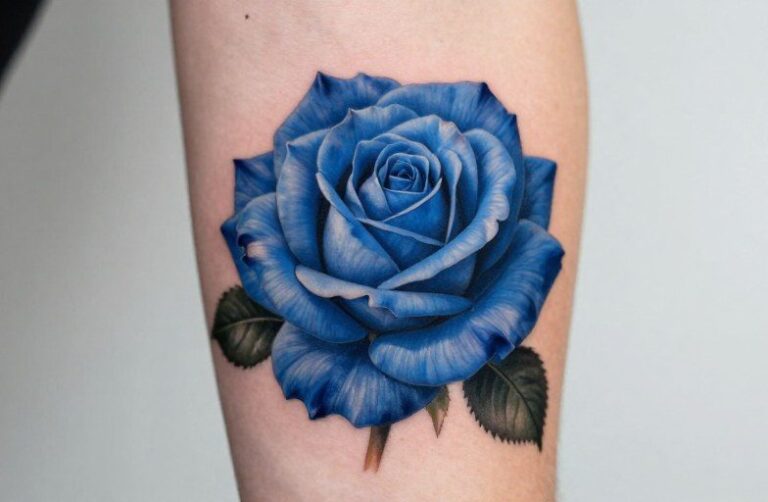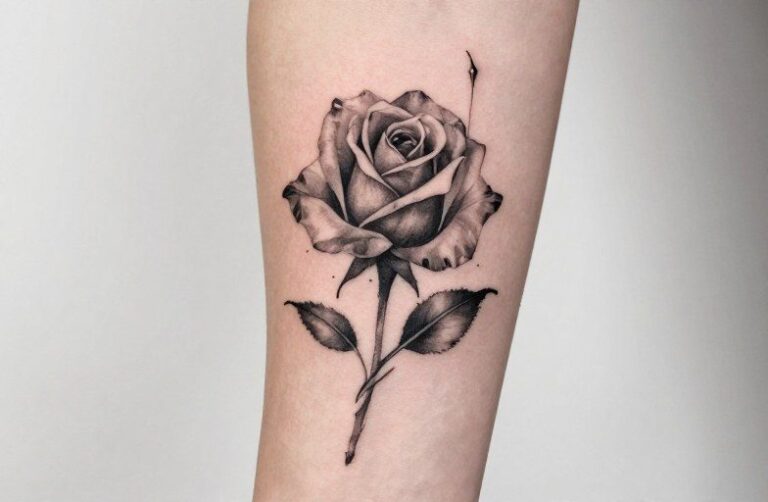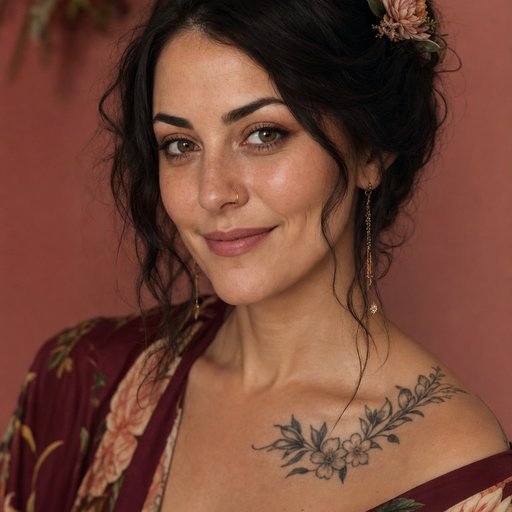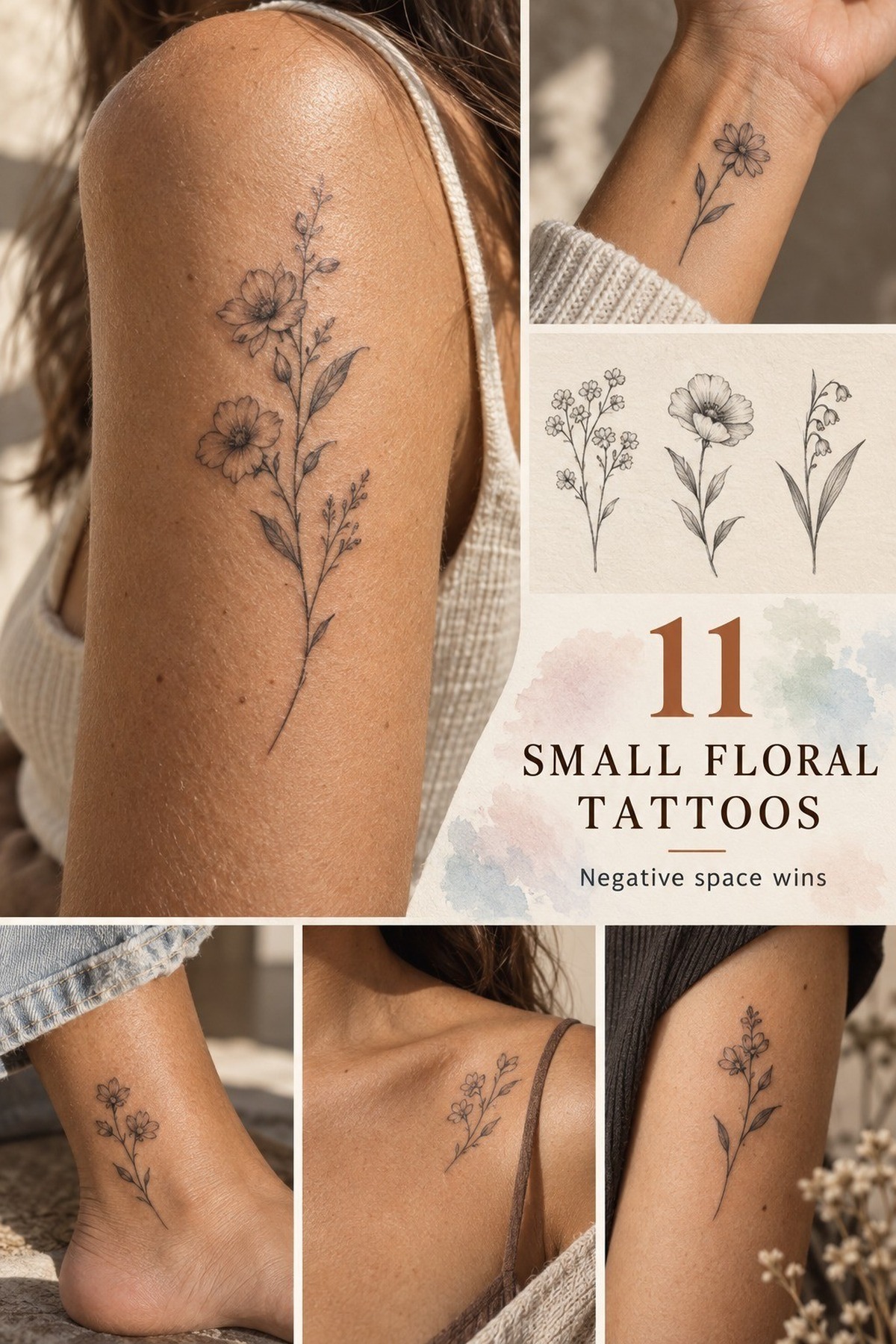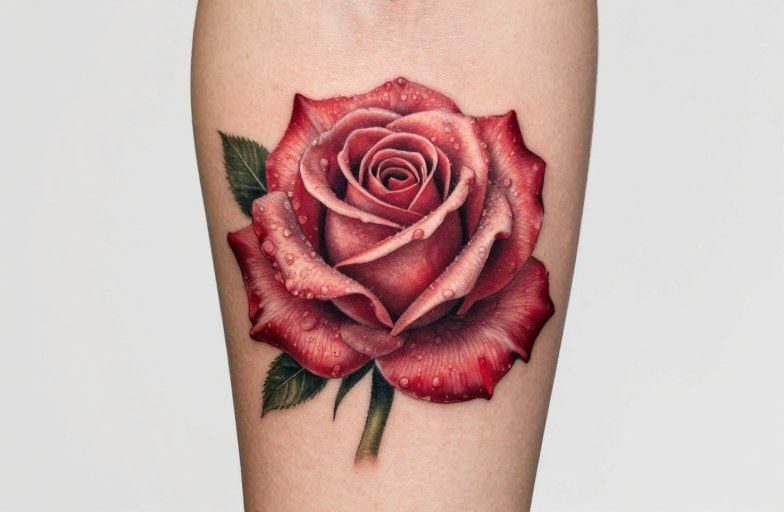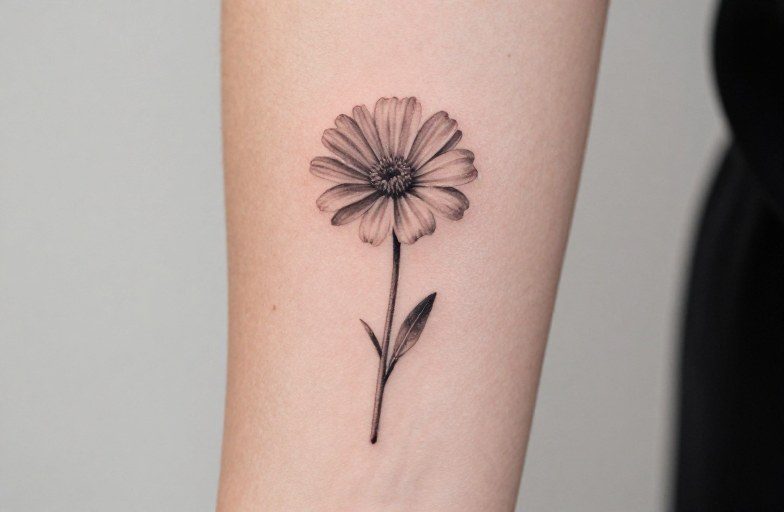
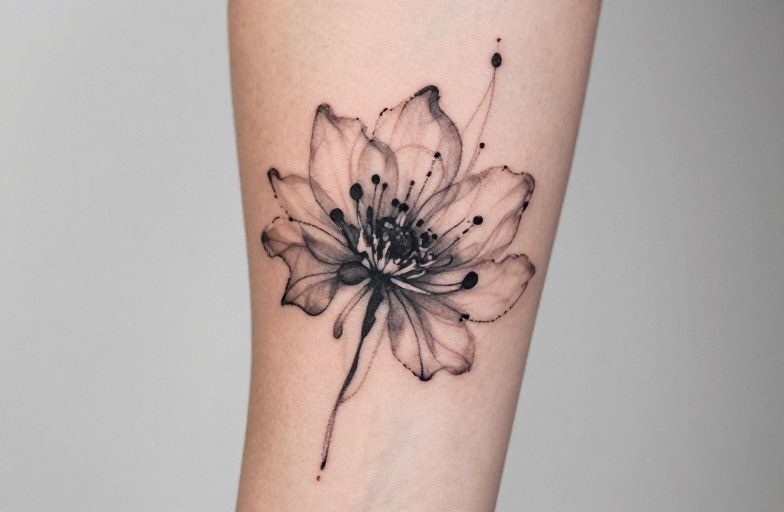
An abstract flower tattoo strips a bloom down to its essence, petals become brushstrokes, stems dissolve into geometry, color fields replace careful shading. The meaning hinges on that tension between recognition and reinvention: it signals growth, beauty, and transience, but refuses to pin them to a single species or fixed symbol. For many, that looseness is the point. The image holds personal meaning without broadcasting it.
How It Ages on Skin
Line Work vs. Soft Wash
Abstract florals fall into two aging camps, and the difference matters long-term. Bold, continuous lines, think single-needle stems or thick black petal outlines, hold their edges for years. The eye still reads “flower” even as surrounding skin changes. Soft, watercolor washes and blurred color fields age faster. Pigment disperses under skin over time, and without anchoring lines, that dreamy bleed can become a muddy bloom. If you want the abstract feel to last, ask for some structural linework beneath or beside the color.
Placement Realities
Inner bicep, upper thigh, and ribcage see more friction and stretching than you’d expect. Abstract flowers with fine detail in these spots blur sooner. The outer forearm, calf, and shoulder blade stay truer. One exception: abstract florals with heavy black negative space actually improve as they settle, the contrast deepening rather than fading. Sun exposure remains the universal enemy. No abstract technique outruns unprotected UV.
Symbolism & Core Meaning
Flowers carry ancient associations, life, death, renewal, beauty’s briefness. Abstraction doesn’t erase those; it complicates them. A rose rendered as a spiral of red suggests passion without the cliché. A tulip reduced to two crossing lines hints at spring and resilience without the botanical accuracy. The viewer recognizes the flower impulse, not the flower itself.
- Impermanence: All flowers die. Abstracting one admits that directly, no attempt at photographic preservation.
- Transformation: The gap between real bloom and interpreted form mirrors personal change, becoming something else but remaining rooted.
- Emotional shorthand: A jagged, angular floral suggests struggle or defense. Rounded, flowing petals read as openness or healing.
- Rejection of literalism: Choosing abstraction over realism often signals a preference for felt experience over documented fact.
The color palette shifts meaning too. Muted earth tones ground the piece in memory or grief. Electric neons claim futurism, artificiality, or deliberate play. Black and grey abstraction tends toward melancholy or stark elegance.
Religious & Spiritual Angles
Buddhist and Hindu Threads
The lotus rises unstained from mud, a concept central to both traditions. Abstract lotus tattoos often drop the literal eight petals or precise symmetry, keeping only the upward motion and layered form. This suits practitioners who want the symbol without orthodox representation. Some trace the abstract floral mandala to tantric art, where geometric flowers contain cosmic diagrams. The abstraction becomes devotional through structure rather than likeness.
Christian and Mystical Traditions
The rose has long been linked to Mary and the rosary. An abstract rose, perhaps a circle of thorns with a central void, or a cross of petal-shapes, carries that lineage without the traditional iconography. Medieval mystics often described divine visions as flowers that refused normal form. An abstract floral can channel that: beauty too intense for accurate depiction. The absence of clear petals becomes the point.
Common Variations & Styles
Not all abstract flowers share the same approach. The style label matters for both meaning and longevity.
- Geometric abstraction: Petals become triangles, hexagons, or fractal repeats. Reads as mathematical, controlled, sometimes cold. Holds lines well over time.
- Brushstroke/wash: Mimics ink painting, sumi-e, or watercolor. Emphasizes spontaneity, the single decisive mark. Requires skilled application to avoid aging poorly.
- Negative space floral: The flower exists in what isn’t inked, black surrounds carve out petal shapes. Bold, graphic, ages excellently.
- Biomechanical fusion: Organic floral meets mechanical elements, gears, wires, circuits. Suggests nature adapting to or fighting technology.
- Minimal line: A single continuous line forms stem, leaf, and bloom. Intimate, often small. Demands perfect execution; mistakes have nowhere to hide.
Size affects abstraction’s success. Too small, and the form collapses into confusion. Too large, with insufficient detail, and the piece feels empty rather than spacious. The sweet spot usually sits between palm-sized and dinner-plate, depending on complexity.
Personal & Modern Meanings
Contemporary wearers often choose abstract florals for reasons that bypass traditional symbolism entirely. The form allows commemoration without mourning, a parent’s favorite flower rendered unrecognizable becomes private memorial. It permits floral imagery for those who reject “girly” tattoo stereotypes; the abstraction distances the piece from decorative tradition.
Some use abstract flowers to mark bodily change. Post-mastectomy floral work often rebuilds rather than covers, the abstraction refusing to pretend nothing happened. Transition-related tattoos sometimes adopt blooming forms that refuse fixed gendered readings. The looseness serves political and personal purposes simultaneously.
Mental health references appear frequently. The flower that doesn’t look like any real flower becomes a stand-in for states hard to name, depression’s fog, anxiety’s static, recovery’s uneven progress. The abstraction matches the experience’s resistance to clear description.
Mythology & Folklore
Greek and Roman Roots
Narcissus, Hyacinth, Adonis, their flower-origin stories involve transformation through death. An abstract narcissus, eye-shaped rather than trumpet-formed, can invoke that myth without illustrating it. The flower that grew from blood or grief becomes any flower, any loss. Some trace the anemone’s link to Aphrodite’s tears to modern red abstract petals, though the connection is more associative than direct.
East Asian Traditions
Peonies symbolize wealth and honor in Chinese culture; chrysanthemums, longevity and nobility. Abstract versions appear in contemporary ink that references these associations without reproducing classical paintings. The Japanese concept of wabi-sabi, beauty in imperfection and impermanence, aligns naturally with abstract floral work. A deliberately incomplete blossom, petals trailing off into blank skin, embodies the principle directly.
Norse and Celtic traditions carry fewer specific flower myths, but the general association of plants with seasonal cycles, the goddess Eostre, and spring renewal persists. Abstract florals in these contexts tend toward the runic or knotwork-integrated rather than purely botanical.
Before You Decide
Abstract flower tattoos reward patience in design. Bring reference images of real blooms you respond to, then let the artist distort them. The best pieces emerge from that dialogue, not from selecting a flash design labeled “abstract rose.” Consider how much recognition you want, should strangers see “flower,” or only those who know?
Discuss aging explicitly with your artist. Ask where lines will spread, how colors will mute, whether the negative space will close in. A responsible artist maps this without prompting. Plan for touch-ups, especially with watercolor techniques; budget and schedule them from the start.
Finally, sit with the abstraction’s meaning. The looseness that attracts you can also distance you. If the tattoo needs to carry specific weight, grief, celebration, transition, make sure the abstract form still holds it. Sometimes a slightly more recognizable flower serves memory better than a beautiful blur. The choice belongs to you, but choose consciously.
Frequently Asked Questions
Do abstract flower tattoos fade faster than realistic ones?
Not inherently, but certain styles do. Watercolor and heavy color wash fade quicker without black linework to anchor them. Bold-line abstraction often outlasts realism because there’s less fine detail to lose.
Can any flower be made abstract, or are some better suited?
Technically any bloom works, but flowers with strong silhouettes, lotus, tulip, magnolia, translate most clearly. Complex multi-petaled flowers like peonies can become chaotic when abstracted unless the artist simplifies aggressively.
What’s the typical price range for a good abstract floral piece?
Size and artist reputation matter more than style. Expect $150, $400 for small, simple pieces from established artists; large, complex work from renowned names runs into thousands. The skill required for clean abstraction often commands premium rates.
Is an abstract flower tattoo more or less painful than a realistic one?
Pain depends on placement and your own tolerance, not style. However, abstract work sometimes requires more passes for solid color fields or precise geometric lines, which can extend session time in a given area.