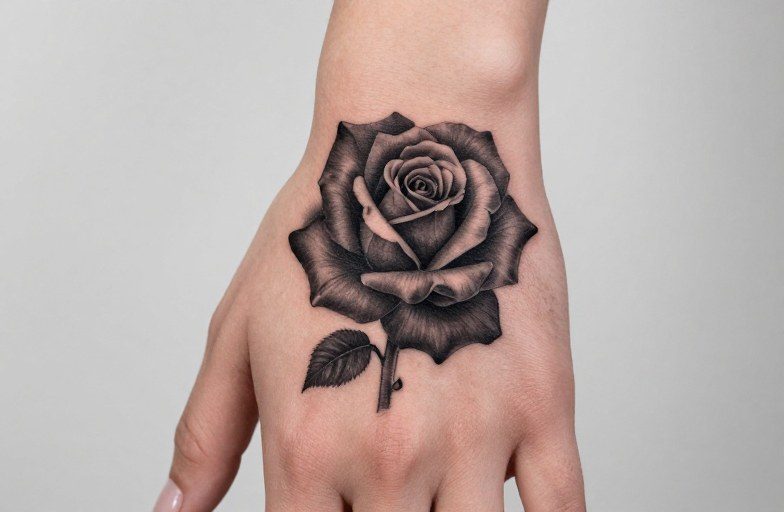
A black rose tattoo on the hand reads as grief, defiance, or a love that outlasted death, sometimes all three. The hand placement strips away privacy; this is a statement made to the world, not a secret kept close. Black ink pushes the symbolism toward shadow: mourning, the end of something, or a refusal to pretty up hard truths.
Symbolism & Core Meaning
What the Black Rose Actually Signifies
The black rose carries weight that red or pink simply doesn’t. In tattoo culture, it’s long stood for memorial, lost love, lost family, lost versions of yourself. Some trace it to anarchist movements of the early 20th century, where it marked anti-establishment stance. Others connect it to gothic romance, to the beauty found in decay. On the hand, none of this hides. The wearer isn’t tucking symbolism under a sleeve; they’re forcing the conversation.
There’s also the “black rose” as code for impossible or ended love, drawn from the language of flowers but pushed into starker territory by the color choice. A hand placement amplifies this: you can’t un-ring the bell, can’t take back the declaration.
Why the Hand Changes Everything
Hand tattoos function differently. They’re job-market visible, socially unavoidable, technically challenging for the artist. Choosing the hand says something before the image even registers. With a black rose specifically, the placement suggests the meaning isn’t theoretical, it’s lived, daily, inescapable. This isn’t a tribute you visit occasionally; it’s a weight you carry in every handshake.
- Knuckle-adjacent placement: harder to hide, faster to fade, reads more aggressive
- Back of hand: maximum visibility, better aging than fingers, classic canvas shape
- Side of hand / thumb web: subtler but still exposed, tricky for fine detail
Design Tips & Pairings
What Works at Hand Scale
The hand is a small, curved, high-movement surface. A black rose here needs bold enough lines to hold, simple enough composition to read from conversational distance. Single rose with minimal leaves tends to work better than crowded bouquets. Negative space becomes crucial, too much solid black and the design muds together as it ages.
Common pairings that actually function:
- Drops of blood or dew: adds narrative but keep them sparse; tiny details blur
- Thorned stem wrapping a finger: visually connects, technically demanding
- Banner or lettering underneath: risky on hands; script spreads and becomes illegible
- Clock face or hourglass: mortality pairing, works if kept bold and simple
- Skull integrated into bloom center: heavy-handed unless the artist specializes in smooth transitions
Line Weight and Shading Strategy
Hand skin is thin, vascular, and prone to blowouts. Lines need to be confident, wobbly or hair-fine work won’t survive six months. For black roses specifically, whip shading or smooth black-and-grey gradation gives depth without the muddiness of solid fill. Some artists use stipple shading for texture; this can age beautifully or turn to soup depending on needle grouping and hand placement.
How It Ages on Skin
The Reality of Hand Longevity
Hand tattoos fade faster than almost anywhere else. Constant washing, sun exposure, friction from pockets and surfaces, hands live hard. Black ink holds longer than color, which is one reason the black rose persists as a hand choice, but “holds longer” still means touch-ups every few years for crisp work.
Specific aging patterns:
- Lines soften and spread; what was a tight petal edge becomes fuzzy
- Shaded areas lighten unevenly; some spots drop to grey, others stay near-black
- Finger-adjacent work almost always needs rebuilding; the skin there sheds and regenerates aggressively
- Back of hand ages most gracefully of the hand placements, but still faster than forearm or chest
What Helps Slow the Fade
Moisturizing isn’t optional on hands, dry, cracked skin accelerates ink loss. Sunscreen matters enormously; UV breaks down pigment. But realistically, hand tattoos are maintenance tattoos. Budget for touch-ups, find an artist who does them at reasonable rates, and accept that crisp black rose will live in phases: sharp, then weathered, then rebuilt.
Religious & Spiritual Angles
Christian and Catholic Contexts
The rose carries Marian associations, the Virgin Mary as “rose without thorns.” Blackening that symbol twists it: mourning for the fallen world, or personal darkness held in tension with faith. Some Catholic mourners use black roses specifically for memorial tattoos, reclaiming the color from purely secular grief. The hand placement can suggest prayer, supplication, or the impossibility of hiding sin.
Pagan and Occult Readings
In some traditions, the black rose marks initiation, endings as necessary precursors to beginnings. The hand as active agent, doing, making, touching, pairs with this as a willful embrace of transformation. Less common but persistent: the black rose as sigil, a personal magical mark made visible and permanent. These readings depend heavily on the wearer’s actual practice; the symbol doesn’t automatically confer meaning.
Common Variations & Styles
Traditional and Neo-Traditional
Traditional black rose on hand means bold outlines, limited but high-contrast shading, maybe a banner if the client insists. The shape reads instantly, ages better than complex alternatives. Neo-traditional allows more detail, jeweled centers, ornamental leaves, subtle color accents in grey, but risks becoming illegible as it softens.
Realistic and Dark Art Approaches
Photorealistic black rose demands an artist who understands how black ink layers to create depth without becoming a blob. On hands, this is technically punishing. Dark art or horror-influenced versions might integrate decay, insect damage, or anatomical elements; these read as more aggressive, less elegiac. The meaning shifts from “mourning” toward “confrontation with death.”
- Trash polka style: black rose with red splatter or geometric elements, visually loud, hand placement amplifies the chaos
- Minimalist / single-needle: fashionable, risky on hands; fine lines blur fast here
- Dotwork / ornamental: can frame the rose in patterns that extend toward wrist or fingers
Color vs Black and Grey
Why Most Choose Black
Color roses on hands face double jeopardy: the hand’s natural fading plus color’s faster breakdown. A red rose here becomes pink, then orange-peel, then indistinct. Black and grey offers longevity and aligns with the somber symbolism. That said, a single red drop or subtle crimson accent in an otherwise black rose can land hard, blood, passion, life against death, if the artist knows how to make it last.
When Color Actually Works
Some wearers want the black rose specifically for its funerary weight, then subvert with unexpected color: a blue-black rose, a purple so dark it reads black in low light. These choices are aesthetic rather than symbolic, personal rather than traditional. On the hand, they draw questions, which may be the point.
The Bottom Line
A black rose on the hand is commitment, to the meaning, to the visibility, to the maintenance. The symbolism runs from grief to rebellion to beauty found in darkness, but the hand placement makes it social, unavoidable, lived-in-public. Design for longevity: bold lines, restrained detail, shading that holds. Find an artist with actual hand-tattoo experience, not just willingness. Budget for touch-ups. And know that whatever the rose means to you, the world will read it first as defiance, then ask for the story.
Frequently Asked Questions
Does a black rose hand tattoo make it harder to get jobs?
Visible hand tattoos still close doors in conservative fields, finance, law, medicine, much corporate work. Some industries don’t care; others absolutely do. The black rose specifically reads less threatening than skulls or lettering, but hands are hands. Consider your actual career path, not just your ideal one.
How much does a black rose hand tattoo typically cost?
Hand work runs higher than equivalent-size tattoos elsewhere because of technical difficulty and touch-up likelihood. A solid black rose on the back of the hand might range from $200 to $500+ depending on the artist’s rate and location. Budget another session’s worth for the inevitable touch-up.
How painful is getting a tattoo on the hand?
Hands hurt more than most spots, thin skin, lots of nerve endings, bone close to surface. The back of the hand is manageable for most; fingers and knuckles are genuinely rough. Pain is subjective, but don’t expect a relaxing session. Bring something to squeeze.
Can you cover up an old black rose hand tattoo with something new?
Cover-ups on hands are limited by space and existing ink density. A faded black rose offers more options than solid black; laser lightening first opens possibilities significantly. Consult a cover-up specialist early, hand real estate is too precious to waste on a plan that won’t work.