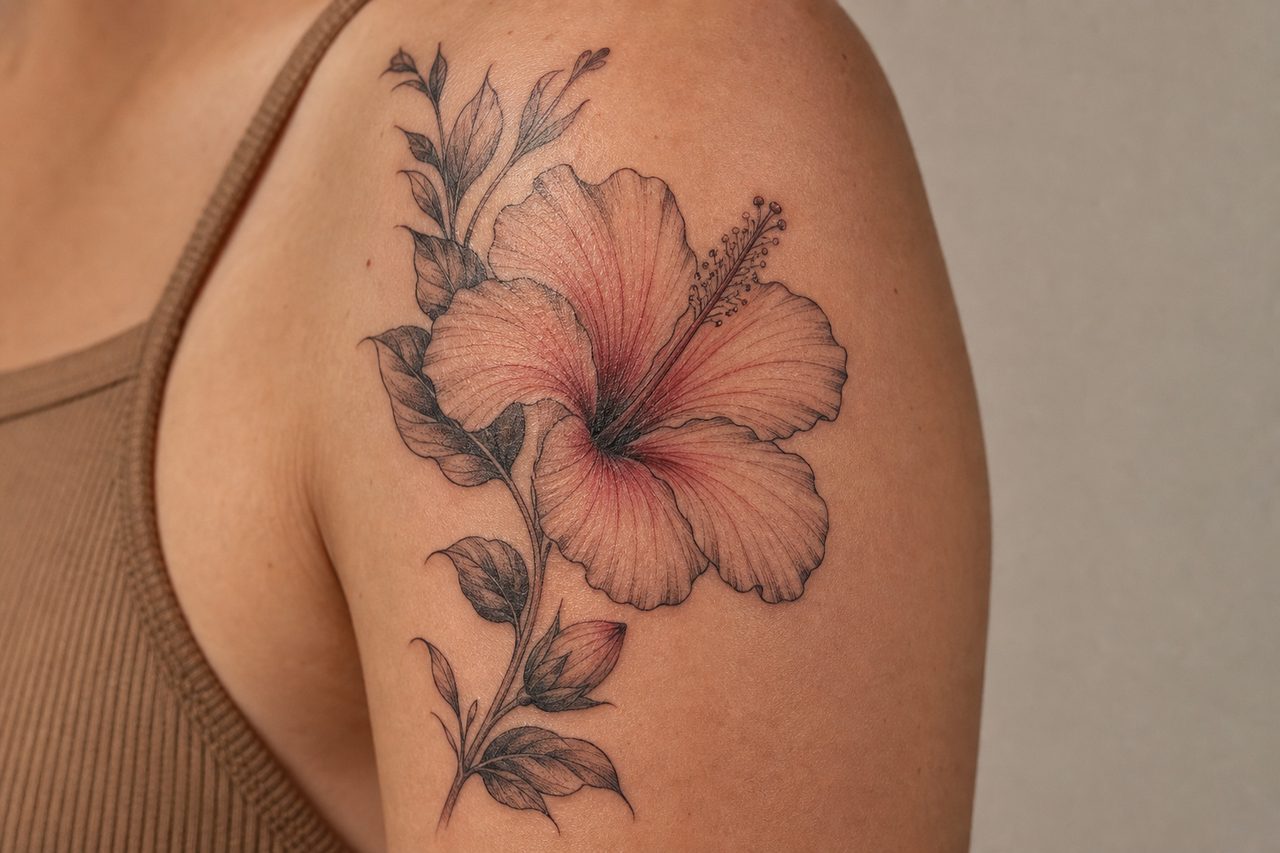
A hibiscus tattoo most commonly signals beauty that is temporary and intense, tied to Pacific cultures where the flower marks status, welcomes guests, and honors feminine energy. The meaning shifts noticeably depending on whether you choose the soft Chinese hibiscus, the native Hawaiian ma’o hau hele, or the white-blossomed koki’o ke’oke’o. Color, placement, and line weight all change how the symbolism reads on skin.
Symbolism & Core Meaning
What the Flower Actually Represents
The hibiscus blooms for a single day, then folds. That brevity is the core symbol, beauty that does not linger, pleasure that demands presence. In Hawaiian tradition, a hibiscus tucked behind the left ear signals a woman is taken; behind the right, she is available. The tattoo can carry that same relational coding, or it can abstract it into a broader meditation on impermanence.
Red and pink hibiscus dominate the imagery, associated with the goddess Kali in some Hindu contexts and with the aloha spirit in Hawaiian usage. Yellow hibiscus, specifically the ma’o hau hele, Hawaii’s state flower, carries a different weight: rarity, native identity, ecological fragility. White hibiscus reads as purity or spiritual transition in some Asian traditions, though that association is looser and more modern.
Feminine Power and Fragility
The hibiscus is not a neutral flower. Its structure is overtly sexual, stamens thrusting from a soft corolla, and tattoo artists have played with that tension for decades. Some designs emphasize the delicacy: thin lines, watercolor wash, the petal edges dissolving into skin. Others push the structural boldness: heavy black outline, geometric simplification, the flower filling a chest piece or thigh with unapologetic scale. The meaning bends with that choice. Soft rendering reads as vulnerability or ephemeral grace. Bold rendering claims space and refuses to shrink.
Common Variations & Styles
Line Work vs. Color Saturation
Black-and-grey hibiscus tattoos exist, but they fight the subject. The flower’s impact depends on color temperature, cool reds, hot pinks, the particular yellow-orange of the native Hawaiian species. Without color, the hibiscus becomes generic floral; the specific cultural resonance drains away.
That said, fine-line single-needle hibiscus pieces have gained ground, especially on inner arms and collarbones. The technique suits the subject’s delicacy, but it ages poorly. Hibiscus petals have thin edges and subtle color gradients; at small sizes, those details blur within five to seven years. A hibiscus with a defined black outline and solid color packing holds its shape longer and reads clearly from distance.
Composition Choices
- Single bloom: Focused, intimate, often placed where the wearer can see it, wrist, forearm, thigh front.
- Trailing vine: Suggests growth, connection, sometimes family lineage. Works on ribs, spine, or wrapping a limb.
- With Pacific motifs: Turtles, waves, or tribal patterns anchor the hibiscus in specific cultural context rather than generic tropical aesthetic.
- With skull or clock: The mortality angle made explicit. Effective but risks cliché if the imagery is too on-the-nose.
Best Placements
Where the Shape Works
The hibiscus is a radial flower with a clear center and five distinct petals. That geometry suits flat planes: shoulder cap, outer thigh, sternum center, upper back. Curved surfaces distort the radial symmetry; a hibiscus wrapped around a bicep or calf often looks slightly wrong, the petals compressing on the inner curve and stretching on the outer.
Size matters for detail. A hibiscus under two inches loses petal texture and stamen definition. At four to six inches, the artist can build color depth, darker at the petal base, lighter at the edges, the central stamens standing in contrasting yellow or orange. Larger than eight inches, the flower becomes a landscape element, often paired with background foliage or Pacific scenery.
Skin Tone Considerations
Deep red and magenta hibiscus pigments show clearly on darker skin; pastel pinks and yellows can ash out or disappear. The white highlights that give hibiscus petals their dimension, those bright edges where light catches, need to be applied as negative space or very light skin-tone ink, not as stark white, which heals to a chalky grey on melanin-rich skin. Experienced artists adjust the color palette rather than forcing a standard tropical-bright scheme.
History & Cultural Roots
Pacific Origins
The hibiscus is often linked to Polynesia, but the genus is genuinely ancient and widespread, native to Asia, the Pacific Islands, and parts of Africa. What matters for tattoo meaning is the specific cultural adoption. In Hawaii, the yellow hibiscus (Hibiscus brackenridgei) became the state flower in 1988, replacing the generic red hibiscus that had stood in unofficially for decades. That shift matters: the yellow species is endemic, endangered, and specifically Hawaiian, not the pan-tropical ornamental that colonizers planted everywhere.
Tattoo wearers with Hawaiian heritage sometimes specify the yellow hibiscus to signal that specificity. Others choose the more common red Chinese hibiscus for its visual punch, a choice that can read as aesthetic tourism if the wearer has no Pacific connection. The distinction is worth knowing before you commit.
Asian Thread
In China, the hibiscus (fu rong) appears in poetry and painting as a symbol of autumn beauty and fleeting glory, similar to the Japanese cherry blossom but less burdened with samurai death-cult associations. Korean tradition uses the hibiscus (mugunghwa) as the national flower, with connotations of persistence (the flower blooms daily despite its short individual life) rather than pure transience. A Korean-American hibiscus tattoo might carry that national identity; a generic tropical design probably does not.
Mythology & Folklore
Goddess Connections
Some trace the hibiscus to the Hawaiian goddess Pele, though the connection is indirect, Pele’s domain is volcanic fire, and the hibiscus is a soft flower. More solidly, the red hibiscus is commonly associated with the Hindu goddess Kali, representing the life-death cycle and feminine destructive power. That association is modern and diasporic rather than ancient scriptural; it gained traction in Western tattoo culture through the 1990s fusion of Eastern spirituality and tropical imagery.
Caribbean folklore sometimes links hibiscus to Oya, the Yoruba orisha of winds and transformation, through the syncretic practices of Santeria and Vodou. That connection is regional and practitioner-specific, not universal.
The Mortality Thread
Across cultures, the one-day bloom is the consistent mythic anchor. In Malaysian tradition, the hibiscus (bunga raya) is the national flower, chosen partly for its daily renewal, death and rebirth compressed into a twenty-four hour cycle. Tattoo designs that emphasize the falling petal, the bud beside the bloom, or the flower with a sundial or hourglass, draw on this universal recognition: the hibiscus is beautiful because it ends.
Religious & Spiritual Angles
Hindu and Buddhist Contexts
The red hibiscus is offered to Kali and Ganesha in Hindu practice, the flower’s shape and color matching descriptions of divine energy. A tattoo drawing on this tradition should probably be red, probably be rendered with some respect for the religious context rather than mixed with unrelated party imagery. The hibiscus is not deeply embedded in Buddhist iconography; lotus dominates there, and a hibiscus tattoo is unlikely to read as Buddhist unless explicitly paired with Buddhist symbols.
Christian Adaptations
Some Christian wearers use the hibiscus as a symbol of God’s daily provision, beauty renewed each morning, the flower as evidence of divine care for transient things. This is a modern interpretive move, not ancient tradition, but it is coherent. The hibiscus works better for this than the lily (too funereal) or the rose (too romantic). A hibiscus with a subtle cross or scripture reference can carry this meaning without the heavy iconography of explicitly Christian tattoo genres.
The Takeaway
The hibiscus tattoo offers genuine symbolic density if you choose deliberately. The default tropical-flower aesthetic is empty; the specific color, species, and cultural reference give it weight. Red Chinese hibiscus reads as generic beauty or vacation memory. Yellow Hawaiian hibiscus claims specific place and heritage. Black and grey loses the flower’s power. Fine-line ages poorly on a subject that needs edge definition. The hibiscus is not a safe, meaningless choice, it is a flower that dies daily, and the best tattoos honor that mortality rather than prettifying it away.
Frequently Asked Questions
Does the color of a hibiscus tattoo change the meaning?
Yes, significantly. Red and pink signal passion and beauty, yellow specifically connects to Hawaiian identity and rarity, while white leans toward purity or spiritual transition. Black and grey drains most cultural specificity from the symbol.
Is a hibiscus tattoo only for women?
No, though the flower carries feminine-coded symbolism in many cultures. Men often choose bolder, larger compositions or pair the hibiscus with Pacific tribal elements to shift the gender reading.
How well does a hibiscus tattoo age over time?
Moderately. The petal edges and fine color gradients blur faster than bold geometric designs. A defined outline and solid color packing help, but expect some softening after five to seven years, especially on small pieces.
Can I get a hibiscus tattoo if I don’t have Pacific Islander heritage?
You can, but be specific about your intent. The generic tropical hibiscus is widely worn without cultural claim. If you choose the native Hawaiian yellow hibiscus or pair it with sacred Pacific motifs, research thoroughly and consider whether the symbolism genuinely belongs to your story.