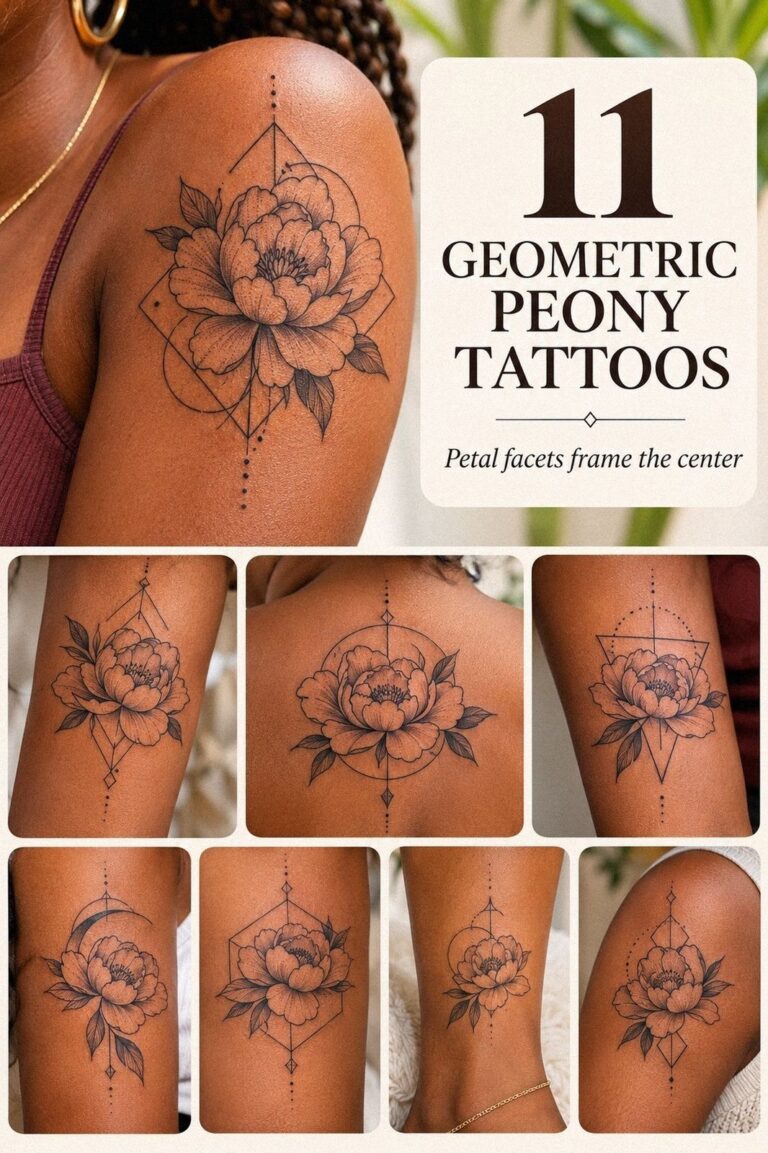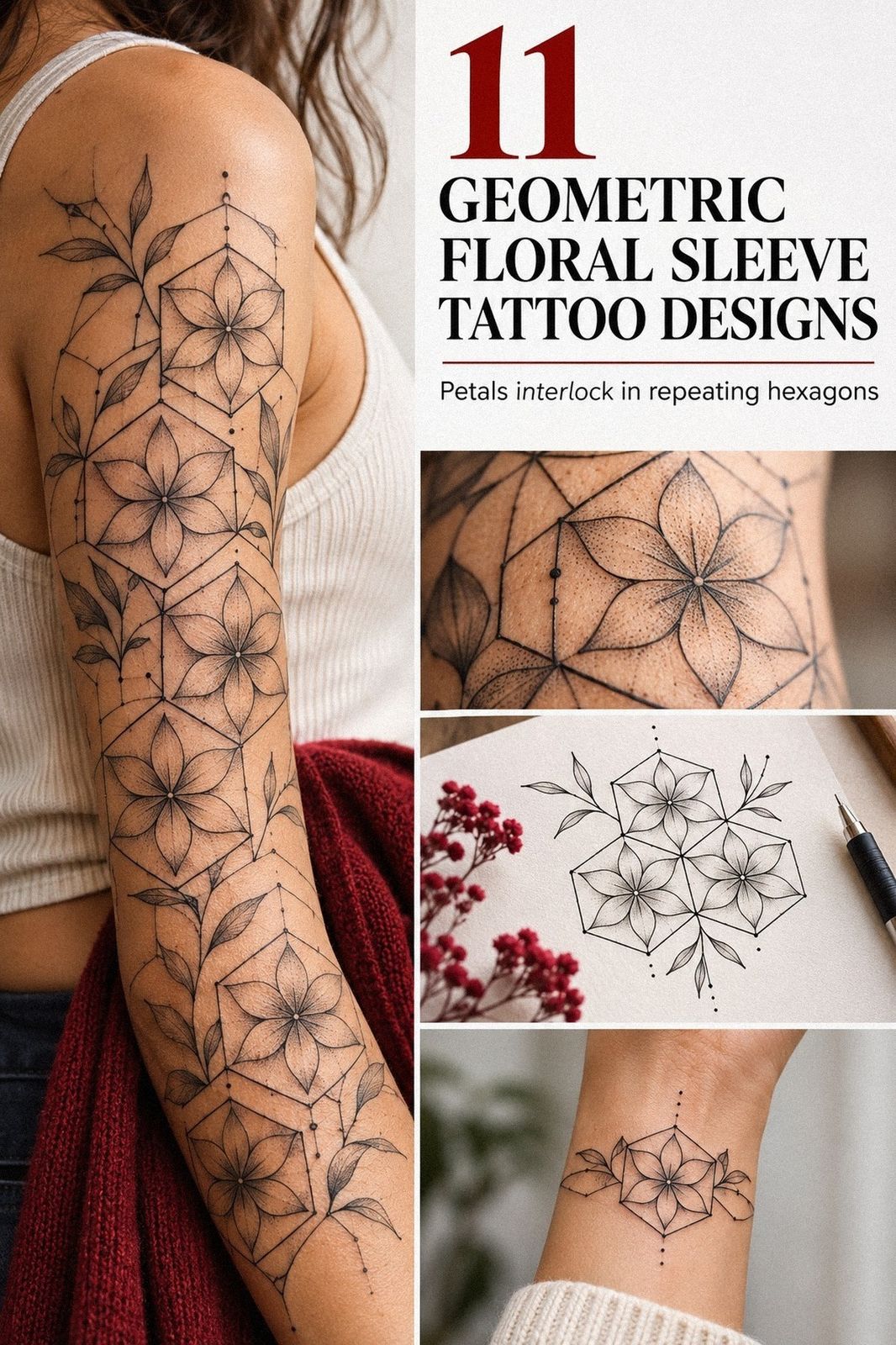
Geometric floral sleeve tattoo designs can work beautifully for a first tattoo when scale, placement, and line weight are planned together. I once chose detail before thinking about skin movement, and the result looked crowded. These ideas show how wildflowers, geometry, and negative space can stay readable. Start smaller than your nerves suggest!
Editor’s note: A first tattoo can still feel personal, striking, and expressive without covering your whole arm. I’d focus on one flower, one geometric idea, and enough open skin for the design to breathe.
- Start Small With Fine-Line Geometry
- Which Forearm Layout Feels Right?
- Sacred Geometry With Personal Symbols
- Choose Blackwork When You Want Presence
- Mandalas or Roses? Let the Contrast Lead
- Keep Dotwork Delicate
- Wrap It Around the Upper Arm
- Add One Vibrant Botanical Accent
- Let Negative Space Lead
- Test the Wildflower Placement First
- Make Sharp Symmetry Work for You
1Start Small With Fine-Line Geometry

This forearm design uses single-needle linework around a delicate wildflower stem. A slim geometric frame follows the arm’s natural length.
If you’re planning your first tattoo, you’ll want the flower to breathe. You don’t need to fill every inch. That restraint can make the result feel dainty, elegant, and easy to read.
I’d keep the central bloom a few inches tall. Let the surrounding lines stay open. That’s what makes this small geometric floral sleeve tattoo feel striking without becoming visually heavy.
The best supporting details are tiny circles, clean triangles, and a narrow halo of dotwork. Black tattoo pigment gives the fine outline enough contrast, while light greywash can soften the leaves.
I’d skip heavy solid fills here. They’d overpower the thin botanical structure. If you’re comparing options, browse these small floral sleeve tattoo references and fine line floral sleeve tattoo examples before your consultation.
Bring the references you like, but let your artist redraw the pattern for your arm. Your skin isn’t a flat sheet. The stencil shouldn’t pretend it is.
2Which Forearm Layout Feels Right?
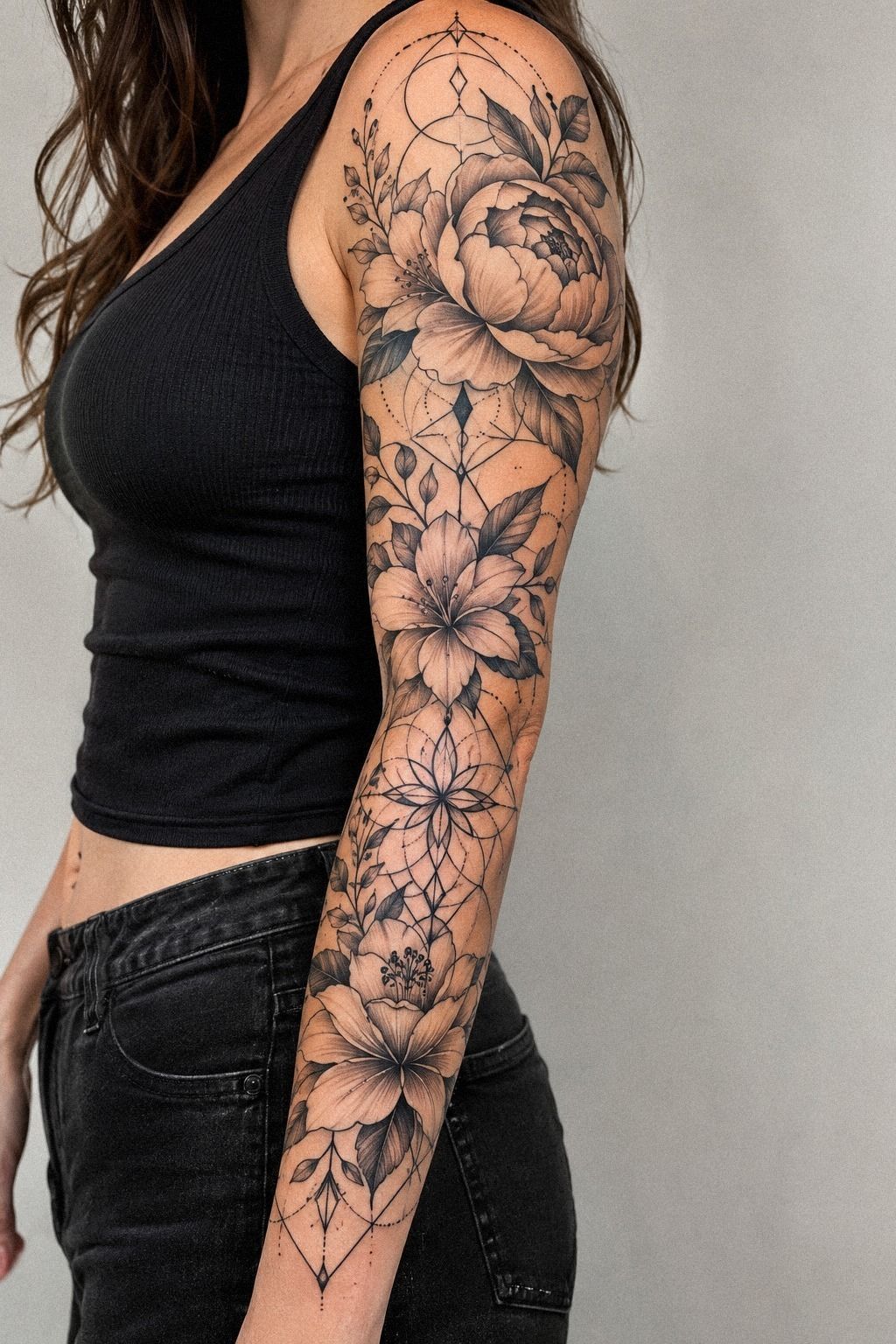
This version places a wildflower stencil along the forearm. A diamond shape sits near the wrist, while a larger floral form moves toward the elbow.
You’ll notice how the geometry acts like a path. Your eye moves upward instead of stopping at one isolated blossom. That gives the arrangement a flowing, graceful quality.
I’d choose this layout if you want geometric floral sleeve tattoo ideas that still feel delicate. The flower can be intricate, but the spacing keeps it from looking busy.
You’re getting structure without losing the organic bend of the petals. That balance is why I’d choose this over a dense wrap for a first session.
Use greywash shading only beneath the petals and inside the smallest geometric shapes. If you’re nervous about commitment, ask for a stencil check from the front, side, and relaxed arm position.
I didn’t do that with my first piece. The angle looked different whenever I moved. These tiny floral sleeve tattoo ideas can also help you judge scale before you book.
3Sacred Geometry With Personal Symbols

This concept combines a sacred geometry circle with a wildflower cluster and a small central sun symbol. The arrangement feels meaningful without forcing one fixed interpretation.
If you want a unique geometric floral sleeve tattoo, you can choose symbols tied to your own history. You don’t have to borrow a motif just because it’s popular.
The flower sits inside the circle, but its leaves cross the boundary slightly. That small break makes the composition feel expressive and alive. It also gives the design an edgy, less predictable rhythm.
You’ll want the circle checked from several positions. An imperfect curve can look more obvious on the forearm than it did on paper. Ask your artist to rotate the design while your arm stays relaxed.
I’d use black ink with soft stippling around the symbol. Leave the petals mostly open. Heavy blackwork would compete with the sacred geometry, while faint lines could disappear too quickly.
For inspiration, compare delicate floral sleeve tattoo designs with this guide to watercolor floral tattoo meaning. You don’t need watercolor to borrow its ethereal softness.
4Choose Blackwork When You Want Presence
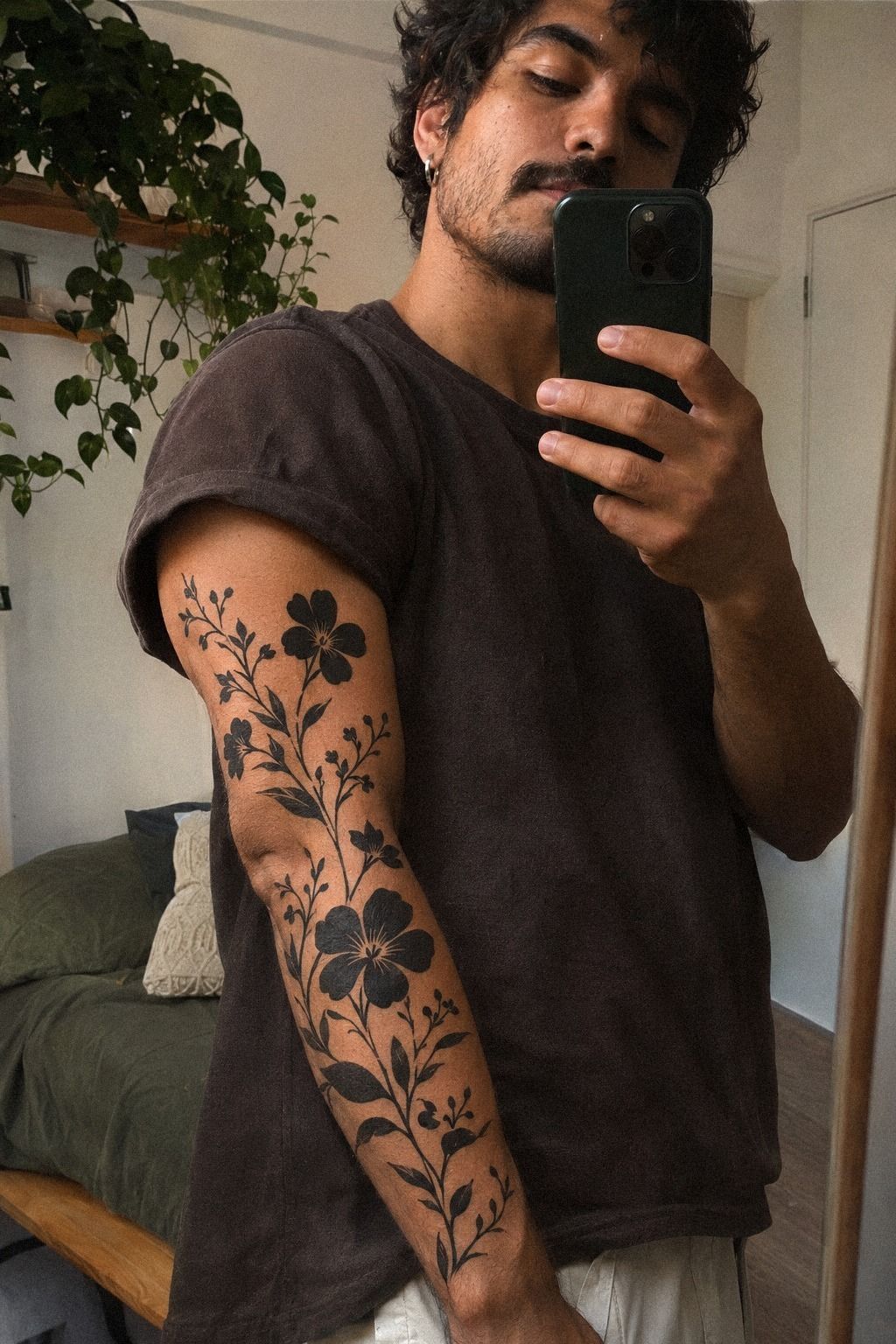
This design uses solid blackwork petals with sharp geometric borders cutting through the floral shapes.
It’s fierce, direct, and much more visible than the fine-line options above. If you want your first tattoo to have instant presence, this blackwork approach won’t whisper!
I’d keep the bold petals limited to the largest flower. Use thinner outlines for the leaves. That contrast gives your eye somewhere to rest.
You’ll get a powerful result without turning the entire forearm into one uninterrupted block of pigment. I’d skip full saturation in every shape because the design would lose its botanical rhythm.
The cleanest version uses smooth grey shading beneath the petal overlaps. That shading creates depth while keeping the edges crisp.
Your artist should show healed examples, not only fresh work. Solid black can settle differently as the skin recovers. This check tells you more than a polished portfolio page.
If you prefer this strong direction, explore black floral sleeve tattoo references and ask how the artist spaces dark areas. Blackwork can age well when the placement is sensible.
5Mandalas or Roses? Let the Contrast Lead

This concept blends mandala linework with roses. A rose can provide the romantic focal point, while the mandala adds a classic geometric rhythm.
The strongest option uses one rose as the anchor, a smaller mandala above it, and thin connecting stems between them. That hierarchy keeps the sleeve from becoming crowded.
I’d choose the flowing rose version over the most ornate sketch. Your arm needs movement when you turn it. A fixed-looking pattern can feel rigid from one position.
Look for transfer paper stencil details that preserve the mandala’s repeated spacing. If one ring is too tight, the whole pattern may look uneven after placement.
You can ask for a slightly larger center opening. That gives the design a graceful rhythm and lets the petals remain readable after healing.
For more direction, compare watercolor floral sleeve tattoo ideas with black floral sleeve tattoo layouts. Color isn’t required for personality. A rose, a mandala, and protected negative space can already feel iconic.
6Keep Dotwork Delicate

This approach uses a delicate wildflower shape with geometric arcs around the stem. Dotwork can create a raw, tactile effect without filling every petal.
You’ll want your artist to choose contrast with care. Skin tone, pigment choice, spacing, and healed examples all matter when the design depends on tiny points.
I’d keep the largest dots near the flower center. Let them become lighter toward the outer arcs. That creates a soft, ethereal fade without making the pattern look unfinished.
The main flower should remain easy to identify from a normal distance. Dotwork shading can support the form, but it shouldn’t swallow the stem or close the negative space.
Ask to see healed work on skin close to yours. That gives you a clearer sense of contrast, softness, and long-term readability than fresh work can provide.
7Wrap It Around the Upper Arm

This upper-arm design wraps a curved floral stencil around the arm. Keep the petals flowing with the muscle, and ask for enough open skin between the geometric marks to preserve a sleek, graceful outline.
8Add One Vibrant Botanical Accent
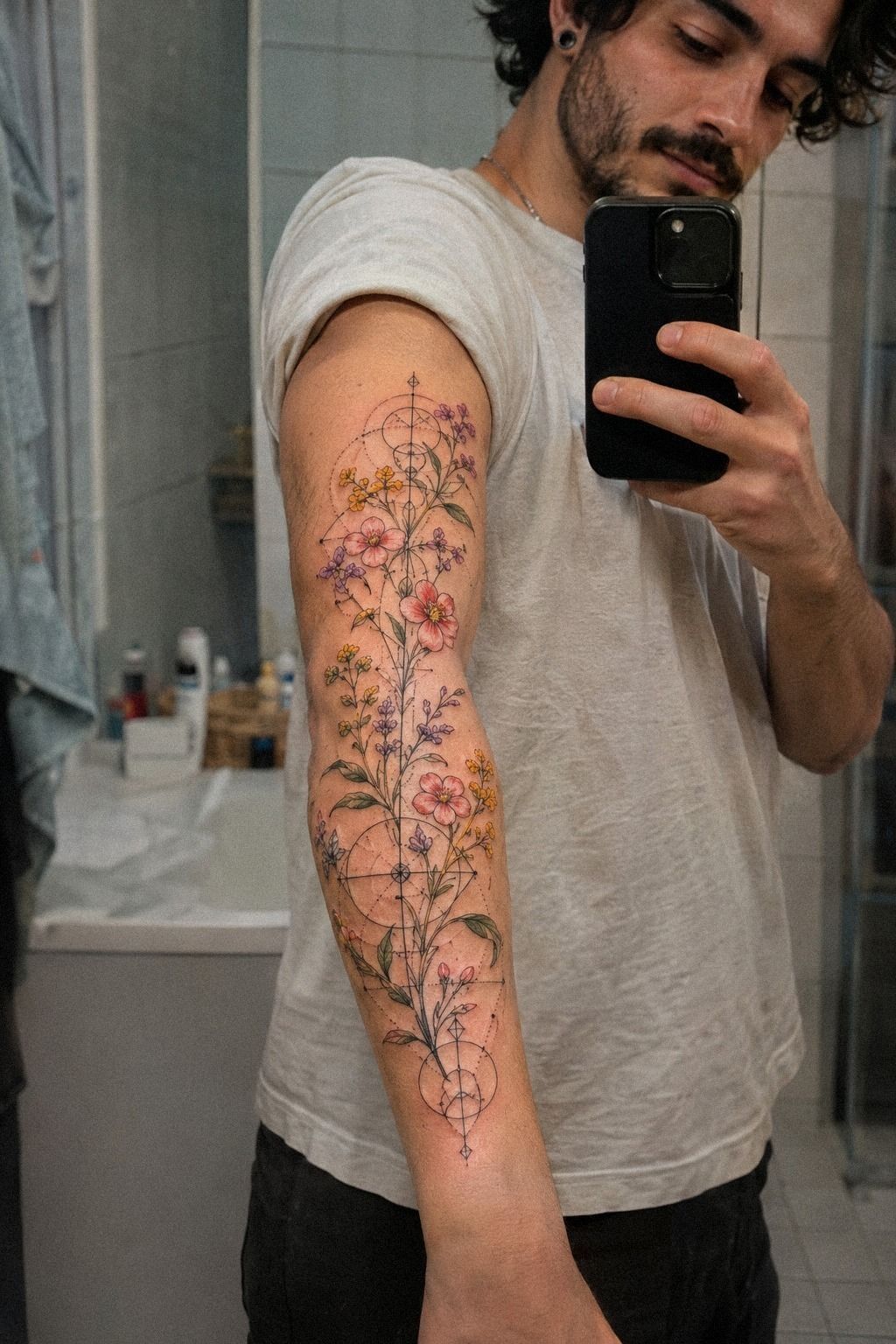
This concept adds botanical accents around a geometric flower. Crisp leaves and small warm-camel touches separate the forms.
The effect is playful but still organized. If you’re drawn to color, you’ll want the artist to choose one dominant accent instead of adding every shade you like.
A warm camel pigment can sit inside selected leaves while the flower stays black and grey. That gives you a clear anchor and makes the color feel intentional.
I’d avoid coloring every petal. The geometry could lose its sharp contrast. One controlled accent can be more daring than a sleeve packed with competing tones.
Ask how the chosen pigment may shift as it heals. You’re not only choosing a fresh look. You’re choosing an aftercare routine.
Gentle washing, light hydration, and avoiding sun and swimming during early healing matter more than a complicated product list. That’s the move!
For a softer color reference, look through watercolor floral sleeve tattoo examples and watercolor floral tattoo meaning. You can borrow the vibrant mood without copying loose watercolor edges.
9Let Negative Space Lead
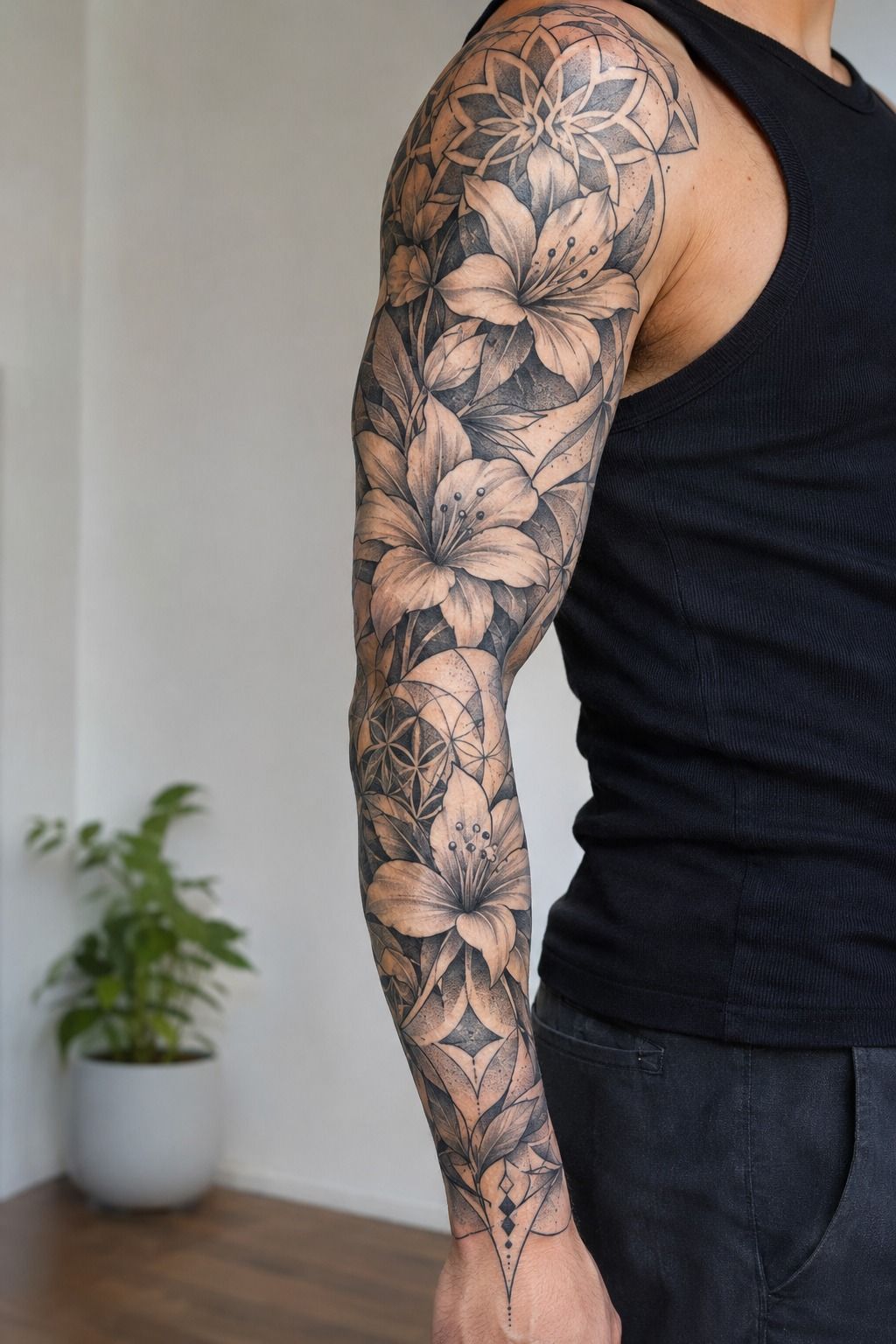
This concept leaves large areas of untouched skin around the flower. Negative space becomes an active part of the design.
The result is minimal, crisp, and surprisingly expressive. If you’re worried that a sleeve will feel too intense, this is the direction I’d show your artist first.
The central flower uses a thin geometric frame. Small black marks sit farther apart near the forearm. You’ll get a sleek silhouette when your arm is relaxed.
The open sections keep the tattoo from looking sealed shut. I’d choose this over a dense pattern if you want your first tattoo to remain understated.
Negative space isn’t empty by accident. It protects the legibility of the petals and gives future additions somewhere to sit.
Your artist can also use fine black pigment in selected shapes instead of shading every surface. That contrast makes the small details visible from a normal distance.
Review minimalist floral sleeve tattoo ideas alongside fine line floral sleeve tattoo references. A minimal design still needs careful spacing.
10Test the Wildflower Placement First

A wildflower concept works best when you test how it moves with your arm. The stencil should follow your body instead of treating your forearm like a rigid template.
Ask your artist to check the design while your arm hangs naturally. Then look at it from the front, side, and a relaxed three-quarter position.
A temporary stencil placement can reveal problems before the session starts. You may notice that a petal points inward, a circle tilts, or the strongest detail disappears when your arm turns.
I’d keep the main flower near the visual center. Let smaller leaves and geometric marks guide the eye toward the elbow and wrist.
This approach can feel vintage, personal, and quietly playful. It also gives you a clearer sense of whether the design is worth the cost before you commit.
If you like this direction, compare the fine line floral sleeve tattoo examples with the small floral sleeve tattoo references. Use them for proportion, not direct copying.
11Make Sharp Symmetry Work for You

This design uses sharp symmetrical geometry around a floral center. Strong angles extend toward the wrist and elbow.
It’s bold and commanding, but the flower keeps it from feeling purely mechanical. If you want a fierce first tattoo with a clear silhouette, this one has real presence.
The symmetry should be checked while your arm hangs naturally. A perfectly centered shape on paper may need a small adjustment once it wraps around the forearm.
I’d let the flower lead and allow the side angles to shift slightly. That keeps the tattoo crisp without making your anatomy fight the design.
Use solid black anchor shapes sparingly. Let thin outlines carry the smaller leaves. The strongest contrast belongs near the center, where your eye lands first.
I’d skip equal darkness everywhere because the sleeve would become flat. A controlled hierarchy makes the design powerful and easier to read years later.
If this direction feels right, compare black floral sleeve tattoo ideas with watercolor floral sleeve tattoo references. I’d choose the symmetrical blackwork version when you want a timeless tattoo that still feels daring.
Check Your Placement Before Booking
Placement changes how a tattoo looks, feels, and ages. Forearm placement is often easier to inspect, while an upper-arm design can offer more privacy.
Ribs, feet, hands, and sternum may feel sharper for many people. Everyone responds differently, so your artist can help you plan a realistic session.
Ask to see the stencil while your arm is relaxed. Then move naturally. A circle that looks perfect while standing still may shift when you bend your elbow.
I’d also check how the design fits your clothing, work routine, and future tattoo plans. A polished first piece should still feel practical six months later.
What Makes the Cost Worth It?
Your artist’s portfolio matters more than a low quote. Look for healed linework, consistent circles, clean saturation, and work on skin tones similar to yours.
A lower price may not offer the same value if the design needs major correction later. I’d rather wait for a skilled artist than rush into a session that leaves you second-guessing every mark.
For cost, typical US pricing varies by artist and region. A shop minimum may sit around $50 to $100, while hourly rates often fall around $100 to $250.
A smaller geometric floral tattoo may cost about $100 to $300. Your consultation should clarify the estimate, session length, and whether a touch-up policy exists.
If your budget is tight, reduce scale or detail before choosing an artist with less relevant experience. The best value comes from a design that suits your skin, placement, and long-term plans.
Questions I’d Ask Before Booking
I’d ask whether the artist has healed examples of geometric floral work. Fresh work can look crisp, but healed examples show how lines settle.
Ask how they adapt circles, petals, and symmetry to your anatomy. You’ll want a clear answer before you approve the stencil.
I’d also ask about hygiene, aftercare, session length, deposits, and the touch-up policy. Those details can affect the final price and your comfort.
Don’t feel pressured to book during the first consultation. A meaningful tattoo should feel personal and empowering, not rushed.
How I’d Keep the Geometry Readable
Use one main geometric language. Circles, diamonds, arcs, and triangles can work together, but too many competing shapes may weaken the focal point.
Open line spacing helps small details stay crisp. If every gap is narrow, the design can lose its delicate quality as the skin heals.
I’d keep the darkest marks near the main flower. Then I’d let lighter outlines and open skin carry the eye outward.
That contrast can make the tattoo feel iconic without making it overly ornate. You’re giving each element a job.
The Three-Anchor Rule: How I’d Judge a First Tattoo
A first tattoo should earn its detail. I’ve seen people choose an intricate reference because the design looked impressive online, then regret the scale once the stencil reached their arm.
My rule is simple: choose one floral anchor, one geometric structure, and one area of open skin. If all three can be seen from a relaxed position, the design is doing its job.
Healed linework matters more than a perfect fresh result. Fine lines can spread over time, and ultraviolet exposure can soften contrast.
Healing at the surface usually takes about 2 to 3 weeks. Complete healing can take about 2 to 3 months. You’ll need gentle washing, light hydration, and a break from swimming and direct sun.
The best design isn’t always the most ornate one. It’s the one you can explain, wear comfortably, and still recognize when the fresh shine has gone.
I’d choose a crisp wildflower with meaningful geometry over a crowded sleeve every time. That choice gives you room to grow, and you won’t feel pressured to finish everything in one sitting.
A Few Things Worth Answering
How much does a geometric floral sleeve tattoo usually cost?
A smaller design often runs about $100 to $300 in the US. Shop minimums may be about $50 to $100, with hourly rates around $100 to $250. Artist quality and placement affect the estimate most, so you’ll want a consultation before choosing a number.
Are geometric floral sleeve tattoo designs a good idea for a first tattoo?
Yes, especially when you choose a tolerable placement and readable line weight. Forearm placement and open geometry can make the design easier to plan, while a meaningful flower gives you a personal reason to keep it.
How do I choose a tattoo artist for geometric floral sleeve tattoo work?
Review healed examples, clean linework, geometric circles, and work on skin tones like yours. A specialized portfolio matters more than a polished social feed. Ask about hygiene, stencil placement, aftercare, and fine lines that may widen with age.
How much do geometric floral sleeve tattoos hurt?
Pain varies, but forearm, thigh, and shoulder placements are often more tolerable than ribs, feet, hands, and sternum. Placement changes the experience more than the flower style does. If you’re nervous, ask about shorter sessions and take breaks when you need them.
How long does a geometric floral sleeve tattoo take to heal?
Surface healing usually takes about 2 to 3 weeks, while complete healing can take about 2 to 3 months. Gentle aftercare protects the lines: wash softly, hydrate lightly, avoid swimming, and keep the tattoo away from direct sun while it recovers.
What’s the best placement for geometric floral sleeve tattoos?
The forearm is a strong choice when you want visibility, readable geometry, and a generally more tolerable area. The upper arm offers more privacy and can wrap naturally around the muscle. Ask your artist to check the stencil while your arm hangs normally.
Where I’d Start First: The Negative-Space Wildflower
If I had to pick one, I’d start with the minimal geometric wildflower in negative space. It leaves the cleanest room for future changes, and the open skin helps fine lines stay readable as they age.
Pin the minimalist floral sleeve tattoo guide for later. Take your time with the stencil, ask every practical question, and trust that pause!