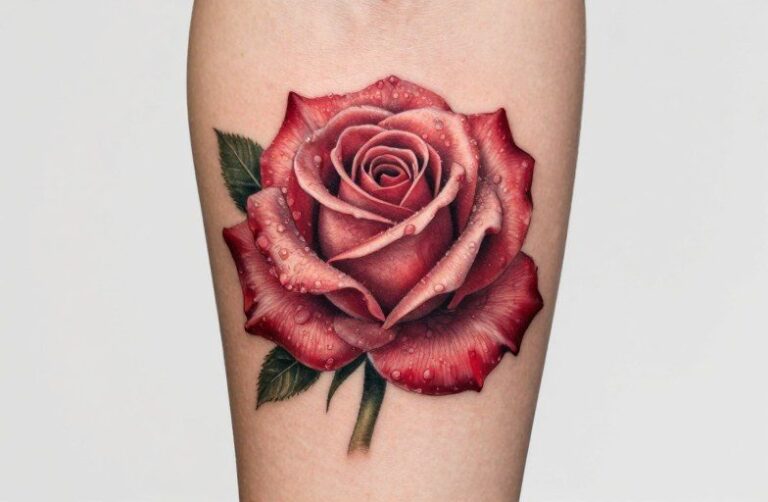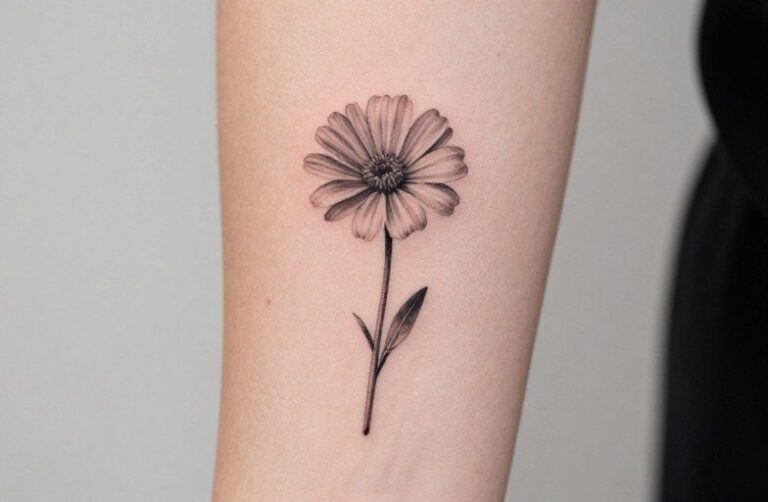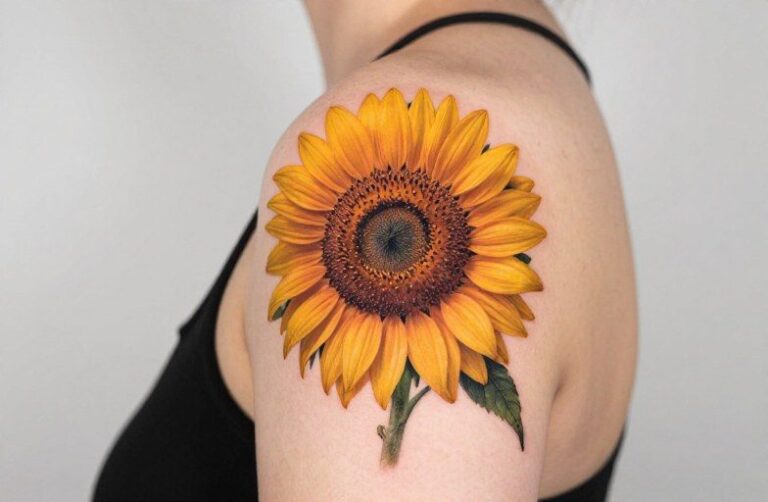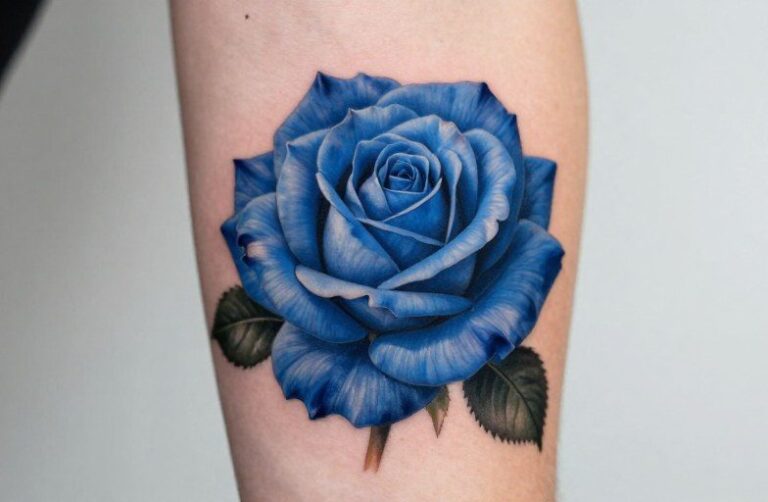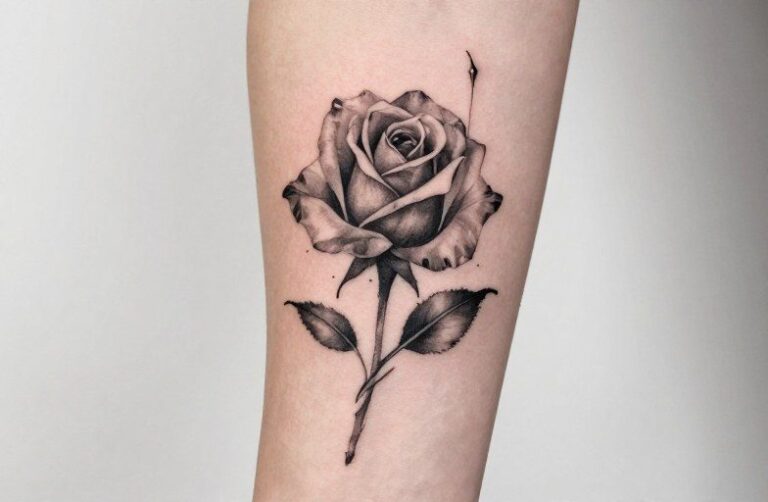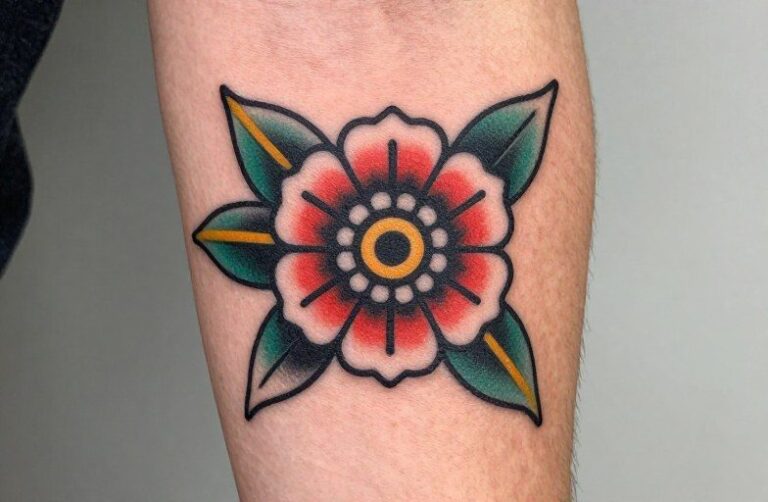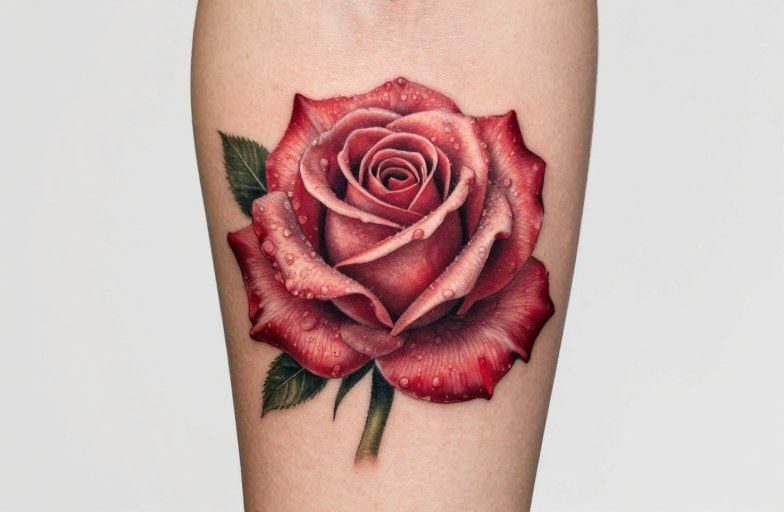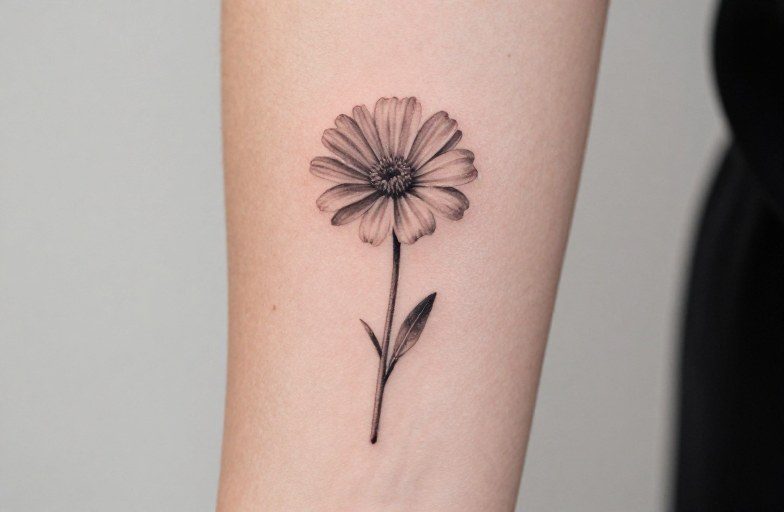
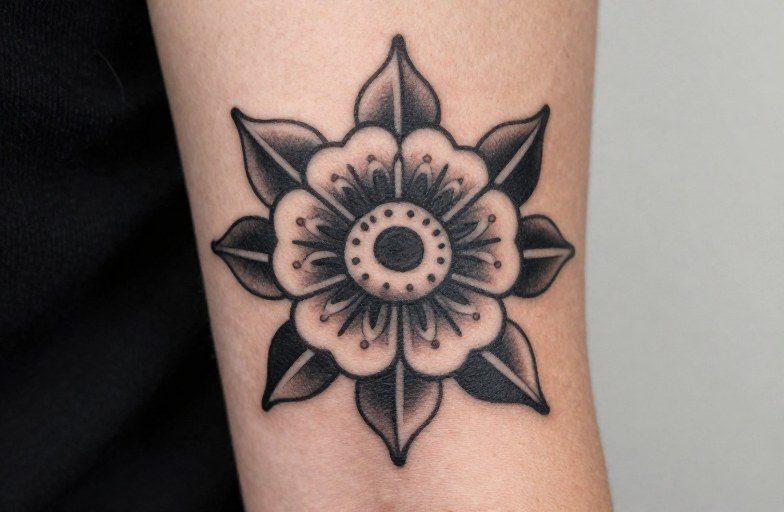
Black American traditional flower tattoos strip the classic sailor style down to its bones: thick black outlines, solid fill, minimal shading, and iconic floral imagery like roses, peonies, chrysanthemums, and lotus blooms. No color. No soft gradients. Just brute-force contrast and readable silhouette built to hold for decades. The flowers carry the same symbolic weight they always have, love, death, resilience, beauty, but rendered in a visual language that prioritizes longevity and bold graphic impact over delicate realism.
Modern Variations
Today’s artists push the black traditional flower in several directions without abandoning its core grammar. Some lean harder into ornamental framing, wrapping florals in dagger handles, banners, or snake coils. Others isolate the bloom itself, blown up large on thigh or ribs, letting negative space do the heavy lifting. The “painting” approach treats the flower as a flat graphic shape, almost stencil-like, while “sculpted” black traditional adds subtle whip-shading to suggest depth without betraying the monochrome commitment.
Placement Scaling
Small black traditional flowers above the knee or behind the ear work as single-needle or tight three-liner pieces, but the style really breathes at palm-size and up. Forearms, outer thighs, and chest plates give the bold lines room to resolve. A rose crammed into a two-inch ankle spot will blur into a black blob faster than the same design at four inches with proper spacing between petals.
- Hand and neck: high visibility, faster fading, requires touch-ups
- Ribs and sternum: excellent for symmetrical floral arrangements
- Back of arm above elbow: classic “show” placement, ages well
- Shin and calf: flat planes suit the graphic flatness of the style
Hybrid Styles
Some shops blend black traditional flowers with Japanese composition, floating blooms, wind bars, or finger waves, or with Chicano black-and-grey softness around the edges. These hybrids work when the artist commits to one dominant language. A black traditional rose with photorealistic dewdrops looks confused, not evolved.
Origins & History
The American traditional style coalesced in early 20th-century port cities, often linked to sailors and traveling military personnel who wanted identifiable, fast-healing tattoos that wouldn’t turn to mush at sea. Floral motifs entered the lexicon alongside anchors and swallows, partly through supply catalogs that offered flash sheets by mail order. Roses dominated early sheets, but chrysanthemums gained traction through Japanese influence on West Coast artists, and peonies followed as the style globalized.
The black-only variant has murkier origins. Some trace it to prison and street-shop economics, black ink was cheapest and most available. Others note that early electric tattooing often meant limited color palettes, and many clients simply preferred the stark graphic quality. What emerged was a parallel tradition: same bold outlines, same limited shading, zero chromatic distraction. The flower became pure symbol, stripped to silhouette and shadow.
How It Ages
This is where black traditional flowers earn their reputation. Dense black ink blocks UV penetration better than color pigments, which tend to break down faster under sun exposure. The thick outlines act as retaining walls, keeping the shape readable even as internal details soften. A well-executed black traditional rose at ten years old usually outperforms a color realism piece of the same vintage.
The Blob Risk
That said, over-packing black fill creates problems. Ink spreads slightly during healing; lines that looked crisp on day three can expand by month six. Solid black petals with no negative space or highlight cuts will eventually merge into undifferentiated masses. Good artists leave hairline gaps between petals or use “sparkle” dots and small highlight shapes to maintain internal structure as the tattoo settles.
- Line weight matters: outlines should be noticeably heavier than internal details
- Contrast through value, not just black vs skin: dark grey shading creates readable layers
- Negative space is not empty space, it’s an active design element
- Finger and palm tattoos in this style rarely age well regardless of execution
Aftercare Notes
Heavy black fill means more trauma to the skin and longer weeping periods. The first 48 hours are critical: plasma and excess ink need gentle washing, not aggressive scrubbing. Black traditional pieces often develop thicker scabs than fine-line work; picking them pulls ink out unevenly and creates patchy healing.
Sun Management
Fresh black ink looks almost blue-black initially, settling to true black over weeks. Sun exposure during this window can push the tone toward grey-green. Long-term, unprotected black tattoos grey out uniformly rather than fading to pastels like color work, but they still degrade. A healed black traditional flower benefits from the same SPF routine as any other tattoo, it’s not invincible, just more forgiving.
Linework & Technique
The hallmark is confident, consistent line weight. Outlines are typically run with 7- to 14-round liners or 9- to 15-magnums, depending on scale. Hesitation shows immediately in this style, wobbly borders kill the graphic authority. Artists often “sculpt” petal edges with a single bold pass rather than building up thin lines, which would muddy the silhouette.
Whip Shading and Saturation
Black traditional isn’t necessarily flat black. Many artists use whip shading (flicking the needle out of the skin to create tapering grey tones) for depth in flower centers or under overlapping petals. The key is restraint: three values maximum, black, dark grey, skin tone. More gradation starts looking like black-and-grey realism, which is a different conversation entirely.
- Single-pass outlining preferred over multiple build-up passes
- “Packing” black: tight circular motions, no visible skin between ink deposits
- Highlight cuts made with a 3-round or 5-round, not carved out later
- Stipple and dotwork for texture, not smooth greywash blends
Color vs Black and Grey
Traditional American tattooing built its reputation on limited, bold color, red, yellow, green, blue, applied in flat, unblended shapes. Black traditional flowers abandon that heritage entirely. The trade is specific: you lose immediate visual pop and cultural color coding (red roses for passion, yellow for friendship), but gain structural clarity and decades of readability.
When Black Wins
Dark skin tones often carry black traditional work with more visual punch than color, which can appear muted or ashy. Cover-up situations favor black, dense black flowers can mask older tattoos more effectively than color attempts. Professional environments with visible tattoo restrictions sometimes tolerate bold black graphics more readily than bright color.
The choice isn’t hierarchy; it’s dialect. Color traditional speaks one visual language, black traditional another. Both demand the same foundational discipline: bold drawing, clean application, respect for how ink lives in skin over time.
What to Remember
Black American traditional flower tattoos reward patience in design and precision in execution. The style looks simple because every element must carry weight, no color to hide behind, no soft gradients to suggest form. Choose an artist whose healed work you can examine, not just fresh photos. Ask about line weight strategy and how they handle negative space at scale. A rose that reads clearly at ten feet on day one should still read at ten feet after ten years. That durability is the whole point.
Flowers in this style carry their symbolism straight: love, loss, growth, memory. The blackness doesn’t erase meaning; it concentrates it. What you get is a graphic object that functions as both personal marker and enduring piece of craft, built to outlast trends, fading slower than almost anything else in the tattoo vocabulary.
Frequently Asked Questions
Do black traditional flower tattoos hurt more than color ones?
The pain level depends on placement and your personal tolerance, not the ink color. Heavy black fill requires more passes to saturate, which can mean longer sessions for the same area, but the needle configuration matters more than pigment choice.
Can any artist do black American traditional well?
Not necessarily. The style demands specific line confidence and understanding of how black ink settles. Look for artists with healed portfolio examples in this exact style, not just general traditional work or black-and-grey realism.
How do I keep the black from turning grey or blue?
Quality black ink and proper depth help, but sun protection is your main tool. UV exposure degrades all tattoo pigment over time. A healed piece with consistent SPF application maintains its tone far longer than an unprotected one.
Are certain flower types better suited to black traditional than others?
Roses and chrysanthemums translate most naturally due to their layered petal structure, which reads well in silhouette. Simple blooms with clear shape definition work better than intricate flowers like cherry blossoms that rely on delicate color gradation.