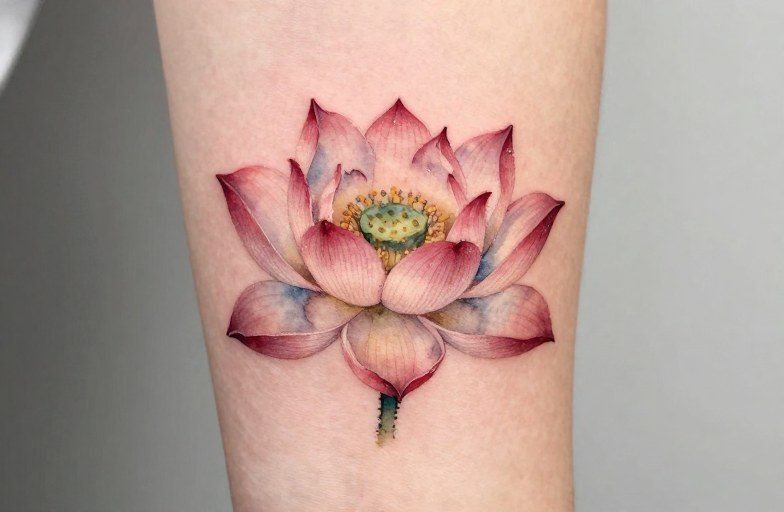
A lotus watercolor tattoo combines the recognizable silhouette of the lotus flower with washes of pigment that look spilled, brushed, or bleeding into the skin. Unlike traditional tattooing that relies on bold outlines and saturated fills, this style mimics actual watercolor painting: transparent layers, color gradients, splatter effects, and deliberate negative space. The lotus shape provides the structural anchor; the color work around and through it supplies the feeling. Done well, the flower reads clearly from across a room. Done poorly, it dissolves into a bruise-like blob within a few years.
Who This Style Serves
Skin tone matters enormously with watercolor techniques. The translucent color layers sit on top of your natural melanin, not replacing it. On very fair skin, pinks, lavenders, and soft blues glow with that genuine watercolor luminosity. On medium to deeper skin tones, those same pastels can read ashy or disappear entirely; richer jewel tones, deep magentas, emerald greens, burnt oranges, hold their own far better. This is not about limitation. It is about physics. The ink is not opaque paint.
Personality-wise, this style attracts people who want something organic and non-traditional without going fully abstract. The lotus carries enough cultural weight, often linked to Buddhist and Hindu traditions, commonly associated with rebirth and rising above difficulty, that it grounds the otherwise loose, painterly execution. You get symbolism plus art-school energy.
Related reading: lotus watercolor tattoo guide | black and grey lotus tattoo | Egyptian lotus art tattoo | tribal lotus tattoo meaning
When the Style Works Against You
If you need your tattoo to read perfectly in every photograph, every lighting condition, every decade of your life, watercolor lotus designs will frustrate you. They are designed to look slightly different in sun versus shade, fresh versus settled. That variability is the point, but not everyone wants it.
People who obsess over symmetry and crisp edges often feel betrayed by watercolor aging. The same person who loves the soft, bleeding quality at month three may hate the blurred ambiguity at year ten. If you are drawn to this style, ask yourself honestly: do I love the painting, or do I love the photograph? Fresh watercolor tattoos are among the most photographed, most Instagrammed work in tattooing. Healed watercolor, especially past year five, is harder to find in portfolios for a reason.
How It Ages
This is where watercolor tattoos get their reputation, and not always fairly. The aging problems are specific and predictable, not mysterious.
Line-less color washes blur fastest. Without black or dark gray to hold edges, those soft pink petals feather outward like watercolor on wet paper. Within five to eight years, what was a crisp petal edge becomes a hazy suggestion. The splatter effects, the little droplets and flecks that look so dynamic fresh, often fade to uneven spotting or vanish entirely. Skin regenerates; those tiny ink deposits get carried away.
White highlights, often used to suggest paper showing through or light catching petals, are particularly vulnerable. Titanium white ink in watercolor context tends to yellow, gray, or disappear entirely as the skin’s undertone shifts with sun exposure and time. Artists who rely heavily on fresh white for the effect are building on sand.
What Actually Holds Up
The lotus outline itself, if executed with intention. Many strong watercolor lotus tattoos use a hybrid approach: a dark gray or black illustrative line drawing of the flower, with watercolor effects layered around and partially over it. The structure survives; the color evolves. Think of it as a house with good bones and paint that weathers naturally.
Placement on low-friction, low-sun skin dramatically extends life. Inner bicep, upper thigh, ribcage under clothing, these areas preserve watercolor work far longer than forearms, hands, or shoulders that see constant sun and abrasion. The back of the neck, despite being easy to hide, fails here because sun exposure is unpredictable and monitoring difficult.
The Cover-Up Problem
Watercolor tattoos, especially those with extensive negative space and light color fields, are notoriously poor candidates for future cover-up work. The lack of dense pigment, the intentional blurring, the pale washes that remain after aging, all leave little for a new artist to work over. Choosing watercolor is, in a practical sense, choosing a tattoo that must stand on its own or be removed, not reworked. This is not a reason to avoid the style, but it is a reason to choose your design and placement with finality in mind.
How the Work Is Made
Watercolor tattooing differs from traditional work at the needle level, not merely in aesthetic preference. Artists typically use multiple needle configurations within a single piece: tight liners for the structural lotus outline, curved magnums or flat shaders for the broader color fields, and sometimes single needles or loose three-round liners for the fine splatter and droplet effects.
The color itself is diluted. Some artists use distilled water or witch hazel to thin their pigments to transparency; others work with pre-mixed greywash-style color solutions. The machine voltage often runs slightly lower for wash work than for saturation packing, allowing the needle to deposit ink more superficially, which creates that stained-glass quality. Too deep, and the transparency is lost; too shallow, and the color heals out entirely.
Negative space is not absence of planning. It is reservation. The artist must know exactly where skin will show through, which means knowing where not to tattoo. This sounds obvious, but in practice it requires working backward from the finished image, a different cognitive process than traditional tattooing where you fill defined spaces.
White Highlight Approaches
There are two schools. Some artists place white highlights during the initial session, accepting that some will be lost to healing but trusting the remainder to settle correctly. Others reserve white for a dedicated second pass after the color has healed, allowing them to see exactly where the skin has absorbed pigment and where true negative space remains. Both approaches work. The question is whether your artist can articulate their choice and its consequences.
Cost & Sessions
Watercolor technique demands more time than equivalent-sized traditional work. Blending gradients, building transparent layers, placing splatter with control rather than chaos, none of this is fast. A medium-sized lotus watercolor piece, roughly palm-sized with moderate color complexity, typically runs three to five hours. Larger pieces with full background washes can stretch across multiple sessions.
Pricing reflects both time and specialist skill. Artists who genuinely master watercolor tattooing, as opposed to those who simply own bright inks, are fewer and charge accordingly. Expect to pay above standard hourly rates in your region. The exact premium varies by city and artist reputation; the point is not to expect a bargain. The investment is front-loaded; touch-ups, when needed, usually focus on reinforcing structure rather than rebuilding color.
Session Planning
- Single session: Small lotus, limited color palette, minimal background wash.
- Two sessions: Medium piece with complex color layering; allows healing between stages to assess saturation and adjust the second pass.
- Multiple sessions: Large compositions, cover-up integrations, or pieces combining watercolor with other techniques like geometric framing or dotwork.
Origins & History
The watercolor tattoo style emerged most visibly in the early 2010s, though pinning exact origins is difficult. The technique is often linked to artists experimenting with painterly approaches in Eastern Europe and Russia, where academic art training was historically common among tattooers. Parallel developments appeared in California and New York studios where fine art backgrounds intersected with tattoo machine culture. The lotus specifically gained traction as Western tattoo collectors sought Eastern spiritual imagery without the heavy black-and-gray traditionalism of earlier decades.
What distinguishes mature watercolor tattooing from its predecessors is intentionality. Early experiments with paint brush stroke tattoos and abstract color work often looked accidental. Contemporary strong work looks inevitable: the splatter is placed, the bleeding edges are calculated, the negative space is reserved. The evolution from novelty to discipline took roughly a decade, and not all artists made the transition.
The Lotus Symbolism
The lotus has carried weight across cultures for millennia, rising from mud to bloom, closing at night and reopening. In tattooing, it is often chosen for personal resonance rather than cultural appropriation, though context matters. A lotus combined with specific Buddhist iconography, mandala geometry, particular mudras, or Sanskrit script carries different weight than a standalone botanical watercolor piece. Being thoughtful about combinations is not political; it is respectful craft.
The watercolor style itself, with its softness and impermanence, resonates with the lotus’s associations: beauty that is not fixed, emergence that is ongoing, purity that is process rather than state. Whether this resonance is intentional or convenient depends on the individual piece and the conversation between artist and client.
Choosing the Right Artist
Portfolio review for watercolor work requires looking past the fresh, bright photos. Every artist’s portfolio shows fresh work. You need healed examples, ideally two or more years old. Ask directly. If an artist has none, that is information.
Look specifically for:
- Controlled splatter versus chaotic spatter. The difference is placement intention.
- Color transitions that maintain distinct hues rather than muddying to brown.
- Structural elements that remain readable even where color bleeds across them.
- Range of skin tones in their healed portfolio, not just fair skin.
Technical questions to ask: Do they use a mix of needle configurations for line and wash? How do they handle the white highlight stage, fresh during the session, or reserved for later? Both approaches work; evasiveness does not. What is their specific touch-up policy for watercolor work, which behaves differently than traditional? Do they have photographs of their own healed watercolor in natural light, not just studio flash?
Red Flags
Artists who claim watercolor does not need any outline at all for longevity. Artists whose portfolios show only fresh, brightly lit photography with no healed or natural-light documentation. Artists who cannot explain why they chose specific pigments for your skin tone. The technique is specialized; generalists claiming mastery without evidence are gambling with your skin.
Also: artists who dismiss questions about aging with “it will look great if you take care of it.” All tattoos age. Watercolor ages differently. An honest artist discusses this openly.
Best Placements
The lotus watercolor style thrives where the body provides natural canvas shapes and movement.
Shoulder cap and outer upper arm: The rounded muscle creates a natural frame. Watercolor effects can extend toward the deltoid edge, suggesting the flower emerging from or dissolving into the body. The lotus reads frontally; the color wash catches light from multiple angles.
Forearm, inner or outer: Excellent for medium-sized pieces with the lotus positioned toward the wrist or elbow and color bleeding along the arm’s length. The elongated canvas suits the vertical lotus form. However, forearms age fast: sun exposure, friction, frequent washing. Expect more maintenance and earlier fading.
Ribcage and side: The natural curve accommodates larger compositions. Lotus at the center, watercolor wash extending toward hip or breast. Painful placement, but the concealment and reveal dynamic suits the lotus’s emergence symbolism practically. Protected from sun, aging is kinder.
Thigh, front or outer: Generous space for detailed petal work and extensive color fields. The muscle stability preserves line quality. Easily shown or hidden. One of the most forgiving placements for watercolor longevity.
Back of neck, upper back center: Riskier for watercolor. The lotus can work beautifully as a centered piece, but the flat plane does not showcase the dimensional color bleeding as effectively as curved surfaces. Also difficult to monitor for sun exposure and healing. Consider carefully.
Placement to Avoid
Hands, feet, fingers: Watercolor’s delicate color work simply does not survive the cellular turnover and friction. The lotus becomes unrecognizable faster here than almost anywhere. If you must have lotus imagery on your hand, choose a different style entirely.
Inner wrist: Similar problems, though slightly less severe than fingers. The constant flexing, washing, and sun exposure degrade color quickly. The small surface area also forces simplification that undermines the style’s strengths.
Healing & Aftercare
Watercolor tattoos heal differently than traditional work, though the basic rules apply: keep clean, keep moisturized, keep out of sun. The specific risk is color dropout in the transparent layers. Where traditional tattoos pack enough pigment to survive some surface loss, watercolor operates on thinner margins. A scab that pulls too thick, a sunburn during healing, a swimming pool infection, these can remove color that cannot be easily rebuilt.
Moisture management is critical. Too dry, and scabs thicken; too wet, and maceration blurs edges. Follow your artist’s specific instructions over generic advice. Ask them about their experience with watercolor healing; they should have preferences based on observation.
Plan touch-ups with realistic expectations. Watercolor touch-ups are harder than traditional. Adding density to transparent areas changes the effect; rebuilding splatter that has faded entirely requires artistic reconstruction, not mere reinforcement. The best strategy is prevention through good placement and careful healing.
Before You Decide
A lotus watercolor tattoo is a specific commitment, not a default choice for someone who wants something pretty and floral. It asks you to accept impermanence as aesthetic principle, to trust that blurring and softening over time will remain beautiful rather than merely faded. It asks you to find an artist with genuine technical mastery in a style that is harder to execute than it appears. It asks you to protect your skin from sun and friction more diligently than traditional work requires.
The reward is a tattoo that genuinely looks like a painting, that carries the emotional associations of the lotus through a visual language that feels contemporary and personal. The risk is a tattoo that looks like a bruise, that ages poorly, that cannot be easily fixed or covered. Both outcomes are common. The difference is usually in the decisions made before the needle touches skin.
Frequently Asked Questions
How long does a lotus watercolor tattoo take to heal?
Surface healing follows the same two to three week timeline as most tattoos, but the color settles and reveals its true transparency over two to three months. Watercolor’s thin pigment layers are more vulnerable during this extended settling period; protect from sun and avoid swimming or soaking for the full six weeks minimum.
Can a lotus watercolor tattoo be touched up if it fades?
Touch-ups are possible but more complex than with traditional work. Adding density to transparent areas changes the watercolor effect; rebuilding faded splatter requires artistic reconstruction rather than simple reinforcement. Structural elements (outlines, dark grays) touch up more predictably than pure color washes. Discuss your artist’s specific approach and policy before committing.
Do watercolor lotus tattoos work on dark skin?
They work beautifully with the right pigment choices. Pastels and light washes often read ashy or disappear on deeper skin tones; jewel tones, deep magentas, emerald greens, burnt oranges, and saturated purples hold their own. The key is an artist with demonstrated experience working across skin tones, not just theoretical confidence. Ask to see healed examples on skin similar to yours.