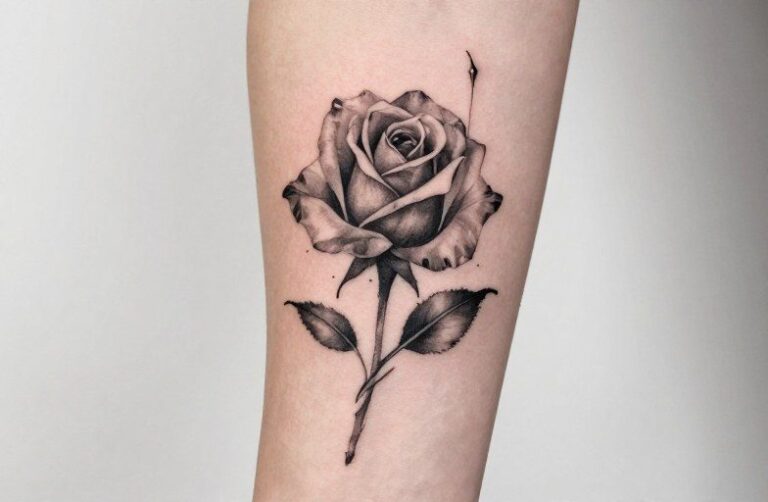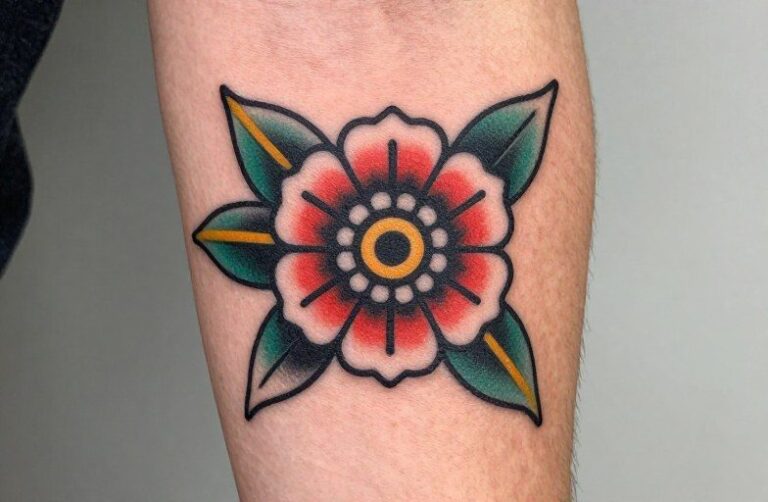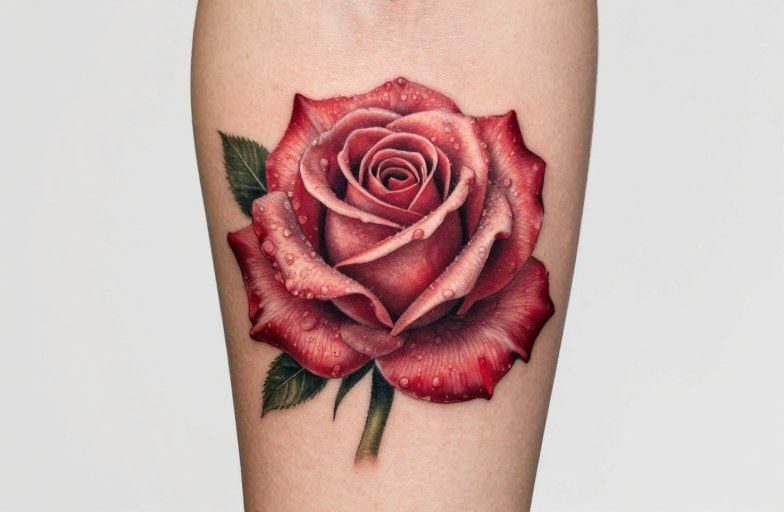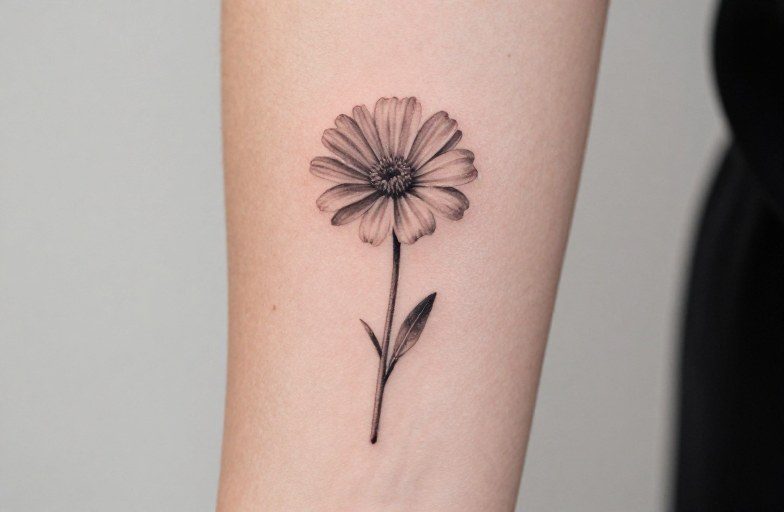
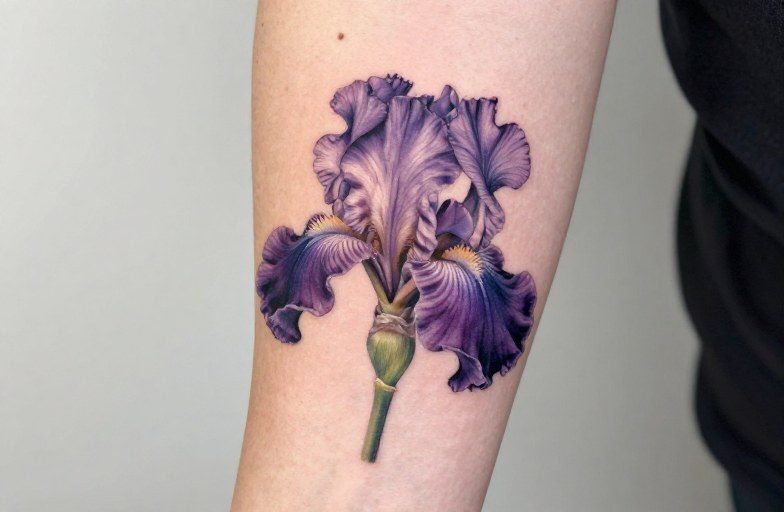
An iris flower tattoo most commonly signals hope, faith, wisdom, and valued friendship. The three upright petals are often linked to these virtues, while the three drooping sepals can represent courage, admiration, and mystery. Depending on color and cultural context, the same bloom can mark a personal loss, a military connection, or a creative spirit, so the specific meaning hinges on what you emphasize.
Best Placements
Where the Detail Holds
The iris carries distinctive architecture: three standards (upright petals), three falls (drooping sepals), and a fuzzy “beard” on many varieties. Fine linework preserves this structure best on flatter skin with minimal stretching. Inner forearms, outer upper arms, ribs, and calves give the petals room to breathe without warping. Thighs work for larger compositions but tend to blur the beard detail over time as the skin shifts.
Hand and finger placements are genuinely difficult. The iris’s narrow lines blow out fast on high-movement areas, and the beard texture becomes mud within a few years. If you are set on a hand piece, simplify to silhouette or heavy blackwork rather than attempting botanical accuracy.
Scale and Aging
Small iris tattoos, under two inches, lose their defining lines within five to seven years. The beard dots merge, petal edges soften, and the whole flower reads as generic bloom. For longevity, aim for at least three inches in height, with line weights no thinner than a single needle grouping (roughly 0.25mm). Shading in the falls helps maintain contrast even as black lines spread slightly.
- Forearm: excellent for medium-scale color or black-and-grey
- Ribcage: suits vertical compositions, higher pain threshold
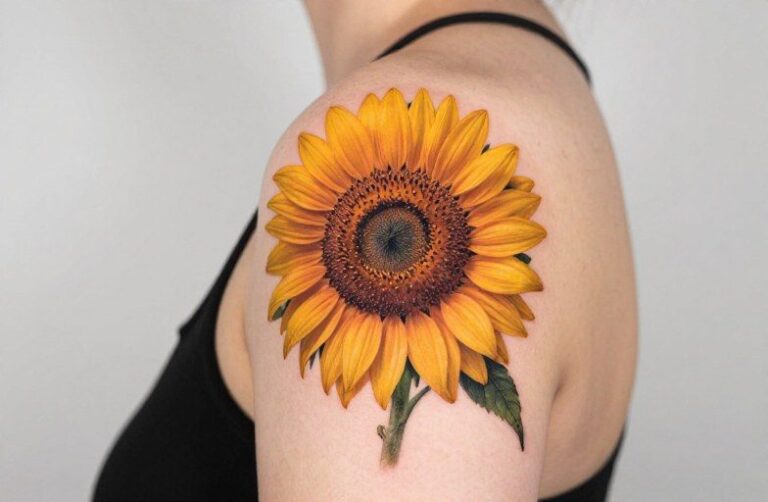
- Shoulder cap: frames the iris naturally, good for Japanese-influenced water backgrounds
- Ankle: popular but fades faster due to sock friction and thin skin
Mythology and Folklore
Greek Connections
The iris takes its name from the Greek goddess of the rainbow, often linked to her role as messenger between gods and mortals. Some trace the flower to her path across the sky, petals as colors made solid. This association with communication and bridges between worlds still surfaces in tattoo requests from people marking transitions, reconciliations, or new chapters.
Medieval European Beliefs
Fleur-de-lis imagery, commonly associated with the iris shape, appears across French heraldry and religious art. The stylized lily may derive from the iris or true lily; historians still debate this. What matters for tattooing: the visual shorthand became fixed as power, purity, and regional identity. People with French heritage or Louisiana connections often request this specifically, knowing the visual history even when botanical accuracy blurs.
Symbolism and Core Meaning
The Three-Petal Reading
Traditional iris symbolism often organizes around the number three. Upright petals are frequently read as faith, hope, and charity in Christian contexts; wisdom, faith, and valor appear in some Victorian floriography texts. The falls, those drooping outer petals, add shadow: passion, memory, or warning against rashness. Not every bearer assigns these literally, but the structure invites personal mapping. A parent might place children’s initials in the three standards; someone in recovery might emphasize the falls as descent and return.
Color-Specific Codes
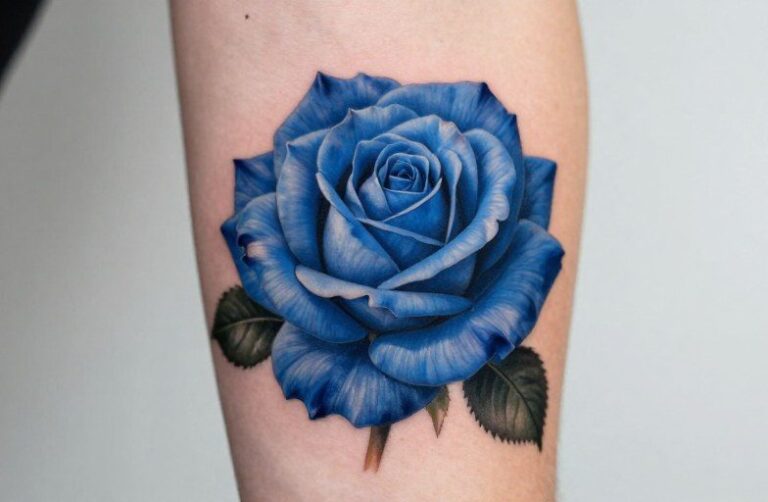
Blue irises dominate as the default meaning color, tied to hope and faith. Purple leans royalty and wisdom, historically the most expensive dye, now the most requested shade for academic or creative professionals. Yellow signals passion and can mark friendship specifically, though it is less common in tattooing because it ages poorly, shifting toward greenish tones. White irises function in memorial pieces, the blankness reading as absence or peace. Black irises in nature are typically deep purple so dark it appears black; tattooed true black reads as gothic adaptation or personal mourning.
- Blue: hope, calm, spiritual trust
- Purple: wisdom, creativity, dignity
- Yellow: friendship, passion, caution in some European traditions
- White: purity, memorial, new beginnings
History and Cultural Roots
Japanese Ikebana and Tattooing
Japanese iris (hanashōbu) carries distinct cultural weight through the Boy’s Festival and samurai aesthetics. The leaves’ sword-like shape and the flower’s brief blooming period connect to martial virtues and the transience of life. In tattooing, this appears in traditional Japanese bodysuits paired with water, koi, or warrior figures. The drawing style differs markedly from Western botanical approaches: bolder outlines, flatter color planes, less emphasis on the fuzzy beard.
Modern Military and Fraternal Use
The fleur-de-lis, again commonly associated with iris form, marks specific military units and scouting organizations. Tattoo requests from veterans or former scouts often blend this institutional history with personal growth narratives. The design challenge becomes honoring that specific visual tradition without defaulting to generic clip-art reproduction.
Common Variations and Styles
Botanical Realism
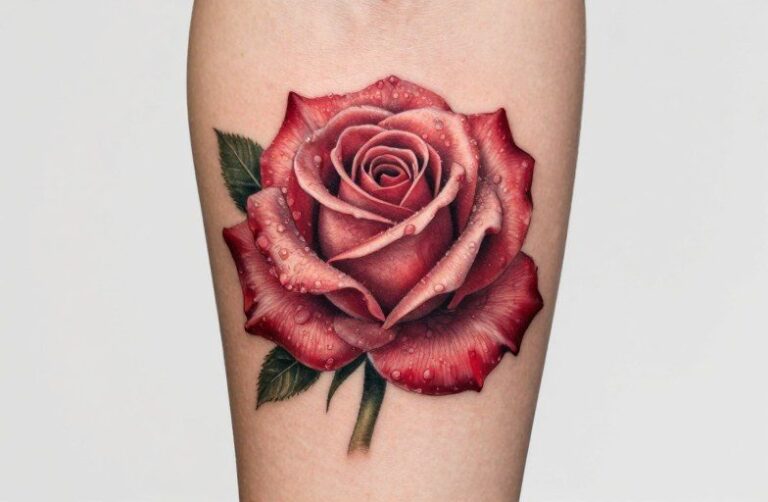
Contemporary tattooing can render iris varieties with photographic accuracy. Bearded Iris, Siberian Iris, and Japanese Iris each carry slightly different petal structures. Realism demands a skilled color artist comfortable with purple’s behavior (some purple pigments shift over time, though modern formulations have improved stability). Reference photos from the same angle as the tattoo placement help enormously. A top-down view of an iris will not translate to a forearm’s vertical plane without compositional adjustment.
Graphic and Stylized Approaches
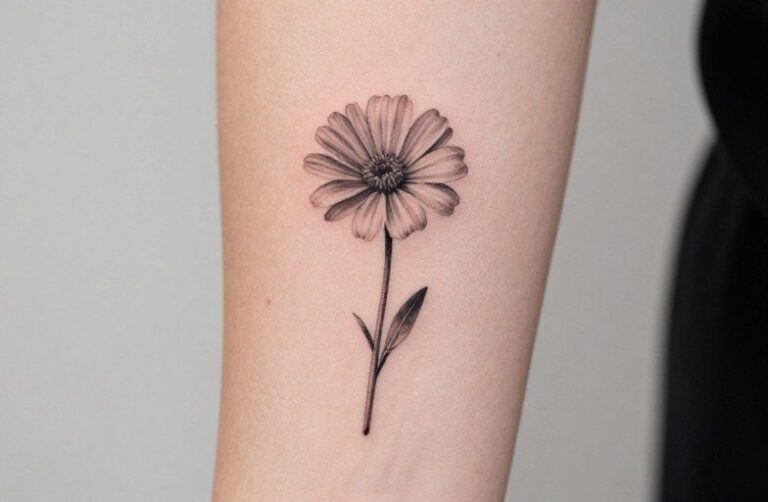
Art Nouveau interpretations emphasize the iris’s natural curves, often flowing into hair or abstract form. This style ages well because the bold outlines and limited color palette resist blur. Minimalist line versions strip the flower to three strokes and a dot, immediately readable to those who know the flower, cryptic to others. Blackwork and dotwork approaches sacrifice color meaning for texture and longevity, letting the form carry the symbolism.
- Traditional Japanese: bold outlines, flat color, often with water or stone background
- Art Nouveau: flowing lines, organic integration with other elements
- Minimalist: single needle, high risk of aging poorly unless scaled appropriately
- Blackwork: strong contrast, beard texture rendered through stippling or hatching
Religious and Spiritual Angles
Christian Iconography
The iris is often linked to the Virgin Mary through its three-petal structure as Trinity symbol, appearing in medieval and Renaissance religious painting. Blue irises specifically signal her sorrow and compassion. Tattooed in this context, the flower rarely stands alone, usually paired with rosaries, hands in prayer, or scriptural text. The meaning tightens to devotion rather than general hope.
Contemporary Spiritual Use
Beyond institutional religion, the iris functions in chakra and energy-work contexts through its purple association with the crown chakra. Some practitioners request the flower as a grounding symbol during spiritual transition. This usage tends toward stylized or abstract rendering, less concerned with botanical accuracy than with felt resonance. The tattoo becomes a private marker rather than communicative symbol.
What to Remember
The iris rewards specificity. A generic purple flower with a name underneath communicates little; an identified variety, chosen color with intent, and placement that respects the structure’s needs creates something that holds meaning and holds up visually. You might draw from Greek messenger, French heraldry, Japanese transience, or personal loss. The key is choosing with intent, then finding an artist who understands that particular iris and its gravity. The flower has carried meaning for centuries. Your version should earn its place in that lineage through care in selection and execution.
Frequently Asked Questions
Does an iris tattoo work in black and grey, or does it need color to carry meaning?
Black and grey works beautifully; the form itself carries the symbolism. Color adds specificity, purple for wisdom, blue for hope, but strong linework and contrast communicate the flower’s identity clearly without it. Many traditional Japanese iris pieces use minimal color.
How do I choose between a realistic iris and a stylized fleur-de-lis?
The fleur-de-lis is more immediately recognizable as heraldic symbol and reads faster from distance. A botanical iris invites closer inspection and allows color meaning. Choose based on whether you want historical shorthand or personal, nuanced reference.
What’s the typical pain level for an iris tattoo?
It depends heavily on placement. Forearm and outer upper arm rate moderate, similar to most floral work. Ribcage and inner bicep spike significantly. Ankle and hand are sharp and tend to need more sessions due to skin trauma. The iris itself does not dictate pain; placement does.