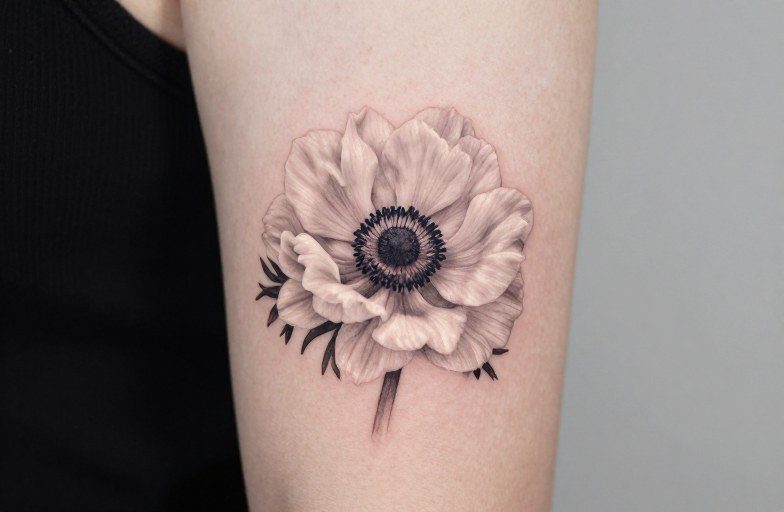
The white anemone carries layered meaning that shifts depending on who wears it and why. Most commonly, it represents anticipation and expectation. The flower’s name comes from Greek roots suggesting “wind flower,” and it opens fully before many other blooms. In tattoo form, it also carries darker undertones: protection against evil and ill wishes, forsaken love, and the fragile boundary between beauty and transience. That tension makes it a compelling choice if you want something visually delicate but symbolically weighty.
Symbolism and Core Meaning
The Dual Nature: Hope and Loss
White anemones refuse a single emotional register. In Victorian floriography, they conveyed forsaken love, a message sent when a relationship ended or hope dissolved. Yet the same flower, in Greek tradition, was often linked to protection and the warding off of harmful intentions. A tattoo of this bloom can hold both frequencies simultaneously: the grief of something unfinished, and the quiet armor of having survived it. You do not need to resolve that contradiction. That is the point.
Anticipation as a Verb
The anemone opens early, sometimes before the last frost has passed. That precarious timing gave it symbolic associations with waiting, with readiness, with the vulnerability of hoping before certainty arrives. You might choose this flower to mark a period of limbo: a diagnosis pending, a move delayed, a love unreturned but not yet abandoned. The white variety specifically strips away the romantic color coding of red or pink anemones, leaving something more austere and direct.
Best Placements
Where Detail Survives
White anemones demand space for their structural complexity: the ring of petal-like sepals, the dense central stamen cluster, the slender stem that needs to read as graceful rather than spindly. The outer forearm, from wrist to elbow ditch, gives enough real estate without requiring a sleeve commitment. Upper ribs, placed to follow the body’s curve, can make the stem feel naturally rooted. The thigh front or side offers a larger canvas for multiple blooms or accompanying foliage.
Smaller placements work if you simplify. A single bloom behind the ear, roughly quarter-sized, needs clean line work and minimal interior detail. The ankle bone area risks blowout on the white ink highlights; the skin there is thin and unforgiving. Finger placements are generally inadvisable for this subject. The scale compresses too much, and the white ink will yellow or disappear entirely within months.
Flow and Orientation
Consider how the stem travels. Vertical compositions suit the inner bicep or calf side. Horizontal arrangements work across the upper back below the neck, or sweeping along the collarbone. The anemone’s natural posture is slightly nodding, not rigidly upright, which gives tattoo artists useful asymmetry to exploit.
How It Ages on Skin
The White Ink Problem
This is where white anemone tattoos get technically interesting, and where many go wrong. The “white” of the petals is typically achieved through negative space (untattooed skin) plus possibly white ink highlights. White ink alone, without darker surrounding tones to create contrast, ages into a muddy, translucent veil. It does not stay white. It becomes the color of your healed skin tone, slightly raised, occasionally yellowed by sun exposure or metabolic factors.
Skilled artists create the illusion of white petals through strategic use of gray wash, very light blue-gray, or pale violet undertones. Your eye reads these cool tints as “white” against properly saturated darker greens or deep stem tones. Over five to ten years, those surrounding darks will soften and spread slightly; the “white” areas will appear to shrink if the original design relied too heavily on pure negative space without enough supporting structure.
Line Weight and Longevity
Fine single-needle outlines defining each petal edge look exquisite at six months. At six years, those lines may have feathered into near-invisibility, leaving the petal boundaries ambiguous. A slightly heavier line weight, think 7RL or 9RL for main contours, with finer needles reserved for interior texture, preserves readability longer. Shading should be built in layers rather than one pass; this gives the tattoo dimension that survives the inevitable settling and softening.
Common Variations and Styles
Botanical Realism versus Stylized Interpretation
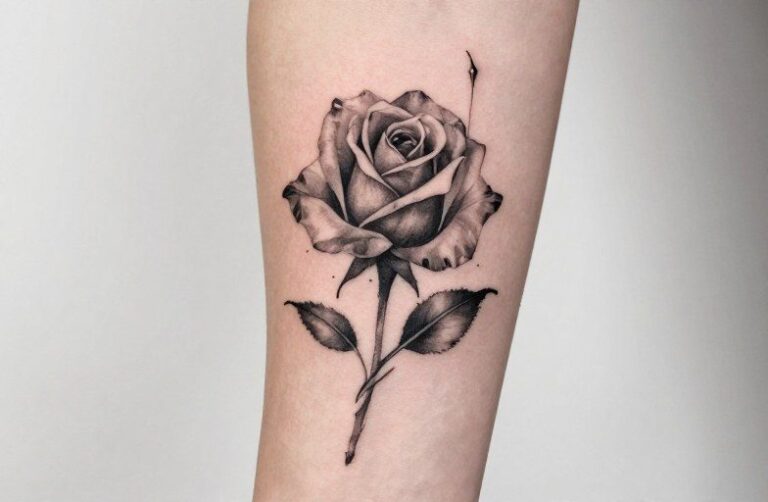
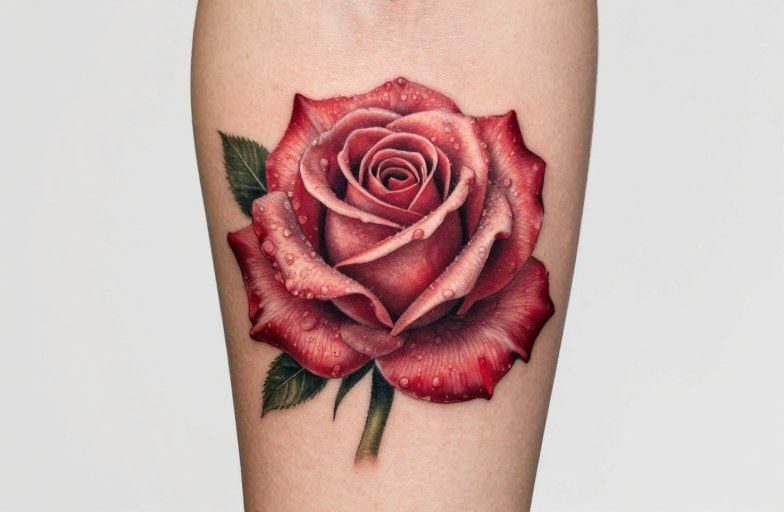
Hyper-realistic white anemones require a specialist in color or black-and-gray floral work. The best examples show translucent petal edges, visible veining, and the fuzzy texture of the central disk. This style demands larger scale and higher budget; rushing it produces flat, poster-like results.
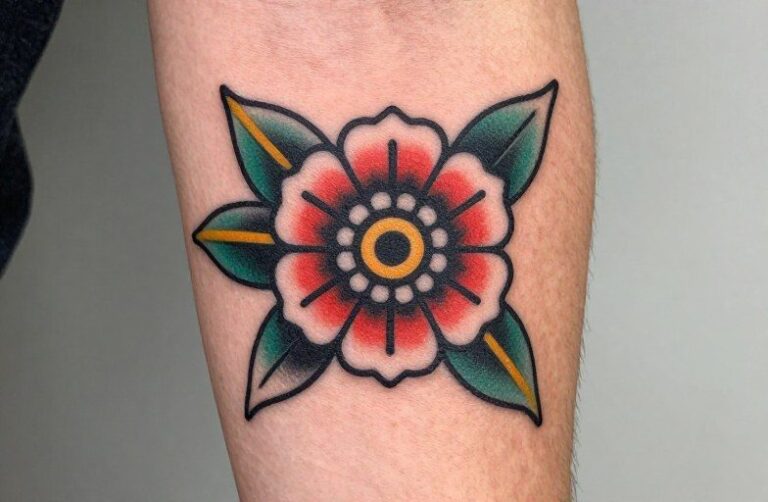
Neo-traditional and Japanese-influenced approaches simplify the form into bolder shapes. Petals become more geometric, outlines heavier, color choices more saturated than nature provides. These age better and read clearly from distance. The tradeoff is botanical accuracy for graphic impact.
Accompanying Elements
- Bees or butterflies: literal pollinators, adding movement and scale reference
- Broken stems or scattered petals: amplifying the forsaken-love narrative
- Script banners: risky; text competes with the flower’s natural lines and rarely ages well together
- Other early spring blooms (snowdrops, crocus): seasonal grouping that reinforces the anticipation theme
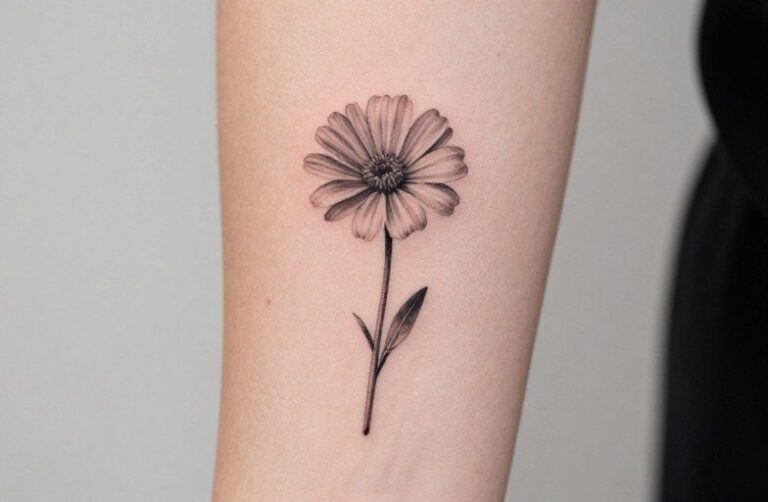
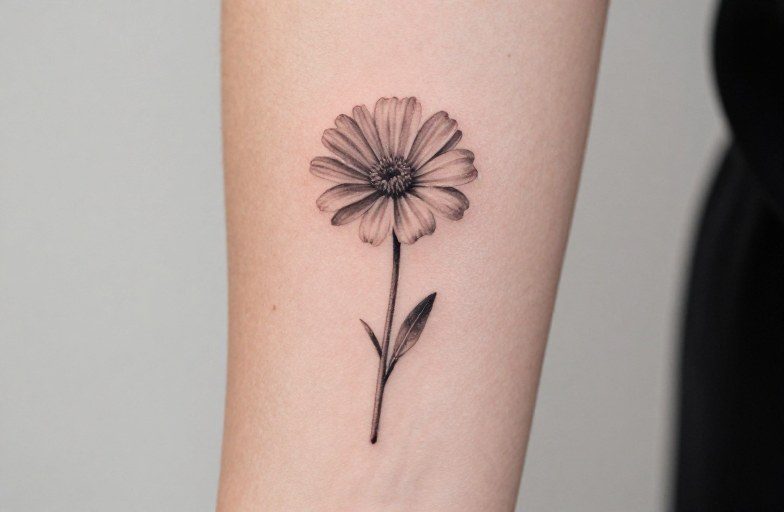
Black-and-gray versions emphasize the anemone’s sculptural quality; color versions, even restrained ones with pale green stems and yellow-green centers, can feel more immediately legible to viewers unfamiliar with the flower.
Religious and Spiritual Angles
Christian Associations
The anemone is often linked to the Passion of Christ in European Christian tradition, with red varieties representing the blood of the crucifixion. White anemones shift that symbolism toward resurrection, purity of sacrifice, or the sorrow of the Virgin Mary. Some trace this connection to the flower’s brief blooming period and its drooping habit, suggesting mourning. A white anemone tattoo with this intent might be placed where you can see it during prayer or reflection: the wrist inner surface, the chest near the heart.
Pagan and Folk Protective Use
Pre-Christian European traditions commonly associated the anemone with protection against misfortune. Dried blooms were carried as talismans; planting them near thresholds was believed to prevent illness from entering. A tattoo drawing on this lineage operates less as explicit religious statement and more as personal folk practice. Your body becomes the boundary; the ink becomes the ward. The white coloration specifically amplifies protective associations across multiple traditions, from European folk practice to certain East Asian color symbolisms.
History and Cultural Roots
Greek Mythology and Naming
The flower’s name comes from Greek anemos, wind. Some trace it to the myth of Adonis, where red anemones were said to spring from his blood; white varieties, in this framework, become the mourning of Aphrodite herself, or the transformation of grief into something enduring. The wind association also suggests impermanence, the bloom that opens and closes with weather, that cannot be forced or predicted. That quality made it a favorite of Romantic-era poets and painters, who favored symbols of fleeting beauty.
East Asian Presence
In Chinese art and medicine, related species appear, though the specific symbolic weight of the European garden anemone differs. Japanese hanakotoba (flower language) assigns distinct meanings to ichige (anemone species), often linked to sincerity and anticipation. A tattoo design drawing on Japanese composition principles, asymmetry, bold negative space, limited color palette, can honor this connection without appropriation, provided the artist understands the visual grammar rather than borrowing surface motifs.
Floriography and Victorian Codes
The Victorian era’s coded flower language gave the anemone its specific association with forsaken love. A bouquet including white anemones sent a message of abandonment or disappointed hope. Translating this into permanent body art removes the social negotiation of gift-giving and makes the statement inward-facing: a reminder of what you survived, or what you are still waiting for.
What to Remember
White anemone tattoos succeed when the technical execution matches the symbolic ambition. The flower’s meaning is genuinely complex: anticipation and loss, protection and vulnerability, not a single sloganable concept. That demands an artist who can handle subtle tonal gradation and who will not rush the negative space planning.
Before you commit, ask to see healed photos, not just fresh work. White ink and fine lines change dramatically over time. Discuss explicitly how your artist plans to create the illusion of white petals, and what surrounding tones will provide the necessary contrast. Consider placement in terms of sun exposure, which accelerates fading and yellowing. Most importantly, know why you want this specific flower. The anemone’s power comes from its refusal to simplify, and your tattoo should honor that same complexity.
Frequently Asked Questions
Does white ink actually stay white in an anemone tattoo?
No, not reliably. White ink typically heals into a translucent veil matching your skin tone, sometimes yellowing with sun exposure. Skilled artists create the illusion of white petals through negative space and cool gray or pale violet undertones, not pure white ink alone.
What is the smallest size a white anemone tattoo can work at?
Roughly quarter-sized for a single simplified bloom behind the ear. Smaller than that, and the structural details collapse. Finger placements are generally inadvisable due to scale constraints and rapid white ink fading.
Can a white anemone tattoo have meaning without religious association?
Absolutely. The core meanings of anticipation, forsaken love, and protection exist independently of any religious framework. Many wearers draw on personal or folk symbolism rather than Christian or specifically spiritual traditions.