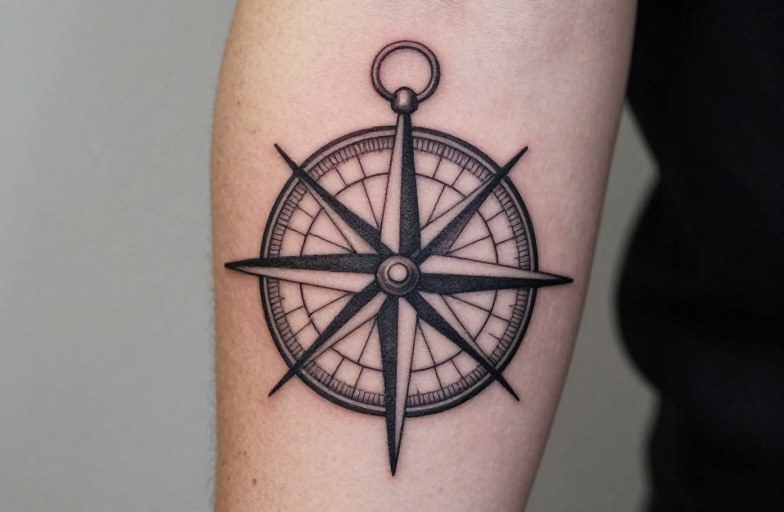
A compass rose tattoo means direction and purpose. People get it to mark a turning point, honor a guiding force, or remind themselves where they’re headed when life pulls them off course. The design carries weight because the compass rose itself is a functional tool, every line serves a navigational purpose, which gives the tattoo a built-in sense of intention.
How It Ages on Skin
Compass roses are linework-heavy designs, and that changes how they hold up over time. Fine radial lines, especially the long ones pointing to the cardinal directions, tend to spread slightly as skin ages. A line that starts at half a millimeter can blur to double that within five to seven years, depending on placement and sun exposure.
Placement Reality
Inner bicep and thigh hold detail longest because they’re protected from UV and friction. Forearms, hands, and collarbones see faster fading. The compass rose’s symmetrical structure means any uneven aging is obvious, one faded north point throws off the whole balance. If you want fine detail, budget for a touch-up in three to five years.
Line Weight Strategy
- Outer ring: bold, consistent weight anchors the design
- Inner star: slightly heavier lines than you think you need
- Directional markers: avoid hairline detail; it’ll disappear
- Lettering (N, S, E, W): simple block fonts age cleaner than script
Design Tips & Pairings
The compass rose works as a standalone piece or an anchor for larger work, but the pairings matter. A compass floating alone reads as contemplative; paired with a map, it becomes journey. Paired with an anchor, it signals stability. The combination you choose shifts the meaning without changing the core symbol.
Effective Combinations
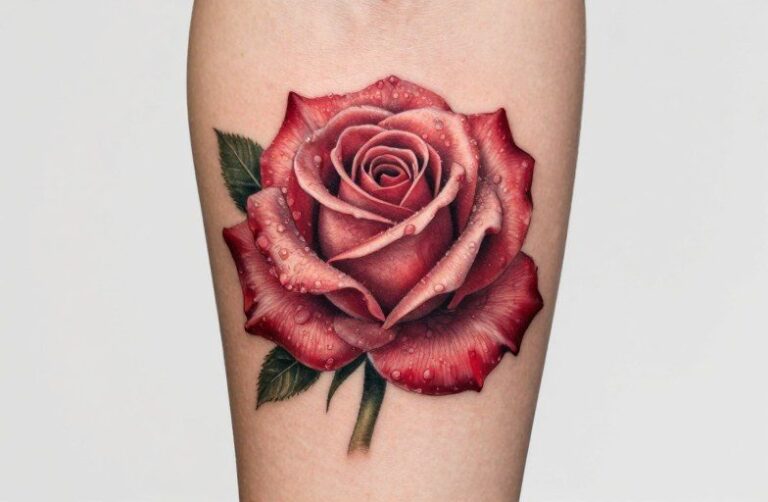
Map fragments work well behind or beneath the compass, creating depth without clutter. Coordinates in small text below the center point add personal specificity, birthplace, a memorial location, where you met someone important. Keep coordinate text small but legible; overly ornate fonts defeat the purpose. Roses or other floral elements can soften the geometric rigidity, though they move the tone toward romantic or memorial territory.
Scale and Composition
At two inches, a compass rose is a clean, readable icon. At six inches, you have room for a wind rose with all thirty-two points, decorative cartouches, or surrounding landscape. Don’t scale down complex historical compass roses, they were designed for printed maps, not skin. Simplify to three or four layers of detail maximum for anything under four inches.
Common Variations & Styles
Not every compass rose tattoo looks like a Boy Scout badge. The style you choose carries as much meaning as the symbol itself.
- Traditional/Americana: Heavy black outlines, limited color palette, bold and readable from across a room
- Dotwork/stipple: Creates texture and shadow without solid black; softer aesthetic, longer sessions
- Geometric/abstract: Breaks the circle, plays with negative space, appeals to people who want the concept without literalism
- Realistic/antique: Brass patina, cracked glass, worn leather case, requires a specialist in texture and light
- Minimalist: Single continuous line or extreme reduction; high risk of aging poorly if too thin
The antique brass style is particularly demanding. What looks like “weathered metal” in reference photos often becomes muddy brown and grey on skin if the artist doesn’t understand warm-to-cool tone shifts in tattoo ink. Ask to see healed examples, not fresh photos.
Color vs Black and Grey
Compass roses originated in black ink on parchment, so black and grey carries historical resonance. That said, color opens specific symbolic doors. Deep blue for water and voyage. Red for the north point, following the convention of portolan charts where the lodestone needle was often marked in red. Gold or yellow for the sun’s position.
Color Longevity
Red holds well but can pinken over time. Blue-purples last longer than bright cobalt. Yellow and white fade fastest and are hardest to touch up effectively. If you want color, commit to sunscreen or accept that vibrancy has a timeline. Black and grey with a single accent color, red north point, perhaps, often ages better than full multicolor pieces.
Mythology & Folklore
The compass rose’s history is entangled with maritime exploration, though its exact origins are often linked to Italian portolan charts of the thirteenth and fourteenth centuries. The term “rose” comes from the flower-like pattern of the early designs, which sometimes included elaborate petal divisions. Some trace it to the wind roses of classical antiquity, where twelve or sixteen winds were named and personified.
The North Star Connection
Before magnetic compasses were reliable, sailors used the North Star, Polaris, for orientation. The compass rose tattoo sometimes incorporates a star at center or north to honor this overlap. The eight-point rose (four cardinals, four intercardinals) became standard by the fifteenth century, and that geometry still dominates tattoo designs today. Sixteen and thirty-two point roses exist but read as busy on skin; most artists simplify to eight for clarity.
Superstition at Sea
Compasses were serious business for sailors. A broken or inaccurate compass meant death. Tattoos of navigational tools sometimes served as protective talismans, though this is commonly associated with sailor tradition rather than documented historical practice. The compass rose specifically, as opposed to the magnetic compass itself, was more cartographic tool than carried instrument, which distinguishes its symbolic weight: it’s about knowing where you are, not just which way you’re facing.
Personal & Modern Meanings
Today, people choose compass roses for reasons that have nothing to do with sailing. Recovery from addiction, finding direction after chaos. Graduation or career change, marking a deliberate path. Memorial work, someone who guided you, or a promise to stay oriented after loss. The tattoo functions as a private checkpoint, visible enough to catch your own eye in a mirror, personal enough that strangers don’t automatically read the specific meaning.
Gender and Placement Shifts
Historically more common on men, particularly in nautical traditional sets, compass roses now appear across demographics. Women often place them on ribs, sternum, or behind the ear for intimacy of meaning. Men still favor forearm and calf for visibility. None of these placements are gendered inherently, it’s about whether you want the reminder for yourself or want others to see it.
What to Remember
A compass rose tattoo succeeds or fails on geometric precision. Asymmetry that wouldn’t matter in a floral piece destroys the symbol here. Choose an artist with strong linework in their portfolio, not just one who “does compasses.” Ask how they stencil for symmetry, good artists have specific techniques, not just “I freehand it.”
Meaning isn’t automatic. The symbol gives you a framework; what you do with it, coordinates, paired imagery, placement, scale, fills in the specifics. A compass rose without personal anchoring is just a nice geometric design. There’s nothing wrong with that, but know which one you’re getting.
Finally, plan for the long term. This is a tattoo that should look correct at forty, not just fresh. Simplify detail, commit to sun protection, and find an artist who’ll talk to you about how it heals, not just how it photographs.
Frequently Asked Questions
Does a compass rose tattoo always mean travel or adventure?
No. While the nautical roots are real, many people choose it for guidance through personal transitions, recovery, or memorial purposes. The meaning depends on what you pair it with and why you chose it.
What’s the difference between a compass rose and a regular compass tattoo?
A compass rose is the circular directional marker from maps, with no magnetic needle. A compass tattoo includes the needle and housing. The rose is more abstract and symbolic; the compass is more literal and tool-focused.
How much detail can a small compass rose actually hold?
Less than you think. Under two inches, stick to eight points with a clean outer ring. Fine interior lines and thirty-two point roses blur together and lose readability quickly.
Is there a traditional meaning to which direction faces up in the tattoo?
North up is standard, matching map convention. Some people orient it to a meaningful direction, toward a hometown, for instance. There’s no universal rule; it’s your choice and your meaning.