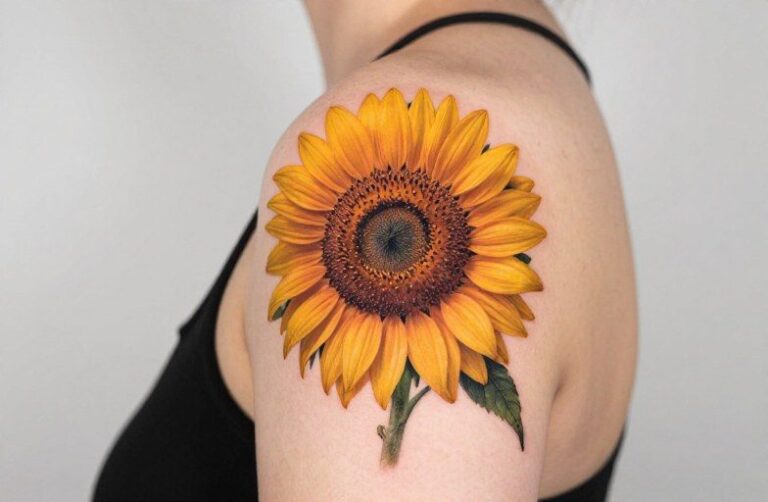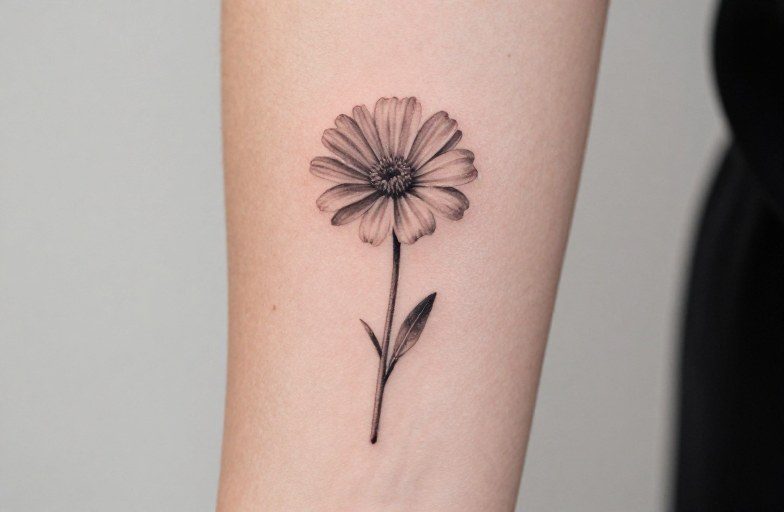
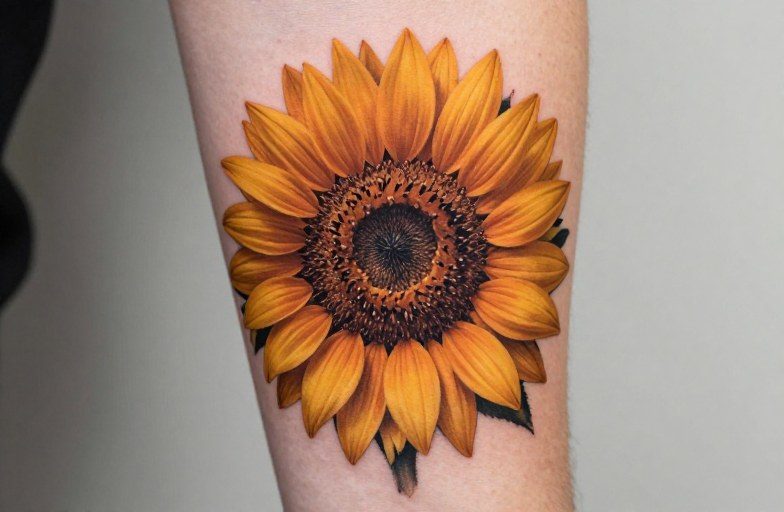
The skull with sunflower photography tattoo captures the tension between endings and beginnings in a single, striking image. this design speaks to the cycle of life, death as the necessary shadow that makes growth visible and meaningful. The skull grounds the piece in mortality and impermanence, while the sunflower, a bloom that physically tracks the sun across the sky, insists on persistence, warmth, and the drive toward light. Together, they create a visual argument: neither darkness nor light exists without the other.
Who Chooses This Tattoo
People drawn to this design often occupy transitional spaces, recovering from loss, marking survival, or acknowledging that their brightest periods emerged from difficult soil. The photography element, with its crisp realism and frozen-moment quality, appeals to those who want permanence without romantic softness. It attracts individuals who work with their hands, who value craft, who find beauty in unflinching observation rather than idealized decoration.
Placement and Scale Considerations
The photographic detail demands real estate. Fine lines rendering sunflower petals and skull bone texture need enough surface to breathe. Common placements include:
- Upper arm/outer bicep: Cylindrical surface lets the sunflower wrap partially around, creating depth against the skull’s frontal structure
- Thigh: Largest uninterrupted canvas; allows for dramatic scale differences between bloom and bone
- Ribcage: Painful but effective for vertical compositions where the sunflower rises above or beside the skull
- Forearm: Visible daily reminder; works best with simplified detail to prevent muddy aging
Small placements, wrists, behind ears, ankles, rarely succeed with this specific combination. The photography style requires tonal range that compresses poorly into under three inches.
Design Tips & Pairings
Technical Execution for Longevity
Photography-style tattoos age differently than traditional or neo-traditional work. The smooth gradients that make a skull look like actual bone, or sunflower petals like living tissue, rely on subtle ink transitions. Over years, these soften and blur. Strategic contrast saves the image: deep blacks in the skull’s eye sockets and nasal cavity, crisp highlights left as negative space, saturated yellows in the sunflower center that hold better than pale petal tones.
Line weight matters enormously. A single-needle outline around photography shading looks crisp for roughly two years, then begins to disappear, leaving orphaned gray wash. Better to build edges through value shifts, dark against light, rather than relying on thin contour lines.
Complementary Elements
The photography framework opens specific pairing possibilities:
- Camera aperture blades or viewfinder corners: Frames the image as captured moment, reinforces the photography concept without cluttering
- Film strip borders or sprocket holes: Risk cliché unless rendered with genuine mechanical accuracy, know your camera models
- Additional flora: Dried or wilting sunflowers create narrative sequence; fresh buds suggest renewal
- Time indicators: Pocket watches, hourglasses, or clock faces without hands, avoid overloading; choose one temporal element maximum
Color versus black-and-gray is a genuine fork in the road. Color photography tattoos of this subject require a specialist comfortable with realistic yellows (notoriously difficult to saturate in skin) and the patience for multiple sessions. Black-and-gray with selective yellow, sunflower center only, or a single petal edge, often ages more gracefully and maintains the photographic documentary feel.
Common Variations & Styles
Not every skull-and-sunflower piece pursues photographic realism. Understanding the style spectrum helps clarify what you actually want.
- Hyperrealistic photography: Full tonal range, visible pore detail in bone, individual pollen grains on stamens. Requires master-level technician. Heals with some loss of micro-detail; expect 70% of initial impact after five years
- Black-and-gray realism: Photographic composition without color. Relies on contrast and texture. More forgiving of aging, less dependent on specific artist color-mixing skill
- Double exposure: Skull silhouette containing sunflower field, or sunflower with skull texture mapped to petal surfaces. Conceptually dense, technically challenging, requires genuine design sophistication to avoid looking like a filter application
- Split composition: Skull half emerging from or dissolving into sunflower. Literal life/death juxtaposition; effective when the transition point is carefully planned, not arbitrary
Traditional or neo-traditional approaches with this specific pairing rarely incorporate photography elements, the aesthetic languages conflict. If you want bold outlines and limited shading, reconsider whether the photography framing serves the piece or was selected by default.
History & Cultural Roots
Vanitas and Memento Mori
European still-life painting from the sixteenth through eighteenth centuries established the visual vocabulary this tattoo draws upon. Skulls appeared alongside flowers, rotting fruit, extinguished candles, objects selected to remind viewers that pleasure and beauty terminate. The sunflower, however, was a relative latecomer to this tradition. Native to the Americas, it reached European iconography only after colonization, so its pairing with skulls in historical vanitas is limited. When sunflowers do appear in historical memento mori, often linked to agricultural prosperity rather than the specific life-cycle symbolism modern wearers intend.
Photography’s Mortality Connection
Photography itself carries death associations from its inception. Early theorists described the medium as embalming time, producing images of the necessarily gone. The photograph fixes a moment that no longer exists; the skull marks a person who no longer lives. This parallel gives the photography-style tattoo additional conceptual weight beyond mere aesthetic preference, the medium and the message align.
Mythology & Folklore
Sunflower mythology centers on fixation and transformation. The Greek account of Clytie, often linked to this flower, describes a nymph who watched the sun god across the sky until her body rooted and became the first sunflower. The skull’s mythological associations are more diffuse, death personifications across cultures, from Aztec Mictlantecuhtli to European Grim Reaper imagery.
The pairing lacks deep mythological precedent as a combined symbol. This is not a design with centuries of unified storytelling behind it. Instead, it operates as a modern bricolage: the wearer assembles meaning from available visual fragments. The sunflower skull’s power comes from immediate, almost visceral recognition rather than inherited narrative authority.
Contemporary Folk Beliefs
Some tattoo communities associate sunflowers with loyalty and adoration, skulls with protection or fearless confrontation. These looser associations circulate informally, shaping why people request the combination without constituting formal tradition. The photography framing adds a layer of supposed documentary truth, this happened, this was real, which can be deployed sincerely or ironically depending on the wearer’s intent.
Personal & Modern Meanings
Individual interpretations vary substantially, which is the design’s genuine strength. Common threads emerge in consultation conversations:
- Survivorship: Cancer remission, addiction recovery, abuse survival, the skull marks what was survived, the sunflower what grew afterward
- Commemoration: Death of someone who loved sunflowers, or who embodied their solar-seeking persistence
- Agricultural or rural identity: Farming families, prairie roots, connection to land cycles where death and growth are literally seasonal
- Creative practice: Photographers, specifically, choosing the medium as self-identification alongside the life/death thematic
The photography element often signals a desire for unvarnished truth. Where painted or illustrated versions might soften, the camera’s supposed neutrality, knowing full well that photography is as constructed as any medium, appeals to people who want their symbolism direct, unflinching, perhaps slightly confrontational.
Final Thoughts
The skull with sunflower photography tattoo succeeds when technical ambition matches conceptual clarity. This is not a design to request casually from an artist whose portfolio lacks demonstrated realism skill. The photography framework raises stakes: poor execution looks like a bad print, not stylized interpretation. Seek artists with healed realism examples, not just fresh photography. Ask about their yellow saturation methods, their approach to maintaining skull detail through skin’s natural aging processes.
Meaningfully, this tattoo works because it refuses easy resolution. The skull does not defeat the sunflower; the sunflower does not redeem the skull. They coexist in tension, which is where most authentic living actually occurs, not in triumph or despair, but in the difficult middle where both are present and neither yields.
Frequently Asked Questions
How well does the yellow in sunflower photography tattoos hold up over time?
Yellow ink is notoriously finicky. Bright, lemony tones fade fastest; deeper, almost orange-gold concentrations last better. Expect significant softening within five to seven years, especially on sun-exposed skin. A skilled artist builds yellow through multiple saturation passes rather than single-layer application.
Can this design work without the photography framing?
Absolutely. The skull and sunflower pairing predates photography-style execution and functions in traditional, neo-traditional, or illustrative approaches. The photography element adds conceptual weight about captured time and documentary truth, but the core symbolism stands independently.
What’s the most common mistake people make with this tattoo’s composition?
Overcrowding. Adding too many elements, clocks, roses, banners, birds, destroys the stark contrast that makes the pairing effective. The skull and sunflower are already doing substantial symbolic work; additional imagery typically dilutes rather than enriches.
Is this design gendered in tattoo culture?
Not inherently, though presentation varies. Some iterations lean darker and more aggressive, others softer with fuller color saturation. The photography style itself tends toward gender-neutral presentation, emphasizing technical execution over decorative convention.