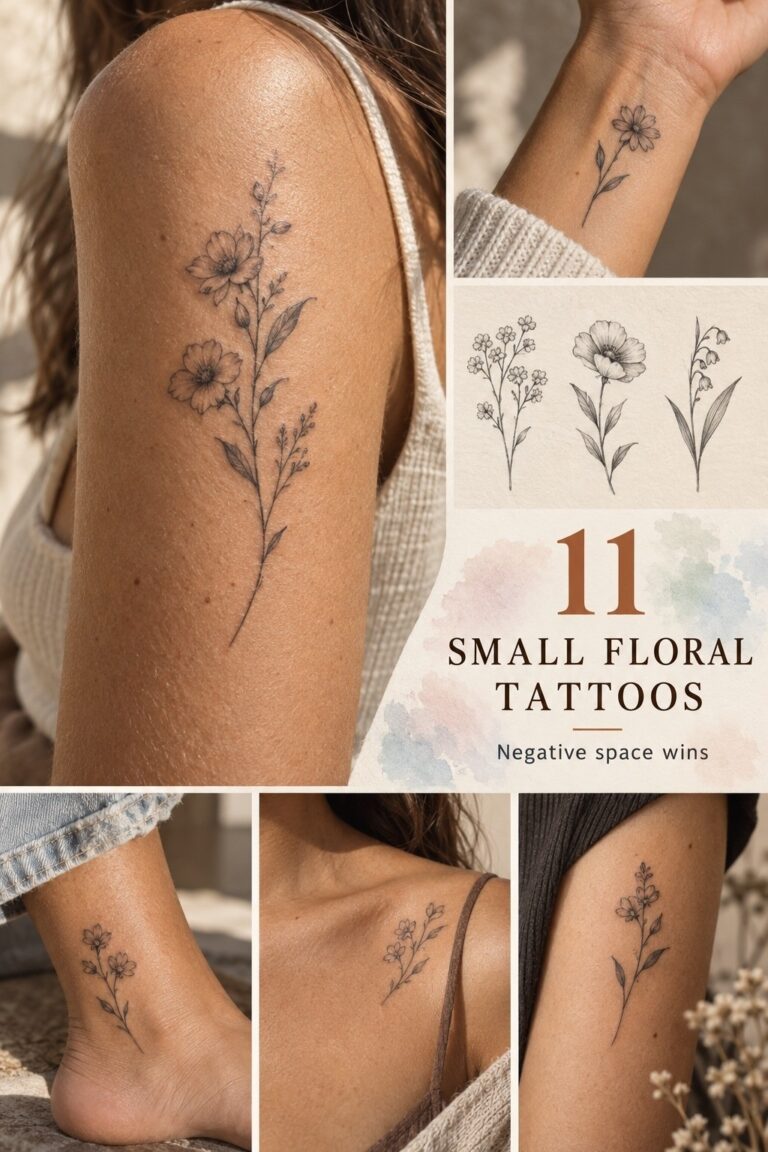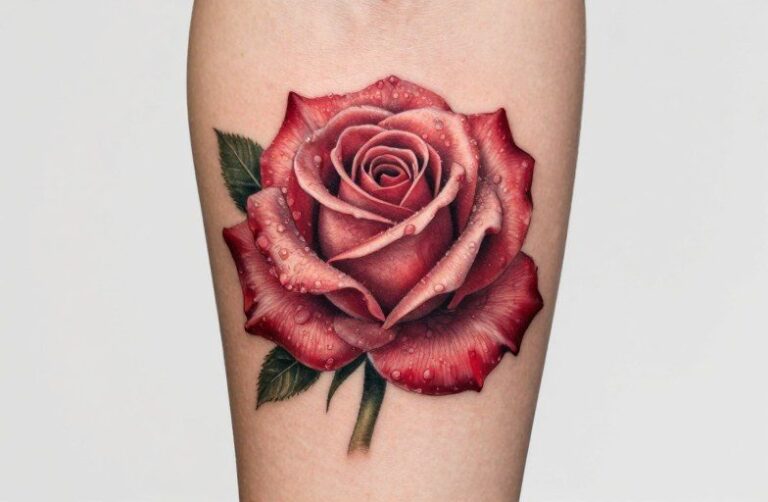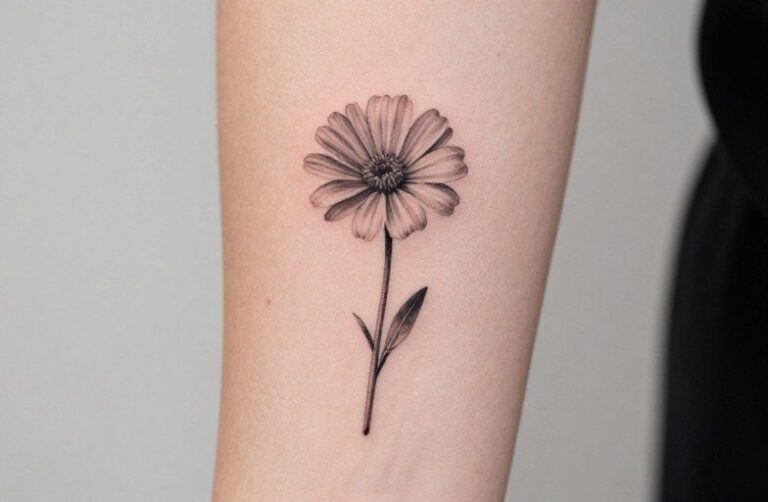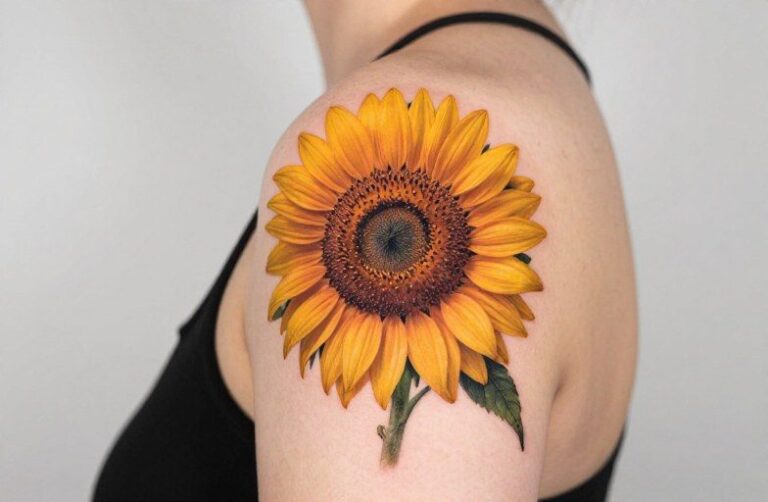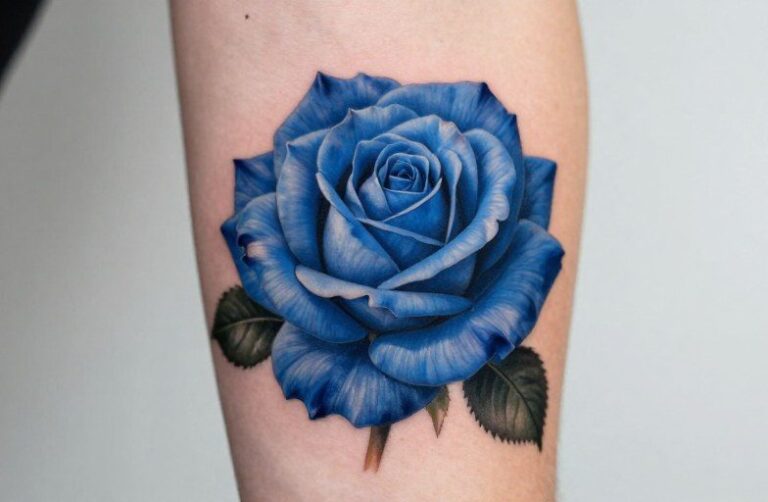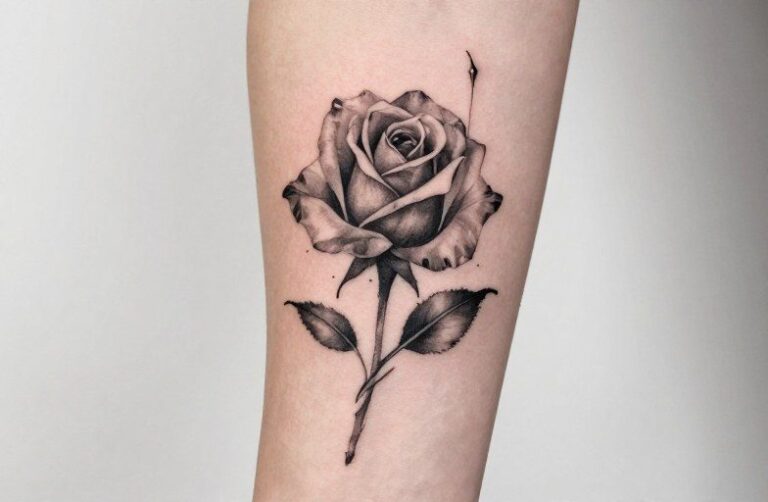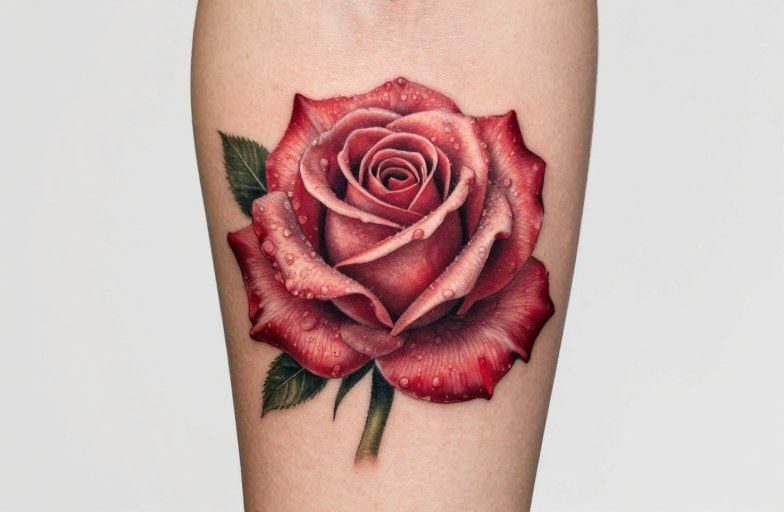
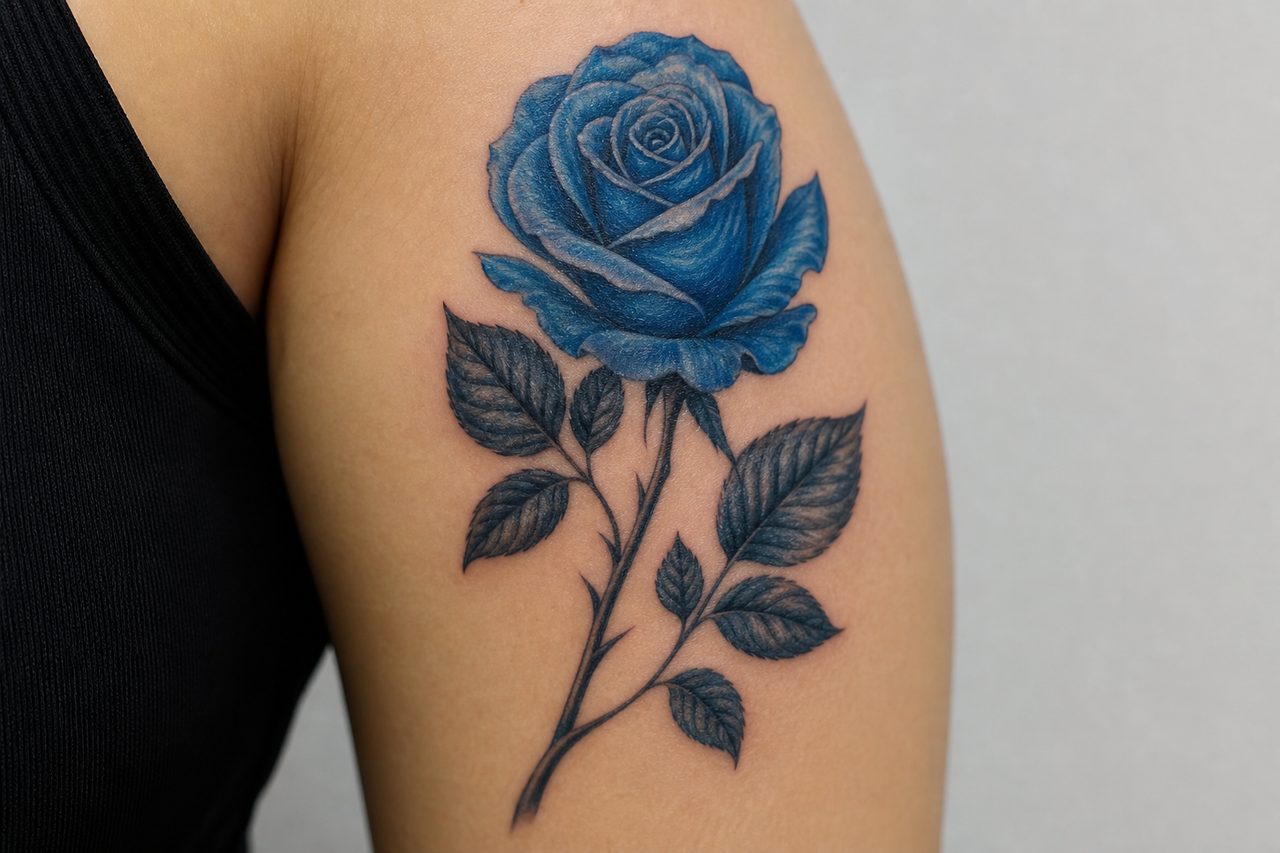
A blue rose tattoo most commonly represents the unattainable, the mysterious, or a longing for something that does not exist in nature. Unlike red roses rooted in straightforward romance, the blue rose carries an edge of melancholy, fantasy, or quiet rebellion against natural limits. The meaning shifts noticeably depending on whether the design leans photorealistic, traditional, or abstract.
How It Ages on Skin
Blue pigment behaves differently than black or red, and this matters enormously for a design built around a single color statement.
Which Blues Last
Cobalt and royal blue inks generally hold their saturation longer than lighter sky or pastel blues. Navy tones tend to gray out toward charcoal rather than staying distinctly blue. For a rose that still reads as “blue” after five years, artists typically reach for concentrated, darker pigments rather than diluted washes.
Line weight matters here. A blue rose built with bold outlines traps the color and slows the bleed that turns detailed petals into blue mush. All-color, no-line watercolor styles in blue age poorly on most skin tones; the pigment diffuses and the flower loses its rose structure entirely. If you want that soft, petal-without-boundaries look, expect touchups every few years to maintain any recognizable form.
Skin Tone Considerations
- On lighter skin, true blue stays visible longer but can take on a bruised or greenish cast as it fades
- On medium to deeper skin tones, lighter blues may disappear entirely or read as ashy gray; saturated indigo and violet-leaning blues tend to remain more legible
- White highlights placed for dimension often yellow or disappear completely, flattening the design
UV exposure degrades blue ink faster than black. A blue rose on a frequently sun-exposed forearm will look noticeably different from one on a ribcage or upper thigh after the same number of years.
Similar & Related Symbols
The blue rose sits in a broader family of floral tattoos that carry overlapping but distinct emotional registers.
Black roses share the blue rose’s association with death, endings, or the impossible, but without the fantasy element. A black rose reads as gothic or memorial; the blue rose reads as wistful or speculative. Purple roses, sometimes confused with blue, lean toward enchantment and royalty rather than longing.
Butterflies paired with blue roses amplify the transformation aspect, though this pairing risks cliché without specific personal context. Clocks or hourglasses with blue roses emphasize the unattainable nature of time, moments that cannot be recovered. Single blue roses versus bouquets change the scale of the symbolism: one suggests a specific, private fixation; multiple roses can suggest a pattern of impossible desires or a collective mystery.
Skull-and-blue-rose combinations invert the romantic tradition, though this pairing has become common enough that its impact depends heavily on execution quality.
Religious & Spiritual Angles
The blue rose carries limited direct religious iconography, which makes its spiritual interpretations more personal and less doctrinal.
Marian and Mystical Associations
In some Catholic folk traditions, blue flowers generally associate with the Virgin Mary, though the rose specifically is more commonly red or white in established iconography. A blue rose tattoo might be adopted by someone drawing on this connection without claiming strict liturgical accuracy. The color blue in Marian contexts traditionally signifies heaven, truth, and purity, meanings that can overlay the rose’s unattainable quality with a sense of sacred longing.
Some contemporary spiritual practitioners use the blue rose as a meditation focus or symbol for the “third eye” and intuitive knowledge, though this is a modern syncretic practice rather than an ancient tradition. The flower’s non-existence in nature supports its use as a symbol for truths that must be perceived inwardly rather than empirically.
Mythology & Folklore
Unlike the red rose’s well-documented Greek and Roman mythological roots, the blue rose lacks deep ancient lineage. Its symbolic life is largely modern, which does not diminish its power but changes how you might understand it.
The Turkish Tale and Later Variations
One often-cited origin traces the blue rose to a Turkish legend about a quest for an impossible flower to win a beloved’s hand. Variations of this narrative circulate in multiple cultures, typically involving a prince or seeker who fails despite extraordinary effort. The tale’s persistence suggests the blue rose’s symbolic core, striving toward what cannot be possessed, resonates across cultural boundaries.
Some trace the blue rose’s modern popularity to the 1950s when a white rose dyed blue was presented as a genuine botanical achievement, briefly capturing public imagination before the deception was revealed. This incident of manufactured impossibility arguably reinforced the flower’s association with illusion and unattainability.
In Japanese media and tattoo culture, the blue rose often appears in anime and manga contexts, sometimes carrying connotations of artificiality, genetic modification, or love that defies natural order. These associations have traveled into Western tattoo selection through cultural exchange rather than traditional Japanese tattooing (irezumi) itself.
Best Placements
The blue rose’s symbolic weight and color behavior suggest specific placement strategies.
Ribcage and sternum placements allow for vertical compositions that follow the body’s natural lines, with the rose’s stem drawing the eye. These areas see less sun, preserving blue pigment, though sternum tattooing involves significant pain and potential blowout on the thin skin over bone.
Upper arms and thighs provide enough flat surface for detail work without the extreme fading of constantly exposed areas. A blue rose on the outer upper arm can be easily shown or concealed, suiting the symbol’s private, introspective quality.
Hand and neck placements are technically possible but generally inadvisable for blue roses specifically. The small scale required loses petal detail, and these high-wear areas accelerate fading. Finger blue roses in particular tend to blur into unrecognizable blue smudges within a few years.
Back pieces allow for blue roses in larger compositions, gardens, memorial landscapes, or symbolic scenes, where the flower’s impossibility contrasts with more naturalistic elements.
Who Chooses This Tattoo
Certain life circumstances and temperaments align with the blue rose’s particular emotional register.
Common Motivations
People who have experienced profound unrequited love or longing, whether romantic, familial, or aspirational, often gravitate toward this symbol. The blue rose acknowledges the feeling without requiring resolution or happy ending. It suits those who find meaning in the striving itself rather than achievement.
Science fiction and fantasy enthusiasts sometimes select blue roses for their connection to impossible worlds, particularly those influenced by Alice in Wonderland (the “Painting the Roses Red” sequence) or the Twin Peaks television series, where a blue rose signifies unnatural or inexplicable phenomena.
Individuals with transgender or nonbinary identities occasionally adopt the blue rose as a symbol for self-creation and identity that transcends “natural” categories, though this is a contemporary community-specific usage rather than universal.
What the Choice Reveals About Design Preferences
Blue rose collectors often favor illustrative or neo-traditional styles over strict photorealism, perhaps because the flower’s non-existence frees the artist from botanical accuracy. They frequently request complementary elements, moons, stars, keys, locked doors, that reinforce the theme of access denied or mystery maintained.
What to Remember
The blue rose tattoo works best when its meaning is specific rather than generic. “The unattainable” is a starting point, not a destination, what specifically do you long for? What mystery do you live inside? The design gains power with precision.
Prioritize technical execution for longevity. Blue fades, blue blurs, blue turns strange colors. Invest in an artist who understands pigment behavior on your particular skin, not just someone who can render a beautiful reference photo. Ask to see healed blue work from their portfolio, not just fresh tattoos.
Consider whether you want the blue rose to stand alone or speak within a larger composition. Solitary blue roses carry more existential weight; contextualized ones become part of a narrative you may need to explain repeatedly. Both are valid, but they create different relationships with viewers.
Finally, the blue rose’s modern symbolic lineage means you are not connecting to ancient tradition but participating in a living, evolving conversation. That is neither deficit nor advantage, just context worth understanding before the needle touches skin.
Frequently Asked Questions
Does a blue rose tattoo always mean something sad?
Not necessarily sad, but it typically carries a note of longing or unfulfillment. Some people choose it to celebrate the beauty of striving rather than the ache of failure. The emotional tone depends on what you specifically connect it to.
Can you actually get a blue rose tattoo in naturalistic colors?
Tattoo ink cannot replicate the exact optical effect of a real blue rose because none exists in nature. Artists approximate using cobalt, indigo, or violet pigments. The result is always interpretive rather than documentary.
How much does a blue rose tattoo typically cost?
Pricing depends on size, detail, artist reputation, and geographic location. A small simple design might start around $150-300, while detailed multi-hour work runs considerably higher. Complex blue shading requires more technical time than solid blackwork.
What styles work best for blue rose tattoos?
Neo-traditional and illustrative styles generally age better than fine-line or watercolor approaches for this subject. Bold outlines preserve the rose structure, and concentrated pigment maintains the blue identity over years.