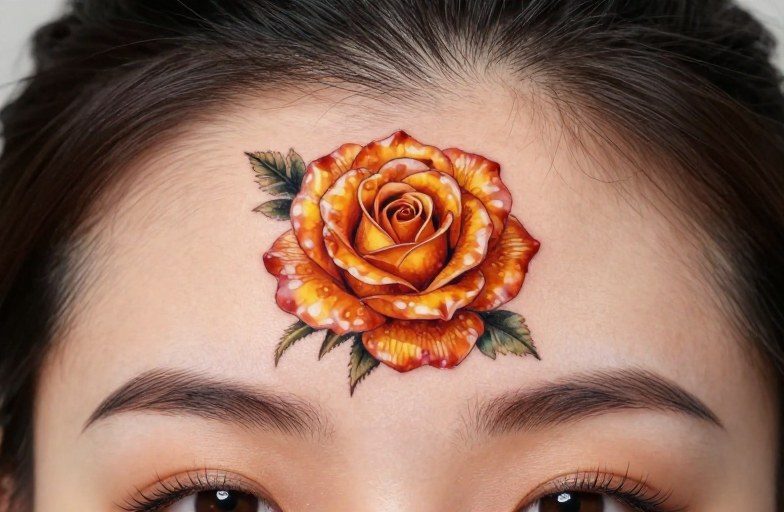
The amber rose forehead tattoo says “Bash Slash”, the names of her two sons, Sebastian and Slash. This placement choice transformed a personal tribute into a public statement about motherhood, identity, and the refusal to conform to conventional beauty standards. The lettering sits high and centered, impossible to hide, making it one of the most discussed celebrity face tattoos in recent years.
Who Chooses This Tattoo
Forehead lettering isn’t for the tentative. The people who commit to this placement share a specific psychological profile: high tolerance for social friction, strong attachment to the words being inked, and a fundamental indifference to traditional employment norms. Amber Rose’s choice made headlines precisely because it violated the unspoken rule that face tattoos belong to men in specific subcultures, not to mothers, not to mainstream celebrities, not to women who’d previously built careers partly on conventional glamour.
Gender and Face Tattoo Stigma
Women with face tattoos still encounter sharper judgment than men. The same placement that reads “rebellious artist” on a male musician becomes “bad mother” or “unstable” on a woman. Rose’s tattoo forced that double standard into open conversation. The placement also shifted how people interpreted her existing aesthetic, the shaved head, the bold fashion choices, reframing them from performance to consistency.
Career Implications in Different Fields
Anyone considering forehead lettering needs to understand sector-specific realities:
- Entertainment and creative industries: increasingly neutral, sometimes even advantageous for brand differentiation
- Service industries: often still disqualifying, regardless of quality of the work
- Corporate environments: remains broadly prohibitive even with shifting norms
- Self-employment: removes the employer variable but not client prejudice
Rose’s existing financial independence made this a viable choice that would be genuinely reckless for someone without established resources.
Color vs Black and Grey
Rose’s tattoo uses solid black lettering, which was the right technical call for this specific placement. Black ink on forehead skin, thick, sebaceous, constantly mobile from eyebrow and forehead movement, ages more predictably than color. The forehead’s high sun exposure also degrades color pigments faster, causing blues to grey and reds to muddy within a few years.
Healing Challenges on the Forehead
This area heals poorly compared to most tattoo locations. The skin moves constantly with facial expressions, disrupting the settling ink. Sleeping position matters enormously, face-down pressure can push pigment out during the critical first week. Artists working this placement typically recommend:
- Shorter sessions to minimize swelling that distorts letterforms
- Bolder line weights than you’d use elsewhere, fine lines blur within 2-3 years
- Minimal aftercare product to avoid clogged pores in the T-zone
Color Options and Their Risks
Some people request the amber rose concept in actual amber tones, yellows, oranges, honey browns. These warm pigments are particularly vulnerable to UV degradation. A color forehead piece requires either lifelong religious sunscreen application or acceptance of significant fading. Black and grey remains the practical default for anyone who wants the message readable at age fifty.
Common Variations & Styles
The “amber rose forehead tattoo” as a search term has spawned several distinct stylistic branches. Some people mean the literal celebrity reference; others use it as shorthand for any bold forehead lettering, particularly maternal or name-based designs.
Lettering Styles That Work Here
Not all fonts survive forehead placement. The best choices share structural qualities:
- Moderate weight, too thin disappears, too bold looks like a stamp
- Minimal interior detail, complex serifs or textures blur together
- Horizontal emphasis, vertical lettering fights the natural lines of the brow ridge
- Generous letter spacing, crowded text becomes illegible as ink spreads slightly
Rose’s “Bash Slash” uses a clean, slightly stylized sans-serif with adequate spacing. It’s readable at conversation distance, which is the minimum standard for any text tattoo.
Adjacent Placements
Not everyone commits to full forehead. The temple area, just above the eyebrow, offers similar visibility with slightly less social shock. Hairline tattoos, placed to peek through or above hair, provide concealment options that pure forehead placement denies. Some people choose the center of the forehead but smaller, subtler, though this often reads as tentative rather than refined.
Mythology & Folklore
Roses carry layered symbolic weight across cultures, though the “amber” specifically, fossilized tree resin, not the flower, adds different resonances. Amber has been used in jewelry and amulets for millennia, often linked to protection and preservation. The Greeks called amber “elektron,” noting its static properties, and it appears in mourning jewelry from the Victorian era through contemporary Baltic traditions.
The Rose as Symbolic Counterpart
The flower rose, separate from the resin, carries its own dense symbolism: love, secrecy (sub rosa), mortality through its thorns, cyclical rebirth through its blooming pattern. Combining rose imagery with forehead placement isn’t common in historical tattooing, the face was generally reserved for specific cultural markings rather than decorative botanicals. Modern Western tattooing has collapsed these distinctions, though the forehead remains relatively protected territory.
Forehead Marking in Historical Context
Forehead marking appears across cultures with specific ritual functions, Hindu tilak, Buddhist urna representations, some Indigenous ceremonial paint. These carry religious authority that contemporary cosmetic or expressive tattooing doesn’t claim. The modern forehead tattoo operates in a different register: individual assertion rather than communal participation. This distinction matters for understanding why the placement reads as aggressive or transgressive to many viewers.
Symbolism & Core Meaning
At its center, this tattoo is about visibility as commitment. Naming children on your body is common; placing those names where they cannot be hidden, where they precede you into every room, makes a different claim. It says the relationship being marked matters more than social comfort, more than professional flexibility, more than the option to present differently in different contexts.
Permanence as Philosophy
There’s a coherent worldview behind choosing the most exposed placement for the most permanent marking. It rejects the contemporary premium on optionality, on keeping possibilities open, on strategic flexibility. The forehead tattoo says: this is fixed, this is prior, this will not be optimized away. Whether that reads as admirable integrity or concerning rigidity depends on the observer’s own relationship to change.
Motherhood Specifically
Public discourse around Rose’s tattoo revealed persistent assumptions about maternal presentation. The expectation that mothers should be modest, should redirect attention to children rather than self, should avoid choices that might “embarrass” offspring later, all surfaced in criticism. The tattoo functions as a refusal of that framework, claiming maternal identity as part of public selfhood rather than private sacrifice.
Religious & Spiritual Angles
No major religious tradition explicitly endorses forehead tattoos as spiritual practice, though several involve forehead marking. The Christian Ash Wednesday cross, the Hindu tilak, the Buddhist third-eye symbolism, all suggest the forehead as a spiritually significant zone. Contemporary tattooing borrows this charged location without necessarily claiming its traditional authority.
Secular Spirituality
For people without formal religious practice, intensely personal tattoos often absorb spiritual functions: marking transformation, commemorating loss, binding commitment. The forehead placement amplifies this, it’s the location of “the mind’s eye,” of consciousness, of identity in several philosophical traditions. A tattoo here can function as secular prayer, as materialized intention, without requiring theological framework.
Concerns in Specific Traditions
Some religious communities actively discourage tattooing, Orthodox Judaism, certain Islamic interpretations, some Christian denominations. Forehead placement intensifies the conflict where it exists, being harder to conceal than arm or back pieces. People from these backgrounds considering forehead work need to understand the specific social and familial consequences, not just generic “tattoo stigma.”
What to Remember
The amber rose forehead tattoo says “Bash Slash”, names, not abstract philosophy. Its meaning is specific and personal, though it resonates outward into broader conversations about gender, motherhood, and visibility. Anyone drawn to this reference should distinguish: do you want the specific content (children’s names, personal dedication), the specific placement (forehead, unhideable), or the general attitude (bold, unconcerned with convention)? These are separable choices. The placement commits you to explaining, defending, or ignoring commentary for decades. The content commits you to living with those specific words. Both commitments outlast the initial impulse, the social media cycle, the current phase of life. Good tattoo decisions account for that duration. This one, whatever else it means, clearly did.
Frequently Asked Questions
Does the tattoo actually say ‘Bash Slash’ or is there a hidden meaning?
It literally says ‘Bash Slash’, the nicknames of her sons Sebastian and Slash. There’s no hidden code or deeper phrase underneath the obvious maternal tribute.
How painful is a forehead tattoo compared to other placements?
The forehead rates moderately high on pain scales due to thin skin over bone and numerous nerve endings, though the small size of most lettering pieces limits total session duration.
Can forehead tattoos be removed if you change your mind?
Laser removal on the forehead is possible but challenging, the area’s high vascularity and proximity to eyes require specialized protocols, and complete removal typically needs more sessions than arm or leg placements.
Do forehead tattoos age worse than tattoos on other body parts?
Yes, generally, constant sun exposure, frequent facial movement, and the skin’s natural oiliness in the T-zone all contribute to faster fading and blurring compared to protected areas like the upper arm or back.