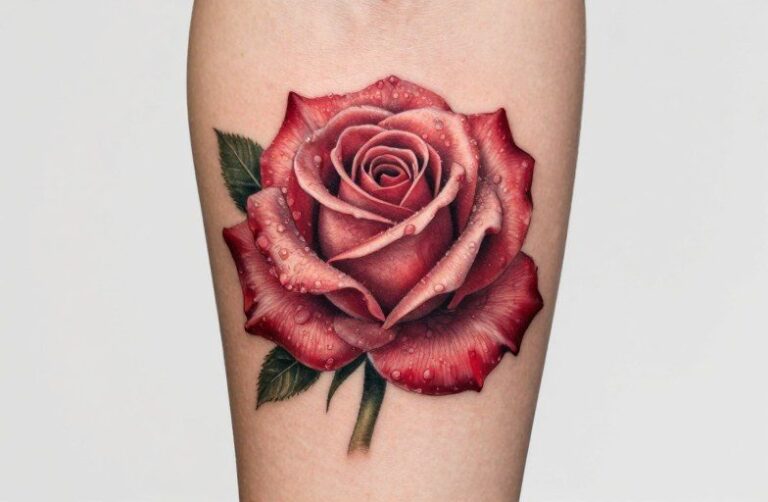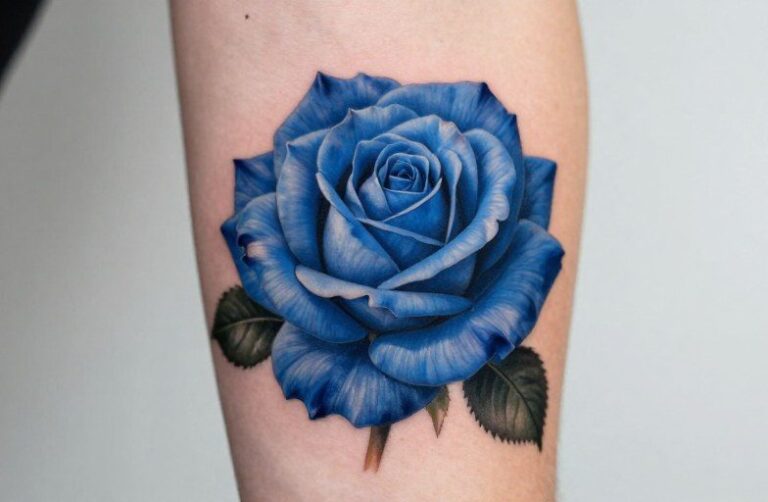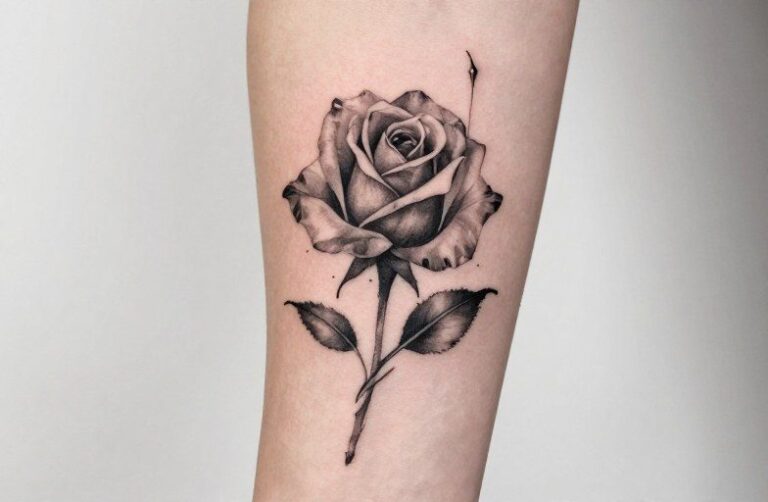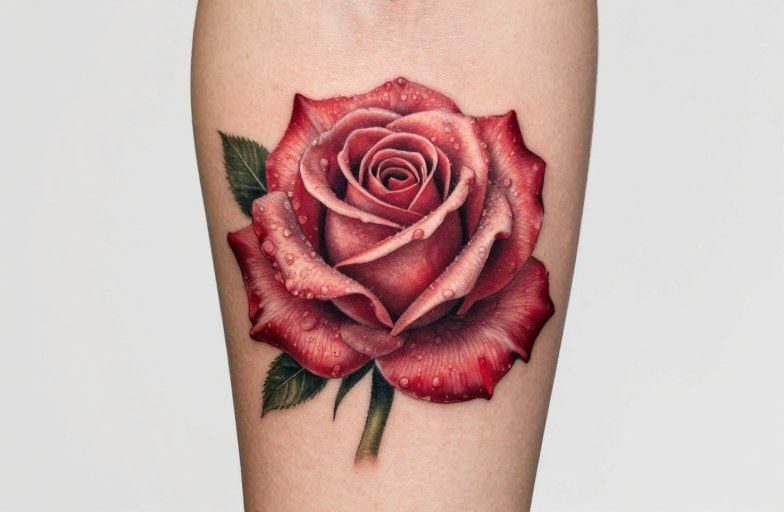
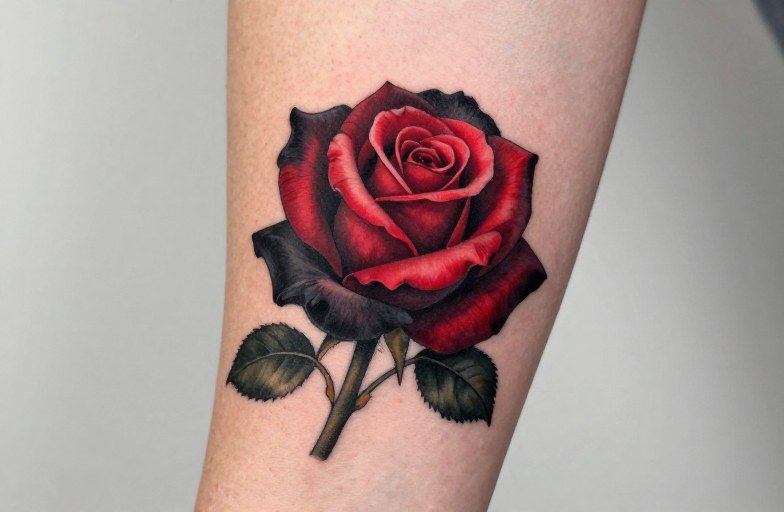
A black and red rose tattoo carries a layered duality that draws people in immediately. The red speaks to passion, romantic love, blood, vitality, while the black introduces mourning, mystery, rebellion, or the shadow side of those same emotions. Together, they create a tension that feels lived-in rather than purely decorative: beauty with an edge, desire with awareness of its cost.
Who Chooses This Tattoo
People Marking Contradictory Truths
This design lands hardest with folks who don’t want their tattoo to read as one-note. Someone might get it after a relationship that contained both deep love and real damage. Others choose it to acknowledge that growth often comes through pain, that the same experience can wound and transform. The visual clash between red and black mirrors internal complexity without requiring text or additional imagery to explain it.
You’ll see this on people who’ve moved past the phase of wanting tattoos that only celebrate. The black red rose accommodates ambivalence. It works for memorial purposes too, where red honors the living connection and black marks the absence. Unlike an all-black rose, which can read as purely gothic, or an all-red rose, which can feel conventional, the split or blended color scheme keeps viewers guessing.
Subcultural Affiliations
The design has solid footing in punk, metal, and goth aesthetics, though it’s crossed into mainstream popularity over the past decade. Traditional tattoo collectors sometimes pair it with dagger-through-heart motifs or banner scrolls. Fine-line enthusiasts might render it with delicate linework and strategic black negative space. The adaptability across styles means the “who” spans surprisingly different demographics, what unites them is comfort with emotional contradiction.
Religious & Spiritual Angles
Christian Symbolism
In Catholic tradition, the red rose connects to the Virgin Mary’s love and the blood of Christ, while black roses appear in martyrdom imagery and certain monastic orders. Combined, they can represent the coexistence of divine love and human suffering, the Passion itself. Some wearers with Catholic backgrounds use this pairing specifically to acknowledge that faith encompasses both joy and sorrow, not as denial but as integration.
Protestant and evangelical contexts rarely embrace rose symbolism to the same degree, so this tends to resonate more with Catholic, Orthodox, or lapsed-Catholic wearers. The black red rose can function as a quiet devotional piece that avoids the obviousness of a cross or praying hands.
Esoteric and Occult Readings
Rose cross symbolism in Rosicrucian traditions uses the flower to represent unfolding spiritual consciousness. Adding black shifts this toward the “dark night of the soul” concept, necessary spiritual desolation before renewal. In tarot-influenced tattooing, the red rose might correspond to the suit of cups (emotion) while black suggests the swords suit (intellect, conflict) or the death/major arcana transformation. These aren’t universal interpretations but recurring threads that some wearers intentionally invoke.
Best Placements
Forearm placement dominates for visibility and the natural verticality of a rose stem. Outer forearm gives the design public presence; inner forearm makes it more intimate, something the wearer sees rather than advertises. The black red color scheme reads clearly at this scale, which matters because the contrast between the two colors is the whole point.
- Thigh or calf: Larger canvas allows for full bloom with leaves, thorns, and color gradient work. The black can bleed into background shading while red pops forward.
- Over the heart (chest, left side): Literal placement for love-and-loss themes. The pectoral muscle provides relatively flat, stable skin for aging.
- Upper arm/shoulder cap: Classic tattoo placement that frames the design with natural body curves. Works well with traditional bold lines.
- Hand or neck: High-commitment spots where the stark color contrast gets maximum attention. Not recommended for first tattoos; the black will spread faster in thin hand skin.
Smaller designs, under two inches, risk the red and black muddying together as ink settles. If you want something compact, consider separating the colors into distinct petals rather than blending them.
How It Ages on Skin
Red Ink Behavior
Red is among the less stable tattoo pigments, particularly brighter, more orange-reds. True deep reds (naphthol, quinacridone-based) tend to hold better than cadmium-derived bright reds. Over five to fifteen years, red often desaturates toward a dusty pink or muted coral. In the black red rose, this isn’t necessarily catastrophic, the fading can actually enhance the vintage, melancholic quality if the black remains solid.
Some red inks have historically caused more allergic reactions than other colors, though modern formulations have improved. The black surrounding or interwoven with red can create visual continuity even if the red shifts tone.
Black Ink Stability and Contrast
Black outlasts virtually every color, which creates a predictable aging dynamic: the black stays crisp while the red softens. A well-designed black red rose anticipates this. Artists often use black for structural elements, outline, thorns, stem, shadowed petal undersides, while placing red on the highlight areas. As the red fades, the design maintains its readable form through the black skeleton.
Line weight matters significantly. Thin black lines in a fine-line approach can blur over time; bolder traditional outlines preserve definition. For longevity, ask your artist about their black-to-red ratio and how they’ve seen similar pieces age in their portfolio.
Similar & Related Symbols
The black red rose sits within a family of floral tattoos that use color to modify meaning. Understanding the alternatives helps clarify why someone might choose this specific combination.
- Black rose alone: Death, farewell, anarchist symbolism, or the end of something. More absolute; less room for the warmth that red provides.
- Red rose alone: Romantic love, beauty, passion. Can feel generic without modification; the black distinguishes it from countless other red rose tattoos.
- White and red rose: Tudor rose imagery, unity, purity combined with passion. Historically specific; less personally ambiguous.
- Blue rose: The unattainable, fantasy, transgressive desire. No natural blue roses exist, so the color signals artifice or impossibility.
- Skull and rose pairings: Memento mori traditions. The black red rose achieves some of this same life-death tension without the skull’s more aggressive visual impact.
Dagger-through-rose designs sometimes incorporate both colors, with the blade’s handle or blood drops adding black to a red flower. The black red rose condenses that narrative into a single element.
Mythology & Folklore
Greek and Roman Threads
The rose’s association with Aphrodite/Venus established its link to love and beauty, but the flower also carried funeral connections in Roman culture. Roses were strewn at graves and used in death rites; their fragrance was thought to comfort the dead. This dual sacred-profane role predates the black red color split but establishes the conceptual foundation. The color pairing amplifies what was already present in the flower’s mythic DNA.
Adonis, beloved of Aphrodite, was often linked to anemones and roses in death-and-rebirth cycles. Some trace the red rose’s color to Aphrodite’s blood when she rushed to the dying Adonis, though this origin story is often linked to rather than definitively established.
Medieval and Renaissance Developments
The War of the Roses in England (1455-1487) used red and white roses as faction symbols, but the black rose occasionally appeared in alchemical and heretical contexts, secret knowledge, forbidden transformation. Rosicrucian emblems from the 17th century combined roses with crosses in esoteric configurations. The black red pairing in modern tattooing draws on this accumulated symbolic weight without necessarily referencing any single source directly.
By the Victorian era, floriography (the language of flowers) assigned roses precise meanings by color. Black roses weren’t naturally available, so they entered the lexicon through dyed flowers or dark purple varieties read as black. The Victorian system was always somewhat artificial, meanings were codified by popular guides rather than organic tradition, but it shaped how subsequent generations received floral symbolism.
Final Thoughts
The black red rose tattoo works because it refuses to resolve its own tension. It doesn’t settle into pure mourning or pure celebration, and that instability is precisely what makes it feel honest. For placement, prioritize scale and contrast; for longevity, trust the black structure and accept that the red will soften. The design rewards artists who understand how color behaves in skin over decades, and wearers who choose it usually know why they need both colors present, not as compromise, but as truth.
Frequently Asked Questions
Does the black have to be solid black, or can it be dark gray shading?
Dark gray shading works and can look more dimensional, but solid black gives stronger contrast against red and ages more predictably. If you want the two-color read to stay obvious long-term, ask for saturated black in key areas rather than relying entirely on graywash.
Can a black red rose work in a small tattoo, or does it need to be large?
It needs more space than a single-color rose because the colors must remain distinct. Under two inches, they tend to blur together during healing. Three inches or larger gives the red and black room to breathe as separate elements.
Is this design more common for men or women?
It crosses gender lines more than many floral designs. The black element draws people who might avoid an all-red rose as too feminine-coded, while the flower form itself appeals across identities. Style execution matters more than gender in who chooses it.
What if I want the red to stay bright for as long as possible?
Avoid sun exposure on the tattoo, moisturize properly during healing, and consider touch-ups every few years. Deep crimson reds generally outlast orange-reds. Your artist can recommend specific pigment brands with stronger longevity records in their experience.