An abstract rose tattoo distills the flower into gesture rather than botanical accuracy. Where traditional rose tattoos show petals and thorns in literal detail, the abstract version trades realism for emotion, suggesting beauty through broken lines, color fields, or geometric fragmentation. Most people who choose this design aren’t after a picture of a flower; they’re marking something the rose has come to represent for them personally.
Personal & Modern Meanings
The abstract rose carries the rose’s historic weight, love, grief, beauty with thorns, without locking the wearer into any single narrative. For how that weight plays out in a specific design, rose tattoo meaning and symbolism offers a grounded comparison. The abstraction itself becomes part of the meaning: incompleteness, transformation, something still becoming.
What the Style Signals
A watercolor wash rose with no hard edges suggests something fleeting, a memory dissolving. Sharp geometric fragmentation reads as deconstruction, analysis, maybe rebuilding after breakage. Heavy black brushstrokes with negative space petal shapes feel assertive, almost aggressive in their refusal to be pretty in the traditional sense. The style choice communicates as much as the flower itself.
- Single-line continuous drawings: connection, simplicity, the idea that beauty needs no elaboration
- Split or shattered compositions: duality, before-and-after states, compartmentalized emotion
- Color bleeding outside implied boundaries: intensity that won’t be contained
- Negative space dominant: absence as presence, what’s missing made visible
Why Now
Abstract rose tattoos have gained traction as people move away from flash-sheet symbolism toward custom work that resists instant interpretation. There’s privacy in abstraction. A realistic rose on the forearm announces itself; an abstract version might read as decorative until the wearer chooses to explain. That control appeals to people marking private grief, quiet devotion, or personal turning points they don’t owe strangers.
How It Ages on Skin
Abstract roses age differently depending on their construction, and this matters for a design that often relies on subtlety.
The Line Work Problem
Single-line and fine-line abstract roses look stunning fresh. Over five to ten years, lines spread slightly, ink migrates under skin as collagen breaks down. A line weight of one needle pass can blur from crisp to fuzzy. Designs built with slightly heavier line variation, or those that incorporate small areas of soft shading for depth, hold their structure longer. The negative space petal trick works only if the surrounding black stays dense; faded grey-black turns to mud, erasing the illusion.
Watercolor and Color Field Aging
Abstract roses using unlined color washes, watercolor style without black anchors, age fastest. Blues and purples shift cool and dull; reds and pinks tend to hold better but still soften. Without black line to define the shape, the rose can become a colored blob as edges feather. The best aging abstract color roses use strategic black or dark grey “spine” elements, stem fragments, center details, hard edges at key points, to maintain recognizable structure even as color diffuses.
Color vs Black and Grey
The color choice rewrites the tattoo’s emotional register entirely.
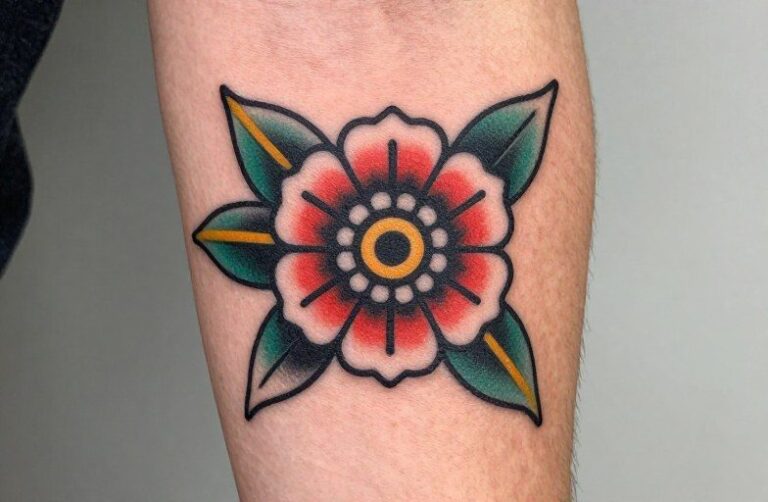
Black and grey abstract roses read as somber, architectural, timeless. They suit designs emphasizing form over feeling, geometric deconstructions, heavy shadow pieces, negative space work. For how this approach looks in bolder traditional execution, black American traditional flower tattoos show the contrast clearly. The limited palette forces attention to line quality and composition. Healing tends to be predictable; there’s less risk of uneven saturation than with multiple colors.
Color abstract roses, especially those using non-traditional palettes, electric blue, acid green, ultraviolet purple, reject the flower’s natural associations entirely. These become pure symbol, the rose shape a vessel for personal color language. A red-to-black gradient abstract rose keeps some traditional love/blood association while modernizing delivery. Multi-color pieces require more technical skill to age well; poorly saturated color heals patchy and requires more frequent touch-ups.
Best Placements
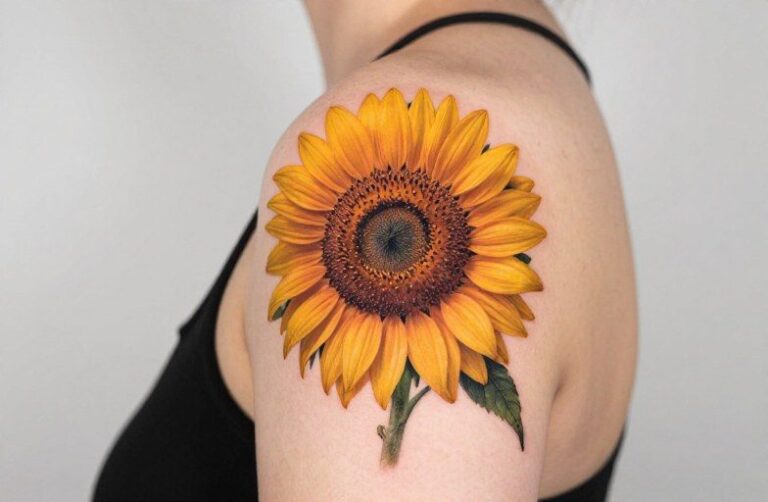
Abstract rose tattoos work across body locations, but the design’s openness or density should match the skin’s behavior in that spot. For placement-focused thinking on another flower, shoulder sunflower placement guide covers similar ground.
Flat, Stable Canvas
Outer upper arms, forearms, thighs, and calves offer relatively stable skin with minimal stretching over time. These suit detailed abstract work, fine line, geometric fragmentation, delicate negative space. The design stays legible as skin shifts moderately with age or weight change.
High-Movement Areas
Ribs, inner biceps, sternum, and knees move constantly. Abstract roses here should be bolder, with heavier line or more solid fill, to prevent the design from distorting into unrecognizability when skin flexes. A knee placement with a stem wrapping the joint can work beautifully if the design anticipates movement, flowing lines that bend naturally rather than rigid geometry that breaks.
Small abstract roses behind the ear or on the wrist function as personal talismans, visible but not demanding attention. Finger placements risk significant blur and blowout; abstract roses here need extremely simple, high-contrast construction to survive.
Who Chooses This Tattoo
There’s no single demographic, but patterns emerge in the consultation chair.
People with existing traditional tattoos sometimes add an abstract rose as contrast, something that reads as contemporary against older work. First-timers drawn to abstract roses often arrive with reference images from painters or graphic designers rather than from tattoo portfolios; they want art translated to skin, not tattoo conventions applied to a flower.
Those marking specific events, divorce, recovery, creative breakthroughs, frequently prefer abstract roses because the form bends to private meaning without requiring explanation. The tattoo becomes a marker that the wearer understands completely and others need not. This differs from memorial realism, which often invites conversation.
Common Variations & Styles
The abstract rose umbrella covers genuinely distinct approaches.
Geometric Deconstruction
Petals become triangles, hexagons, or irregular polygons. The rose is “readable” only when the eye completes the pattern. This style pairs well with black and grey, sometimes with a single accent color. It ages solidly due to the bold shapes. Artists with background in graphic design or architecture often execute these most convincingly.
Continuous Line and Minimalist
One unbroken line creates the entire rose, or the barest suggestion of it. These demand perfect execution, there’s nowhere to hide a shaky curve. They work small and medium, rarely large; the conceit loses elegance when scaled up. Healing must be meticulous; any scabbing that pulls ink compromises the single continuous path.
Abstract Expressionist / Brushstroke
Heavy, gestural black or color application suggesting the rose through movement rather than outline. These read as energetic, almost violent. They require confident artists; tentative brushstroke tattoos look accidental rather than intentional. Best placed where the body provides a natural “canvas” orientation, thighs, ribs, back panels.
Negative Space Botanical
Black or color-filled background with the rose shape left in skin tone. Striking when fresh, these depend absolutely on the surrounding fill staying solid. Patchy healing in the fill ruins the effect. Not recommended for darker skin tones where the contrast principle functions differently; skilled artists adapt by using lighter ink values rather than bare skin for the rose shape.
Final Thoughts
The abstract rose tattoo succeeds when it embraces what abstraction offers: specificity without literalness, personal meaning without public explanation. The worst examples try to have it both ways, realistic enough to be recognized, abstract enough to seem contemporary, ending up as neither. The best commit fully to their chosen language, whether that’s a single whispered line or a shattered geometric explosion.
Choose an artist whose abstract work shows consistent voice, not just technical competence. This style reveals hesitation instantly. Bring references that communicate feeling, music, paintings, textures, not just other tattoos. And accept that the abstraction you choose will mean something slightly different to every viewer, which is precisely the point.
Frequently Asked Questions
Do abstract rose tattoos hurt more than realistic ones?
Pain depends on placement and your personal sensitivity, not style. However, abstract work with heavy solid fill or dense black requires more needle passes over the same area, which can intensify sensation compared to lighter realistic shading.
Can an abstract rose tattoo be covered up later?
Abstract designs with heavy black or dense color are harder to cover than realistic work with varied tones. If you anticipate wanting change, opt for lighter linework with skin breaks rather than solid fill.
How do I find an artist who specializes in this style?
Search portfolios for actual abstract botanical work, not just roses rendered realistically with slight stylization. Look for consistent line confidence in minimalist pieces or coherent geometric logic in fragmented designs.
Will an abstract rose look dated in ten years?
Abstract styles age better than hyper-trendy micro-realism because they rely on fundamental design principles rather than technical novelty. Choose bold composition over delicate detail for longevity.