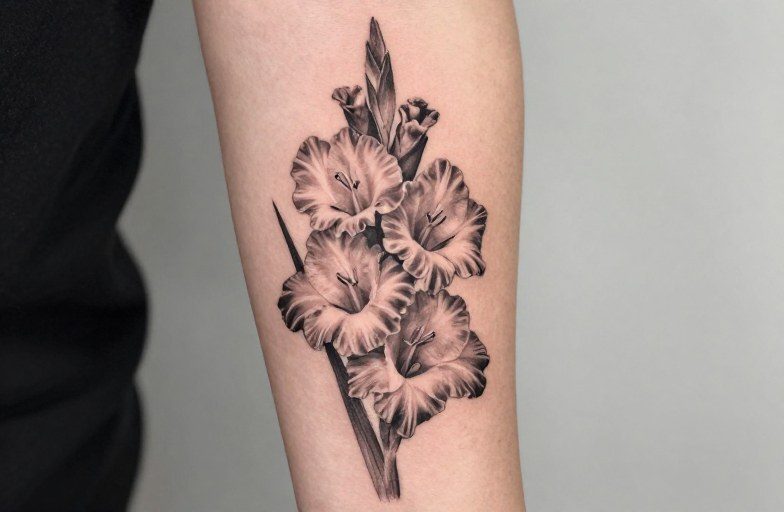
The gladiolus carries a core meaning of strength and moral integrity, drawn from its Latin root gladius, sword. That blade-like shape runs through the leaves and the flower’s upright posture, making it a tattoo choice for people who’ve fought through something, not with aggression but with endurance. It’s also the August birth flower, which adds a secondary layer of personal significance for summer birthdays or commemorating someone born in that month.
Religious and Spiritual Angles
In Christian iconography, the gladiolus sometimes appears in depictions of the Virgin Mary or martyred saints, its sword-like form referencing the “sword of sorrow” piercing Mary’s heart. This association gives the flower a quiet resonance with faith-based perseverance, suffering borne with grace rather than complaint.
Funeral and Remembrance Symbolism
Many churches and funeral homes use gladiolus arrangements for their height and solemn vertical lines. A tattoo here can channel that same sense of dignified grief, particularly when rendered in muted color or black and grey. The flower’s natural habit of blooming from the bottom up, older flowers dying as new ones open above, mirrors the spiritual idea of transcendence, of something continuing upward.
Strength Through Faith
Some wearers pair the gladiolus with crosses, praying hands, or scripture references. The flower’s structural rigidity works well alongside the straight lines of religious imagery. Line-heavy designs here age cleaner than heavy shading, which can blur the fine distinctions between petals after several years.
Design Tips and Pairings
Gladiolus stems create natural vertical movement, which tattoo artists can exploit for forearm, rib, or spine placements. The flower’s actual structure, multiple blooms opening along a single stalk, offers built-in composition: you can show the full stalk with buds, half-open flowers, and fully mature blooms, creating visual progression.
Color Versus Black and Grey
- Natural gladiolus colors range from white through pink, red, purple, yellow, and green. Each carries loose associations: red for passion or sacrifice, white for purity or remembrance, purple for dignity.
- Black and grey emphasizes the sword-like structure and reads more somber, more about struggle than celebration.
- Watercolor styles can look striking fresh but require touch-ups sooner; the gladiolus’s long, thin petals don’t hold diffuse color as well as denser flowers like roses or peonies.
Common Pairings
Butterflies landing on gladiolus blooms suggest transformation after hardship. Hourglasses or clocks paired with the flower narrow the meaning toward time, time running out, time endured, time remembered. Names and dates work naturally into the vertical stem space. Avoid overcrowding; the gladiolus’s elegance comes from its relative simplicity and height.
Best Placements
The gladiolus’s vertical form dictates most placement decisions. Horizontal placements fight the flower’s natural structure and usually look awkward unless you’re doing a deliberately sideways or wrapped composition.
Vertical Placements
- Forearm: classic, visible, the stem follows the bone line. Inner forearm offers more privacy; outer forearm shows more.
- Rib cage: follows the body’s natural verticality. Pain here is sharp and sustained; the gladiolus’s multiple sessions (lining, then shading or color) can make this placement mentally taxing.
- Spine: dramatic, centered, the stem literally runs the backbone. Often chosen for memorial pieces. Requires precise symmetry from your artist.
- Back of calf: less common but effective, especially for designs showing the full stalk with root bulb at ankle and bloom near knee.
Smaller Options
A single gladiolus bloom rather than full stalk works for wrists, behind ears, or collarbones. These lose some of the “sword” symbolism but keep the flower’s recognition and birth-month connection. Fine line single-needle work suits these smaller scales but fades faster on high-movement areas like wrists.
History and Cultural Roots
The gladiolus is often linked to ancient Rome through its name. Roman gladiators were supposedly associated with the flower, though historical documentation is thin. What we know for certain: the name derives from gladius, and European cultivation intensified in the 18th and 19th centuries. The flower’s presence in Victorian floriography, the language of flowers, is better documented, where it signified strength of character, infatuation, and “you pierce my heart.”
African Origins
Wild gladiolus species are native to South Africa and the Mediterranean. South African varieties include the poisonous Gladiolus dalenii, used in traditional medicine and ritual. This origin is sometimes referenced in tattoos for people with South African heritage, though the connection is more botanical than deeply cultural, unlike, say, the protea, which carries stronger national symbolism.
Modern Cultural Adoption
The gladiolus gained prominence in 20th-century funeral arrangements across Europe and North America, cementing its association with memorial. This practical usage has shaped tattoo meaning more than any ancient tradition. Someone choosing this flower today is likely drawing on contemporary funeral symbolism and personal birth-month connection rather than Roman gladiator lore.
Personal and Modern Meanings
Beyond the established symbolism, the gladiolus works as a flexible personal emblem. Its August association makes it a birthday marker, an anniversary of survival, or a parent’s flower for children born in that month. The “sword” aspect can read as fighting illness, addiction, abuse, or any prolonged struggle where the weapon wasn’t external force but internal endurance.
Commemorative Usage
Many people choose gladiolus tattoos for loved ones lost in August, or whose character embodied the flower’s upright, unyielding quality. The vertical format accommodates dates running down the stem, names worked into leaves, or birthstones integrated as color accents. Unlike roses or lilies, the gladiolus hasn’t become so common in memorial work that it feels generic.
Recovery and Resilience
Mental health recovery tattoos sometimes use the gladiolus for its implication of fighting without violence, standing straight, continuing to bloom. The flower’s actual growth habit supports this: it requires staking or support in gardens, suggesting that strength isn’t always self-sufficient, that external help doesn’t diminish the achievement of blooming.
Mythology and Folklore
Mythological connections to gladiolus are sparse compared to flowers like lotus or narcissus. Some trace it to Greek gladiolus species and associate it loosely with Demeter or Persephone myths of seasonal return, but this is speculative rather than established tradition. The flower lacks the dense mythic narrative that drives some tattoo choices.
Folk Beliefs
In European folk practice, gladiolus corms were sometimes carried as protective charms, the sword shape thought to ward off evil. This is minor folklore compared to plants like rowan or St. John’s wort. A tattoo drawing on this would be more personal interpretation than cultural revival.
Modern Myth-Making
The gap in ancient mythology hasn’t stopped contemporary wearers from creating their own. Some associate the gladiolus with the legend of the Spartacus revolt, imagining the flower as a symbol of oppressed peoples rising. Others connect it to Joan of Arc, though she has no documented gladiolus association. These modern mythologies are personal inventions rather than recovered traditions. If you’re honest about that origin, they can still carry genuine meaning for you.
Before You Decide
Consider what aspect of the gladiolus actually matters to you: the sword strength, the August birth connection, the memorial tradition, or simply the visual form. Be specific with your artist about which blooms should be open, which buds tight. This progression is where the design’s narrative lives. Ask to see healed photos of their floral work, not just fresh tattoos; the gladiolus’s thin lines and delicate petal edges are unforgiving of sloppy technique once settled.
Think about color commitment. Bright gladiolus tattoos look striking for two to five years, then yellows and pinks soften fastest. If long-term clarity matters more than immediate impact, black and grey with selective white highlights often serves better. Discuss with your artist how they’ll handle the flower’s natural verticality against your body’s movement. Ribs expand, forearms rotate, and the gladiolus’s straight stem will distort slightly with skin stretch. A skilled artist accounts for this in the initial stencil placement.
Finally, resist the urge to load every possible meaning into one design. The gladiolus works best when one or two resonances are allowed to stand clear: a birth month, a memorial date, a sword of endurance. Overloading it with symbols turns the flower into a crowded bulletin board rather than a focused statement. The stem gives you vertical space, not infinite space. Choose what belongs there with restraint, and the tattoo will keep its power for decades rather than feeling busy after six months.
Frequently Asked Questions
Does a gladiolus tattoo always mean strength?
Not necessarily. While the sword-like form and Latin root suggest endurance, many people choose it for August birth-month connection, memorial purposes, or simply the visual verticality. Meaning depends on what you emphasize in the design and your personal intent.
How well do gladiolus tattoos age?
They require careful execution. Thin petals and long lines blur faster than dense, rounded shapes like roses or peonies. Line-heavy designs with minimal shading tend to hold better. Color saturation in yellows and soft pinks fades notably within five years. Ask your artist for healed photos of floral work before committing.
Can I place a gladiolus tattoo horizontally?
You can, but it usually fights the flower’s natural structure. Horizontal placements work only with deliberate compositional choices, like wrapping around a limb or incorporating the stem into a larger scene. Most successful gladiolus tattoos follow the body’s vertical lines: forearm, rib, spine, or calf.
Is there a real connection to Roman gladiators?
The name derives from gladius, the Roman sword, but direct historical evidence linking gladiators to the flower is thin. The association is largely etymological and modern interpretive. Victorian floriography and 20th-century funeral tradition have shaped the tattoo’s meaning far more than any ancient Roman practice.