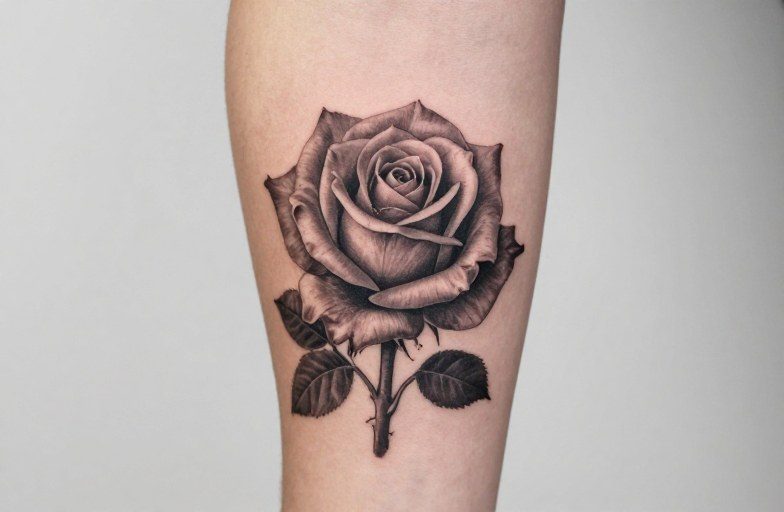
A rose tattoo on a man usually signals that he holds two truths at once, beauty coexists with pain, growth demands sacrifice. The thorns aren’t decorative; they’re the point. Unlike softer floral designs, men’s rose tattoos lean into contrast: the bloom against the stem, color against blackwork, life against what it cost to get there.
Personal & Modern Meanings
Today, men choose rose tattoos for reasons that rarely fit a single category. The same design might memorialize a death, mark sobriety, celebrate fatherhood, or simply acknowledge that the wearer has been through something and emerged changed.
Loss and Remembrance
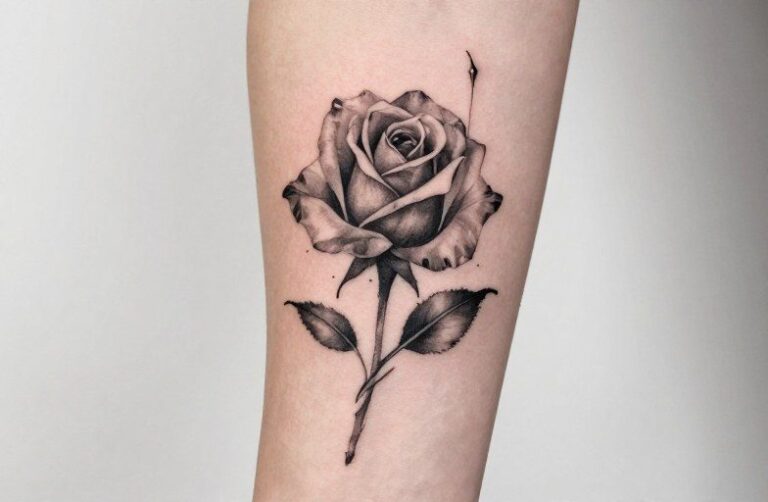
A single rose, especially in black and grey with a name or date, functions as a permanent elegy. The flower wilts; the tattoo doesn’t. Many men place these on the forearm or over the heart, visible enough to keep the memory present, not tucked away. Some add a clock, a set of dates, or a banner, though the rose alone carries sufficient weight when the line work is strong.
Resilience and Transformation
The rose grows from concrete, through thorns, despite pruning. Men who’ve rebuilt after addiction, divorce, prison, or combat sometimes choose this imagery without explaining it. The meaning sits in the choice itself: something beautiful, deliberately cultivated, in a body that has survived rough handling. A stem wrapped in barbed wire or a bloom emerging from cracked stone pushes this further without needing words.
- Single rose: singular focus, one person, one event, one turning point
- Rose with snake: temptation survived, or wisdom earned through pain
- Dagger through rose: sacrifice, betrayal, or love that cut both ways
- Rose and clock: time’s passage, mortality, moments that defined
History & Cultural Roots
The rose’s symbolic weight accumulates across centuries, not from one origin but from many overlapping uses. Understanding this prevents the design from feeling arbitrary.
War and Secrecy
In medieval England, the Wars of the Roses pitted the white rose of York against the red rose of Lancaster. The flower became shorthand for faction, loyalty, and violent political allegiance. Later, sub rosa, “under the rose”, denoted confidential matters, a practice traced to Greek and Roman associations with silence and secrecy. A rose tattoo can still signal: I keep my own counsel, or I hold allegiances that run deeper than casual acquaintance.
American Traditional Lineage
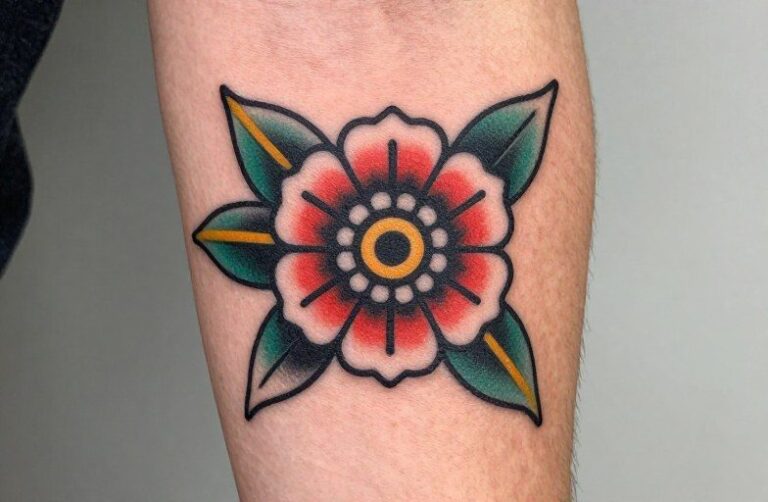
Sailors and soldiers carried rose tattoos into the 20th century through American Traditional flash. Bold outlines, limited color palette, no sentimentality. These roses meant mothers, sweethearts, or simply the desire to carry something beautiful into ugly circumstances. The style persists because it ages well, thick lines hold, saturated reds and greens fade slower than delicate shading. A traditional rose on a man’s bicep or chest still reads as masculine by association with this history, not despite the flower.
Best Placements
Where the rose sits changes what it communicates and how it ages. Some placements suit the design’s natural geometry; others fight it.
The forearm offers visibility and a vertical canvas that mirrors the stem’s line. A rose here becomes part of how the world sees you, deliberate, not hidden. The upper arm and shoulder provide more space for a fuller composition: bloom, thorns, leaves, maybe a scroll or companion piece. The chest, over the heart, intensifies the personal meaning, though this area blurs faster with age and sun exposure.
Hand and neck placements have shifted from strictly subcultural to more accepted, but a rose here still carries edge. The small space demands simplification, too much detail crowds and ages poorly. A single bold rose on the side of the neck, or a small stem between thumb and forefinger, works better than an attempted miniature bouquet.
The back and thigh accommodate larger, more elaborate designs: a full sleeve of roses and thorns, a bloom with a skull or animal companion. These areas allow the artist to use the body’s contours, the curve of a shoulder, the plane of a thigh, to give the flower dimension.
Mythology & Folklore
Greek myth often links the rose to Aphrodite, born from sea foam with roses springing from her footsteps. But the flower’s blood-red color is sometimes attributed to her tears over Adonis, or to the thorns wounding her in haste. The rose thus carries love’s wound built in, not an afterthought, but structural.
Christian and Medieval Symbolism
The rose became associated with the Virgin Mary, the “rose without thorns,” a symbol of purity and divine love. Conversely, the Rosary derives its name from this association, and the rose garden appears in medieval visions of paradise. A man wearing a rose with religious intent might pair it with a cross, praying hands, or a sacred heart, though the rose alone can signal faith without explicit iconography.
Eastern Traditions
In Persian poetry, particularly the works of Rumi and Hafez, the rose and nightingale form a recurring pair: the bird consumed by love for the bloom, the bloom indifferent to its own beauty. The rose represents the beloved, the divine, or the unattainable. A man drawn to this tradition might choose a rose with a bird, or simply appreciate the layer of meaning: desire that doesn’t diminish the desiring.
Design Tips & Pairings
The rose pairs with almost anything, but some combinations have earned their repetition through visual balance and accumulated meaning.
Line Work vs. Shading
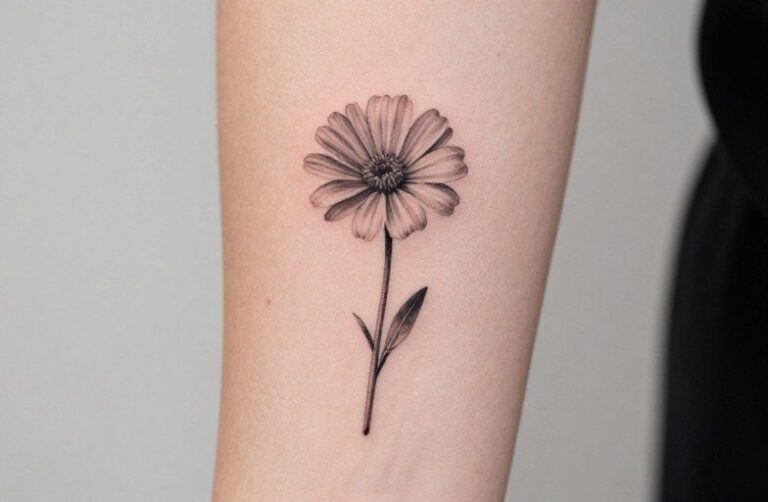
Bold line work with minimal shading, American Traditional or neo-traditional, lasts. Fine-line realism, while impressive fresh, often softens into muddy indistinction after five to ten years. Skin changes; ink spreads slightly. A man’s rose tattoo that needs to read clearly across a room or across decades benefits from decisive outlines and enough contrast that the bloom doesn’t disappear into the stem.
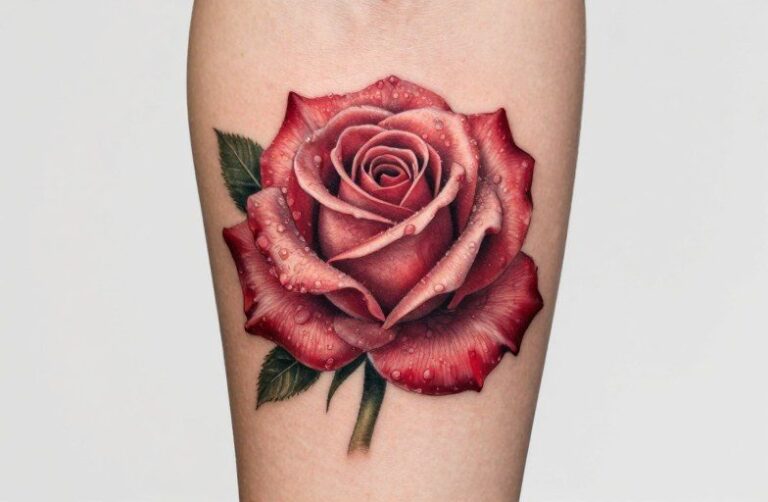
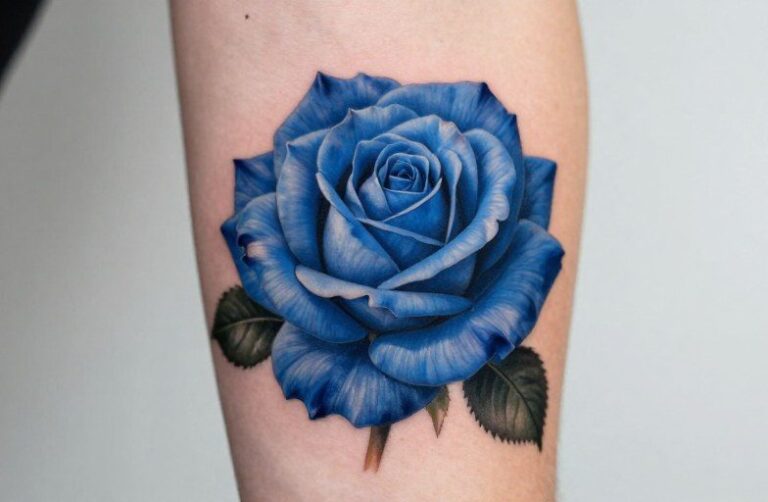
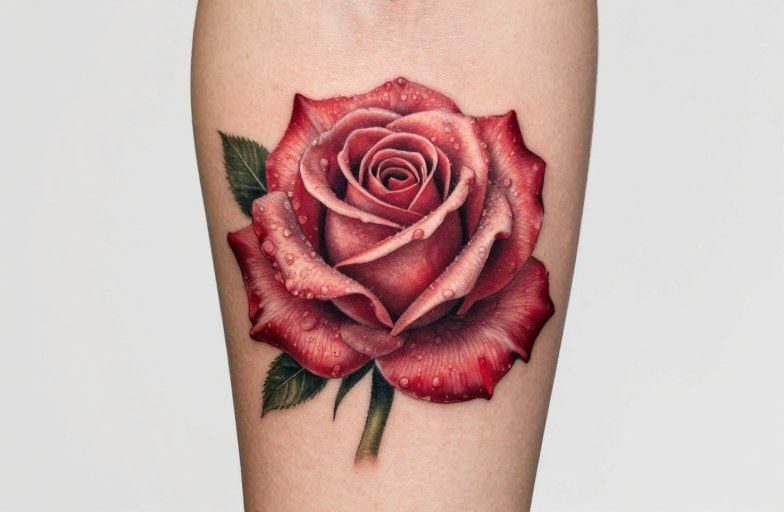
Color choices carry weight. Red: passion, blood, love, danger. Black and grey: mourning, timelessness, refusal of sentimentality. White ink on dark skin creates luminosity but fades fastest. Blue roses, having no natural counterpart, suggest the impossible or the artificial. Yellow, traditionally friendship or jealousy depending on context.
Companion Imagery
- Skull: memento mori, beauty and death intertwined, carpe diem with teeth
- Clock or pocket watch: time, mortality, moments frozen
- Snake: temptation, transformation, knowledge that wounds
- Dagger: betrayal, sacrifice, protection of something fragile
- Banner with text: names, dates, phrases, risky if the relationship shifts
The rose’s natural shape, radiating petals, thorned stem, paired leaves, creates movement. A skilled artist uses this to flow with muscle structure, not against it. A rose on a forearm should follow the arm’s length; on a shoulder, it might bloom outward from the joint.
Religious & Spiritual Angles
Beyond specific Christian iconography, the rose appears in broader spiritual contexts. The rose cross of Rosicrucianism combines esoteric Christianity with alchemical symbolism. In Sufi poetry, the rose garden represents the divine presence, the thorns the necessary trials of the spiritual path.
A man need not adhere to any tradition to draw on this resonance. The rose as spiritual symbol works because it doesn’t require doctrine, growth through difficulty, beauty emerging from pain, the cycle of blooming and apparent dying and blooming again. These map onto secular experience as readily as religious narrative. A tattooed rose can mark a spiritual crisis survived, a faith held or lost, or simply the wearer’s sense that life operates in seasons.
The Takeaway
A rose tattoo on a man means what he brings to it, shaped by how it’s drawn, where it sits, and what accompanies it. The flower’s centuries of accumulated symbolism provide depth, but the specific choices, line weight, color, placement, pairing, make it personal. The thorns matter as much as the petals. The stem’s length, the leaves’ serration, the bloom’s stage of opening: these details transform a generic flower into a particular statement. Work with an artist who understands the style you want, not one who promises to “make it unique” without grasping the tradition they’re working within. The rose doesn’t need reinvention; it needs your reason for carrying it.
Frequently Asked Questions
Do rose tattoos look too feminine for men?
Not when executed with bold line work, strategic placement, and appropriate scale. American Traditional and neo-traditional styles, especially on the forearm, chest, or upper arm, carry established masculine associations through military and sailor history.
How well do detailed rose tattoos age on men?
Fine detail and subtle shading blur over time as skin loses elasticity and ink disperses slightly. Bold outlines, strong contrast between black and skin, and sufficient spacing between elements preserve readability for decades.
What’s the difference between a rose and a rose with thorns in meaning?
The thornless rose suggests idealized beauty, love without cost, or religious purity. Thorns add the necessary counterpart: pain, defense, sacrifice, or the price of what the bloom represents. Most men’s designs include thorns intentionally.
Can a rose tattoo be covered up if I change my mind?
Roses cover reasonably well because their shape accommodates transformation into other organic forms, more flowers, a skull, abstract patterns. Dark, saturated original work limits options, but a skilled cover-up artist can work with most rose tattoos.